The vanguard of the 3D film and TV industry explains why 3D stereo techniques should become a staple visual storytelling tool, on par with lighting, set design, or sound. Words of wisdom from Jeffrey Katzenberg, Martin Scorsese, Dean DeBlois, Baz Luhrmann, Jon Landau, Barrie M. Osborne, Wim Wenders, and more, provide you with unparalleled insight into the leading minds in 3D. Not only is effective use of 3D in movies thoroughly covered, but also included is a chapter on live events, with insight from the people bringing us the FIFA World Cup in 3D, and those pushing the boundaries of 3D TV documentaries
Including full-color imagery from many of your favorite 3D films released thus far, Exploring 3D provides a window into how those dazzling movies were created, and insight into what the future may hold.
eBook - ePub
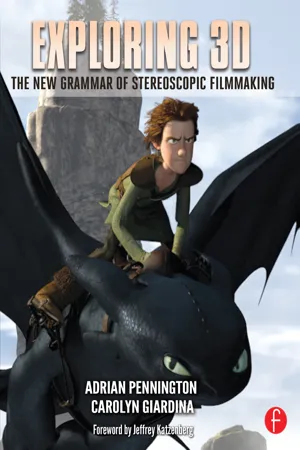
Exploring 3D
The New Grammar of Stereoscopic Filmmaking
- 214 pages
- English
- ePUB (mobile friendly)
- Available on iOS & Android
eBook - ePub
About this book
Information
1
THE NEW GRAMMAR OF STEREOSCOPIC FILMMAKING
Following the recent wave of stereoscopic 3D film and TV content there is a growing body of opinion that if 3D is ever to be more than a theme park experience the potential of the new format needs far greater artistic exploration.
There is a need, not just for technically accurate stereo 3D to create a comfortable viewing experience, but for a creatively enhancing 3D that lifts content away from novelty and mundanity and into the art form of filmmaking.
Curious directors are beginning to see the potential of stereo 3D as a visual storytelling tool and to embed it into productions from inception as one would use lighting or sound.
Such filmmakers have instinctively reached for artistic metaphors with which to describe the new medium at their disposal. Working on Hugo, Academy Award winner Martin Scorsese likened the technology to cubism and sculpture, understanding that characters and objects can be seen from new perspectives and need no longer be fixed to a flat canvas. “Picasso and Braque went to see films between 1909 and 1912 and were fascinated by the idea that on a flat screen you could see different aspects of the same figure because they move,” says Scorsese. “This seemed to translate into cubism.”
Perhaps, he suggests, 3D cinema can provide the illusion of seeing around people and objects. “With sculpture you walk around it so it becomes something different every place you look. In doing so you are visually performing a tracking shot. Suddenly the sculpture has a very powerful presence with different aspects to it and that is the effect that 3D delivers.”
He also sees parallels in dance. “When you see dancers move on stage, the depth between their bodies allows you to see a fluid sense of the visual field they are moving in. The only thing that approximates that in 2D cinema is camera movement. Add to that the illusion of depth and you have something that is not simply a flat image but something that opens up to infinite possibility. It is no longer cinema that we know.”
Director Wim Wenders (Paris, Texas; The Buena Vista Social Club) has also compared 3D direction to sculpture. Struggling to find a way to capture the choreography of Pina Bausch on film, he claims, “It was only when 3D was added to the language of film that I could enter dance’s realm. 3D, with its illusion of depth, could open out the flatness of the cinema screen and give dance the depth and sculptural quality it needed to work cinematically.”
Some of the most successful Hollywood producers, once dubious of the new medium, are converts. Baz Luhrmann needed to convince Barrie M. Osborne, the Oscar-winning producer of The Lord of the Rings trilogy, that his proposed literary adaptation of The Great Gatsby was suitable for stereo treatment.
‘‘I was a skeptic who thought 3D was a fad,” admits Gatsby’s Executive Producer. “However having gone through the experience I would definitely consider 3D for future projects. The use of 3D to compose a shot and story can make a scene much more powerful. The power of the actor’s performance and personalities is heightened.”
Given that Peter Jackson has shot The Hobbit in 3D, Osborne unsurprisingly suggests that “were the technology as advanced then as it is now, I think we would have made The Lord of the Rings in 3D.”
For Avatar producer and Oscar winner Jon Landau, stereo 3D can create an “almost voyeuristic experience” as well as a “sensory experience.”
He says, “In the past, for the most part, 3D had been relegated to the B movies—it wasn’t for new, original studio tentpole pictures. I think Avatar showed audiences that 3D doesn’t have to be a gimmick, that it can be a core part of the filmmaking process and the theater-going experience.”
Stereoscopic 3D is not new of course. It has been around since the very foundations of filmmaking and there have been several books and many articles written about the history of previous incarnations. The current vogue has come about because all the technical elements from digital cinematography cameras to mass market display on cinema and TV screens have made it practicable.
For Landau the backdrop of the wider transition to digital production is more significant than the arrival of 3D alone. “There are many filmmakers and cinematographers who have spent careers working in [35mm] film and for whom the biggest change is not the ability to shoot 3D but to shoot digitally,” he says.
While critics continue to contend that 3D will be a passing fad, or at best a niche suitable only for select blockbusters, others believe that this time around stereoscopy will grow to become as ubiquitous as two-dimensional imagery is today. Indeed there are some who believe that for the past 100 years or more cinema has been missing a trick.
Some of the earliest stills photography deployed stereo processing as a matter of course. Stereoscopic stills from the 1860s have, for example, been used as the basis of a four-hour documentary series about the American Civil War, featured here in a section examining how 3D has impacted the documentary genre.
At the very birth of cinema its founding fathers Georges Méliès and the Lumière brothers dabbled in stereoscopic short films with the Lumière brothers reshooting their original L’Arrivée d’un Train (1896) in 1935 stating that stereo was how they had conceived cinema would evolve. In Hugo, his astute evocation of the period, rendered in 3D and featuring reconstructions of L’Arrivée d’un Train and the fantasy films of Méliès, Scorsese underscores their vision.
“Once the moving image arrived people wanted sound, colour and depth but depth has always been experimental—because of the technology and cost,” says Scorsese. “Méliès would have gone there, and did, since two minutes of film he shot in stereo has survived.”
Stereo 3D may trick our mind into believing that the images we see are three-dimensional but proponents of the format argue that since we see in three dimensions 3D is simply a more realistic, more natural approximation for how we experience life. Similarly, just as we hear sound surrounding us, so audio technology has evolved from mono to stereo to surround sound to help us support our belief in what we are seeing on screen.
“Our physiological ability to negotiate the world through spatial awareness works very well between distances of 50 cm to about 10 meters,” notes Jamie Beard, Previs Supervisor at Weta Digital. “I can only theorize that we need this information about our immediate surroundings in order for us to move about. It is no coincidence that stereo 3D is best at this range also—it reflects the same responses we have to the real world.”
“For instance, 3D works particularly well when we look down almost as if we respond more to dimensionality when it feeds our fear of falling.”
Stereo 3D comes closer to simulating human vision, but can only approximate our depth perception. Unlike other art forms which are created in space—notably sculpture and theater—we cannot physically move our heads or bodies in stereo 3D to see around an object. Filmmakers must direct the way we perceive depth just as they are directing our view of a subject and of a scene by composition and focus.
“To me, 3D is a tool that allows you to visualize a scene in a way that you would if you could be there to see it yourself,” says Joe Letteri, a four-time Academy Award-winning visual effects supervisor (including one for Avatar) and partner in digital effects facility Weta Digital. “That is its biggest strength and biggest promise.”
“Once you have the idea as a basis, you can work with that as a creative tool, for example to get the audience to focus on certain parts of the frame to enable the storytelling.”
This philosophy informed the 3D choices in Avatar: “The primary goal was to give you a sense of presence and being there,” explains Letteri. “And on top of that to work in specific cues for the audience to be able to follow the action, guiding them to where they should be looking within a frame and across shots.
“If viewers are fishing around the screen not knowing where to look, it becomes uncomfortable. If they have to do it too much, the experience starts to fall apart.”
Cinematographers represent depth using a variety of techniques that have become ingrained in our understanding of what it means to watch a motion picture. Techniques such as perspective, selective focus (depth of field), movement, framing, variations in scene brightness, and other depth cues like shadow and texture can convey the depth of a scene. This entrenched cinematic grammar must obey the physical constraints of the size, shape, and position of the screen plane itself. Stereo 3D however promises a broader palette.
Fig. 1.1 How to Train Your Dragon used 3D to underscore the film’s emotional connection.
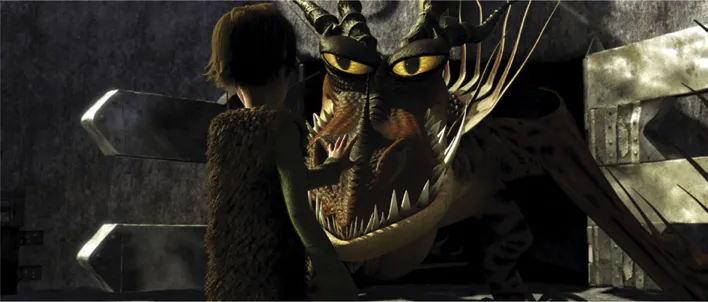
“How To Train Your Dragon” © 2010, Courtesy of DreamWorks Animation.
”We have to deal with an art that has established itself over a century, with an incredibly intricate and elaborate grammar and vocabulary that we love and cherish, but we which we should perhaps see as some sort of a mistake—a two-dimensional film with the second eye missing,” Wenders argues.
According to Wenders, 3D belongs in the hands of “people willing and able to forget limits, rules, formulas, recipes, and enter a whole new age of cinema, where there is more…connection. Existential connection. Believe it or not, 3D has that connecting power.”
He goes further and suggests that stereo 3D could move beyond mere imitation of real life, transcending it perhaps.
“These stories will need some sort of affinity to space, to depth and to volume,” Wenders says. “I can’t help thinking that the next groundbreaking film needs to be an intimate piece, maybe a simple story trying to transcend everyday life. A film that is thriving on moods, on existential situations, on a description of contemporary living.”
Phil “Captain 3D” McNally, Global Stereoscopic Supervisor, DreamWorks Animation

Courtesy DreamWorks Animation
“You can think of stereo as a dial on the palette of filmmaking tools that you can increase or decrease with the emotional intensity of the story.
In its simplest form, the benefit of stereoscopic depth over a traditional 2D movie is if you want to be closer to the character, you can really make the character closer. Whether that’s a pleasant closeness—because the character is attractive—or whether it is unpleasant—because the characters is for instance an evil dictator—the fact that you can use the space in front of the screen to literally invade your personal space as a viewer is a very powerful tool. Also, if you want to feel remote from someone, you can push them back to make them feel far away and make them very distant. We adjust the stereo from shot to shot—and even within a shot—to heighten intensity.
I would encourage people to stop thinking about this as making a 3D movie—that can put you in the gimmick/cliché mode—and start thinking about making a spatial movie. When you start thinking about spatial moviemaking that puts you in a different mindset that is more positive for stereoscopic filmmaking. Spatially, what do you want this scene to do or what can this scene add to the story?”
A Creative Discipline
Through the words of filmmakers, we’ll examine the potential of 3D to better tell a story through adding elements and features that 2D can never achieve.
Getting there means shifting the focus from thinking about 3D as a purely technical discipline or a cost issue toward a vocabulary that concentrates on the potential of stereo to enhance mood and emotion or help convey a feeling of connection with an actor’s performance, a landscape, or a narrative.
“With each new movie we produce, 3D is taking us to fantastic new places in visual storytelling,” declares DreamWorks Animation CEO Jeffrey Katzenberg. “And there is no question that we are just at the beginning of this revolution.”
Those interviewed for this book believe passionately that 3D is a creative discipline and that only a creative approach will determine whether stereo 3D will this time stay for good.
Of course there is a precedent for 3D mainly attracting technical-minded enthusiasts. “From the 1950s until now, 3D has attracted a lot of technical people,” says Stereo Supervisor Phil “Captain 3D” McNally, whose credits include DreamWorks Animation’s How to Train Your Dragon and Puss In Boots, and Disney’s Chicken Little and Meet the Rob...
Table of contents
- Cover
- Halftitle
- Title
- Copyright
- Contents
- Foreword
- Acknowledgements
- 1. The New Grammar of Stereoscopic Filmmaking
- 2. Toward Emotional Depth
- 3. Performing Arts: The Best Seat in the House
- 4. Live Sports: Into the Action
- 5. Documentaries: Real World Immersion
- 6. Drama: A Closer Connection
- Index
Trusted by 375,005 students
Access to over 1.5 million titles for a fair monthly price.
Study more efficiently using our study tools.
Frequently asked questions
Yes, you can cancel anytime from the Subscription tab in your account settings on the Perlego website. Your subscription will stay active until the end of your current billing period. Learn how to cancel your subscription
No, books cannot be downloaded as external files, such as PDFs, for use outside of Perlego. However, you can download books within the Perlego app for offline reading on mobile or tablet. Learn how to download books offline
Perlego offers two plans: Essential and Complete
- Essential is ideal for learners and professionals who enjoy exploring a wide range of subjects. Access the Essential Library with 800,000+ trusted titles and best-sellers across business, personal growth, and the humanities. Includes unlimited reading time and Standard Read Aloud voice.
- Complete: Perfect for advanced learners and researchers needing full, unrestricted access. Unlock 1.5M+ books across hundreds of subjects, including academic and specialized titles. The Complete Plan also includes advanced features like Premium Read Aloud and Research Assistant.
We are an online textbook subscription service, where you can get access to an entire online library for less than the price of a single book per month. With over 1.5 million books across 990+ topics, we’ve got you covered! Learn about our mission
Look out for the read-aloud symbol on your next book to see if you can listen to it. The read-aloud tool reads text aloud for you, highlighting the text as it is being read. You can pause it, speed it up and slow it down. Learn more about Read Aloud
Yes! You can use the Perlego app on both iOS and Android devices to read anytime, anywhere — even offline. Perfect for commutes or when you’re on the go.
Please note we cannot support devices running on iOS 13 and Android 7 or earlier. Learn more about using the app
Please note we cannot support devices running on iOS 13 and Android 7 or earlier. Learn more about using the app
Yes, you can access Exploring 3D by Adrian Pennington,Carolyn Giardina in PDF and/or ePUB format, as well as other popular books in Media & Performing Arts & Film & Video. We have over 1.5 million books available in our catalogue for you to explore.