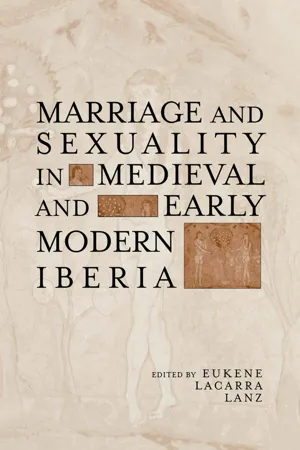
First published in 2002. This fascinating collection of essays examines the politics of gender and desire in premodern Iberia. Eukene Lacarra Lanz brings together a group of noted specialists in Arabic, as well as Castilian, Catalan and other Romance languages, to investigate the changes that affected marriage and sexuality over the course of the millennium, from approximately 650 to 1650 A.D. The contributors utilise a variety of literary and philosophical texts, legal documents, and medical treatises to explore a broad range of topics, such as shrew-taming, wedding rituals, wet-nursing, cross-dressing, sodomy and moral pornography. The volume's interdisciplinary approach traces the origins and genealogies of the predominant discourses on these subjects that engaged the minds of medieval and premodern writers, moralists, politicians and scientists alike. Marriage and sexuality in Medieval and Early Modern Iberia offers a rich history and insightful analysis of some of the central themes of Hispanic literary and cultural life.
Since the Middle Ages, when the Christian West confronted Islam on the battlefields and through polemic writings, Muslims and their religion have been perceived in Western thought to have a permissive attitude toward sexuality. The image of the Prophet of Islam as a sensual and lustful man became commonplace in the medieval litterature of polemics against Muslims, where it was presented as a counterpart to Christian spirituality (Daniel 96-102). In more recent times, this image appears recurrently in texts produced as a result of the European colonial expansion into the southern Mediterranean and Middle East during the nineteenth and early twentieth centuries. Western travelers and observers of the Muslim world in this period frequently remark on the prevailing “sensuality” of the Muslim way of life and conclude more or less openly that this is one of the reasons for its moral inferiority compared with the Christian West.1
This negative image has undergone a radical change since the 1970s, when the sexually repressive Western tradition, narrowly connected with the historical development of the nation-state, was subjected to a shattering reevaluation.2 Eurocentrism as the organizing standard of the Western worldview suffered a similar process, and “orientalism” became a minefield where scholarly pursuits had to negotiate carefully other avenues of interpretation. A new approach to Muslim sexual attitudes appeared as it was assumed that Islam had historically maintained a sympathetic understanding of human sexual needs. In open contrast to the traditional views alluded to in the preceding paragraph, a new current in Middle East studies underlines the sex-positive aspect of Islam as an undeniable contribution to global culture (Lindholm 241).
This general change has also affected the history writing on al-Andalus. Traditional historiography never dealt in detail with sexuality in al-Andalus, but the classical topoi of Western scholarship are easy to identify in the descriptions of family life or in the recurrent subject of the supposed Andalusi women’s higher degree of freedom in comparison with other Muslim women. A striking image stands out in these texts, that of the sexually passive woman subject to masculine domination. The Andalusi man—and, by implication, any other Muslim—was the all-powerful master of his household and specially of his womenfolk. In the domestic life of a well-off Cordoban family, as portrayed in the authoritative España musulmana by E. Lévi-Provençal, the lady of the house is “a refined Cordoban [who] every day gave up many hours to her embellishment and toilet, because the pampered wife or the favourite slave girl had to wait the return of her master and owner adorned in her finest apparel” (Lévi-Provençal 279).3 Historiography reproduces here, in a more subdued form, the iconography of European orientalist painting, depicting women reclining on divans awaiting for their masters, or getting dressed for them (Thornton). Both in written and in visual forms, the image offered is that of a sexual relationship in which masculine authority is overpowering and only restrained by man’s own will.
In recent times, this traditional interpretation of Andalusi sexual mores, frequently—and acritically—reproduced and still prevalent in much of what is written about Andalusi women (Garrido 137-39) has experienced a reevaluation, along the same lines identified above for the general Western trend of contemporary critique. The most significant contribution to the new approach is, perhaps, that of L. López-Baralt, whose edition and study of a Morisco text on marriage was published as Un Kama Sutra español (Madrid, 1992). This somewhat provocative title reflects López-Baralts’s understanding of a text based upon the Muslim tradition of marriage relationships. For its contemporary editor, it is a matter of wonder that the Morisco author did not condemn physical love between spouses but rather approved heartily sexual enjoyment by both husband and wife. The text is read by López-Baralt as a “treatise” on conjugal erotology, and as such, it becomes a proof of the superior quality of Muslim sexuality in comparison with its hispanic Christian contemporary counterpart.
In the nineteenth century, a staunch Catholic like F. J. Simonet described the “brutal sensuality” of the Muslim invaders of the Iberian Peninsula, where the spiritual essence of Christianity was preserved by indigenous women married to Arabs and Berbers (Simonet 13-32). A century later, López-Baralt makes the opposite interpretation, claiming an equally distorted image. A full circle is thus closed, because both arguments share a common, if opposing, vindication of their understanding of sexuality.
It is obviously necessary to reexamine a traditional historiography linked to the European colonial expansion and, in the Spanish case, also conditioned by a centuries-old tradition of suppressing Islamic traces in its own national history. However, in the process of counteracting the massive presence of an exclusively Hispanic-Catholic past, old myths give way to new ones, and not only in sexual matters. Not infrequently, the traditional view of Spain as a monolithic continuum of Catholicism and Hispanism is replaced by a depiction of al-Andalus as an ideal haven of tolerance and convivencia (Marín 2000a, 57-66). As for sexuality, it may be useful to remember what F. Rosenthal wrote some years ago: “Islam always took care to admit that sexuality existed as a problematic element in the relationship of individuals and society and never hesitated to leave room for the discussion of approval or disapproval” (Rosenthal 4). In al-Andalus, as in other traditional Muslim societies, this realistic admission of the role of sex in human relationships was indeed present. To label it as “brutal sensuality” is as misleading as the much later and opposing view.
Along with the primary task of dispensing with these heavily ideologized positions, research on the history of sexuality in al-Andalus confronts another difficulty, namely, the scant number of contemporary studies of sexuality in Islamic societies.4 It is not suprising to note that the most recent contributions to this subject focus on homosexuality,5 thus reflecting the inner evolution of Western societies which continues to condition the approach toward Islam. To draw a more complete and comprehensive view of the history of sexuality in Islamic societies it is increasingly necessary to produce monographs analyzing what documentation has been preserved in concrete periods and regions. This kind of research will then allow comparisons to be made and establish parallels and divergences. The present essay is but an attempt along these lines, a first step, in fact, to show how Andalusi Arabic texts dealt with the problem of sexuality in a medieval Islamic society.
A preliminary remark about these texts is imperative. Generalizations about al-Andalus abound, leaving aside the fact that, as with other contemporary societies, Christian or Muslim, this was a strongly hierarchical society. Andalusi texts do not provide a detailed and complete view of Andalusi society. On the contrary, their authors belonged to the urban elites of al-Andalus, as did the public to which they were addressed. Religious scholars and men of letters, these authors reflected the interests of very concrete and privileged segments of society. Moreover, they were men who wrote primarily for other men. The only known exception to this rule—poems written by women—follows closely the prevalent literary canons, and only in very specific cases can they be considered an autonomous voice.
A first group of texts may be characterized as “normative,” in the sense that they project the Arab-Islamic tradition, offering it as an ideal pattern of behavior. Among these texts we find, first, collections of Prophetic Tradition (hadith), legal and juridical compendiums and anthologies of Eastern Islamic literature. In fact, what these texts present is a repertoire of norms of conduct, legitimized by their religious or cultural origins. As an expression of social ideals, these norms are an unavoidable system of reference, although it is difficult to assert to what extent they were put into practice.
Three works of this kind have been selected here, among the many written in al-Andalus of a similar character. All of them contain, to a greater or lesser degree, significant information about the sexual rules of behavior, approved or condemned by their authors. The oldest of these three works is also the most interesting for the present purpose: the Kitab Adab al-nisa’ (Treatise on the Proper Behavior of Women), by ‘Abd al-Malik b. Habib, a native of Granada (d. 853).6
The Kitab Adab al-nisa’ is not an “original” work in the modern sense of the word, but a collection of materials, gathered by Ibn Habib around the main subject of the book. So we find in it quotations from the Quran, Prophetic Traditions, and short stories whose heroes are the Prophet’s wives, his companions, and other prominent Muslims from the earliest period of Islam. Through these texts, Ibn Habib draws a clear picture of the role of women in an Islamic society, based upon a normative corpus endowed with the highest religious authority. An important part of this documentation is directly related to sexuality indicated in some of the book’s chapter headings:
On what a man has to do with his wife and a woman with her husband in the night of consummation; (155-60)
On what has to be done during intercourse; (168-71)
On the reward earned through intercourse and the desire to practice it frequently; (171-80)
On the heavy breathing, groaning, panting and frolicking allowed during intercourse; (181-182)
On condemning speaking (in public) about the intimacy of a man with his wife; (182-83)
On what a man has to do when he is attracted by a woman; (189-90)
On the question of the permissibility, for a man, to have intercourse with his wife when she is kneeling and in other ways he may wish; (190-92)
On condemning intercourse with a woman other than by the vulva; (192-97)
On coitus interruptus; (200-203)
On how frequently a woman needs to have intercourse; (203)
On condemning lesbianism; (204-205)
This regulation of sexuality is exclusively directed to conjugal relationships, the only ones legally authorized, and has to be considered in the context of the whole book, in which a rigid system for the control of women’s public presence appears as the fundamental basis of the ideal Muslim social order. In the same train of thought, other chapters establish very detailed norms on women’s physical aspect and appearance, in order to avoid attracting men’s gaze and attention in public spaces. Women’s presence in places such as baths or mosques is also strictly regulated or even discouraged in other parts of Ibn Habib’s compilation. In short, if a superficial reading of the chapters on sexuality could lead to their interpretation as a “treatise on conjugal erotology,” an analysis of their contents and their connection to the rest of the book does not leave any doubts as to the compiler’s intentions: to establish a set of rules for controlling women’s sexuality through marriage and giving husbands, the exclusive right on their wives’ sexual acti...
Table of contents
Cover
Half Title
Title Page
Copyright Page
Table of Contents
Acknowledgments
Introduction
Part 1 From Maidenhood to the Marriage State Domesticating Women
Part 2 Playing the Game of Wife and Mother
Part 3 Love and Sexuality Allegory of Society’s Corruption
Part 4 Female Approaches to Power Revelation and “Moral Pornography”
Afterword Sexuality, Marriage, and Power in Medieval and Early Modern Iberia
Contributors
Index
Trusted by 375,005 students
Access to over 1.5 million titles for a fair monthly price.
Study more efficiently using our study tools.
Frequently asked questions
Yes, you can cancel anytime from the Subscription tab in your account settings on the Perlego website. Your subscription will stay active until the end of your current billing period. Learn how to cancel your subscription
No, books cannot be downloaded as external files, such as PDFs, for use outside of Perlego. However, you can download books within the Perlego app for offline reading on mobile or tablet. Learn how to download books offline
Perlego offers two plans: Essential and Complete
Essential is ideal for learners and professionals who enjoy exploring a wide range of subjects. Access the Essential Library with 800,000+ trusted titles and best-sellers across business, personal growth, and the humanities. Includes unlimited reading time and Standard Read Aloud voice.
Complete: Perfect for advanced learners and researchers needing full, unrestricted access. Unlock 1.5M+ books across hundreds of subjects, including academic and specialized titles. The Complete Plan also includes advanced features like Premium Read Aloud and Research Assistant.
Both plans are available with monthly, semester, or annual billing cycles.
We are an online textbook subscription service, where you can get access to an entire online library for less than the price of a single book per month. With over 1.5 million books across 990+ topics, we’ve got you covered! Learn about our mission
Look out for the read-aloud symbol on your next book to see if you can listen to it. The read-aloud tool reads text aloud for you, highlighting the text as it is being read. You can pause it, speed it up and slow it down. Learn more about Read Aloud
Yes! You can use the Perlego app on both iOS and Android devices to read anytime, anywhere — even offline. Perfect for commutes or when you’re on the go. Please note we cannot support devices running on iOS 13 and Android 7 or earlier. Learn more about using the app
Yes, you can access Marriage and Sexuality in Medieval and Early Modern Iberia by Eukene Lacarra Lanz in PDF and/or ePUB format, as well as other popular books in History & European History. We have over 1.5 million books available in our catalogue for you to explore.