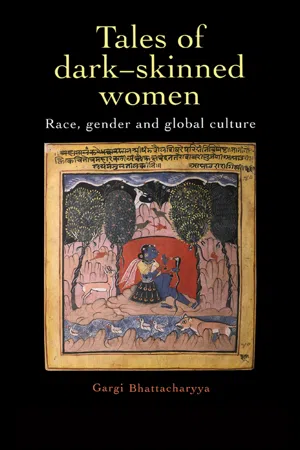
Exploring the way race and gender are portrayed in popular culture, this text focuses on the representation of black women. It incorporates a discussion of the politics of representation in Britain and North America, and the shift from negative stereotypes to positive images to postmodern knowingness. The author pays particular attention to the reach of various race/gender literacies, most notably the impact of North American racial discourse on British conceptions of Asian and Afro-Caribbean femininity.
- 400 pages
- English
- ePUB (mobile friendly)
- Available on iOS & Android
eBook - ePub
About this book
Information
CHAPTER 1
Beginning
This is the beginning of a long trail of stories —a trail which will lead us twice around the world, in both directions, touching everywhere, but stopping nowhere. These are the tales of a fabulous, dangerous, downright bloodcurdling place, the West; and, to tell this story, we need to hear about the range of Western fantasy and the places and peoples which bore the scars of these fictions.
Our trail begins with Scheherazade, storyteller extraordinaire. Her story leads on to a tale about all stories and the reasons why we think stories are important. This sets the scene for our own tale—a tale about a land of suffering, greatly in need of narrative healing.
In the tales to follow, we will have call to remember the potency of stories, of various sorts. We will come to see, as fairytale audiences always do, that an appreciation of the logic of fantasy can smooth our understandings of the everyday, and, in reverse, a remembrance of mundane pains is the only route to the heart of a story. Above all, we will hear that both the serious business of social analysis and the frivolous business of distraction require a similar attentiveness. Good stories help us to practise the necessary concentration, stretch our capacities for patience and possibility, help us to process a world which is not easily or immediately understood. Stories promise to teach us an attitude to learning.
But this is all to come. For now, you must only listen, and the shape of the tale will start to appear.
Once there was a woman called Scheherazade. She told stories to keep alive, to save her people, to keep it going.
And of course, the main story is her.
The two brothers, Schahzenan and Schahriar, have discovered that their wives and queens sleep with their slaves and servants—despite giving the appearance of being respectable women. At first, both brothers resolve to renounce the world and travel until they find someone unhappier than themselves. But on their journey they are seduced by the mistress of a jealous genie who imprisons his lover to ensure her chastity. Elated by this experience, the brothers decide that this is proof of woman’s devious and lascivious nature and that they are no more fools than other men. Relieved, they return to their lives and Schahriar begins his new life.
In his new life, Schahriar resolves to be no woman’s fool. He orders his vizier to bring him the daughter of his general to marry, and next morning he orders her execution. The next night he does the same with someone else’s daughter. And the next and the next and the next, until the land lives in terror. Scheherazade is the talented daughter of the grand vizier and she offers herself as wife to the king in order to halt the bloodshed. Her method of salvation is stories.
She is dealing with an absolute and unreasonable power. The caliph is already convinced that women are lesser, treacherous, contaminated. The hetero-sexual imperative which signifies his potency in all areas (to himself at least) pushes him into sex with women, compulsively, fearfully. Managing the fear means killing the girls. Our heroine volunteers for this bedroom duty which has always led to death. Her self-assigned task is to distract the king. If she can distract him with her stories, the framing story will shift. If she keeps on talking, woman will mean different things. She becomes voice and mind, a thing above the sex-hungry flesh of the king’s imagination.
Scheherezade talks her way to safety and saves her people into the bargain. She tells us nothing about herself, although she tells many tales, a countless number, until she is free. No clues about what kind of woman she is—only her dutiful-daughter advert at the start of the story. But whatever she is, her skin is dark. And that is where our story starts.
Where is she from?
This is a mixed-up set of stories; what we are talking about here is not some founding text or key work of enduring truth. No-one is quite sure where these stories came from. Despite attempts to collect and translate definitive versions, popular wisdom recognizes stories from many sources as belonging to the title Arabian nights. Sindbad and Aladdin belong in this collection now —tracing their origins to other sources cannot disrupt the long history of feverish fantasy which links these tales to those of the ladies of Baghdad and the other textually authenticated episodes. The angry forewords denouncing the failings of orientalist scholarship in relation to this story series can never hit their target; it is much too late to reclaim one version as the version, and, more importantly, who is interested in authentication here? Listen to a scholar, one who understands the violences of the West.
The stories of the Nights are of various ethnic origins, Indian, Persian, and Arabic. In the process of telling and retelling, they were modified to conform to the general life and the customs of the Arab society that adapted them and to the particular conditions of that society at a particular time. They were also modified, as in my own experience, to suit the role of the storyteller or the demand of the occasion. But different as their ethnic origins may be, these stories reveal a basic homogeneity resulting from the process of dissemination and assimilation under Islamic hegemony, a homogeneity or distinctive synthesis that marks the cultural and artistic history of Islam.1
As the twentieth century draws to a close and the most powerful and violent concoct new fears to justify their brutality, it makes sense to remember the long, varied and exceptionally multicultured history of Islam.2 One version of literary scholarship ties the work known in “the West” as Tales from one thousand and one nights to a geography and historical moment named “Islam”. Now that so many stories are told about the monolithic and frighteningly humourless and sexless character of this thing, Islam, it is worth remembering that these fragments also belong to this tradition. The account which follows does not dispute this parentage. But it does work on a different version of family, one which acknowledges the messy links of hidden sex and out-of-town blood as well as the official family tree.
All commentators agree that, in its written form, the Arabian nights remains cut through with the traces of the oral practices from which it comes. Kernels of various individual tales can be traced to the storytelling traditions of different places—some to several places. Consideration of the echoes of form and concern spread the tales’ origins further still. The names of the chief characters seem to be Iranian; the frame story can be traced to India; the names within the tales are Arabic. We know that, in its written form, there were two translations from Persian into Arabic in the eighth century; that the ninth and tenth centuries saw new collections which included other stories current at the time; that in the twelfth century Egyptian tales were added; that the version we inherit, more or less, can be traced to the sixteenth century and includes earlier tales plus stories from Islamic counter-crusades and tales from further east, brought to the Middle East by the Mongols. Given this history, who is brave enough to name the origin of the tales? Better to accept this global mix-up as part of our own confusion.
In their incarnation via the West, it is inevitable that the Arabia of the tales is that of orientalist fantasy. This is unspecifically not the West—easily North Africa and Asia, and most probably beyond—and my attraction to the stories is their status as archetypally “foreign”, not from anywhere in particular, but emphatically not the work and property of white men. Even in the collections of white men, the discomforts of this foreignness show through; maybe these stories are bad for you, much too distracting, enticing, from somewhere else. One editor worries about the focus on entertainment “to the total exclusion of moral and didactic teaching” (Baskett in Galland 1995); other commentators on the progress of the tales in the West berate the Nights for being too feminine and feminizing, fit for women and children, but potentially weakening to the intellects of adult men (Galland 1995:xvii). Unlike the dubious discipline of literary study, these stories are too much like fun to be good for you. Mixing in with the hothouse cultivations of anthroporn and travel writing and bedding down with the poor cousins of literary culture, fairytales and folklore, the Nights retain their deeply marked foreignness however much translation, appropriation and misunderstanding take place around them. Perhaps it is these confused processes which confirm the epithet “foreign”? It is the many levels of inauthenticity—from being dangerously fantastic, to being from many places, to being fragmentary and multi-authored, to being different things to different people and changing shape in repetition— which make sure we know what the name means. “Entertainments”, “Arabia”, “nights”—every part beyond the reasonable and reasoned world of white men in modernity.
While the history of textual scholarship in the West has been, since the Renaissance, increasingly one of keen accuracy and authenticity, its counterpart in the East, especially in the case of the Nights, has been one of error and corruption, at the hands of Eastern and Western scholars alike, the result of ignorance and contempt.3
As we shall see, the storytelling of white men has taken certain forms, with their own particular pleas ures and prohibitions. The development of technologies of writing and reproduction, most obviously print, has contributed to the naturalization of this one form of narrative, the way the white men tell it.4 As the big theorists say, the concept of reiterability has a special status in Western cultures: this is what makes truth, the ability to repeat and check.5 The error-filled and corrupt pleasures of the Nights, on the other hand, in any inauthentic version from orientalist translation to half-remembered half-embellished bedtime story, offer another way of telling the story and making sense of the world.
The white men who translated pretended not to understand this alternative set of claims about the world. To them, as we will go on to see, foreign was scary, but it was necessary and had its own place and logic in the worldview of the white men. They are talking supplement, not alternative. These stories are supposed to supply the thrill of the other and the reassurance of the known, that special buzz we call “exotic”. The exotic cannot work unless its audience believes that it presents something like truth, in the terms they understand. If you can see that it is a trick, a fantasy, just make-believe, the fun is spoilt. Instead of seeing the tales as a strategy of narrative collected from many times and places, the key orientalist translators of the Nights presented “their” work as part of the important business of learning about the mysterious East. However unlikely, this was supposed to be social science.6 “Time and again, Galland, Lane, or Burton claimed that these tales were much more accurate than any travel account and took pains to translate them as such.”7
Of course, this is partly about making the translation of strange and unusable stories into a respectable job for a white man. When Said writes his seminal work on the career the East became, he is describing a process in which white men learned to pass off unlikely stories as hard knowledge. Orientalism, as he explains it, gives birth to a region called the Orient, newfound supplement to the West. For the supplement to do its job, whole legions of white men must now devote their time to telling these stories with a straight face. The Nights get included in this collection of potentially useful fictions, because this is their best chance of respectability. This produces whole bookshelves of dubious scholarship, with fictions built on fictions, without reference to anything which may disrupt the story.
…amongst themselves Orientalists treat each other’s work in the same citationary way. Burton, for example, would deal with the Arabian Nights or with Egypt indirectly, through Lane’s work, by citing his predecessor, challenging him even though he was granting him very great authority. Nerval’s own voyage to the Orient was by way of Lamartine’s, and the latter’s by way of Chateaubriand. In short, as a form of growing knowledge Orientalism resorted mainly to citations of predecessor scholars in the field for its nutriment. Even when new materials came his way, the Orientalist judged them by borrowing from predecessors (as scholars so often do) their perspectives, ideologies and guiding theses…. From these complex rewritings the actualities of the modern Orient were systematically excluded, especially when gifted pilgrims like Nerval and Flaubert preferred Lane’s descriptions to what their eyes and minds showed them immediately.8
The strange happenings of the Nights are passed off as some kind of accurate depiction of what the East is like—in the footnotes if not in the main story—and, of course, this is part of that wider process which concocts fictions as part of political domination. Who would deny this? All those regions which have been “orientalized” by wealthier and more militarized powers have indeed come to suffer through these fictions. But apart from all this, there is still the story.
Framing the stories as victims and props to the orientalist conspiracy misses what I like about them, something which bypasses issues of authenticity and correct translation altogether. However the stories of the Nights are collected and translated, the framing conceit remains the same. A country is ravaged by an implacable and irrational power and a young woman demonstrates that even the most irrational and violent of rulers can be distracted by entertainment; and in the gap of this distraction unimagined change becomes possible. The glamour of Scheherazade is her ability to see another story hidden in the despair of today.
She, unlike her father, was convinced that she had exceptional power and could stop the killing. She would cure the troubled king’s soul simply by talking to him about things that had happened to others. She would take him to faraway lands to observe foreign ways, so he could get closer to the strangeness within himself. She would help him see his prison, his obsessive hatred of women. Scheherazade was sure that if she could bring the king to see himself, he would want to change and to love more.9
Storytelling
More recent storytellers have also entered into contracts with implacable powers. In a world where some people face disparagement for irrational yet inescapable reasons, once more the test has been to shift the thinking of the king. When some bodies (dark-skinned, female) mean violence and disorder (allround bad times) somehow the story has to shift. ...
Table of contents
- Cover Page
- Title Page
- Copyright Page
- Race and representation
- Series editor’s preface
- Acknowledgements
- Chapter 1: Beginning
- Chapter 2: The next few stories
- Chapter 3: The model’s tale
- Chapter 4: The sportswoman’s tale
- Chapter 5: The newsreader’s tale
- Chapter 6: The entertainer’s tale
- Bibliography
Trusted by 375,005 students
Access to over 1.5 million titles for a fair monthly price.
Study more efficiently using our study tools.
Frequently asked questions
Yes, you can cancel anytime from the Subscription tab in your account settings on the Perlego website. Your subscription will stay active until the end of your current billing period. Learn how to cancel your subscription
No, books cannot be downloaded as external files, such as PDFs, for use outside of Perlego. However, you can download books within the Perlego app for offline reading on mobile or tablet. Learn how to download books offline
Perlego offers two plans: Essential and Complete
- Essential is ideal for learners and professionals who enjoy exploring a wide range of subjects. Access the Essential Library with 800,000+ trusted titles and best-sellers across business, personal growth, and the humanities. Includes unlimited reading time and Standard Read Aloud voice.
- Complete: Perfect for advanced learners and researchers needing full, unrestricted access. Unlock 1.5M+ books across hundreds of subjects, including academic and specialized titles. The Complete Plan also includes advanced features like Premium Read Aloud and Research Assistant.
We are an online textbook subscription service, where you can get access to an entire online library for less than the price of a single book per month. With over 1.5 million books across 990+ topics, we’ve got you covered! Learn about our mission
Look out for the read-aloud symbol on your next book to see if you can listen to it. The read-aloud tool reads text aloud for you, highlighting the text as it is being read. You can pause it, speed it up and slow it down. Learn more about Read Aloud
Yes! You can use the Perlego app on both iOS and Android devices to read anytime, anywhere — even offline. Perfect for commutes or when you’re on the go.
Please note we cannot support devices running on iOS 13 and Android 7 or earlier. Learn more about using the app
Please note we cannot support devices running on iOS 13 and Android 7 or earlier. Learn more about using the app
Yes, you can access Tales Of Dark Skinned Women by Gargi Bhattacharyya in PDF and/or ePUB format, as well as other popular books in Scienze sociali & Antropologia. We have over 1.5 million books available in our catalogue for you to explore.