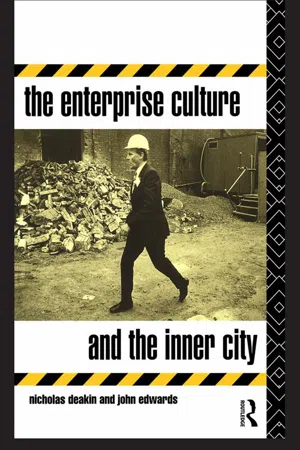
Throughout the 1980s and into the 1990s, policy for inner city regeneration underwent a transformation from a reliance on central and local government activity and the use of public funds, to a much heavier dependence on private sector activities and private investment. In The Enterprise Culture and the Inner City, the authors offer a vigorous and critical investigation of government policy and, in response to the result of the 1992 general election and the implications of the Olympia and York Canary Wharf project, present a credible prediction for the future (or lack of future) of the inner city.
- 288 pages
- English
- ePUB (mobile friendly)
- Available on iOS & Android
eBook - ePub
The Enterprise Culture and the Inner City
About this book
Information
1
Enterprise as policy
In the period since 1980 the rationale underlying government policies for the inner cities has undergone a sea change.
Policies themselves have been radically transformed, partly in response to this change but also in deference to the explicit ideological predilections of the government. Such has been the presentation and packaging of these policies that it has not always been possible to distinguish the substantive from the illusory, but that there has been a real redirection of policy (and resources) is beyond doubt.
What has happened is that the enterprise culture has come to the inner cities. The idea that ‘inner city problems’ (whatever they may be) can be solved or even alleviated by targeting public resources into them in order to establish projects that will meet ‘special’ or ‘additional’ needs is now defunct. Once the 1977 White Paper Policy for the Inner Cities had put down a marker that the fundamental problem was the collapse of the economic infrastructures of the inner cities, the way was clear for an incoming government, ideologically so inclined, to see economic regeneration as a job for the private sector. Thus there was a neat fit between economic logic and ideological leanings. Clearly, only the private sector could produce the jobs and economic buoyancy that the inner cities lacked, and equally self-evident was the superior drive, energy and effectiveness of a private sector increasingly fired by the enterprise culture.
The engine of enterprise is now the driving force of inner city policies, and has been for some seven years. It is the purpose of this book to evaluate the enterprise strategy. At its simplest, our task is to answer the question, ‘does the enterprise solution work?’, but before we can begin to answer that we shall have to clarify a number of other questions. How much of the overall solution to inner city problems is it claimed the enterprise strategy will provide? What are inner city problems (not so arcane a question as it looks) and which ones might the enterprise strategy have an impact on and which must find other solutions? What is the logic of the enterprise solution; how does it solve inner city problems? There will be many other questions to answer along the way and many different versions of success to tease out, but in essence our purpose is a simple one: a radically different strategy to deal with the inner cities has been in full gear for more than half a decade; does it work?
The ideas of enterprise and the enterprise culture are of course chimeric; they are as much prescriptive rallying slogans as descriptions of cogent concepts, but the policy changes they have wrought are real enough and we cannot ignore that these are inextricably tied to the sets of attitudes and beliefs that characterise those who promote enterprise. Inner city policies have changed because of the sets of attitudes that go to make up the enterprise culture and these attitudes in turn have informed policy. We cannot therefore understand the directional drive of current inner city policies without an understanding of what ‘enterprise’ and the ‘enterprise culture’ mean.
‘Enterprise’ in the political lexicon of the 1980s is a property exclusive to the private sector. The public sector does not possess it, or worse, it is a hindrance to its exercise. But it is also shorthand for a collection of other, related values, values which, as Corner and Harvey note, are ‘… primarily, to do with the economics of neo-liberal “freedom” and the politics of individualism’ (Corner and Harvey 1990:24). Enterprise is having initiative and drive; it is taking opportunities when they arise; it is independence from the state; it is having confidence and being responsible for one’s own destiny; it is being driven by the work ethic; and it promotes self-interest. But it is in this last property that its real value as a policy instrument lies. There is no stronger motivating force, so the culture of enterprise tells us, than the pursuit of self-interest. This is what gets things done. Why not therefore harness this, the strongest motive to action, to serve your policy goals? True it is unlikely that effective action will be directed precisely at your policy goals, but if these can be effected as an intended (on the government’s part) or unintended (on the part of the entrepreneur) consequence of being enterprising, then you will have achieved your policy goals and at minimum cost to the public purse. Furthermore, the drive of enterprise will have achieved at little cost what countless millions of public expenditure has failed to achieve.
It is just this sort of reasoning (only mildly parodied here) that lies behind the drive to bring enterprise to the inner cities.
More than this however, the enterprise culture was (and remains) an integral part of the government’s philosophy. It was, as Corner and Harvey point out, not simply descriptive but also, and mainly, a campaigning idea (Corner and Harvey 1990:24), a set of beliefs that permeated the government’s approach to everything it was doing (with the possible exception of foreign policy). In other words, the enterprise culture was at the heart of the cultural revolution that the government saw as necessary before economic recovery and national pride would be re-established. To this extent, there was nothing unique about the inner cities (though they were singled out by the then Prime Minister on election night in 1987). Quite simply, they, like most things, would benefit from the latent energy that commitment to the enterprise culture would release.
There was, however, one train of events that made inner city problems seem peculiarly vulnerable to the enterprise approach. Until 1977 or thereabouts, if there was any consensus (or indeed any cogent view at all) about the nature and causes of urban deprivation (as the inner cities problem was then more usually styled), it was that inner city areas contained disproportionately large concentrations of the poor, the dependent and the inadequate. To this could be added a poor physical environment, poor housing and a lack of social and community facilities. Urban deprivation was essentially a residual problem of the welfare state (Lawless 1979; Edwards 1984). The policy response (mainly by means of the Urban Programme, the Educational Priority Areas, Section 11 Grant and the Community Development Projects)1 was to target more (or re-directed) resources into these areas to provide for the additional and special needs to be found there. For reasons that we shall discuss at greater length in Chapter 2, this diagnosis was transformed over a relatively short period (very approximately between 1975 and 1978) and there emerged the new orthodoxy that the root cause of the problems of the inner cities was the collapse of their economic infrastructures brought about by the emigration of firms to out-of-town sites or their death in situ, compounded by the socially selective emigration of their populations (see Hall et al. 1973; Elias and Keogh 1982; Lawless and Brown 1986; Manners 1986; Robson 1988). What needed to be done was now clear: new industry, new jobs, and an economically active population had to be attracted back into the inner areas in order to regenerate their economic infrastructures. It was a diagnosis that lent itself far more readily than its predecessor to an enterprise culture solution. And the timing was just about right. The new diagnosis received official confirmation in the 1977 White Paper and a government committed to the enterprise response came to power two years later.
REALITY AND ILLUSION
Even a cursory glance at government inner city brochures since 1987 is all that is required to see that there has been a strong presentational element in the way in which policy information is conveyed. These are no longer policy statements so much as hortatory notices of progress and intent. Their style allows of no debate or dissension any more than the sales brochures of property developers. The style and language is that of the enterprise culture and the purpose has been less to inform than to promote the ‘enterprise revolution’. The problem with presentational politics, however, is that it engenders cynicism and distrust. If the way government presents its policies has the superficial gloss of a Sunday colour supplement there must always be the suspicion that the content is equally insubstantial. We are left wondering how much of current policy and recent policy change has real substance and how much is old policy decked out in presentational froth. (The answer, it turns out, is ‘a good deal of substance’ as we shall see, but we ought certainly to be forgiven for harbouring some doubts.)
The launch of Action for Cities was an example par excellence of the triumph of packaging over substance. The purpose was to launch a new ‘drive’ on the inner cities and the occasion was a press conference attended by the Prime Minister with six ministers-in-attendance, each armed with a copy of the Action for Cities brochure (Cabinet Office 1988). The message was exclusively that regenerating the inner cities was a job for the private sector and that local authorities would be relegated to a minor role in which the damage they could do could be controlled. The sub-text however was, in all significant respects, a panegyric to the enterprise culture and this appeared to be an important—if not the most important —part of the exercise. No new policies were announced, the then Prime Minister herself admitting ‘It is not a new programme. I don’t think there’s a single new policy here’ (as reported in the Guardian 8 March 1988) but rather, a bringing together of all existing policies under a new umbrella. But neither was any new co-ordinative machinery on offer, so that the ‘bringing together’ was collectivisation in name only though it did permit, by the inclusion of education, crime, tourism and a number of other activities, a new global sum of £3,000m for inner city policies to be floated.
However, it has to be said that if the purpose of this kind of presentational politics has been to inculcate the idea of enterprise as an effective policy agent then it has in many respects been successful. Whether or not it works (something it is our purpose to examine in this book), the idea of the usefulness and even the necessity of the private sector as an instrument of regeneration is now firmly planted, and policy has followed in the wake of this conviction. Therefore, whilst presentational politics combined with an apparent lack of substantial change in policy give an impression of the power of packaging over content, the reality is quite different and it may be that government policy presentation has done a disservice, less in cloaking old policies in glossy covers than in engendering an impression of the insubstantial when what is on offer is very substantial. We devote Chapter 3 to a detailed examination of how policy changed over a period of twelve years from an emphasis on service provision to one of economic regeneration, but in essence what has happened has been a reorientation of existing policies and a redirection of finance to promote the enterprise culture rather than the generation of entirely new policies. This may in part account for the impression of a victory of presentation over substance, but the shift of emphasis has been real and inner city policies of the early 1990s are very different from those of the previous decade.
However, the story is not a straightforward one. Policy development and the promotion of enterprise have not always moved forward in tandem. The idea of urban development corporations for example, which the government now presents as the spearhead of the enterprise attack on the inner cities, was first given reality (in the form of the London Docklands and Mersey side Development Corporations) in 1981, yet it was six years before it was brought to the forefront of inner city policy. Indeed, so many and so apparently fleeting have been the shifts in policy over the past decade that it is often difficult to identify any coherent strategy. There are at present, for example, thirty-two schemes directed solely or in large measure at the inner cities (see Chapter 3, p. 55–6) and all fall loosely under the Action for Cities umbrella. (‘Loosely’ because there is no definitive list).2 It is not surprising therefore that Action for
Cities should engender confusion or that some of these schemes occasionally ‘disappear’, only to surface again when the need arises. Nor, given this multiplicity of schemes should it be surprising if there appears to be little coherence to the overall strategy (if, indeed, there were an overall strategy). The story is not a simple one to tell therefore, and we should not expect to find an unhindered line of policy development leading to the enthronement of enterprise. When the House of Commons Public Accounts Committee produced its report on regenerating the inner cities in 1990, it accepted the view of the Department of the Environment that there could not be any ‘master plan’ but it still had difficulty making sense of ‘this recipe for confusion and overlap’ (House of Commons 1990:V).
There is another reason why inner city policy has at times been difficult to comprehend and that is that prime responsibility for it (more accurately, them) appears to have floated from one department to another. The Department of the Environment first took over responsibility from the Home Office in 1976 but with the shift in emphasis from social provision to economic regeneration and skills-development, the Departments of Trade and Industry and of Employment have played an increasingly prominent role over which Environment has not seen fit, or has not been able, to exercise hegemony. There has not therefore, in recent years, as the Public Accounts Committee note, been any single department with overall responsibility for all inner city policies (House of Commons 1990:VI). There has, however (to add to the confusion), been an ‘inner cities minister’ responsible for the presentation of policies but this ministerial position has not rested with any one department. The position was first held by Mr Kenneth Clarke at Employment; he was followed by Mr Tony Newton at Trade and Industry and then, in the Summer of 1989, by Mr David Hunt at Environment.
What is now being done at the beginning of the 1990s by way of inner city policy therefore is very different from what was done a decade earlier. There has been a fundamental shift even though the names of some of the policy components are now a decade old, despite the heavy rhetorical overlay and despite the absence of a coherent longer-term strategy. Behind the sometimes illusory gloss of the enterprise culture, different ends are being pursued and money is being spent in different ways. And all this will affect—for good or ill—people who live in the inner cities. But their welfare on the one hand and successful economic regeneration on the other may not necessarily be synonymous.
EVALUATING THE ENTERPRISE APPROACH
There are two broad themes to our evaluation of the enterprise approach to the inner cities and each has a number of components. The first concerns the logic of economic regeneration as a means of reducing or eliminating urban deprivation— which we take to be the human component of the inner city problem. To put it at its starkest, how do the glittering (or tawdry) towers of docklands reduce poverty and privation? This will require us to assess the ‘reach’ of regeneration into the social conditions in the inner cities but also the wisdom of trying to reverse history—of trying to recreate what policy rhetoric appears to assert were the culturally rich, vital and throbbing cores of our cities—devoid (presumably) of poverty and hardship. The second theme revolves around some important consequences of adopting a private enterprise approach and, in particular, the change in the principal actors responsible for implementing policy including the relative exclusion of local government, and the effects these changes have on the accountability for policies and their outcomes. If, for example, responsibility for putting inner city policy into practice shifts either wholly or on balance from local government to private sector developers and financial markets, who then is to be accountable for policy outputs and to whom? Once more, to put it at its starkest, who is to be held accountable (and to whom) if economic regeneration fails and inner city residents are left no better, or worse off? Or, more problematically, who is to be held accountable (and to whom) if economic regeneration succeeds and inner city residents are left no better, or worse off?
Urban deprivation and economic regeneration
An imperative of any policy is that there must be some causal connection between what it is doing, and what it is meant to achieve. Such a connection is not immediately obvious in the case of current inner city policies for two reasons. First, recent policy ‘statements’ have been determinedly reticent on the issue of what is to be achieved. And second, if we take the liberty of assuming that part, at least, of what is to be achieved is a diminution of urban deprivation and if we permit ourselves to think that this includes reductions in poverty, privation and dependency, then it is not manifestly clear how economic regeneration will affect these issues.
Our evaluation therefore will require us to specify in detail what constitutes the ‘inner city problem’. We shall find that there is a multiplicity of components including economic, social and physical ones, and it is the second of these that will prove to be the most testing for the economic regeneration strategy. Among the social indicators, the incidence of which will be found to be relatively greater in inner city areas, will be poverty, unemployment and dependency, particularly among the elderly, the young and the chronically sick. These constitute an important part of urban deprivation (itself a part of the inner city problem). Two lines of approach then present themselves for our evaluation of policy in respect of these characteristics. The first is whether and how the economic regeneration strategy itself may reach down to impact upon them. The second is to see what, if any, other components of the overall inner city policy package may have an impact on them and this will require also that we assess the extent to which the other (and lesser) parts of the strategy are compatible with, and additive to, the economic regeneration component. The more problematic of the two lines of approach however is undoubtedly the first. It is easy enough to see how service provision can alleviate privation; it is not so clear how private sector investment in an area will do so. Certainly, insofar as greater employment prospects are a necessary component of relieving deprivation, then inward investment which produces jobs that go to the presently unemployed will be beneficial, but how far such benefit will ‘trickle down’ to those not in the labour market remains to be investigated. Some private sector investment for job creation must therefore be a part of the policy package but it will be of benefit, even to those in the labour market, only if this market is manipulated in such a way as to ensure that they get the jobs.
Reversing history
The strategy is one of economic regeneration. It is a strategy (presumably) to restore the inner cities to some former state which (again presumably) was one of economic vitality and social well-being. However, there are some weighty, and usually unspoken, assumptions behind the wisdom and efficacy of trying to recreate the right mix of economic activity and population profiles which (we are expected to believe) worked before the ‘great decline’. Were the areas we call inner cities once of such a nature that we are right in wanting now to recreate them? Two aspects of this question immediately present themselves. Firstly, how much of a mix was there in the pre-decline inner cities of economic and social activity; how socially heterogeneous were they; and did manufacturing and commercial activities sit happily with residential usage? Secondly, the regeneration thesis does assume that the inner cities were social and economic microcosms with their own relatively self-contained economies. If this was ever the case, is there reason to believe that it could or would be the case now or in the future? Or is it as plausible for example to promote the inner cities as (say) purely residential areas (or for that matter, as purely industrial or commercial locations)? There are two uncertainties that should at least give us reason to entertain such possibilities. The first is whether economic activity (of whatever kind) has to be in the inner cities to be of benefit to them. The second is whether we have any more reason to believe that inner city residents wish to live in close proximity to non-residential land users than do their suburban counterparts. After all, does it make any more sense in an age of international corporatism to speak of inner city economies than it does to e...
Table of contents
- Cover Page
- The Enterprise Culture and the Inner City
- Title Page
- Copyright Page
- Illustrations
- Preface
- Acknowledgements
- 1: Enterprise as Policy
- 2: From Public Provision to Private Enterprise
- 3: Is Inner City Policy about Urban Deprivation?
- 4: The logic of the Enterprise Strategy
- 5: Trafford Park: Manchester’s Economic Larder
- 6: Docklands: Flagship or Titanic?
- 7: Heartlands—A Different Approach to Partnership
- 8: Private Enterprise Alone
- 9: The Reach of Private Enterprise
- 10: Social Policies for the Inner City
- 11: Private Investment as Public Policy
- References
Trusted by 375,005 students
Access to over 1.5 million titles for a fair monthly price.
Study more efficiently using our study tools.
Frequently asked questions
Yes, you can cancel anytime from the Subscription tab in your account settings on the Perlego website. Your subscription will stay active until the end of your current billing period. Learn how to cancel your subscription
No, books cannot be downloaded as external files, such as PDFs, for use outside of Perlego. However, you can download books within the Perlego app for offline reading on mobile or tablet. Learn how to download books offline
Perlego offers two plans: Essential and Complete
- Essential is ideal for learners and professionals who enjoy exploring a wide range of subjects. Access the Essential Library with 800,000+ trusted titles and best-sellers across business, personal growth, and the humanities. Includes unlimited reading time and Standard Read Aloud voice.
- Complete: Perfect for advanced learners and researchers needing full, unrestricted access. Unlock 1.5M+ books across hundreds of subjects, including academic and specialized titles. The Complete Plan also includes advanced features like Premium Read Aloud and Research Assistant.
We are an online textbook subscription service, where you can get access to an entire online library for less than the price of a single book per month. With over 1.5 million books across 990+ topics, we’ve got you covered! Learn about our mission
Look out for the read-aloud symbol on your next book to see if you can listen to it. The read-aloud tool reads text aloud for you, highlighting the text as it is being read. You can pause it, speed it up and slow it down. Learn more about Read Aloud
Yes! You can use the Perlego app on both iOS and Android devices to read anytime, anywhere — even offline. Perfect for commutes or when you’re on the go.
Please note we cannot support devices running on iOS 13 and Android 7 or earlier. Learn more about using the app
Please note we cannot support devices running on iOS 13 and Android 7 or earlier. Learn more about using the app
Yes, you can access The Enterprise Culture and the Inner City by Nicholas Deakin,John Edwards in PDF and/or ePUB format, as well as other popular books in Politics & International Relations & Development Economics. We have over 1.5 million books available in our catalogue for you to explore.