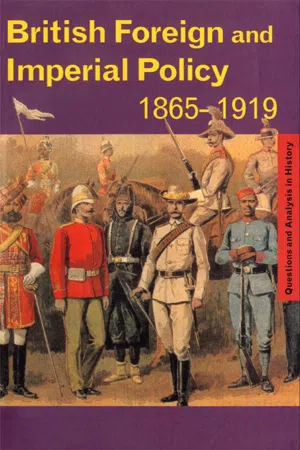
British Foreign and Imperial Policy explores Britains role in International Affairs from the age of Gladstone and Disraeli to the end of the First World War, exploring such themes as Britain's involvement in the Scramble for Africa, the Anglo-Boer War, the foreign policy of Lord Salisbury and the prospects for Britain and the Empire at the end of the First World War.
- 128 pages
- English
- ePUB (mobile friendly)
- Available on iOS & Android
eBook - ePub
British Foreign and Imperial Policy 1865-1919
1 The Patriotic Party Disraeli, the Conservatives and Britain's world role
10.4324/9780203982808-2
Background Narrative
In the decade and a half following the death of Lord Palmerston in 1865, British politics revolved around the rivalry of Benjamin Disraeli and William Ewart Gladstone, the leaders of the Conservative and Liberal parties respectively. These two statesmen competed for power in a country that stood at the peak of its power and influence. Britain's mid-Victorian economic position as the world's first industrial power was not yet seriously challenged by the rise of foreign competition. London stood at the centre of the international financial system and would continue to do so until the First World War. Naval supremacy underpinned Britain's leadership of a far-flung empire and enabled it to protect the world-wide commerce upon which its prosperity depended. Although the ending of the American Civil War in 1865 made possible the United States’ emergence as the dominant power in the western hemisphere, it did not present an immediate threat to British interests. On the European continent, the most significant development of the period was the creation, through a series of wars, of a united Germany.
Disraeli spoke in 1870 of ‘the German revolution, a greater political event than the French revolution of the last century’. 1 This was, however, the statement of an opposition leader, concerned to show up the inaction of the Gladstone government. In power after 1874, Disraeli initiated no major policy change in reaction to the unification of Germany. The defeat of France, Britain's traditional rival, by Germany in the war of 1870–1 was hardly a matter of great regret. Moreover under the cautious leadership of Otto von Bismarck, German Chancellor until 1890, the policy of the new Reich was largely directed towards the avoidance of further continental upheavals.
Nonetheless, British policy makers in the era of Disraeli and Gladstone were conscious that they lived in a changing world. At home, the first steps towards the democratisation of politics were taken with the passage of the 1867 Reform Act. The enfranchisement of large numbers of working men, followed shortly by measures to combat electoral intimidation and corruption, compelled political parties to organise themselves in a more modern and professional manner. In the 1860s the repeal of restrictive taxes on paper facilitated the rise of the popular press, while the 1870 Elementary Education Act initiated a significant growth in working-class literacy, with long-term implications for the character of the electorate. These developments meant that politicians of both parties increasingly had to shape their policies with the opinions and prejudices of a mass electorate in mind. Politics could no longer be viewed as the special preserve of an aristocratic elite, insulated from the feelings of the populace at large.
As they looked at the world outside, policy makers were aware of the weaknesses as well as the strengths of their country's position. Lacking a large standing army, active intervention in European affairs was not a realistic option for Britain. Disraeli's description of his country as adopting a stance of ‘proud reserve’ towards the continent was a reflection of this lack of military power. In any case British economic prosperity was tied closely to the maintenance of free trade and international peace. A major war would interrupt trade and necessitate increased domestic taxation, with unwelcome economic and political consequences in a nation accustomed to limited government intervention. Moreover, the very scale of Britain's empire could be viewed as a source of danger. A country with scattered imperial possessions and extensive trading interests was intensely vulnerable to pressure exerted by foreign rivals.
In the second half of the nineteenth century, as in the first, Britain continued to perceive France and Russia as its most likely foes. The need to resist expansion by the latter in the Near East, where it might conceivably threaten the routes to India, lynchpin of Britain's imperial system, involved successive governments in a particularly heavy commitment. Although it was increasingly decadent and corrupt, the maintenance of the Ottoman Empire was traditionally seen as the most effective barrier to Russia's desire for influence in the Balkans, leading to access to the Mediterranean. Britain had fought the Crimean War of 1854–6 to uphold the regime of the Turkish Sultan, widely regarded as ‘the sick man of Europe’, against the ambitions of Tsarist Russia. The Treaty of Paris, which closed the war, had guaranteed the Ottoman Empire's independence and had excluded Russian warships from the strategically important Black Sea. The growth of national sentiment among the Sultan's Christian subjects in the Balkans, exacerbated by Turkey's refusal to reform its inefficient and oppressive administrative system, introduced a dangerous element of instability to the region. The ‘Eastern Question’, with its ramifications for Britain's imperial power, was not the least of the problems faced by the governments of Victorian Britain.
Analysis (1): How Successful were Disraeli's Foreign and Imperial Policies?
Of all the leading politicians of Queen Victoria's reign, Benjamin Disraeli remains perhaps the most controversial. He held the premiership only twice, for ten months in 1868 and then from 1874–80, and real power came to him relatively late in life. With his Jewish ancestry and his early reputation as a playboy and novelist, he lacked the traditional landed background and public school education shared by most of his fellow Conservatives. He had risen from the backbenches through his skills as a parliamentary debater and sustained himself against the prejudices of his own side through sheer force of personality. In the three short-lived Conservative governments of 1852, 1858–9 and 1866–8, he served as the indispensable lieutenant of the Prime Minister, the fourteenth Earl of Derby. The last of these governments undertook an action that has sometimes been seen as initiating a new period of British imperial expansion, the Abyssinian War of 1867–8. The arrest of some British officials by King Theodore of Abyssinia (present-day Ethiopia) was followed by the despatch of a military expedition by the Derby–Disraeli administration. The success of the expedition enabled Disraeli to associate the Conservative government with the vigorous defence of British overseas interests.
This theme was developed further by Disraeli in two celebrated speeches, at the Manchester Free Trade Hall and the Crystal Palace, delivered while the Conservatives were in opposition in 1872. In these speeches, and on other occasions, Disraeli highlighted the failure of Gladstone's Liberal government to uphold British prestige with sufficient determination. The Liberals had accepted the action taken by Russia two years earlier, when it had unilaterally repudiated the Black Sea clauses of the Treaty of Paris. More recently they had tamely paid compensation to the United States for damages caused by a British-built ship, the Alabama, during the American Civil War. Such concessions, according to Disraeli, would not have been granted by a Conservative Party committed to the maintenance of British imperial interests.
The electoral victory of February 1874 offered Disraeli an opportunity to give practical expression to his professed concern for the defence of the empire. Several steps towards the consolidation of British power in the tropics were taken in the first year of the government. In West Africa a new authority, the Gold Coast Protectorate, was created. British residents were installed in three of the Malay states, while in the southern Pacific, Fiji was annexed to the empire. In 1875 Disraeli engineered one of the most dramatic coups of his career when he purchased for Britain shares in the Suez Canal Company. These shares had belonged to the Khedive of Egypt, who administered the country on behalf of the Ottoman Empire and who by 1875 was financially overstretched. Disraeli took advantage of his difficulties to acquire a major stake in the canal, a waterway which provided a vital short-cut to Britain's Indian interests. The purchase enhanced British prestige and prevented the French, who had constructed the canal and were major shareholders in it, from exercising untrammelled influence in the region. It paved the way for a system of Anglo-French dual financial control over Egypt, which prevailed until the British occupation of the country in 1882.
The desire to consolidate British control over India had a bearing on another action of Disraeli's government, the passage of the Royal Titles Act in 1876. By declaring Queen Victoria Empress of India, the Act made her the equal of the Emperors of Russia, Germany and Austria-Hungary. It was also intended to increase the legitimacy of British rule in the eyes of the Indian princes and people. In fact the idea did not originate with Disraeli, and the timing of the Act was the outcome of pressure from the Queen herself. However, the publicity surrounding her elevation bore the characteristic stamp of a grand Disraelian gesture.
The central years of Disraeli's second ministry were dominated by a revival of the Eastern Question. At the end of 1875 the Ottoman Empire faced uprisings in two of its Balkan provinces, Bosnia and Herzegovina. Disraeli's response was conditioned by his distrust of Russian ambitions in the region and his concern to see Britain act as an independent, front-ranking power. Thus, when Germany, Russia and Austria issued the ‘Berlin Memorandum’ in May 1876, calling upon Turkey to introduce reforms in the discontented provinces, Disraeli refused to associate Britain with the document. Later that year his identification with the Ottoman Empire became a source of political embarrassment, when news reached Britain of savage Turkish repression following an uprising in Bulgaria. A massive popular agitation on behalf of the oppressed Bulgarian Christians, exploited by Gladstone and the Liberals, threatened to leave Disraeli dangerously isolated. His support for the Ottoman regime as a buffer against Russian expansionism seemed indefensible to an outraged public. Within the cabinet the Prime Minister's belligerently anti-Russian stance provoked a damaging confrontation with the pacific Foreign Secretary, the fifteenth Earl of Derby. Fortunately for Disraeli, now ensconced in the House of Lords as the Earl of Beaconsfield, opinion swung back in favour of his ‘patriotic’ stance when Russia attacked Turkey in April 1877. The government's decision to order the fleet to Constantinople, as a deterrent to further Russian aggression, attracted widespread popular support. There was little support for Derby, whose insistence on strict non-intervention drove him to resign from the government. By early 1878 humanitarian concern for the victims of Ottoman cruelty had been smothered by a wave of popular nationalism, or ‘jingoism’, a word derived from a popular music-hall verse of the day: ‘we don't want to fight, but by jingo, if we do, we've got the ships, we've got the men, we've got the money too’.
In fact Disraeli achieved his aims without the need for military involvement. When the Russians imposed the punitive Treaty of San Stefano on a defeated Ottoman Empire in March 1878, they found Britain, Austria and Germany united against them in determination to secure a more equable settlement. The outcome was the Congress of Berlin, which Disraeli attended together with his new Foreign Secretary, Lord Salisbury. Russia was compelled to relinquish some of the gains made at San Stefano. In return for guaranteeing Turkish possessions in Asia, Britain acquired from the Sultan the island of Cyprus, a new base from which to protect the lines of communication to India. Disraeli enjoyed his greatest triumph when he returned to London in August 1878, claiming to have secured ‘peace with honour’ at Berlin.
In other aspects of external policy the Disraeli government enjoyed less resounding success. In Southern Africa the British colonies of Natal and Cape Colony co-existed uneasily with several independent black African kingdoms and two provinces established by Dutch (or Boer) settlers, the Transvaal and the Orange Free State. In an attempt to bring stability to a strategically important part of the African continent, Lord Carnarvon, Disraeli's Colonial Secretary, tried to bring about a federation of the British and Boer settlements. In 1877 he used the Boers’ vulnerability to attack from the armies of the Zulu kingdom as a lever to secure the annexation of the Transvaal. Two years later the British High Commissioner in South Africa, Sir Bartle Frere, provoked a war with the Zulus in order to protect the Transvaal. To some extent this initiative can be excused by the need for rapid reactions by ‘men on the spot’ in an age of relatively slow communications over long distances. The war went badly for the British forces, which sustained a heavy defeat at Isandhlwana in January 1879. The Zulus were eventually defeated at considerable cost in terms of lives and money, with adverse consequences for the reputation of the imperial government.
Disraeli's South African difficulties coincided with the adoption of an equally contentious ‘forward’ policy on the north-west frontier of India. The Viceroy, Lord Lytton, was convinced that British control of the buffer state of Afghanistan was essential if Russian designs on the subcontinent were to be thwarted. Acting on his own initiative, Lytton sent British troops into Afghanistan at the end of 1878. The war initially went in Britain's favour and the Amir of Afghanistan was forced to accept the presence of a British military mission in his capital, Kabul. The following September, however, the mission was massacred, necessitating a renewal of hostilities. The situation was unresolved in the spring of 1880, when the Conservatives faced a general election in Britain. Their association with mismanaged conflicts on the frontiers of empire provided the Liberal opposition with effective ammunition in the electoral contest. In the celebrated Midlothian campaigns of 1879–80, Gladstone was able to depict the Disraeli government as authorising unnecessary, extravagant and immoral adventures, motivated by the empty pursuit of prestige. Although not the only factor in the heavy defeat suffered by Disraeli, the charge of imperial arrogance and incompetence undoubtedly played a part in his government's overthrow. It was an ironic outcome for a political leader who had so closely identified himself with the positive and effective defence of British overseas interests.
Questions
- How effective was Disraeli's handling of the Eastern Question?
- Have Disraeli's achievements in imperial affairs been exaggerated?
Analysis (2): Did Disraeli Put into Practice a Coherent Vision of British Imperial Interests in his Years of Power?
Both critics and admirers of Disraeli traditionally credited him with a distinctive and consistent approach to the question of empire. To his political opponents, his association with a series of imperial adventures in the second half of the 1870s was thoroughly reprehensible. Following the Conservative leader's elevation to the House of Lords, Gladstone coined the term ‘Beaconsfieldism’ to describe the ideology that allegedly underpinned his rival's policies in the Near East, the Indian subcontinent and Southern Africa. From a more favourable standpoint, the ‘official’ biography, begun by W.F. Monypenny and completed by G.E. Buckle in the second decade of the twentieth century, portrayed its subject as the author of a far-sighted philosophy of imperial development. Thus the 1872 Crystal Palace speech is hailed as containing ‘the famous declaration from which the modern conception of the British Empire largely takes its rise’. 2
To many commentators, Disraeli's period of power was a preparation for the late nineteenth-century phenomenon known as ‘the new imperialism’. In the decade after his death in 1881, the so-called ‘scramble for Africa’ 3 awakened a conscious spirit of militant expansionism in Britain. Disraeli's frequently expressed pride in Britain's overseas role, his unashamed emphasis on the pursuit of power and prestige, led many to see him as the architect of a new direction in external affairs. In more recent times the view of Disraeli as progenitor of a ‘new imperialism’ has enjoyed a revival in the work of the historian Freda Harcourt. Focusing on th...
Table of contents
- Cover
- Half Title Page
- Title Page
- Copyright Page
- Contents
- Series preface
- Acknowledgements
- 1 The patriotic party: Disraeli, the Conservatives and Britain’s world role
- 2 Late Victorian Liberalism and empire: the era of Gladstone
- 3 A ‘new imperialism’? British overseas expansion in the late nineteenth century
- 4 ‘The weakest link in the imperial chain’: Britain and the South African War of 1899–1902
- 5 ‘Splendid isolation’? Lord Salisbury and foreign policy
- 6 ‘A diplomatic revolution’? Edwardian Britain and the great powers
- 7 ‘The lamps are going out’: Sir Edward Grey and the growth of Anglo-German rivalry
- 8 Danger or opportunity? The Great War and its impact
- Notes and sources
- Select bibliography
- Index
Trusted by 375,005 students
Access to over 1.5 million titles for a fair monthly price.
Study more efficiently using our study tools.
Frequently asked questions
Yes, you can cancel anytime from the Subscription tab in your account settings on the Perlego website. Your subscription will stay active until the end of your current billing period. Learn how to cancel your subscription
No, books cannot be downloaded as external files, such as PDFs, for use outside of Perlego. However, you can download books within the Perlego app for offline reading on mobile or tablet. Learn how to download books offline
Perlego offers two plans: Essential and Complete
- Essential is ideal for learners and professionals who enjoy exploring a wide range of subjects. Access the Essential Library with 800,000+ trusted titles and best-sellers across business, personal growth, and the humanities. Includes unlimited reading time and Standard Read Aloud voice.
- Complete: Perfect for advanced learners and researchers needing full, unrestricted access. Unlock 1.5M+ books across hundreds of subjects, including academic and specialized titles. The Complete Plan also includes advanced features like Premium Read Aloud and Research Assistant.
We are an online textbook subscription service, where you can get access to an entire online library for less than the price of a single book per month. With over 1.5 million books across 990+ topics, we’ve got you covered! Learn about our mission
Look out for the read-aloud symbol on your next book to see if you can listen to it. The read-aloud tool reads text aloud for you, highlighting the text as it is being read. You can pause it, speed it up and slow it down. Learn more about Read Aloud
Yes! You can use the Perlego app on both iOS and Android devices to read anytime, anywhere — even offline. Perfect for commutes or when you’re on the go.
Please note we cannot support devices running on iOS 13 and Android 7 or earlier. Learn more about using the app
Please note we cannot support devices running on iOS 13 and Android 7 or earlier. Learn more about using the app
Yes, you can access British Foreign and Imperial Policy 1865-1919 by Graham Goodlad in PDF and/or ePUB format, as well as other popular books in History & Modern British History. We have over 1.5 million books available in our catalogue for you to explore.