- 194 pages
- English
- ePUB (mobile friendly)
- Available on iOS & Android
eBook - ePub
PART I
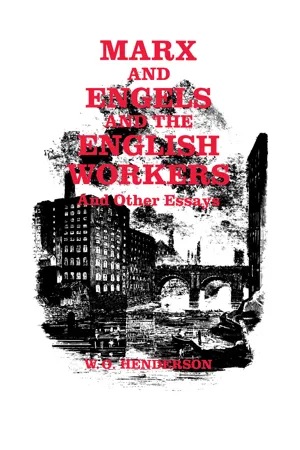
Marx and Engels and the English Workers
1
MARX IN MANCHESTER
For twenty years between November 1850 and September 1870 Friedrich Engels was living in Manchester while Karl Marx was living in London. They corresponded regularly and they met from time to time either in London or in Manchester. The frequency of Marx's visits to Manchester has not always been appreciated.1 He was in the city nearly every year2 and there were six years in which he was there twice. Several visits were paid over the Whitsun holiday. Marx's expenses were generally paid by Engels. His main purpose in visiting Manchester was to see Engels and other friends such as Wilhelm Wolff, Carl Schorlemmer, Eduard Gumpert and Samuel Moore.
It was natural that such close friends as Marx, Engels and Wolff should wish to meet as often as possible to discuss their joint literary projects and the fortunes of their communist friends in Germany and elsewhere. Sometimes there were other reasons for Marx's visits. Once he came to Manchester for a rest after an illness and he always took the opportunity to consult Dr Gumpert on his numerous complaints. There were times when Marx came to Manchester to escape from his creditors in London who were clamouring for a settlement of their accounts. He came to Manchester in May 1864 to see Wolff who was on his death-bed. Marx generally came alone but he was accompanied by his wife in 1855 and 1880, by Hermann Meyer in May 1867, by Lafargue in September 1867, and by his daughter Eleanor on three occasions in 1868–70. He stayed either in Engels's “official lodgings” or at a house rented for Mary and Lizzie Burns. The “official lodgings” were in Great Ducie Street, Thorncliffe Grove and Dover Street while (after 1864) Lizzie Burns lived in Mornington Street.3 However in April 1869 on the eve of his retirement, he gave up his lodgings in Dover Street and moved to 86 Mornington Street.4
Marx's first visit to England was in the summer of 1845.5 He arrived in the middle of July and returned to Belgium on about August 24. He was accompanied by Engels who had recently joined him in Brussels. Engels had told his family that he was going to Manchester to collect the books that he had left behind when he returned to Barmen after working for twenty months in the office of Ermen and Engels. Presumably he also hoped to see Mary Burns again. The two friends spent most of their time in Manchester. All that is known of their visit is contained in a letter which Engels sent to Marx many years later. On May 15, 1870, when he had retired from business, he recalled that in 1845 they had worked together in Chetham's Library. “During the last few days I have again spent a good deal of time sitting at the four-sided desk in the alcove where we sat together twenty four years ago. I am very fond of the place. The stained glass window ensures that the weather is always fine there. Old Jones, the librarian, is still alive but he is very old and no longer active. I have not seen him on this occasion.”6 Hitherto Marx had studied philosophy and law. Now, stimulated by the appearance of Engels' recently published book on the English workers, he turned his attention to economics. In Chetham's Library he continued the work that he had begun in the previous year7 and studied the works of the English classical economists and statisticians. From Manchester Marx and Engels went to London where they met leading members of the League of the Just, the forerunner of the Communist League.
After the failure of the revolutions of 1848/1849 Marx had come to London as a refugee in August and Engels had followed him in November. A year later Engels moved to Manchester to serve as a clerk in the office of Ermen and Engels at 7 Southgate (off Deansgate). He found lodgings at 70 Ducie Street, Strangeways.8 In February 1851 Marx wrote to Engels: “You will appreciate how much I miss you and how I wish that I could discuss my problems with you.”9 Marx visited Engels for a week in April 185110 and for ten days in November.11 The purpose of Marx's second visit was probably to discuss with Engels their collaboration as contributors to the New York Daily Tribune, a liberal Republican paper, which had begun in the previous August and was to last for over ten years.12 To raise money for the fare to Manchester Marx borrowed £2 which he promised to repay before December. On his return to London he asked Engels to repay this debt. Engels, however, was short of money himself and the debt was paid by Georg Weerth.13
In 1852 Marx was in Manchester from May 26 to June 26. His visit was delayed because Engels's father was in Manchester to discuss with his partners the future of the firm.14 On May 19 Engels informed Marx that, following discussions with his father, his salary would be raised in July. Two days later he wrote: “My old man has left. All is right. I enclose the first half of a £10 note and I hope to see you here next week.” The second half of the note was sent to Wilhelm Wolff to pass on to Marx. On May 22 Marx acknowledged the receipt of the first half of the note and informed Engels that he would travel to Liverpool by sea and then to Manchester by rail. Engels replied that if he wanted to go by sea it would be quicker to sail to Hull. It is not known which route Marx took. At the time of his visit the local press was devoting much space to the general election in which Bright and Milner Gibson were defending their seats in Manchester. But Marx was probably more interested in the pamphlet that he was writing (with Engels' help) attacking German refugees whose views were different from his own. Marx and Engels may have visited the Golden Lion in Deansgate since a few months later Engels asked Marx to enclose letters to him in an envelope addressed to the publican, “our old James Belfield.”15 By June 30 Marx was in London again since on that day Engels wrote that he had found a wallet that Marx had left in his lodgings.
In April 1853 Engels wrote that “the bedroom in my house is ready” and invited Marx to visit him. Engels had recently moved with his landlady to 48 Great Ducie Street which was two doors away from his former lodgings. Since Engels mentioned that the library of Peter Ermen—one of his father's partners— was at their disposal it may be assumed that the purpose of Marx's visit was to work on their joint literary projects. Marx, as usual, was in financial difficulties and needed money for his fare. He told Engels that he was unable to raise money on an American bill of exchange for £32—doubtless payments for articles contributed to the New York Daily Tribune. Engels offered to cash the bill in Manchester with an American firm. Meanwhile Marx borrowed £2 from Bamberger16 and wrote to Engels that he would travel to Manchester on Saturday, April 30.17 He stayed with Engels until May 16.18
Marx did not visit Manchester in 1854. He had an opportunity to do so when he was invited to attend a meeting of a “Labour Parliament” which met in Manchester between March 6 and March 10. This conference of trade union delegates was organised by Ernest Jones to support the power loom weavers of Preston who had been on strike for 29 weeks. The Manchester Guardian reported on March 8 that Marx was “expected to be present today.” But he was not present. He had written to the organisers: “I regret deeply to be unable, for the moment at least, to leave London and thus to be prevented from expressing verbally my feelings of pride and gratitude on receiving the invitation to sit as honorary delegate at the Labour Parliament. The mere assembling of such a parliament marks a new epoch in the history of the world. The news of this great fact will arouse the hopes of the working classes throughout Europe and America.”19 In April Engels informed Marx that when he had found new lodgings he would invite him to come to Manchester.20 In September Marx congratulated Engels on having become “altogether respectable” by being elected to the Royal Exchange21 and in October he wrote that “if circumstances permit” he would be glad to visit Engels in Manchester.22
Two visits were paid by Marx to Manchester in 1855. On April 6 he informed Engels of the death of his eight-year-old son Edgar. He thought that a change of scene would do his wife good and he proposed that they should both pay Engels a short visit, staying at a hotel or in private lodgings. Engels sent Marx £5 and gave him information concerning trains to Manchester. On April 16 Marx replied that he and his wife would come to Manchester on the “Parliamentary Train”. This was a stopping train which left London at 7 a.m. and did not reach Manchester until 6.30 p.m. The fare was a penny a mile. The visit did not help Jenny Marx to get over her bereavement for when she was back in London on May 16 Marx wrote to Engels that she was still “very poorly.”23
Marx was in Manchester again in the autumn of 1855. On September 11 he wrote to Engels that, owing to “force supérieur” he had to leave London quickly for “a week or so” to avoid being harassed by his creditors—particularly the family doctor. He asked that his visit should be kept a secret, except from Wilhelm Wolff.24 Far from returning to London within a week Marx was still in Manchester on November 8. On that day he wrote to Lassalle from 34 Butler Street, Greenheys, where he had taken lodgings. In his letter he mentioned that he had met Georg Weerth and added that he did not know how long he would stay in Manchester.25 Marx was back in London early in December.26
Little is known concerning a visit to Manchester by Marx in the summer of 1856. The correspondence between the friends refers only to Marx's travel arrangements and to the stock of beer and wine laid in by Engels in preparation for Marx's visit. At first, on his doctor's advice Marx planned to go by sea to Dundee, where he would stay with his friend Pete...
Table of contents
- Cover
- Half Title
- Other books by W.O.Henderson
- Full Title
- Copyright
- Contents
- List of Illustrations
- Preface
- PART ONE MARX AND ENGELS AND THE ENGLISH WORKERS
- PART TWO STUDIES ON FRIEDRICH LIST
- PART THREE
- Index
Trusted by 375,005 students
Access to over 1.5 million titles for a fair monthly price.
Study more efficiently using our study tools.
Frequently asked questions
Yes, you can cancel anytime from the Subscription tab in your account settings on the Perlego website. Your subscription will stay active until the end of your current billing period. Learn how to cancel your subscription
No, books cannot be downloaded as external files, such as PDFs, for use outside of Perlego. However, you can download books within the Perlego app for offline reading on mobile or tablet. Learn how to download books offline
Perlego offers two plans: Essential and Complete
- Essential is ideal for learners and professionals who enjoy exploring a wide range of subjects. Access the Essential Library with 800,000+ trusted titles and best-sellers across business, personal growth, and the humanities. Includes unlimited reading time and Standard Read Aloud voice.
- Complete: Perfect for advanced learners and researchers needing full, unrestricted access. Unlock 1.5M+ books across hundreds of subjects, including academic and specialized titles. The Complete Plan also includes advanced features like Premium Read Aloud and Research Assistant.
We are an online textbook subscription service, where you can get access to an entire online library for less than the price of a single book per month. With over 1.5 million books across 990+ topics, we’ve got you covered! Learn about our mission
Look out for the read-aloud symbol on your next book to see if you can listen to it. The read-aloud tool reads text aloud for you, highlighting the text as it is being read. You can pause it, speed it up and slow it down. Learn more about Read Aloud
Yes! You can use the Perlego app on both iOS and Android devices to read anytime, anywhere — even offline. Perfect for commutes or when you’re on the go.
Please note we cannot support devices running on iOS 13 and Android 7 or earlier. Learn more about using the app
Please note we cannot support devices running on iOS 13 and Android 7 or earlier. Learn more about using the app
Yes, you can access Marx and Engels and the English Workers by W. O. Henderson in PDF and/or ePUB format, as well as other popular books in History & Economic History. We have over 1.5 million books available in our catalogue for you to explore.