eBook - ePub
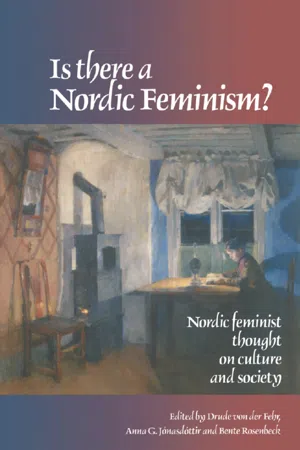
Is There A Nordic Feminism?
Nordic Feminist Thought On Culture And Society
- 384 pages
- English
- ePUB (mobile friendly)
- Available on iOS & Android
eBook - ePub
Is There A Nordic Feminism?
Nordic Feminist Thought On Culture And Society
About this book
The Nordic countries share a special cultural and political experience. This book presents an interdisciplinary perspective, covering the following areas: women's political strategies from different historical, national and text-orientated perspectives; questions of identity, rationality and subjectivity; and the organized production of social and cultural values. It attempts to understand and present internationally some of the complex changes in culture and society that concern women and feminists in the Nordic countries today.
Information
CHAPTER ONE
Introduction: ambiguous times— contested spaces in the politics, organization and identities of gender
Anna G.Jónasdóttir & Drude von der Fehr
Is there a Nordic feminism?
It would be easy to answer yes, of course, there is a Nordic feminism. Look at the consequences feminist thinking has had for women in the Nordic countries! The question, however, implies much more than that. We know for a fact that feminism in the Nordic countries has had a great impact on most women’s lives, but is there something specifically Nordic about the movement and the modes of thought that lie behind it? A related question is whether there is one Nordic feminism or many. In other words, what is feminism in the Nordic countries about? The authors of this edited volume address these questions indirectly. At its close, in Chapter 18, one of the editors, Bente Rosenbeck, deals directly with the questions: “What is the Nordic?” and “What is Nordic feminist scholarship?”
Generally speaking, the situation today in the Nordic countries and in Europe as a whole is radically different from that in the late 1960s and early 1970s when contemporary feminist scholarship emerged. Throughout the 1980s and up to the late 1990s, much in the economic and political structures of these countries has been more or less fundamentally transformed, as too has much in their social and cultural life. Not least, practically every kind of intellectual orientation or belief system— philosophical, theoretical, politico-ideological—that dominated people’s modes of thinking 20–25 years ago, has been somehow displaced or altered, and feminist thinking is no exception.
Our reason for producing this book is the widely felt concern with present changes; concerns with changing conditions and changing modes of living, loving, working, acting, thinking and writing among women in this part of the world. The substantial aim of the book is, therefore, to identify and elaborate on some of the different historical, social, political, cultural and theoretical breakups which are currently taking place in the Nordic countries. By “breakups” we mean profound and in some respects sudden shifts which seemingly put an end to, radically transform or alter the course of on-going cultural and societal processes. Needless to say, our ambition is not to register historical changes in any strict sense, that is, to compare some precisely measured items between one moment of time and another. We aim to come up with some understanding of the different situations or contexts in which changes happen and are acted upon; to obtain more adequate concepts of women’s experiences as well as new knowledge about changing gender relations more generally.
How, then, are women in various Nordic contexts situated today, and how do they act on their situations, socially, politically and culturally? What can be said about female-male relations in these contexts, and what kind of gender problematic is expressed in cultural production? What is the prime concern of Nordic feminist theory and research at present? How has it changed? In what direction(s) is it moving? In short, what does this book tell us about all this?
The outcome of the relatively open-ended premises we started with, and the subsequent interactive process of dealing with the material, will now be summarized and clarified somewhat before we proceed with a more substantial account and discussion of the chapters that comprise this book.
Themes and central problematic of the book
At first glance, the nature of the chapters which follow is such that the book could have been neatly divided into four or five sections according to the aspect of the subject with which they appear to deal. On the surface, the chapters cluster around topics such as “women and politics”, “women and men at work”, “changing forms of experiences among Nordic women”, “women and cultural history”, “gender and subjectivity in postmodernity (or late modernity)”, to name just a few. Also, if organized solely on this concrete level—the social science and history contributions on the one hand, the aesthetic and philosophical on the other—these contributions would most likely be seen only in isolation.
However, beneath these divisions we also detected another pattern, a number of main themes that connected the various chapters somewhat differently and which thus warranted a more analytically grounded division of the whole collection into three distinct, but not wholly separate parts. Having chosen this alternative mode of presentation, the volume is structured so that three internally connected themes are arranged around the key concepts “politics”, “organization” and “identity/subjectivity”. These concepts, of course, still relate to the fields of different concrete subjects at the most immediate level (distinguished above), but they are also intended to function more analytically to help present and discuss the various subject areas or themes, now understood as both distinct yet connected. To take an example: even those chapters that deal most concretely with women in politics (Chs 2 to 4), show that women, in acting politically, often also problematize and try to politicize organizational fundamentals of society and culture at large. Likewise, we see in these chapters how women in politics struggle with issues of identity both in relation to men and among themselves. In other words, politics cannot be analyzed or discussed for long before questions regarding such issues as rationality, identity and subjectivity also emerge.
By distinguishing such themes with the help of key interlinking concepts, we were able to see connections which made the crossing of disciplinary boundaries to construct the three parts seem natural. To take another example. The process of reading and thinking about women in early modernity as they sought self-realization in arranging literary salons (Chs 7–8) in which men—and women, too—had access to the most pleasant room, the most receptive listeners and thoughtful responses, suggests some obvious similarities with the mode of making life pleasant at work—not least for their male colleagues—which the women gynaecologists in the Danish case study practise almost two hundred years later (cf. Ch. 12). This leads to the next analytical level by which we transcend the division into parts, or rather it leads to another sense in which the parts are connected.
A central problematic runs through the whole collection: women’s variously situated and historically shifting struggle with men or maledominated preconditions concerning how to organize and run society, and how to set and ground its cultural premises. Thus, also, this problematic entails women’s various and shifting strategies and negotiations undertaken in order to make room for themselves and their concerns; all this on societally and culturally existing ground that seems to be constantly contested. To speak about struggle in this connection does not mean that women never benefit from the existing conditions they live in and act on. But to “see” the issue of struggle in this sense as it runs through the chapters is also to see relational complexity that demands a particular mode of thinking relationally. It should be underlined, perhaps, that differences or conflict-ridden relations between women are not glossed over or veiled here; the point is rather that the complex of male-female relations and the various same-sex relations do not necesarily exclude each other altogether, theoretically or empirically.
It seems to us that if, on the basis of this book, we are to speak generally about changes or discontinuities in the situation of Nordic women today, seen through changes in what Nordic feminist scholars deal with, we might say the following. If we take as a point of reference the situation, say, ten years ago, then a main focus was on women’s participation and visibility in politics, in paid work, in cultural activities. It was a question of women becoming as much valued as men, although, or even because, they acted differently. While today the issue of participation and visibility continues to be addressed, in spite of advances, the focus has widened. Also, concentration seems to have moved more decisively to engage with the very preconditions/premises on which women were “let in” in the first place, as well as with those which frame their possibilities today. This means that equality and difference—both as institutionalized principles (in law and other formal rules) and as rhetorical arguments—have come into focus. This pair of principles also runs through the present volume in the form of a shifting problematization and arguments that characterize, or rather comprise, a part of what was formulated above as the central problematic of the whole collection.
The last point in this account of our analytical elaboration of the book’s contents concerns the question of how to deal theoretically with issues of equality/difference; that is, is it possible to think about this notoriously difficult dichotomy in a non-dichotomous way? We think so. As a matter of fact, the ambition to do precisely this in the field of philosophy is the main thrust of Chapter 14 below (Heinämaa and Reuter). While neither primarily nor exclusively following these philosophical tracks, we assume that we show—by the very way in which we arrange and present the book’s contents—that we embrace a view that may be called dialectical on how to practise a mode of thinking relationally. Three important aspects of this view need to be mentioned here. First, it goes beyond dichotomies in that things can be both equal and different at the same time. Secondly, instead of thinking in terms of closed or discrete categories of meaning and societal facts, this view is directed at processes in which people interactively —and through some form of dynamic practice or struggle—create various kinds of social and cultural value, including the social value of people. Finally, this view allows for “seeing” things, events and conditions as multilayered, that is, as being and happening at various levels. Therefore, investigations on different levels of analysis and of abstraction are needed.
Regarding the stance taken above and in addition to the more often expressed dichotomy criticism, the adequacy of the equality/difference concept as an analytical tool to be used empirically in history and the social sciences is open to question. This is because the concept is most often applied on the level of philosophical ideas about human nature rather than as a theoretically elaborated concept constructed for empirical use. The result is that questions about women’s positions, possibilities or outlooks being equal to or different from men’s receive a reductionistic treatment as different levels of abstraction are conflated. Confusion often arises as to when these concepts are being used as philosophical and logical categories and when they are being used as empirical concepts aimed at generalizations and ideal-typical descriptions. In Chapter 2, Christina Carlsson Wetterberg takes issue with the kind of approach to women’s history that uses the equality/difference duality as a conceptual tool to determine shifting views and standpoints in the women’s movement and, thus, to understand women’s strategies in various contexts. The abstract either/or thinking that this entails does no justice, she argues, to the complexity of the concrete circumstances from which women’s political strategies emerge. The approaches must also allow space for both/and thinking.
Politics in ambiguous times
Perhaps the most conspicuous and most discussed example of the breakups or changes mentioned above is the contested and uncertain situation of the Nordic welfare state. This issue is partly connected to another one, widely held to be of great importance for the future and further development of the relatively “women-friendly” Nordic societies. In question here is, of course, the emergence and the highly uncertain future of the so-called “New Europe” in general and the European Union in particular. For instance, the fact that women are numerous and comparatively strong in the parliaments and governments of the Nordic nation-states does not necessarily mean that women would be influential to the same extent in a centralized Europe governed by procedural means and principles basically different from those in which women won their political power in the first place.
However, rather than addressing the welfare state debate or the discussion on the EU as such, the chapters in the first part of the book problematize the premises on which Nordic women are, and have been, politically influential. Grounded in material mainly from Sweden and Iceland, they show how women have struggled politically among themselves as well as with men—and not in vain. Looking back, in all the Nordic countries we can easily discern increasing levels of participation and greater visibility of women in politics—a story of success can obviously be told. However, the authors included here have chosen to raise somewhat different questions. Who has the power effectively to define what is common ground and which are the areas of cleavage between women? Although we can see from the historical evidence given here, both from the more remote and the recent past, that men resist women’s political action in various ways, why is it that women have not to a greater degree acted in a unified manner (Ch. 2)? How does it come about that some issues tend to be women’s issues and others not? On what premises do male politicians claim that women shall obey and “follow the men”? Moreover, when women politicians, such as the Swedish Social Democratic women in the late 1970s, grow desperate and feel forced to revolt against party discipline in order to fight for their core issues, how should this particular kind of party in-fighting be framed, that is, in what scholarly terms should it be conceptualized and interpreted (see Ch .3)? Gendered interests seem to be intricately woven into the structure of social cleavages on which the modern party system as a whole has been built. At least, after reading Wetterberg’s and Karlsson’s contributions here, one begins to wonder why, over the years, it has been considered so much more threatening to famous Swedish party discipline when a group of women joins together and acts for the common good than when men (happen to) act in single-sex groups for the same purpose.
In cases such as that of the Icelandic Women’s Alliance, when women decide to organize and conduct politics “on their own premises”, how do they do it and what do they themselves think is different about their way? On the other hand, do phrases and arguments taken from an idiom of women acting on their own premises necessarily mean total separation from men and a categorical difference thinking? And what are the strengths and weaknesses of the Women’s Alliance strategy, to organize separately and differently within the existing political system (Ch. 4)? Furthermore, when actually successful in their own terms, what premises are women acting on, which may, somehow, explain their success in the first place? If, for instance, Icelandic women can be said to have benefited politically from the specific peaceful version of nationalist difference thinking that prevailed in Iceland in the nineteenth century, during the struggle for independence from Denmark, is there a cost too of this benefit (Ch. 5)? Finally, what is the political and ideological message to women around the world of a writer such as the American Camille Paglia who today actually advocates far-reaching separation; a writer who claims not only that women and men are fundamentally different but also applies radically biological and sexualized difference thinking to the whole of human culture as well as the rest of the cosmos (Ch. 6)?
All but one of the chapters brought together in Part I problematize the ambiguous terms on which women as a differentiated collective are and have been able to act as an interested party in the organized power struggle of democratic politics. We believe that the kinds of issue discussed here may open the door to raising other highly relevant questions, such as how to understand and analyze the possibilities and barriers for women with regard to moving on and enhancing their power in more or less transformed political decision-making arrangements.
These chapters, moreover, show clearly that the “ideological duality”, to borrow Wetterberg’s phrase, that comes from the abstract use of equality versus difference thinking, comprises a vital element in the ambiguity that characterizes the premises on which women and men, as well as women and women, relate politically—in consensus and contest. Hence, we find it interesting to connect to these concrete and historically located studies a politically concerned critique by a literary analyst, of a writer whose radical difference thinking and cultural criticism go against feminist claims to sexual equality and the dissolution of gender divisions, as well as against the more general abandonment of limits found in deconstructionism and postmodernism. In her chapter, “Postmodernist space in Camille Paglia’s Sexual personae”, Kerstin Westerlund Shands focuses on the spatial metaphors in Paglia’s work. Thus, it may equally be read in relation to the chapters that make up the book’s second part, arranged as they are around the theme of organization and contested space. Either way, it stimulates further questions: Is Paglia’s extreme difference thinking radically liberating or is it conservative? Further, from what textual levels do these words derive their political meaning? Can Paglia’s polemical dichotomizing moves against feminism be read as an expression of a widely felt cultural anxiety in an era when the traditional dichotomies are in general dissolution?
Another question, then, is how we are to understand the relationship between philosophical discourses and rhetoric on the one hand and people’s acting and thinking in socially structured situations on the other. As a part of recent postmodernist debate, this has become—in a new way, we might add—a fairly open question. Precisely this issue becomes urgent with respect to Inga Dóra Björnsdóttirs revealing analysis of the maleauthored maternalist element in Icelandic nationalism, derived initially from the Herder variant of German Romanticism. What connection, if any, is there between the Romantic ideas about the nature of Iceland, idealistically constructed by male poets and liberation heroes, as the Mother of the land’s sons, and the political impact Icelandic women today may have as they profile their electoral programme around women’s and children’s social and economic disadvantages? What is at issue here seems to resemble Wetterberg’s questioning of the meaningfulness of deriving knowledge about concrete historical realities from analyses of ideas about human nature (see Ch. 2).
Organization and contested spaces
Although the aim of this book is to understand the present, the fact that some of the historical analyses found in Part I concern the nineteenth century does not make their inclusion here less appropriate, quite the contrary. That was the time when nationalism emerged, an ideology which, as we can see from Björnsdóttir’s contribution (Ch. 5), relied heavily on the dualist symbolism of femininity and masculinity. Politically, the late nineteenth century saw the birth of the party system, and it was the formative period for the first wave of the women’s movement as well as the labour movement. So, looking back with gender-seeing eyes into this period of transformation elicits knowledge about variously situated gendered interactions and struggles that actually centre around fundamentals and basic premises. They centre around such fundamental matters as how society—including the production and reproduction of its people, of life— should be organized; and around how politics—including socio-sexual politics—should be institutionalized; and they imply the repeatedly contested question of what makes humanity human and where—in what kind of room/space— the practice(s) necessary for that value creation take (s) place.
Part II also starts with history, this time the history of culture and aesthet...
Table of contents
- Cover Page
- Title Page
- Copyright Page
- List of illustrations
- Notes on contributors
- Foreword
- Preface
- CHAPTER ONE: Introduction: ambiguous times— contested spaces in the politics, organization and identities of gender
- PART ONE: Politics in ambiguous times
- PART TWO: Organization and contested spaces
- PART THREE: Identity/subjectivity—between equality and difference
Trusted by 375,005 students
Access to over 1.5 million titles for a fair monthly price.
Study more efficiently using our study tools.
Frequently asked questions
Yes, you can cancel anytime from the Subscription tab in your account settings on the Perlego website. Your subscription will stay active until the end of your current billing period. Learn how to cancel your subscription
No, books cannot be downloaded as external files, such as PDFs, for use outside of Perlego. However, you can download books within the Perlego app for offline reading on mobile or tablet. Learn how to download books offline
We are an online textbook subscription service, where you can get access to an entire online library for less than the price of a single book per month. With over 1.5 million books across 990+ topics, we’ve got you covered! Learn about our mission
Look out for the read-aloud symbol on your next book to see if you can listen to it. The read-aloud tool reads text aloud for you, highlighting the text as it is being read. You can pause it, speed it up and slow it down. Learn more about Read Aloud
Yes! You can use the Perlego app on both iOS and Android devices to read anytime, anywhere — even offline. Perfect for commutes or when you’re on the go.
Please note we cannot support devices running on iOS 13 and Android 7 or earlier. Learn more about using the app
Please note we cannot support devices running on iOS 13 and Android 7 or earlier. Learn more about using the app
Yes, you can access Is There A Nordic Feminism? by Drude von der Fehr,Anna Jonasdottir,Bente Rosenbeck in PDF and/or ePUB format, as well as other popular books in Social Sciences & Feminism & Feminist Theory. We have over 1.5 million books available in our catalogue for you to explore.