eBook - ePub
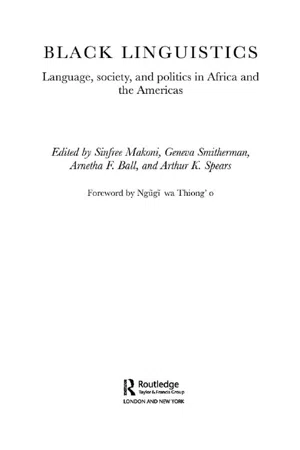
Black Linguistics
Language, Society and Politics in Africa and the Americas
- 240 pages
- English
- ePUB (mobile friendly)
- Available on iOS & Android
eBook - ePub
Black Linguistics
Language, Society and Politics in Africa and the Americas
About this book
Enslavement, forced migration, war and colonization have led to the global dispersal of Black communities and to the fragmentation of common experiences.
The majority of Black language researchers explore the social and linguistic phenomena of individual Black communities, without looking at Black experiences outside a given community. This groundbreaking collection re-orders the elitist and colonial elements of language studies by drawing together the multiple perspectives of Black language researchers. In doing so, the book recognises and formalises the existence of a "Black Linguistic Perspective" highlights the contributions of Black language researchers in the field.
Written exclusively by Black scholars on behalf of, and in collaboration with local communities, the book looks at the commonalities and differences among Black speech communities in Africa and the Diaspora. Topics include:
* the OJ Simpson trial
* language issues in Southern Africa and Francophone West Africa
* the language of Hip Hop
* the language of the Rastafaria in Jamaica
With a foreword by Ngugi wa Thiong'o, this is essential reading for anyone with an interest in the linguistic implications of colonization.
Information
Part 1: IDEOLOGICAL PRACTICES IN RESEARCH ON BLACK LANGUAGES
1: Ideologies of language and socially realistic linguistics
Donald Winford
Like so many of my Caribbean and African American colleagues, I have devoted my entire career to the study of the languages of the New World Black Diaspora. For the most part, these languages are associated with the socially disadvantaged, though their use is not exclusive to such groups, and they are often perceived as corruptions or deviations, lacking expressive power and rules of grammar. These languages were created by Africans across the Diaspora, as they came into contact with speakers of European languages under conditions of forced relocation and enslavement. They include the languages that linguists refer to as “Creoles,” spoken in Africa, the Caribbean, in areas along the Indian Ocean, and in parts of the US.
The speakers of these languages often refer to them by other names, e.g. Patwa in Jamaica, Papiamentu in Aruba and Curaçao, Sranan Tongo in Suriname. Sometimes the popular names match those used by linguists, for instance Kweyol in St. Lucia, Kreyòl in Haiti, Creolese in Guyana, and Creole in Belize. All of these languages display varying linguistic continuities from English and other European languages, though they have been restructured to different degrees as a result of creative learning by Africans. My own scholarly interests lie in the varieties of English that were created by Africans in the Caribbean and the US during the seventeenth and eighteenth centuries, which I refer to as “New World Black Englishes.” In the US, they include the language linguists refer to as African American Vernacular English, recently popularized as “Ebonics” (although the term was coined in 1973), as well as Gullah, the creole that emerged in the coastal areas and on the islands of South Carolina and Georgia. In the Caribbean, English-lexicon creoles are the primary vernaculars of the vast majority of the population in Anglophone countries. The latter include Antigua, Barbados, Belize, Jamaica, St. Kitts, and various other former British colonies. Among them is Trinidad, my home country, where I learned my own native language, Trinidadian Creole, which we call “Trini.” In Trinidad, as in the other Anglophone Caribbean countries, the Creole vernacular exists in a diglossic relationship with Standard English, the official language (Winford 1985)—a situation that applies equally well to African American Vernacular English (AAVE).
Since I have written extensively on the sociolinguistic situation in Caribbean English Creole communities (e.g. Winford 1985, 1988, 1994), I will say little about them here. Instead, I wish to focus my attention on AAVE and examine some aspects of its history, status, and use from my perspective as a Caribbean creolist.
AAVE is part of a spectrum of varieties that can collectively be assumed under the label “African American English” (AAE). The spectrum includes Standard English as spoken by Blacks (cf. Spears’s 1988 “Standard Black English”), as well as various regional (both rural and urban) and socially based varieties of African American Vernacular English. AAVE itself is not monolithic, displaying differences related to region, age, class, and gender. Moreover, there is some overlap between AAVE and more standard varieties of AAE, particularly in the usage of middle-class and educated Blacks. On the whole, however, varieties of AAVE across both urban and rural communities share a set of linguistic features that distinguish this vernacular from others in the US (Wolfram 2002). The urban varieties in particular are the focus of this chapter.
It is evident to all linguists that AAVE and other varieties of New World Black English are legitimate, rule-governed systems of communication—true manifestations of the human faculty of language. But it is equally clear that they are subject to extreme forms of linguistic prejudice, rooted in ideologies and belief systems, which have no basis in linguistic fact, or arise from one-sided interpretations of the facts. The main focus of this chapter is the continuing struggle between ideology and fact in the way these languages are perceived and written or spoken about.
Following Wolfram (1998), I interpret “language ideology” to mean an often subconscious, deeply rooted set of beliefs about the way language is and is supposed to be. Like all ideologies about the world, language ideology is a part of, and derives from, what Bourdieu (1977) refers to as the habitus. The concept refers to a “set of dispositions which incline agents to act and react in certain ways. The dispositions generate practices, perceptions, and attitudes which are regular without being consciously coordinated or governed by any ‘rule’” (Thompson 1991: 12). These dispositions affect every aspect of social life, and inculcate in individuals a set of expectations and attitudes about the world and how to act in it. Like any other social practice, a language (the social practice par excellence) “only exists as a linguistic habitus, to be understood as recurrent and habitual systems of dispositions and expectations” (Duranti 1997: 45).
It isn’t just non-linguists that have such expectations and beliefs. Linguists themselves operate with a certain body of assumptions—a “paradigm” which itself constitutes a form of language ideology. And not all linguists share the same set of beliefs. Among scholars, there are two radically different approaches to the nature of language. On the one hand, language is viewed as an abstract system of rules for the combination of sounds into meaningful units known as morphemes, which are further combined to yield more complex units such as phrases and sentences. In other words, language is viewed as pure code, a set of sentences generated by a set of grammatical rules. On the other hand, language is viewed as a set of culturally transmitted behavior patterns shared by a community of speakers. In other words, language is seen as a form of social behavior, an inextricable part of cultural practice. Linguists emphasize this dichotomy in various ways.
Adherents of the first approach claim a clear boundary between “competence” and “performance,” between langue (the internalized knowledge of grammar) and parole (the actual use of language). In their view, the goal of linguistic theory is to describe an abstract construct—a discrete system of grammatical knowledge divorced from the sociocultural contexts of language use. Chomsky (1986) refers to this abstraction as “Internalized” language or “I-language,” and distinguishes it from “Externalized” language or “E-language,” language in actual use. He further questions whether the latter can become an object of serious study. If such linguists are asked how abstract grammatical rules relate to the behavior of actual human beings, they would say that the rules are meant to account for the behavior of ideal speakers living in ideal, uniform speech communities. But exactly how do these idealizations relate to what we in fact observe in actual communities?
This problem has been explored by LePage (1989), who examines four senses in which the term “a language” is used, and how the different interpretations reflect powerful social stereotypes. First, there is the individual’s perception of what his or her language is. Second, there is the community’s perception of and consensus about its own variety of language. Third, there is the set of data that makes up actual language performance, the behavior we observe in everyday life. Finally, there is the linguist’s description of a grammar, an abstraction based on the kinds of data the linguist chooses to use, often based on his or her intuition. Each of these is a product of some kind of ideology. An individual’s or community’s perception of its own language often runs counter to beliefs that deny status to it as a legitimate or autonomous variety. A particularly insidious form of this kind of belief is what some refer to as “standard language ideology” (discussed below). The notion of linguistic homogeneity that many linguists operate with is also itself a product of ideology, rooted in the idea that the variability of language behavior is not an ideal basis for a theory of grammar. Indeed, Chomsky (1986: 17) specifically says this about the variable language behavior characteristic of bilingual speech communities (and by extension, the variability common in every language).
The crucial problem here is to reconcile the data of performance with the linguist’s construct of the grammar and to reconcile each with the community’s conception of its own and others’ linguistic practices. It is seldom the case that the linguist’s notion of grammatical system is equivalent to the folk notion of language. The two concepts reflect different ways of abstracting from communicative behavior. This in part explains the frequent clashes that occur between linguists and non-linguists in their perception and evaluation of language behaviors.
Sociolinguists, who view language primarily as a sociocultural construct, attempt to bridge the ideological gap between these two ways of looking at language. We see language not just as a set of rules, but as a way of behaving, a way of belonging, a way of creating social identities and relationships. It should come as no surprise, then, that this perspective on language is often at odds with the linguist’s attempt to abstract systems of rules from the data of performance. Nowhere is the conflict more apparent than in the treatment of the vernacular of African Americans. I once witnessed an impassioned attack by a noted sociolinguist on a formal analysis of the AAVE auxiliary system that was based on the analyst’s own intuitive judgments. Apparently, the sociolinguist saw this as a departure from empirical accountability. But there is, in fact, no real incompatibility between the two approaches. The formal analyses of AAVE grammar done, for example, by Green (1997, 2000) provide invaluable insight into the competence shared by users of this variety. On the other hand, the sociolinguistic approaches of scholars like Mitchell-Kernan (1972), Morgan (1994a), Smitherman (2000), and others provide insight into how this grammatical competence is linked to communicative competence and translates into skilled performance. It is high time we reassert the complementary relationship between studies of I-language and studies of E-language, rather than treating them as polar opposites.
Unfortunately, as the controversy over AAVE stirred up in the Ebonics debate has shown, linguists continue to make little headway in their attempt to demonstrate to the public the richness of AAVE grammar and the competence of its speakers. Indeed, the scholarly treatment of this language variety has itself sometimes (not always intentionally) contributed to the negative popular stereotypes of it. I will first consider two areas in which (the potential for) such bias exists— the study of AAVE’s history and the variationist approach to its relationship with Standard English (SE). I will then consider the social contexts of inequality and discrimination that reinforce the negative bias toward the linguistic practices of African Americans.
Ideology and historicity
Historicity—the notion of continuity and tradition, of a distinct lineage and genealogy in the development of a language—is a vital part of the ideology that assigns legitimacy to any language. But because the languages of the African Diaspora were for the most part creations of Africans, this aspect of their history has been either denied or used as grounds for defamation. Thus, G.P. Krapp asserts the following about AAVE: “The Negroes indeed in acquiring English have done their work so thoroughly that they have retained not a trace of any African speech. Neither have they transferred anything of importance from their native tongues to the general language” (1924: 190). This view conveys the impression that AAVE is an exact replica of some unspecified English dialect, and that there is nothing distinctive about its grammar. While no one would deny the strong connections between AAVE and the settler dialects introduced to the American South in the colonial period, it is equally clear that there was a great deal of creative innovation that gave a distinctive stamp to the character of this vernacular. The influence of African languages on the structure of AAVE is admittedly not as strong as in the case of Gullah or the Creoles of the Caribbean. But it is not entirely absent. There is evidence of it in phonology and in some of the vocabulary, as many scholars have noted. And above all, traces of African influence persist in the communicative styles and modes of interacting of African Americans, in the counterlanguage of signifying (Morgan 1993), in boasting and loud talking (Mitchell-Kernan 1972; Smitherman 1986), and perhaps today in Hip Hop. Rickford and Rickford (2000: 13–88) provide a more extensive survey of how African Americans exploit the richness of their linguistic heritage in areas such as preaching, comedy, singing—several of which show evidence of continuities from Africa.
Sometimes the African influence is camouflaged in English guise. In AAVE as in New World Black English generally, we find expressions like bad-mouth “to speak ill of” (cf. Mandingo da-jugu, Hausa mugum-baki “bad-mouth”), suck-teeth “a disapproving sound” (multiple West African sources), and cut-eye “a scornful look” (Rickford and Rickford 2000: 95). These expressions are as familiar to African Americans as to their cousins in the Caribbean. They represent loan translations of African expressions, disguised in English words.
The idea that African Americans played no creative role in the development of their vernacular is very much alive in the scholarly literature today. One instance of this is the recent anthology, edited by Poplack (2000), with the title The English History of African American English. Its main thesis is that “the grammatical core of contemporary AAVE developed from an English base,” and that features peculiar to AAVE are recent developments resulting from a process of “divergence” brought about by racial segregation in the post-Civil War era. Examples of the “grammatical core” treated in this volume include the copula, plural marking, negation, was/were alternation, auxiliary inversion in questions, and relativization strategies. It is argued that in almost every one of these cases, quantitative variationist methodology has shown the system governing their use to be that attested in older forms of English. One notable exception is (variable) copula absence, “perhaps the only variant studied in this volume which cannot be identified as a legacy of English, except perhaps as an additional strategy, complementary to contraction, for reducing prosodic complexity” (Poplack 2000: 20). What this means is totally unclear to me. There is no independent evidence that prosodic demands trigger “deletion” of any other sounds in AAVE. The fact is we have a quite reasonable explanation for copula absence in AAVE as the result of simplification and regularization strategies used by Africans in the acquisition of early settler English. Such strategies are well known from many other cases of the restructuring of English under conditions of contact.
No objective scholar would deny that most of the features listed above, and indeed many others, can be traced back to one or another (British) English source. There is no question that several of these features are thoroughly English dialectal in character, as Schneider (1989) and Winford (1998) have argued. Hence, in these cases, it is not surprising to find patterns of use and variability that reflect those in other dialects of English (with the exception of the copula pattern). To focus entirely on uncontested British dialectal continuities in AAVE, however, conveniently ignores other distinctive features of AAVE grammar that are not so easily explained. The features treated in Poplack’s anthology (Poplack 2000) include none of the tense/aspect auxiliaries and other grammatical features that make AAVE unique among American English dialects. The precise origins of these features are not explained. All we are told is that “many of the features stereotypically associated with [urban AAVE] . . . would have emerged and/or spread since the last quarter of the nineteenth century” (Poplack 2000: 25). The details of this emergence, however, remain a mystery. No explanation or motivation is offered for the “divergence” that supposedly reshaped the grammar of AAVE. There is no hint as to how or why AAVE speakers, in the course of a few generations, proliferated the use of zero copula (e.g. She tall), while oddly increasing use of plural marking, and developed a whole range of tense/aspect markers that had never been part of the vernacular before.
Approaches like these to the history of AAVE are selective and one-sided, conveniently ignoring those aspects of AAVE grammar that do not fit the historical scenario (first proposed by Krapp) that “AAVE originated as English” (Poplack 2000: 27). Also one-sided is the comparison of AAVE with the contemporary descendants of varieties of earlier African American English transported to Samaná and Nova Scotia. No attention is paid to evidence from places like Liberia (Singler 1991a, 1991b) to which African Americans also migrated in large numbers in the later nineteenth century. For example, Singler (1998) has shown that many of the AAVE features that supporters of Krapp claim to be recent developments can, in fact, be found in Liberian Settler English, thus indicating that they must have been present in late nineteenth-century AAVE. Such features include preterite ain’t (= “didn’t”), the auxiliary combination be done, the adverb steady expressing habituality, and habitual auxiliary be. Thousands of loyalist slaves and freemen from the US migrated to the Bahamas after 1783 (Saunders 1983; Hackert 2001); hence some varieties of Bahamian English may provide insight into earlier AAVE. Holm and Hackert (in press) suggest that most of the new arrivals from the US came from South Carolina and Georgia, and thus probably spoke Gullah rather than AAVE. But research still needs to be done to determine whether some varieties of Bahamian English preserve features of earlier AAVE. Wolfram and Thomas (2002), using evidence from intergenerational differenc...
Table of contents
- Cover Page
- Black Linguistics
- Title Page
- Copyright Page
- Figures and table
- Foreword: Decolonizing scholarship of Black languages
- Introduction: Toward Black Linguistics
- Part 1: Ideological Practices in Research on Black Languages
- Part 2: Conceptualization and Status of Black Languages
- Part 3: Inclusion and Exclusion Through Language
- Contributors
Trusted by 375,005 students
Access to over 1.5 million titles for a fair monthly price.
Study more efficiently using our study tools.
Frequently asked questions
Yes, you can cancel anytime from the Subscription tab in your account settings on the Perlego website. Your subscription will stay active until the end of your current billing period. Learn how to cancel your subscription
No, books cannot be downloaded as external files, such as PDFs, for use outside of Perlego. However, you can download books within the Perlego app for offline reading on mobile or tablet. Learn how to download books offline
Perlego offers two plans: Essential and Complete
- Essential is ideal for learners and professionals who enjoy exploring a wide range of subjects. Access the Essential Library with 800,000+ trusted titles and best-sellers across business, personal growth, and the humanities. Includes unlimited reading time and Standard Read Aloud voice.
- Complete: Perfect for advanced learners and researchers needing full, unrestricted access. Unlock 1.5M+ books across hundreds of subjects, including academic and specialized titles. The Complete Plan also includes advanced features like Premium Read Aloud and Research Assistant.
We are an online textbook subscription service, where you can get access to an entire online library for less than the price of a single book per month. With over 1.5 million books across 990+ topics, we’ve got you covered! Learn about our mission
Look out for the read-aloud symbol on your next book to see if you can listen to it. The read-aloud tool reads text aloud for you, highlighting the text as it is being read. You can pause it, speed it up and slow it down. Learn more about Read Aloud
Yes! You can use the Perlego app on both iOS and Android devices to read anytime, anywhere — even offline. Perfect for commutes or when you’re on the go.
Please note we cannot support devices running on iOS 13 and Android 7 or earlier. Learn more about using the app
Please note we cannot support devices running on iOS 13 and Android 7 or earlier. Learn more about using the app
Yes, you can access Black Linguistics by Arnetha Ball,Sinfree Makoni,Geneva Smitherman,Arthur K. Spears,Foreword by Ngugi wa Thiong'o in PDF and/or ePUB format, as well as other popular books in Languages & Linguistics & Linguistics. We have over 1.5 million books available in our catalogue for you to explore.