Museum and art galleries have never been so much in the news as they have been over the past decade. Yet public focus at both professional and non-specialist levels has been remarkable for what has been accidentally or deliberatley left out of recent debates. Moving beyond the narrow issues of professional practice, Museums 2000 probes the political, economic and cultural realities which affect museums today. Because the contributos are drawn from the museum profession and the wider political, academic and business community worldwide, the book is truly international, reflecting the issues which affect all museums.
eBook - ePub
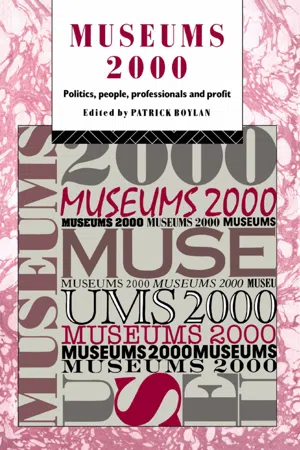
Museums 2000
Politics, People, Professionals and Profit
- 212 pages
- English
- ePUB (mobile friendly)
- Available on iOS & Android
eBook - ePub
Museums 2000
Politics, People, Professionals and Profit
1
Museums 2000 and the future of museums
Patrick J.Boylan
Introduction
Although museums and art galleries have never been so much in the news as they have been over the past decade, the public focus at both professional and non-specialist levels has been remarkable for what has been accidentally or deliberately left out of this debate.
Any priority list of factors of central importance to museums and art galleries in recent years and at the present time should have included the impact of politics on museums at both national and local levels, the relationship between museums and ordinary people, the nature and future of the museums profession, and the changing financial climate for museums, especially the drive for profit (or at least the political agenda of seeking to switch responsibility for museums from public to private funding), and these seem certain to remain central issues for the foreseeable future.
Museums Year 1989
The City of York has played an important part in English national history for almost two millenniums. However, its oldest museum, The Yorkshire Museum, though immensely rich in its collections and a model of its kind in terms of its exhibition, communication and other public services, is still quite a small institution. It was founded in a wave of local scientific zeal and Yorkshire patriotism in 1824 in order to keep in the county some of the remarkable and highly controversial fossil mammal finds from Kirkdale Cave discovered at the end of 1821 (described by Professor Adam Sedgwick, one of its first honorary members, as ‘our Yorkshire Hyaenopolis’!). Yet during the past century and a half the Yorkshire Museum has had the unique distinction of launching not just one, but two, world movements, each aimed at promoting the public understanding of, co-operation in, and the professionalizing of both science and the arts.
In 1830 a small group of scientists (although they did not call themselves that since the very word was not to be invented for another seven years) gathered together in the Yorkshire Museum to create the world’s first national ‘Parliament of Science’—as one of the founders called the British Association for the Advancement of Science. From these small beginnings has grown the still healthy and expanding British Association which meets in both plenary sessions and over twenty specialist Sections, every autumn in a different city of the United Kingdom (and sometimes overseas too), and which also plays a major role in science education and the public understanding of science throughout the year. Further, demonstrating the old saying that ‘lmitation is the most sincere form of flattery’ the aims of those 1830 Yorkshire Museum pioneers have been followed in similar national organizations in many other parts of the world, most notably in the USA, where the ‘Triple A—S’, the American Association for the Advancement of Science, has long since outgrown its UK model in terms of both size and influence.
Precisely the same spirit of co-operation, fellowship and the hope of ‘advancement’ within their chosen field filled a still smaller group of less than a dozen museum curators and governing body representatives from across Britain who met in the office of the Keeper of The Yorkshire Museum on 20 June 1889. These pioneers, perhaps prompted in part by concern about the organization and health of museums expressed by the British Association itself in several critical reviews of the state of the museums of Britain over the preceding two decades, quickly resolved to establish the world’s first national (and indeed international) organization for museums—The Museums Association.
It should be noted that even today it is ‘The’ Museums Association, not the UK (or English) Association, because when it was set up it was the only organization of its kind in the world. Indeed from an early date the Association had international members, both museums and individuals, and although the proportion of overseas members has fallen as national museums associations modelled on it developed elsewhere, the Association still has, and very much welcomes, foreign members. However, the British model has been taken up in most other parts of the world—most spectacularly in the United States, where the American Association of Museums now has more than 9,000 members (three times the membership of our Association) and regularly attracts 3,000 or more delegates to its Annual Meeting.
The Museums Association represents both museums as institutions and the museums profession, with the central aim of enhancing the quality of service, professionalism and standing of the museum community, throughout both the public and private sectors. Its four primary activities are professional support, publication, research and information, and parliamentary and public affairs.
These are all directed towards four primary objectives: enhancing the quality of public service and collections care through career-long professional development for museum staff; enabling the museum community to seize opportunities to meet people’s needs, traditional and changing, from museums, arising from the rapid social, educational, economic and demographic changes in society; representing the views, needs and values of the museum community and its users to national and local government; and the facilitating of the exchange of information about new initiatives, best current practice and likely future trends in the museum community.
Almost six years before the Association’s centenary year its Council, under the leadership of Lord Montagu of Beaulieu as President, recognized that the 1989 centenary offered a special opportunity for the Association and its membership, both institutional and professional, to review the current museum scene, to promote museums and galleries individually and collectively, and to look into the future of the museums within the UK and further afield. After long periods of discussion, the Association developed the concept of seeking support from both the museum movement and the various UK official bodies, including Government, the Museums and Galleries Commission, the Arts Council and the British Tourist Authority, for a year-long nationwide festival and celebration of museums, the arts and sciences—on a scale that had never been attempted anywhere else in the world.
Over 900 individual museums, galleries, and other heritage buildings and sites in over 400 cities, towns, villages and other localities registered one or more different types of special events and activities officially linked to and promoted as part of Museums Year, covering an extraordinary and often ingenious range of special promotions. Indeed, some linked several dozen special exhibitions, lectures, visitor activities and other special events to Museums Year. The original ambition of mounting much the largest national festival of the arts and sciences the world has ever seen was therefore fully realized.
We were very fortunate in having the very active support of the Royal Family, especially the Queen Mother as Patron of the Association itself, and HRH The Duchess of York as an extraordinarily active Royal Patron of Museums Year itself (undertaking thirty-one days of Museums Year events, frequently in the smaller museums which rarely get national publicity), and indeed every one of the adult members of the Royal Family undertook at least one Museums Year engagement, giving us support that was of enormous benefit in publicity terms.
Some of the special events linked to the Museums Year promotion were on a major scale—for instance the opening of the new national Design Museum, or the reopening of the totally remodelled Imperial War Museum by the Queen and the Duke of Edinburgh, while others were very modest indeed—a series of small-scale community events for disabled or otherwise disadvantaged people in a small local museum, for example, but equally effective in their own way and in relation to their own locality and community.
However, Museums Year was not without its problems in the planning stages not least because few potential major corporate sponsors could understand how they could relate effectively to such a diverse and dispersed programme of activities. Many potential corporate sponsors could see the mutual benefits of sponsoring individual events, whether national or local, and probably in total several hundred different businesses and other organizations were involved in this way, and both the individual museums and the Association were extremely grateful to these.
For example, Rank Xerox sponsored this ‘Museums 2000’ Conference on the future of museums. Similarly, the international accountants and management consultants, Touche Ross, gave generous support to our Centenary Conference in York (the Association’s birthplace), which enabled the Association to offer no less than one hundred free places to the younger members of the profession who are usually at the bottom of the list, way below Trustees, Councillors, Directors and Senior Curators, when museums are sharing out the budget for our annual Museums Conference.
Fortunately, Times Newspapers Ltd (part of News International) saw the wider benefits of being associated with such a broadly based national festival and gave enormous support as the principal sponsor of Museums Year 1989. This included covering the costs of the Association’s own central co-ordinating role for Museums Year, organizing (in partnership with Spero Communications) an innovative Museums Year Guide and Passport, which together offered up-to-date information in a pocket-sized guidebook format to participating museums together with—through the ‘passport’ facility—a wide range of material benefits to the passport purchaser, such as admission and shop concessions, or invitations to special Museums Year events.
The Times also ran a weekly feature half page on Museums Year every Saturday in addition to excellent general news and review coverage. Special tribute is due to Simon Tait of The Times for both his news and reviews writing on Museums Year, and for his participation in the Museums Year Guide and Passport scheme.
The benefits of Museums Year proved very substantial for many of the participating museums of all sizes. Despite some initial hostility from other sectors of the national media because of our sponsorship by The Times, a rival newspaper, Museums Year had the desired effects of benefiting individual museums while at the same time getting over to decision-makers in both the governmental and corporate sectors that museums are of central importance to our national educational, cultural and scientific life. Certainly the museums and heritage sector had never before been so much at the forefront in the media and public understanding.
In particular, from the central organization by the Association itself, we tried to get over the (entirely truthful) messages that in the UK museums and related facilities succeed in achieving their mission on generally very limited resources, and that they would be even more effective and successful given quite modest additional investment from both public and private (especially corporate) sources. In other words, both as a nation and at the more local and individual institutional level, we need to build on the success and proven track records of our nation’s museums, large and small, both individually and collectively.
As a final indication of the success of the promotion, it is good to be able to record that Museums Year 1989 also saw record attendances throughout the sector (especially in those areas and institutions who made best use of the opportunity, for example the museums and galleries of the Yorkshire and Humberside region). The English Tourist Board recorded 72 million visits within Museums Year 1989 to museums and art galleries in the narrow sense, plus a further 66 million visits to historic buildings, monuments and other ‘heritage’ sites, giving a remarkable overall total of 138 million visits.
‘Museums 2000’ Conference, May 1989
As part of the programme of Museums Year 1989, the Association brought together in London for two days in May 1989 a panel of twentyone members and guests from across the world. They came from a wide variety of backgrounds both within and outside the museum movement with the objective of debating with no holds barred the future of museums looking towards the new millennium, in front of, and then with, a capacity audience.
Eight different debates were held on the four central themes of the future of museums in relation to politics, people, professionals and profit, presented in the sequence followed in this book. In each case there was a prepared keynote address, followed by a discussion amongst a number of the invited keynote speakers and panel members, which was then broadened into a wider debate bringing in contributions from the floor of the ‘Museums 2000’ Conference.
Both the prepared keynote addresses and the subsequent discussions were recorded and transcribed verbatim. Consequently, by close adherence to the substance of the transcripts, this book attempts to give not just the argument but also the flavour of this challenging and stimulating conference: it is as complete a record as is practicable, with only minimal text editing.
The success or otherwise of a public debate such as ‘Museums 2000: Politics, People, Professionals and Profit’ depended very much on all those participating—not just the invited speakers. Both the Museums Association’s Museums Year 1989 celebrations and our principal Conference sponsor, Rank Xerox Ltd, were very well served in this respect. The very brief biographies as at May 1989 provided for the conference programme by the keynote speakers and panel members are reproduced at the end of this book (Chapter 11), but where appropriate in this introduction I have briefly amplified these (using the transcript of my welcome and introduction to the conference which has not been reproduced).
We were particularly delighted to have HRH The Duke of Gloucester to open the Conference, because of his long interest in museums and the heritage both professionally as a practising architect and through his distinguished and very active public service in the sector. The latter has included a long period as a Commissioner of English Heritage—the Historic Buildings and Monuments Commission (and a full term as Vice- Chairman), and a long and continuing period of service as a Trustee of the British Museum.
The Association’s choice as my co-chairman for the Conference, Lord Montagu of Beaulieu, was an especially appropriate one, since it was during his period as Museums Association President in 1984–5 that he initiated the concept and planning of the Association’s 1989 Centenary Year.
Having founded the original Montagu Motor Museum at Beaulieu almost forty years ago as a small additional attraction for visitors within Palace House, he led its growth and development into the present internationally known and respected National Motor Museum. He has also served many different organizations within the museum and heritage movement, including the Historic Houses Association (founder President), the Association of Independent Museums, and above all as the founder chairman of English Heritage from its creation in 1983.
Museums and politics
Bearing in mind the scale of the recent expansion in museum provision (with more than half of the museums and galleries in Britain being less than forty years old), and the great majority being at least partly publicly funded, the relationship between museums and the political system and the future of public funding ought to have been central issues throughout the 1980s. Similarly, the relationship between the museum and the general public, and the internal relationships of the museum employees themselves—is there at last a museum profession emerging?—should have been major issues as well.
Yet none of the vitally important issues of the relationships between museums and politics and between museums and the non-specialist public, the nature and future of the museum profession, and the relentless drive of the profit motive have been at the forefront of the recent United Kingdom museum agenda, at least in terms of either public or professional debate. The first of the four major themes of the ‘Museums 2000’ Conference was therefore the exploration of the relationship between museums and politics.
The UK museums profession seemed through much of the 1980s to have been very much on the defensive. There have been growing challenges to the traditional, and still central, museum values of public service, education and scholarship, and a marked downgrading of the status of the local museum director or curator in his or (increasingly) her local community. A small minority of public and quasi-public (grantaided ‘independent’) museums (or perhaps more accurately some key senior staff and governing bodies of these) have responded by attempting to adopt the political, economic and social agenda of the 1979 political revolution that quickly became known as Thatcherism. However, many more UK museum professionals reacted to what they rightly or wrongly viewed as a frontal onslaught on them and their institutions by a retreat into a wholly distorted view of what were (not wholly correctly) regarded as traditional curatorial values, with a major emphasis on issues such as collections management.
The opening keynote speaker, Lorena San Roman, was at the time of ‘Museums 2000’ the General Director of the National Museum of Costa Rica, Central America. Originally a researcher in tropical forest ecology, a field in which she retains a very active interest, Lorena San Roman developed a very clear view of the role of museums in a political environment, and as a servant of and fighter for national education and identity.
As her keynote address ‘Politics and the role of museums’ made clear, she was willing to risk all in placing her museums at the service of the nation, its people, its democratic traditions and its unique 1948 Constitution, which amongst other things totally abolished all armed forces and relies entirely on the force of moral argument and international law for its national defence, a policy that has been successful through more than forty years of regional instability throughout the rest of Central America.
Indeed, as I mentioned in introducing her to the Conference, Lorena San Roman faced great personal risks in her 1988 unarmed and undefended investigation for the Costa Rica government of the ecological effects of illegal military activities of Nicaraguan Contras and their US military advisers in the virgin rainforest of northern Costa Rica near to the Nicaragua frontier, as a result of which much of these border zones of both countries are now protected as an international heritage natural park because of their world importance.
She was forthright and challenging from the opening remarks of her keynote address, insisting that museums must have a central role in relation to not just the allegedly dead past, but also to their society and community and the current concerns of that society, and also stressing the political context within which museums operate, quoting the view of the President of her country’s National Congress that national culture both influences politics and politicians, and is in many ways in turn determined by past and current political action.
Amongst her case studies was her own handling of the National Museum’s 1988 exhibition on the history of the Nobel Peace Prize in the context of its award in 1987 to Costa Rica’s retiring social democrat President, Oscar Arias. The Nobel judges made the award in recognition of his role in achieving an international peace agreement in Central America after two decades of regional conflict. Lorena San Roman also referred to her plans to mark later in 1989 the centenary of democracy in Costa Rica (arguably the most truly democratic nation in the world in terms of both constitution and practice, and certainly one of the most civilized in every sense of the word).
Her unambiguous declaration that ‘Today, museums cannot be useless, because if they are they will disappear. They must play a role in the polemics of the country and in its socio-economical development’ was a frontal assault on the declared aim of the UK museum movement throughout recent times (and indeed enshrined in the guidelines under the Museums Association’s Code of Conduct for Museum Curators) of retaining what we regard as strictly non-political and non-controversial ‘balance’ (though this is often perceived by the disaffected in our society as in fact showing massive bias—but in favour of the political middle ground and middle-class social values).
In fact, following the change of government in the 1990 national elections Lorena San Roman paid the price of her convictions and resigned from her post in the interests of the National Museum a few days before the incoming liberal democratic (conservative) government could act. Although the post of National Museum Director was nominally the responsibility of an independent (though government-appointed—as in the UK) body of trustees, she believed that if she insisted on her rights under her terms of employment and stayed in post the museum would suffer indirectly because of her close association with the outgoing government, or perhaps through direct pressure such as reductions in funding and other support, because of the expectation that the new government would want the policies and priorities of the National Museum to reflect more closely the changed national agenda. Instead, she now grows mangoes, directs a ecological c...
Table of contents
- Cover Page
- Title Page
- Copyright Page
- 1: Museums 2000 and the future of museums
- 2: Opening address: Museums 2000 HRH The Duke of Gloucester
- 3: Politics and museums 1
- 4: Politics and museums 2
- 5: People and museums 1
- 6: People and museums 2
- 7: Professionals and museums 1
- 8: Professionals and museums 2
- 9: Profit and museums 1
- 10: Profit and museums 2
- Speakers and panel members
Trusted by 375,005 students
Access to over 1.5 million titles for a fair monthly price.
Study more efficiently using our study tools.
Frequently asked questions
Yes, you can cancel anytime from the Subscription tab in your account settings on the Perlego website. Your subscription will stay active until the end of your current billing period. Learn how to cancel your subscription
No, books cannot be downloaded as external files, such as PDFs, for use outside of Perlego. However, you can download books within the Perlego app for offline reading on mobile or tablet. Learn how to download books offline
Perlego offers two plans: Essential and Complete
- Essential is ideal for learners and professionals who enjoy exploring a wide range of subjects. Access the Essential Library with 800,000+ trusted titles and best-sellers across business, personal growth, and the humanities. Includes unlimited reading time and Standard Read Aloud voice.
- Complete: Perfect for advanced learners and researchers needing full, unrestricted access. Unlock 1.5M+ books across hundreds of subjects, including academic and specialized titles. The Complete Plan also includes advanced features like Premium Read Aloud and Research Assistant.
We are an online textbook subscription service, where you can get access to an entire online library for less than the price of a single book per month. With over 1.5 million books across 990+ topics, we’ve got you covered! Learn about our mission
Look out for the read-aloud symbol on your next book to see if you can listen to it. The read-aloud tool reads text aloud for you, highlighting the text as it is being read. You can pause it, speed it up and slow it down. Learn more about Read Aloud
Yes! You can use the Perlego app on both iOS and Android devices to read anytime, anywhere — even offline. Perfect for commutes or when you’re on the go.
Please note we cannot support devices running on iOS 13 and Android 7 or earlier. Learn more about using the app
Please note we cannot support devices running on iOS 13 and Android 7 or earlier. Learn more about using the app
Yes, you can access Museums 2000 by Patrick Boylan, Patrick Boylan,International Committee of Museums, Patrick Boylan, International Committee of Museums in PDF and/or ePUB format, as well as other popular books in Business & Museum Studies. We have over 1.5 million books available in our catalogue for you to explore.