`God made the country, man made the town.'
William Cowper's words, written two centuries ago, underline an idealisation of rural life and landscape which persists to this day.
What are the main historical processes and ideas underlying the continuing attachment to the countryside? How have these shaped popular values and lifestyles influenced artistic expression, defined attitudes to nature, country life and 8andscape, and affected the development of both rural and urban landscapes? What are the consequences for society and the environment? These are the central questions addressed in this book.
The Countryside Ideal draws together diverse images of landscape to explore this preoccupation with place, culture and representation in the West.
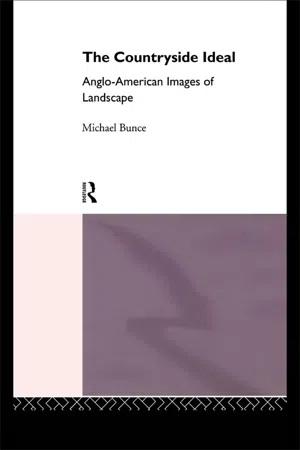
- 256 pages
- English
- ePUB (mobile friendly)
- Available on iOS & Android
eBook - ePub
About this book
1
THE MAKING OF AN IDEAL
Like all ideals, the modern countryside ideal is a creation of the society within which it has developed. It has been fashioned from the combination of historical processes and cultural values of the past three centuries, and must therefore be understood in terms of the evolving experience of metropolitan life. This chapter explores how pro-countryside sentiment has emerged with the rise of urban-industrialism, firstly through the transformation of rural-urban relationships and the respective economies and landscapes of country and city; and secondly through the development of philosophical, aesthetic and social responses to the urbanisation process itself.
THE RISE OF URBANISM
New cities, new countrysides
Modern sentiment for the countryside is the latest version of an ancient theme. From the fragmentary writings which survive from the city-states of Mesopotamia and Egypt we can identify a nostalgic interest in the differences between agricultural and non-agricultural people and a sense of urban separation from the natural world (Sorokin et. al. 1965). In ancient China agriculture was regarded as a superior activity to the commerce of cities. Although, according to Tuan (1974), Chinese scholarship wavered for two millennia between the attractions of city and country, Chinese society was obsessed by a recurrent fear that it would lose sight of its agrarian foundations. In classical Greece the dominance of cities in the Alexandrian Age produced a strong reaction against urban sophistication and a nostalgia for agrarian rusticity. Sentiment for the countryside became a significant philosophical ideal as well as a popular literary device. Hesiod and Xenophon’s regressive notions of an agrarian Golden Age and the idylls of Theocritus and the other rustic poets established the countryside as the metaphor for a pastoral other-world (Williams 1973). In Augustan Rome, literary pastoralism was matched by a growing interest in the countryside as a place of relaxation and pleasure. The poetic reaction against the city of the leading figures of the Roman pastoral tradition, Virgil and Horace, was derived as much from their experience as gentlemen farmers as from their imagination. Their Arcadian vision must be viewed in the context of their ability to retreat to their country estates (White 1977). This was a reaction to the increasingly crowded decadence of Rome which, with the imaginative pastoralism of literature, established the first broad tradition of urban perception of the countryside as an amenity.
While classical civilisation’s attitudes to the countryside reveal how educated society has responded over the longer span of history to the process of urbanisation, its links to the modern countryside ideal are tenuous. As we shall see in the next chapter, they exist primarily through neo-classical revivalism in art and literature rather than through historical continuity. The period which followed the demise of the Roman Empire marked a real break in the evolution of urban civilisation. Most of the European landscape remained thoroughly rural as well as being extensively unsettled. Nor did the emergence of the medieval city bring renewed sentiment in favour of the countryside. On the contrary, it was viewed by medieval urban society with a sense of urbane and scholarly detachment, which found expression in a general literary disdain for country life (Tuan 1974). The fact, too, that most of the population and much of the political and economic power of the times still resided in rural areas, and that towns were largely small and isolated places ensured that the notion of countryside as a pastoral contrast to urbanism could have little meaning.
As cities grew in size, power and frequency in the late Middle Ages, the distinction between rural and urban began to acquire renewed significance. The fifteenth century in Italy saw the rise of modern Europe’s first large cities. Centres of learning, progress and wealth, Venice, Florence and Sienna were culturally aloof from, and, to a degree, economically independent of the surrounding countryside. In design, too, they were uncompromising in their artificiality and in the clarity of their boundaries. Renaissance scholars continued the medieval disinterest in rural life, but the Renaissance did see the revival of classical pastoralism. The differences between city and country began again to be the metaphorical context for poetic and artistic images of artificiality and nature, while affluent and educated urbanites found pleasure in the rural landscape and the acquisition of country houses (Newton 1971). By the sixteenth century, these values were beginning to appear in English society. Indeed, it is in Tudor and Elizabethan England, the period of the so-called English Renaissance, that the conditions for the subsequent development of the Anglo-American countryside ideal begin to appear. Although England was still very much a rural nation, it was a nation undergoing fundamental changes. It was an age, especially towards the end of the century, marked by a great upsurge of capital investment in industry, agriculture and, above all, land (Merrington 1976). Not only did this hasten the breakdown of the feudalism which had governed rural society and economy for several centuries, but it also marked the beginnings of a transformation in the character of and the values associated with the English countryside.
At the heart of this was a rapid increase in investment in land and property. It was a period of great opportunism in the land market and of upward mobility in society which placed increasing amounts of land in the hands of country squires and yeoman farmers (Butlin 1982). Throughout the seventeenth century the influence of the landed gentry steadily increased. It has been estimated that by 1640 the middle and lesser gentry held about half of the land in England and Wales and the larger counties supported hundreds of gentry families (Cooper 1978). As the century progressed, an active land market and a growing number of marriage settlements concentrated ownership into fewer and larger estates. By 1700 large landowners controlled between 70 and 75 per cent of the cultivated land in England and Wales, while a century later their power is estimated to have extended to as much as 85 per cent of this land (Butlin 1982).
This was the major catalyst for the rise of capitalist modes of agricultural production, for what emerged from this process was a classic landlord-capitalist/tenant-wage labour structure (Merrington 1976). The small freeholders, copyholders and cottagers which made up the independent peasantry were gradually eased out by growing numbers of tenant farmers and a new class of rural proletariat. The transition from low to high rates of population growth at the end of the sixteenth century provided a stimulus to the steady growth of agrarian capitalism, which in turn became the basis for a transformation of agricultural production from largely subsistent to commercial objectives. New crops and new methods of livestock production foreshadowed the coming revolution in agricultural technology. Enclosure of the open field and the conversion of arable land to pasture were central issues in this process, for not only did this establish the conditions for further capitalisation of agriculture but it also directly threatened the security of the peasantry. Although displacement of the rural population by enclosure and conversion was not as widespread as observers of the time complained, it is clear that, from the 1580s onwards there was a sharp increase in the mobility of the rural population and a drift from agricultural to non-agricultural occupations (Chambers and Mingay 1966).
In the changes that occurred in seventeenth-century England, then, the essential preconditions for subsequent shifts in rural-urban relationships and hence in perceptions of the countryside were set. Central to this was a new social hierarchy of landlord, tenant farmer and labourer together with a new class of rural entrepreneurs to serve and exploit the agrarian economy. The controlling influence on the countryside, of course, was held by the landed gentry and the aristocracy. They occupied an influential position in both town and country, supporting their urban and industrial enterprises with the economic resources and political power of their country estates and in turn reinvesting the profits of commerce and industry in the countryside (Jones 1968). They also exercised enormous influence over rural society in their own counties and parishes. The country estate was a mark of prestige and a symbol of dynastic control. What was sought was that ‘mixture of enterprise, interest, rural pleasure and social prestige which the successful cultivation of a country estate brings’ (Humphreys 1964:24).
As estates spread across whole counties, the seventeenth– and eighteenth– century countryside came to be viewed, by cultured society at least, increasingly through the filter of the social order and gentrified lifestyles which these estates sustained. It is in early eighteenth-century England, in fact, that the word ‘countryside’ first comes into common usage as a reference to the amenity value of the rural landscape. For the landed classes it was associated with the sporting pleasures of hunting, shooting and fishing, and with a life of genteel ease in carefully landscaped surroundings. Fashionable country seats became part of the regular itinerary of a growing fad for touring the countryside (Ousby 1990). One of the more notable travellers was Daniel Defoe who, in his Tour through the Whole Island of Great Britain published in the 01720s extolled the virtues of a landscape which ‘shines with a lustre not to be described’ (in Humphreys 1964). The association by the landed classes of the countryside with aesthetic and recreational pleasure was also reflected in the popularity of pastoral literature and landscape painting which flourished largely through the patronage of the country estates which served as their favoured settings. In the England of the mid-eighteenth century, in the predominantly provincial Georgian England built upon two centuries of gentrification, with its wealth firmly planted in rural land and market towns, its progress measured by the spirit of improvement in agriculture and scenery and its society gauged through the ordered structure of parish and county, the idealisation of the countryside came largely from those who directly enjoyed its benefits, rather than from any significantly urban-based nostalgia.
Beneath this apparently serene rural order, however, lurked the forces of fundamental changes in economy and society. By the 1750s Britain was a predominantly market economy. It was the world’s leading trading nation, drawing its wealth from an expanding overseas market and its growing colonial possessions. This supported a flourishing domestic economy founded on commercial agriculture, small-scale industry and mining, all hooked into a network of market towns with London as the supreme centre of commerce. Although demographically still predominantly a rural nation, it was one in which virtually all vestiges of a peasant economy had disappeared. In its place had emerged not only capitalist systems of agricultural production, but also an increasingly diversified rural economy based upon the processing and trading of agricultural commodities as well as the local manufacturing of agricultural implements, household articles and other trappings of an increasingly affluent society. In this economy lay the pre-conditions for the industrial revolution: the creation of domestic capital, innovations in transportation necessitated by the growth in internal trade, the production of food as well as consumer and capital goods (such as textiles and building materials), and the establishment of a growing domestic market organised through a monetary system of exchange (Hobsbawm 1968). Above all it created out of a growing body of landless labourers the proletariat which was necessary for the establishment of industrial capitalism (Merrington 1976). For much of the eighteenth century this proletariat was sustained by the growth of the rural economy itself. Yet, with the general increase in population growth which came after 1750, the ability of this economy to absorb an expanding labouring population steadily diminished (Mathias 1969). The consequences were widespread rural poverty and distress towards the end of the century which, despite the settlement laws which were supposed to tie people to their home parishes for the purposes of poor relief, led to a significant increase in the mobility of the rural proletariat (Dunford and Perrins 1983).
Far from being imposed upon the countryside by the unseen and unwelcome hand of technology, then, the urban-industrial system emerged to a great extent out of the changing structure of the rural economy itself. Of course, the direct catalysts for the transformation of Britain from a rural and agricultural nation to a predominantly urban and industrial one were the technological innovations and capital investments which created the industrial system. The huge labour demands of factory production and mining readily absorbed the surplus rural population. By the middle of the nineteenth century, over 40 per cent of the working population was engaged in mining, manufacturing and construction and a further 14 per cent in trade and transportation. At the same time the proportion engaged in agriculture and related occupations dropped from an estimated 75 per cent of the population in 1750 (Mathias 1969), to just over 21 per cent in 1851 (Pollard and Crossley 1968).
By the middle of the nineteenth century Britain had become a thoroughly industrial nation, leading the world in manufacturing and trade. In the process it became the first predominantly urbanised nation. With the industrial revolution’s dependence on large concentrations of labour and materials came phenomenal rates of increase in both the size and the number of large cities. Up to the mid-eighteenth century, only London and Edinburgh had more than 50,000 inhabitants (Hobsbawm 1968) and, with a population of over 600,000, only London approached the scale and the conditions of the modern city. By the beginning of the nineteenth century there were eight cities with a population of over 50,000. At mid-century this number had grown to 29, including nine of over 100,000. By century’s end Britain had 30 cities with populations of more than 100,000 (Weber 1899). Urban rates of population growth exceeded 20 per cent in each decade between 1801 and 1851, and reached almost 30 per cent a decade between 1811 and 1831. What is particularly notable about British urbanisation, however, is how comprehensively the demographic emphasis shifted from rural to urban during the nineteenth century. As the urban share increased from a third of the national total at the beginning of the century to over three-quarters by the end, whole rural areas experienced absolute depopulation (Saville 1957).
Although the drift from the land continued until well into this century, the urbanisation and industrialisation of Britain was almost complete by 1900. Across the Atlantic, of course, this transformation began and was completed somewhat later. Yet the European settlement of North America emerged out of the very changes which have been described above. By the time of American independence commercial, if not industrial, cities were already the established model for economic growth. Jefferson could dream of an agrarian republic, but the reality was that America had to compete with an increasingly urban and industrial Europe. And so, although the continued spread of settlement westwards guaranteed high levels of rural and agricultural population growth throughout the nineteenth century, urbanisation took hold equally strongly in the east. Most of this growth did not begin until after 1830 (Hahn and Prude 1985). Over the next hundred years, however, both the USA and Canada became predominantly urban nations. In the USA, the number of cities of over 100,000 grew steadily from five in 1830 to almost 100 by the time rates of urbanisation began to level off in 1930, while the overall urban population grew from 15 per cent of the national total to over 60 per cent (Monkonnen 1988). In Canada, although clearly the number of large cities which could develop was far smaller, the general rates of urban growth closely mirrored those in the USA (Stone 1967). In both countries urbanisation was closely linked to national growth, and thus to an expanding agrarian economy. Indeed until after the Civil War, it was trade rather than manufacturing which supported the growth of larger cities (Glaab and Brown 1976). However, the rapid urban growth that occurred after 1860 resulted from a steady increase in the movement of people from Europe and from the North American countryside itself into an expanding industrial system.
Urban society and the countryside
Viewed in simple terms, the idealisation of the countryside was an inevitable consequence of the urban-industrial revolution. Certainly it involved rapid and profound changes in society, economy and landscape, a process which at its nineteenth-century height ensured virtually continuous turmoil and instability. What better conditions could there be for the development of nostalgia for the countryside? Yet the countryside ideal cannot be explained simply as a nostalgic reaction to urbanisation. Rather we must see it as an ideal which has emerged from the very nature of modern urbanism itself. Urbanisation established four basic conditions for the nurturing of the countryside ideal. It produced the social structures and experiences within which attitudes towards the country and the city could develop. It created a political economy which redefined rural-urban relationships. It sustained the intellectual and cultural climate in which ideas about the country and the city could flourish. And, finally, it forged the landscapes and living environments around which differential values have formed.
With the massive shifts of people from agricultural to industrial occupations and from rural to urban living came fundamental changes in the general structure of society. As we have seen, the traditional and largely static hierarchical relationships which are conventionally associated with pre-industrial society were already beginning to break down in the period leading up to the industrial revolution. And in colonial North America the very process of agricultural settlement was founded on a rejection of the old European rural order. Yet as industrial systems of production and employment became dominant and thus drew an ever larger proportion of the population into cities, the breakdown of the old social order was rapid and complete. With urban capitalism society was increasingly organised along horizontal, rather than hierarchical lines, within homogenised groupings which divided people into new and simplified class categories.
For the proletarian masses the shift from country to city, and especially from agricultural to industrial employment destroyed a whole way of life. This has been widely studied and discussed by historians (notably Hobsbawm 1968 and Thompson 1968). Briefly summarised, it involved the replacement of the paternalistic ties of the agrarian order with the anonymity and insecurity of industrial wage-labour. It substituted the natural rhythms of farmwork and country life with the time and work discipline of the factory system. The interdependent relationships and conventions of the extended family and of the rural community were replaced by the autonomous nuclear family and individual action. In short, individuals and families were left very much to their own devices in a system which had no rules save those of the market place. As Hobsbawm (1968) has put it, ‘pre-industrial experience, tradition, wisdom and morality provided no guide for the kind of behaviour which a capitalist economy required’ (87). Although these generalisations are taken from analyses of British urbanisation, they are equally applicable to the working-class experience in North American cities. Drawn in huge numbers from the rural and new industrial backgrounds of Europe, and, as time progressed, from the continent’s own rural communities, the polyglot of immigrants to the factories and tenements of New York, Baltimore, Philadelphia, Chicago, Montreal and the like faced the same social disruption as their British counterparts (Thernstrom 1973; Ward 1971).
While the move to the city was clearly a socially disruptive process for the working-class masses, it is less easy to determine to what extent this disruption generated nostalgia for the countryside. In the first place, the sentiments of the common people generally are not expressed in recorded form. Secondly, we have to recognise that the business of surviving the social dislocation and poverty of the new environment would have made nostalgia a luxury for most urban immigrants. Moreover, we should be cautious of assuming that for the working classes, urban life was inherently worse than rural. After all, the the old rural order contained its own exploitation and misery, from which the city offered the only escape. On the whole people were better off, at least in material terms, as urban rather than rural workers, especially as the labour needs of agriculture diminished. Nevertheless, as Gans (1982) has shown, working people, especially in the immigrant neighbourhoods of American cities, did attempt in community and familial relationships to re-create some of the elements of their rural origins. Furthermore, as later chapters will reveal in greater detail, they were quick to seek relief from the pressures of urban living in parks and in brief excursions to hike and picnic in the surrounding countryside, especially when public transportation became more widely accessible.
The principal contribution of the working classes to the development of a countryside ideal, however, was not so much through any direct reaction to their own urban and industrial experience as through their relative position in the urban class structure. The formation of a large urban proletariat was inextricably linked with the rise of the middle class; of the entrepreneurs, bankers, lawyers and other professionals who financed and managed the new industrial system which sustained (and, of course, was sustained by) the influx of the masses. It was within this new bourgeoisie, which had already begun to appear as a social and economic force in pre-industrial Britain, that the seeds of reaction to urbanisation and the concomitant sentiment for the countryside were sown.
In common with bourgeois society in general, the middle classes which emerged out of the urbanisation of both Britain and North America were defined by their wealth, status and respectability. Their first concern, therefore, was to express their position by separating themselves, socially and spatially, from the working classes. Initially this took the form of a shift from the usual pre-industrial arrangement of employer and family living on or near the place of business,...
Table of contents
- COVER PAGE
- TITLE PAGE
- COPYRIGHT PAGE
- THE COUNTRYSIDE IDEAL
- PLATES
- PREFACE
- ACKNOWLEDGEMENTS
- INTRODUCTION
- 1: THE MAKING OF AN IDEAL
- 2: THE ARMCHAIR COUNTRYSIDE
- 3: A PLACE IN THE COUNTRY
- 4: THE PEOPLE’S PLAYGROUND
- 5: THE COUNTRY IN THE CITY
- 6: THE COUNTRYSIDE MOVEMENT
- 7: REFLECTIONS
- SUGGESTED FURTHER READING
- BIBLIOGRAPHY
Trusted by 375,005 students
Access to over 1.5 million titles for a fair monthly price.
Study more efficiently using our study tools.
Frequently asked questions
Yes, you can cancel anytime from the Subscription tab in your account settings on the Perlego website. Your subscription will stay active until the end of your current billing period. Learn how to cancel your subscription
No, books cannot be downloaded as external files, such as PDFs, for use outside of Perlego. However, you can download books within the Perlego app for offline reading on mobile or tablet. Learn how to download books offline
Perlego offers two plans: Essential and Complete
- Essential is ideal for learners and professionals who enjoy exploring a wide range of subjects. Access the Essential Library with 800,000+ trusted titles and best-sellers across business, personal growth, and the humanities. Includes unlimited reading time and Standard Read Aloud voice.
- Complete: Perfect for advanced learners and researchers needing full, unrestricted access. Unlock 1.5M+ books across hundreds of subjects, including academic and specialized titles. The Complete Plan also includes advanced features like Premium Read Aloud and Research Assistant.
We are an online textbook subscription service, where you can get access to an entire online library for less than the price of a single book per month. With over 1.5 million books across 990+ topics, we’ve got you covered! Learn about our mission
Look out for the read-aloud symbol on your next book to see if you can listen to it. The read-aloud tool reads text aloud for you, highlighting the text as it is being read. You can pause it, speed it up and slow it down. Learn more about Read Aloud
Yes! You can use the Perlego app on both iOS and Android devices to read anytime, anywhere — even offline. Perfect for commutes or when you’re on the go.
Please note we cannot support devices running on iOS 13 and Android 7 or earlier. Learn more about using the app
Please note we cannot support devices running on iOS 13 and Android 7 or earlier. Learn more about using the app
Yes, you can access The Countryside Ideal by Michael Bunce in PDF and/or ePUB format, as well as other popular books in History & Art General. We have over 1.5 million books available in our catalogue for you to explore.