1 The Freeze-Drying of Pharmaceutical Products
Introduction and Basic Concepts
Davide Fissore, Roberto Pisano, and Antonello Barresi
Contents
- 1.1 Introduction
- 1.2 Freeze-Drying Equipment
- 1.3 Process Objectives and Constraints
- 1.4 Mathematical Modelling and Process Design
- 1.5 Open Issues
- 1.5.1 Formulation Design
- 1.5.2 Process Monitoring and Control
- 1.5.3 Small-Scale Freeze-Dryers
- 1.5.4 Continuous Freeze-Drying
- 1.5.5 Equipment Design
- References
1.1 Introduction
Freeze-drying (or lyophilization) is a key step in the production process of several pharmaceutical products as it allows recovering an active pharmaceutical ingredient from a liquid solution at low temperature; this increases the shelf-life of the product and preserves critical product quality attributes because the process is carried out at low temperature and the drugs are generally thermolabile molecules (Jennings 1999; Mellor 2004; Oetjen and Haseley 2004; Fissore 2013).
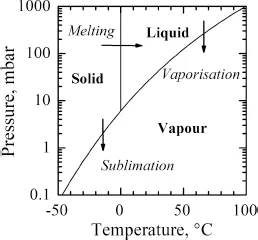
In a freeze-drying process the product temperature is lowered to a value well below the water freezing point. In this way most of the water, the so-called “free water,” turns into the frozen stage (see Figure 1.1), while part of the water remains bound to the product molecules.
Then, chamber pressure is lowered to a value well below the water triple point: in this way the ice may sublimate (primary drying) if heat is supplied to the product, because sublimation of the ice is an endothermal process. Finally, the target value of residual moisture in the final product is obtained by removing (most of) the bound water (secondary drying). In this stage product temperature is further increased with respect to the value reached during primary drying, as chamber pressure may be reduced, although some studies evidenced no improvements when secondary drying is carried out at a very low pressure (Pikal et al. 1980). The freeze-drying equipment, the objectives and the constraints of the process, the role of mathematical modelling and the open issues are briefly presented and discussed in the following sections.
Figure 1.1Water phase diagram.
1.2 Freeze-Drying Equipment
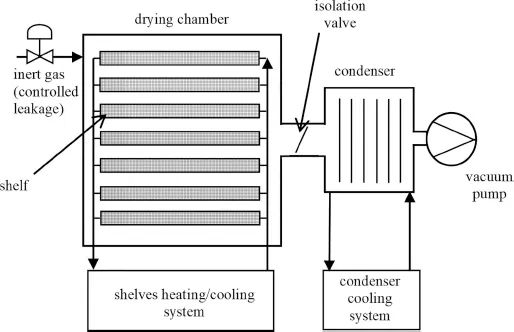
Figure 1.2 shows a sketch of a batch freeze-dryer, representing the current standard equipment used to carry out the freeze-drying of a pharmaceutical product (Oetjen and Haseley 2004).
The liquid solution containing the active pharmaceutical ingredient and the excipients (buffers, bulking agents, etc.) is poured into glass vials that may be loaded directly onto the shelves of the drying chamber or through trays that are placed onto the shelves. As both the ice sublimation (primary drying) and water desorption (secondary drying) are endothermic processes, it is necessary to supply heat to the product, and this is done through a hot fluid flowing inside the shelves. Therefore, the use of a tray, although it can make the loading/unloading of the vials easier, increases the resistance to heat transfer from the heating fluid, which results in a lengthening of the drying process. As an alternative, bulk freeze-drying may be carried out by filling a tray with the liquid solution; in this case at the end of the process the powder has to be collected and further processed to prepare the unit doses.
Before being loaded in the drying chamber the liquid product may be frozen in separate equipment, although the standard approach is to freeze the liquid solution directly in the drying chamber. To this purpose, the temperature of the fluid flowing inside the shelves of the freeze-dryer is lowered, down to −40/−50°C, in such a way that the “free” water may turn into the frozen state. In some cases, controlled nucleation techniques may be used, aiming at inducing the nucleation of the ice crystals in the vials at the same time (and temperature), thus obtaining a more uniform ice crystal size (Searles et al. 2001). In fact, after sublimation, the size of the empty spaces in the dried product corresponds to the size of the ice crystals, and a uniform structure of the dried product allows reduction of the intra-vial variability. Several techniques are currently available to induce nucleation at the same time in all the vials of the batch (and will be discussed in greater detail in Chapter 6):
Figure 1.2Scheme of a batch freeze-dryer.
- The “ice fog” technique: ice crystals are formed in the drying chamber when a flow of nitrogen at very low temperature is introduced in the humid drying chamber (Patel et al. 2009). As an alternative, the ice fog may be obtained in the condenser where a certain amount of water is atomized, provided that the temperature of the condenser has been lowered (Ling 2011; Thompson 2013; Wollrath 2019). Once the ice crystals are obtained, they enter the vials, causing nucleation. The main concern of this technique is related to obtaining a uniform distribution of the ice crystals in the chamber, in such a way that ice nucleation occurs effectively at the same time in all the vials.
- Ultrasonic vibrations (at frequencies above 10 kHz): they can cause the formation of small-size gas bubbles that rapidly grow and collapse. This causes very high pressure and temperature fluctuations that induce ice nucleation (Morris et al. 2004; Nakagawa et al. 2006)
- Pressurization/depressurization: Konstantinidis et al. (2011) proposed a method based on the creation of a pressure fluctuation as a method to induce ice nucleation. The chamber of the freeze-dryer, after vials loading, is pressurized with argon to about 2.80–2.95 bar (26–28 psig) at the beginning of the run. Then, when the target nucleation temperature is reached, the pressure is rapidly reduced to almost atmospheric pressure (about 1 psig) to induce nucleation.
- Vacuum-induced surface freezing: when the desired nucleation temperature is reached, chamber pressure is reduced for a short time interval. This causes water evaporation at the top of the product and causes ice nucleation (Kramer et al. 2002; Liu et al. 2005; Oddone et al. 2014).
Water vapor produced in the drying chamber flows to the condenser, where the low temperature of the condenser surface promotes vapor frosting. A critical issue is represented by size of the duct connecting the drying chamber to the condenser, as sonic flow may be reached, resulting in a loss of pressure control in the chamber.
With respect to pressure control in the drying chamber, a vacuum pump, connected to the condenser, is generally used, although in some cases a flow of nitrogen, or other inert gas, in the drying chamber (controlled leakage) may be used to get a tighter control of chamber pressure.
1.3 Process Objectives and Constraints
Although it is considered a “gentle” process toward the product, the freeze-drying process may compromise the quality of the final product. One of the main constraints that must be respected is the temperature of the product. Each formulation being processed is in fact characterized by a threshold temperature that should not be trespassed during the process. In the case of amorphous products, this limit value is related to the temperature causing the collapse of the dried product (Pikal 1994). Collapse results in a blockage of the pores, thus increasing the resistance of the dried product to vapor flow and increasing the duration of the process. Moreover, it may be responsible for a higher residual amount of water in the product at the end of the process, for a higher reconstitution time, and, in some cases, for the activity loss of the drug (Bellows and King 1972; Tsourouflis et al. 1976; Adams and Irons 1993; Wang et al. 2004). Finally, a collapsed product is generally rejected owing to the unattractive physical appearance. In the case of crystalline products, the limit temperature corresponds to the eutectic temperature, to avoid the formation of a liquid phase.
When dealing with product temperature one must bear in mind that the vials of a batch do not experience the same dynamics throughput the drying process. This is due to several reasons, such as non-uniform heating conditions in the drying stages (for example, due to radiation from chamber walls) and pressure gradients in the drying chamber (Rasetto et al. 2010). In addition, the freezing stage, when no controlled nucleation is used, also may be a cause of non-uniformity in the drying stages, as the non-uniform inter-vial cake structure is responsible for a non-uniform sublimation flux among the vials.
The main goal of the process is thus to keep product temperature below the limit value in all the vials of the batch. In addition to this, the duration of the process must be minimized, as the freeze-drying process of a given product may be a very long process over time.
In addition to product temperature, the equipment is also a constraint. The condenser capacity has to be compatible with the sublimation rate, and, above all, the water vapor flux from the chamber has to be lower than the value for which there is sonic flow in the duct (Searles 2004; Patel et al. 2010; Fissore et al. 2015; Marchisio et al. 2018).
1.4 Mathematical Modelling and Process Design
To meet the goals and the constraints previously listed, the operating conditions of the drying process, namely the values of the temperature of the fluid flowing inside the shelves (or, what is the same, the temperature of the heating shelf) and of the pressure in the drying chamber ...