eBook - ePub
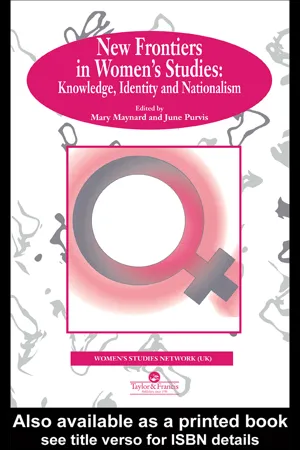
New Frontiers In Women's Studies
Knowledge, Identity And Nationalism
- 259 pages
- English
- ePUB (mobile friendly)
- Available on iOS & Android
eBook - ePub
About this book
This text reveals the diversities which continue to shape women's beliefs and experiences. It includes debates on women and nationalisms, women and social policy, sexuality, black studies and ethnic studies, women and education, women and cultural production and women's studies and gender studies.
Information
Publisher
Taylor & FrancisYear
2005Print ISBN
9780748402885
9780748402878
Edition
1eBook ISBN
9781135747053
Section I
On the Move: New Agendas for Women’s Studies
Chapter 1
Challenging the Boundaries: Towards an Anti-racist Women’s Studies
Mary Maynard
Introduction
Much has been written criticizing the cosy assumptions that all women could be defined in terms of the things they experienced and shared in common, which characterized the early stages of Women’s Studies publishing and teaching (Bhavnani, 1993; Collins, 1990; Frye, 1983; hooks, 1982, 1984, 1989, 1991; Lorde, 1984, Ramazanoglu, 1989). The one-dimensional notions of oppression being employed at that time took for granted that such oppression had the same meanings and occurred through similar processes and mechanisms for all women. Of course, there were different kinds of feminist theories explaining the nature of gender oppression and offering different political programmes for challenging this. Each, however, appeared to assume that its framework had worldwide relevance and applicability. As Audre Lorde summed up, ‘[b]y and large…white women focus upon their oppression as women, and ignore differences of race, sexual preference, class and age. There is a pretence to a homogeneity of experience covered by the word sisterhood that does not in fact exist’ (Lorde, 1984, p. 114).
This chapter focuses on issues of race and racism in Women’s Studies. It questions how far white feminists in the West have really heard and taken to the heart of our agenda the criticisms raised about both our subject matter and how this is approached. The first section, ‘Challenging White Women’s Studies’, considers some of these criticisms, arguing that in the main there has been a fairly tokenistic response. The second section, ‘Issues of Race and Racism in Women’s Studies’, focuses on several issues which might be regarded as currently hindering the development of an anti-racist approach. These relate to the unproblematized use of the concept of difference, a focus on multiculturalism rather than racism, a tendency towards cultural relativism and the effects of cultural imperialism. The third section, ‘Facing the Challenge’, suggests some ways in which the process of developing an anti-racist perspective for Women’s Studies might be taken forward. The chapter finishes with a few brief concluding remarks.
Challenging White Women’s Studies
Challenges to the idea of a universal sisterhood, to be found in Women’s Studies and feminism more generally, came from a variety of sources, although many originated from Black women in the US and Britain.1 Black women pointed to the ways in which Women’s Studies spoke only of a white, Western, largely middle-class world and the extent to which they were invisible in much of the literature. Women’s Studies, they argued, had suppressed the ideas of Black women, so that few of these managed to find their way into mainstream debate (Amos and Parmar, 1984; Collins, 1990; hooks, 1982, 1984). Women from the (so-called) Third World also pointed to the differentiation and variation in women’s economic and social experiences in a wide range of societies other than those of ‘advanced’ industrial countries. This work underscored the plurality of meanings in women’s lives of phenomena such as family, work, nation and citizenship. It also pointed to the consequences for women of being involved in national and liberation struggles, thus illuminating and extending the critique which Black Western women had mounted.
Some of the specific criticisms that were made of Women’s Studies can be set out as follows. One charge, for instance, was that Women’s Studies was racist. Racism is usually taken to refer to those beliefs, statements and acts which assume that certain ethnic groups are intrinsically inferior and which are used as a basis for denying rights or equality (Anthias and Yuval-Davis, 1992; Essed, 1991). Moreover, as Anthias and Yuval-Davis have implied, intention cannot be a criterion in adjudicating racism. They write:
Our view is that all those exclusionary practices that are formulated on the categorization of individuals into groups whereby ethnic or ‘racial’ origin are criteria of access or selection are endemically racist. Further, our view is that racist practices are also those whose outcome, if not intention, is to work on different categories of the population in this way. (Anthias and Yuval-Davis, 1992, p. 16)
The focus on white women’s experiences, to the virtual exclusion of Black and Third World women’s lives, in early Women’s Studies work constitutes a form of racism, as does the tendency to develop concepts, theories and explanations which are both limited and partial. Such ‘erasure’ is racist since it is only possible because of the existence of underlying power relations based on racial privilege (Bhavnani, 1993). These normalize the concerns of certain white women and turn them into what is routinely expected, prioritized and, therefore, unquestioned about Women’s Studies scholarship. Thus it is in the silences, the absences and the omissions—in what is not said as much as what is—that the racism of Women’s Studies is to be found.
Another charge which has been levied by Black and Third World women, one associated with that of racism, is that Women’s Studies tends to be ethnocentric. This can take two forms. Ethnocentrism occurs when one’s indigenous culture is unproblematically taken for granted as the main focus for study and when other cultures are judged and evaluated according to criteria which are specific to one’s own. So, for example, not only has Women’s Studies tended to ignore the circumstances of non-white women who live in their midst, it has also disregarded those who live in different parts of the world. Certainly, there is a strong gender dimension and a forceful feminist presence in work undertaken as part of development studies. But, sadly, this material would appear to be treated as marginal in most Women’s Studies texts and courses. Despite many excellent books addressing the situation of women in different parts of the ‘developing’ world, this is still not treated as ‘mainstream’ literature. Development issues, when considered at all, are sidelined into optional courses in academic programmes. A decade ago, in an article that has recently been reprinted, June Jordan (1995, p. 27) remarked that ‘most of the women of the world persist far from the heart of the usual Women’s Studies syllabus’. Ten years later Chandra Mohanty (1991, p. 54) writes about the ‘overwhelming silence about the experiences of women in these countries’. Even when the latter are included, there is the danger that they will be presented in stereotypical ways, with emphasis given to what, from a white Western perspective, appears particularly exotic or culturally bizarre. This, in part, explains early concerns about the process of veiling, arranged marriages and purdah. Further, as Mohanty has pointed out, Western feminist work on women in the Third World’ has a tendency to imply that the latter passively experience a singular, monolithic and homogenous oppression. This in turn leads to the construction of an ‘average Third World woman’.
This average Third World woman leads an essentially truncated life based on her feminine gender (read: sexually constrained) and her being ‘Third World’ (read: ignorant, poor, uneducated, tradition-bound, domestic, family-oriented, victimized, etc.). This, I suggest, is in contrast to the (implicit) self-representation of Western women as educated, as modern, as having control over their own bodies and sexualities, and the freedom to make their own decisions. (Mohanty, 1991, p. 56)
This kind of ethnocentrism, as de Groot indicates in her chapter for this book, ‘otherizes’ women in different parts of the world, treating their lives as ‘data’ or ‘evidence’ upon which Western commentators can impose their own analysis and commentary.
Women’s Studies has also been criticized in the past for adopting an additive approach to studying the interconnections of race and gender (Brittan and Maynard, 1984). The additive model implies that race merely increases the degree of inequality and oppression which non-white women experience as women. But, just as it has been argued that gender cannot be simply added on to class analysis, so too it is mistaken merely to add race on to existing analyses of gender. This is because race does not just make the experience of women’s subordination greater. It qualitatively changes the nature of that subordination. Black women are not simply subjected to more disadvantages than white women. Rather, their oppression, because of racism, is of a qualitatively different kind. Positing the relationship between race and gender in terms of adding them to each other also overlooks any social structural connections which they might have. Further, it detracts from an understanding of how different configurations of race and gender (and we might add here other forms of diversity, such as age, sexual orientation and class) develop and what the overall implications of this might be.
The additive model also tends to treat race only as a source of oppression, constructing those affected by it as victims and ignoring how the adoption of a racial or ethnic identity can be a source of celebration, support, resistance and pride. It also classifies people into dichotomized categories, such as either Black or white, oppressor or oppressed. This makes race appear to be a fixed category, rather than one which is socially constructed and whose meaning changes over time (Anderson and Collins, 1995b). Such an approach also overlooks how an individual or group may be privileged by one factor, say race, at the same time as being disempowered by another, say gender. A further problem with the adding-in model is the implication that race is an issue only for those groups whose racialization is either clearly visible or explicitly acknowledged. But race is not the kind of minority experience that this assumes. As Haleh Afshar and I have pointed out elsewhere, not only do the majority of the world’s peoples live in situations where ascriptions about race are defining features in their lives, it is also the case that to be labelled ‘white’ is also to be allotted a racial category, albeit one which is privileged, relatively unanalysed, taken for granted and itself a ‘minority’ status (Afshar and Maynard, 1994).
Now this presents, in a fairly schematic form, some of the issues relating to race with which Western Women’s Studies has been grappling over the past decade. Indeed, it would be true to say that a certain amount of progress has been made. Race is now discussed as a significant component of feminist analysis and other disciplines have begun borrowing from the insights it has developed. More work by Black feminists has appeared in print (Bhavnani and Phoenix, 1994; Collins, 1990; Essed, 1991; James and Busia, 1993). There is some evidence that the scope of feminist scholarship is being re-thought in terms of shifting both its focus and its emphasis (de Groot, Chapter 2, this volume). However, there certainly is no room for complacency about any of these developments. In many ways a concern for race and for racism remains at the level of rhetoric alone in a great number of Women’s Studies projects. To profess an interest in racial matters is the trendy, ‘politically correct’ and ‘done’ thing to do. How far this has, in reality, affected the general agenda of what is still, in the main, white Women’s Studies scholarship is more difficult to ascertain. In the following section I address some of the issues which appear to be responsible for hindering progress and for the tokenism which ensues.
Issues of Race and Racism in Women’s Studies
The Concept of Difference
One major problem with how Women’s Studies and feminism more generally have discussed issues about race is that it tends to be done by using the concept of ‘difference’. There are two main connotations of difference, drawing on feminist concerns with experience and post-modern perspectives, although what makes each appealing is surprisingly similar (Maynard, 1994). The concept of difference has been regarded as important by feminists because of its potential for emphasizing the diversity of women’s lives. Its focus on heterogeneity and its implicit critique of universal statements and grandiose theoretical frameworks have made it a very useful tool in challenging the essentialism and ideas about a shared sisterhood which characterized the early Women’s Studies literature. A focus on difference, which variously includes factors relating to class, region, sexuality, religion, disability and age, as well as race and ethnicity, draws attention to the unquestioned dualism and oppositionalism in the Black-versus-white and male-versus-female approaches. It subverts the unity and meaning of terms such as ‘race’, ‘Black’, ‘oppression’, ‘patriarchy’ and ‘woman’, with the implication that these kinds of categories are too internally differentiated to be useful.
This, in turn, has led to a concern for subjectivity and the fragmentation of identity. bell hooks (1991), for example, has argued for the need to reformulate outmoded notions of identity, which are often narrow and constricting in the ways in which they relate ideas of ‘Blackness’ only to colonial and imperialist paradigms. Similar arguments have been made about the deterministic and stereotyped definitions of womanhood and femininity, wi...
Table of contents
- Cover Page
- Half Title page
- Feminist Perspectives on The Past and Present Advisory Editorial Board
- Title Page
- Copyright Page
- Contents
- Acknowledgements
- Introduction New Frontiers in Women's Studies
- Section I On the Move: New Agendas for Women's Studies
- Chapter 1Challenging the Boundaries: Towards an Anti-racist Women's Studies
- Chapter 2 Anti-colonial Subjects? Post-colonial Subjects? Nationalisms, Ethnocentrisms and Feminist Scholarship
- Chapter 3 What Happened to Feminist Politics in ‘Gender Training'?
- Chapter 4 The Political and the Personal: Women's Writing in China in the 1980s
- Chapter 5 Reassessing Representations of Emmeline and Christabel Pankhurst, Militant Feminists in Edwardian Britain: On the Importance of a Knowledge of our Feminist Past1
- Chapter 6 Gender, Nation and Scholarship: Reflections on Gender/Women's Studies in the Czech Republic
- Chapter 7 Possibilities for Women's Studies in Post communist Countries: Where Are We Going?
- Section II Women in Movement: Identity, Migration and Nationalism
- Chapter 8Resituating Discourses of ‘Whiteness' and ‘Asianness' in Northern England: Second-generation Sikh Women and Constructions of Identity
- Chapter 9 Women Who Move: Experiences of Diaspora
- Chapter 10 The Home of Our Mothers and Our Birthright for Ages'? Nation, Diaspora and Irish Women
- Chapter 11 Boundary Politics: Women, Nationalism and Danger
- Chapter 12 Gender, Colonialism and Nationalism Women Activists in Uttar Pradesh, India
- Chapter 13 East German Women Five Years after the Wende
- List of Contributors
- Index
Trusted by 375,005 students
Access to over 1.5 million titles for a fair monthly price.
Study more efficiently using our study tools.
Frequently asked questions
Yes, you can cancel anytime from the Subscription tab in your account settings on the Perlego website. Your subscription will stay active until the end of your current billing period. Learn how to cancel your subscription
No, books cannot be downloaded as external files, such as PDFs, for use outside of Perlego. However, you can download books within the Perlego app for offline reading on mobile or tablet. Learn how to download books offline
Perlego offers two plans: Essential and Complete
- Essential is ideal for learners and professionals who enjoy exploring a wide range of subjects. Access the Essential Library with 800,000+ trusted titles and best-sellers across business, personal growth, and the humanities. Includes unlimited reading time and Standard Read Aloud voice.
- Complete: Perfect for advanced learners and researchers needing full, unrestricted access. Unlock 1.5M+ books across hundreds of subjects, including academic and specialized titles. The Complete Plan also includes advanced features like Premium Read Aloud and Research Assistant.
We are an online textbook subscription service, where you can get access to an entire online library for less than the price of a single book per month. With over 1.5 million books across 990+ topics, we’ve got you covered! Learn about our mission
Look out for the read-aloud symbol on your next book to see if you can listen to it. The read-aloud tool reads text aloud for you, highlighting the text as it is being read. You can pause it, speed it up and slow it down. Learn more about Read Aloud
Yes! You can use the Perlego app on both iOS and Android devices to read anytime, anywhere — even offline. Perfect for commutes or when you’re on the go.
Please note we cannot support devices running on iOS 13 and Android 7 or earlier. Learn more about using the app
Please note we cannot support devices running on iOS 13 and Android 7 or earlier. Learn more about using the app
Yes, you can access New Frontiers In Women's Studies by Mary Maynard,June Purvis in PDF and/or ePUB format, as well as other popular books in Social Sciences & Gender Studies. We have over 1.5 million books available in our catalogue for you to explore.