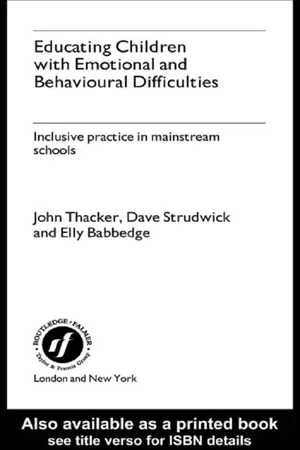
Educating Children with Emotional and Behavioural Difficulties shows that it is possible for schools to provide inclusive education for children with social and emotional difficulties without jeopardising the well-being and progression of the children or compromising the academic standing of the school. Using a case-study approach, the importance of school leadership, organisational culture and classroom strategies for working with troubled individuals and their families is also emphasised. The authors also draw attention to the fact that teachers need to recognise and take account of the effect of the neighbourhood, family, educational history and their own viewpoints on a young child's emotional and social development.
eBook - ePub
Educating Children with Emotional and Behavioural Difficulties
Inclusive Practice in Mainstream Schools
- 168 pages
- English
- ePUB (mobile friendly)
- Available on iOS & Android
eBook - ePub
Educating Children with Emotional and Behavioural Difficulties
Inclusive Practice in Mainstream Schools
About this book
Information
Chapter 1
Educational approaches to children with EBD
History of educational approaches
In this chapter we will look at the ways in which emotionally and behaviourally disturbed children have been seen over the past century and this includes the changing social factors and educational ‘fashions’. Presently dominant positions, including our own, show a stress on the importance of the context, where the child is seen as embedded in networks of relationships which create meaning, and where understanding is aided by considering all the elements in these networks. This view is the systemic (often called ecosystemic) perspective in the literature. In this approach, problem behaviour is seen as an emergent property of a situation that includes the child and the family in the community as well as the behaviour of the teachers and the influences of the school environment. It is no longer seen, simplistically, as behaviour for which the child is totally responsible or which results from a condition which the child ‘has’, like some illness. There has been a broad swing from a medical approach towards a more educationally based approach. However, it should not be forgotten that to conceptualise the child as needing medical help implied a non-punitive therapeutic approach which was, in its day, a real advance over former views of the child. In these the child was seen as being ‘wicked’ or as having ‘bad blood’ or possessed by some demon and in need of strict correction, punishment or even exorcism.
Along with the medical view, which developed in the early years of the twentieth century, the focus of ‘treatment’ moved out of the mainstream educational context and the early methods were deployed in residential provision. The terminology of the time was of ‘maladjustment’ as a category of handicap. This was defined in the 1945 regulations (Ministry of Education, 1945) as children showing ‘evidence of emotional instability or psychological disturbance’ which required 'special educational treatment in order to effect their personal, social or educational readjustment’. In keeping with this medical emphasis, the provision was made through doctors and on to psychiatrists working in child guidance clinics. This whole system has been likened to an ‘out-patients’ department of the medical model with the special schools acting something like an observation ward! Again, without stretching the comparison too far, the role of educational psychologists in testing, the role of psychiatric social workers in counselling families and the role of teachers in providing reports on behaviour all fitted in neatly with the concept of the medical team. Children would be ‘ascertained’ as maladjusted by the psychiatrist, their progress would be regularly assessed at case conferences presided over by the psychiatrist, and, if sufficient progress had been made, the decision to ‘deascertain’ and readmit to the mainstream of education would be made by the psychiatrist. There is no wonder that the whole process was seen as one of outside experts taking the child out of the normal educational provision which, by implication, made it appear that the ordinary classroom teacher did not have the resources to deal with the problem.
In 1955 there were only thirty-six state schools for maladjusted pupils and these were much influenced by the freedom of expression models in education and drew on psychotherapeutic ideas, only looking to classroom experience as source material (see, for example, Lennhoff, I960; Shaw, 1965; Burn, 1964). Problem behaviour was seen resulting from failures of early experience and so the emphasis was on building relationships before building educational skills.
This may be seen in the following quote from David Wills: ‘There are many pathological conditions which, given a warm, restful, non-provocative environment can be self-healing. Many forms of maladjustment are of that kind, and the children will heal themselves if only people will stop ‘‘doing things’’ to them’ (Wills, 1960, p. 19).
This led to the idea of ‘milieu therapy’ where residential schools were run like a family where there are predictable expectations and consistent discipline together with an acceptance that the behaviour of its members is not always going to be perfect.
Such schools offered respite, relationships and what was known as resignification – a rebuilding of self-esteem. Especially in the writing and practice of David Wills, the notion of self-governance was important. The school made many decisions on the basis of community meetings that involved the young people in the process of group rule-making and enforcement.
With the rise in influence of educational psychologists in the 1960s and 70s, the influence of educationalists was brought back into the process. Government advice such as Circular 2/75 (DES, 1975) now saw decisions about ‘maladjusted pupils’ as educational decisions and not medical.
Underlying models
Over this same time, we see a change from psychodynamic explanations linked to psychiatry, to behavioural models linked to psychologists. A key feature of psychodynamic approaches is that of the unconscious, or an inner psychic world, not normally accessible to conscious thought but exerting a powerful influence upon our feelings and behaviour. Thus to concentrate on removing or suppressing the symptom without tackling the underlying problem is seen to be of limited value. The aims of treatment-based education was to understand the cause of the internal pressures and, in many schools, there was development of a ‘cathartic’ ethos encouraging the acting-out of instinctual impulses.
It is important to realise that when we talk about a model becoming dominant this does not mean that the previous model is altogether abandoned. There may be attacks and counter-attacks in the literature but this is more about the adherents of one model defining their territory or ‘turf’. This is best seen as a professional power struggle as much as any seeking after truth. In the fullness of time, when the dust has died down, we are able to see the virtues of at least some aspects of the former approaches. There are many aspects of the work of pioneers such as Wills that is now widely admired, particularly his stress on self-governance, but the stress on residential work would probably be seen in a less favourable light.
Historically the increasing influence of psychologists who brought the ‘treatment’ of children with EBD back into the mainstream educational field was associated with the rise of behaviour modification. This is based upon psychological learning principles and makes no assumptions about the unconscious, but concentrates on dealing with the 'symptoms’ directly through manipulation of the environment, especially the consequences that follow behaviour. It is a here- and-now approach which looks at the antecedents, behaviour and consequences of actions and tries to change the arrangements, particularly of the consequences, to support a change of behaviour in a desired direction using learning principles.
There was considerable success reported in the use of behavioural methods with this group, which helped raise the profile of behavioural approaches (e.g. Burland, 1978). The approach also contains a move away from simple ascriptions of problems to individual psychopathology towards seeing them as a part of a complex interactive process (e.g. D'Zurilla and Goldfried, 1971).
However a more general feature was equally important and this was the focus on the classroom not the clinic. Teachers were seen as being able to learn the psychological principles and apply them to children with EBD in their own classrooms. Often such work was introduced and encouraged by educational psychologists who were widely involved in the training of teachers in these behavioural methods.
A third model, and one that was introduced alongside the other two, was drawn from humanistic psychology, where the individual is seen as unique. Thus, he or she pays attention to his/her perception of him/herself and others rather than to any reductionist objective descriptions. The prime quality required is empathy, to put oneself in another's place. The main techniques deployed would be working in small groups, learning to listen carefully and to understand others’ points of view while being heard oneself. The result is a general gain in self-image which counteracts the destructive nature of the pathological peer group, which is only concerned with conformity and control. This approach was associated with psychologists using ideas from Carl Rogers and George Kelly (e.g. Rogers, 1983; Kelly, 1955).
As we saw above, a general effect of the move to a more educational/psychological approach rather than a medical/psychiatric one involved a change from seeing children as treated by distant experts to a consultative model, initially behaviourally based, which saw teachers as being skilled enough and well placed to help. Although psychodynamic, behavioural and humanistic viewpoints continue to be influential, there has been a shift towards systemic viewpoints, especially ecosystemic, where the child is seen as embedded in networks of relationships which create meaning, and where understanding is aided by considering all the elements in these networks. In the next section we will look at the various influences on children which, in some cases, are expressed as emotional and behavioural disturbance.
Definitions of EBD
Almost all past terminology has suggested that the child ‘has’ the condition and is somehow at fault. The definition of EBD in the Government Circular 23/89 (DES, 1989) writes of ‘children who set up barriers between themselves and their learning environment through inappropriate, aggressive, bizarre or withdrawn behaviour’ and who ‘have developed a range of strategies for dealing with day-to-day experiences which are inappropriate and impede normal personal and social development, and make it difficult for them to learn’.
This ignores the social context, and Ravenette (1972) questioned whether the earlier maladjusted label was for the benefit of the child or the needs of the school. Galloway and Goodwin (1987) drew a distinction between a child ‘disturbed’ in him/herself and/or who was ‘disturbing’ to others to signal this same idea. Such ideas have cut little official or classroom ice. It may be that they act, as Szasz (1972) called them, as ‘mental tranquillisers’ which take away the need for organisations to look at themselves. Anyone who refuses to conform to what is laid down can be explained away as disturbed, thus taking away the need for the school to look at how it functions. The term maladjusted, while implying that a solution could be changing either or both the child and the environment, very often implied in practice that the problem resides in the child and it is he or she who must be treated and cured.
One reason for this is that children with EBD, while failing to learn successfully, like other children with SEN, often also interfere with the learning of other pupils and challenge the personal authority and competence of teachers by non-cooperative and oppositional behaviours. The fact that children with EBD are disturbing to teachers is the unifying feature. As Cooper (1999b, pp. 9–10) says:
Beyond this there is little evidence to suggest that the different emotional and behavioural manifestations that are given the EBDs label are related to a single condition. Students’ emotional difficulties may manifest themselves in terms of extreme withdrawal from social involvement leading to social isolation within school or school refusal. At another level, the student with emotional difficulties may simply be preoccupied with emotional concerns to the extent that this interferes with the learning process ]and] may be involved in bullying either as victims or perpetrators. The most commonly cited forms of behavioural disturbance in classrooms take the form of unauthorised student talk, the hindrance of other pupils from working as well as forms of student behaviour that directly challenge the authority of the teacher. Rarer, but more severe, manifestations include hyperactivity, bullying, problem sexual behaviour and damage to property.
Johnston et al. (1992) found that attributions regarding the origin of (or blame for) the behaviour depended on the type of behaviour. Adults held children less responsible for hyperactive behaviour and were likely to excuse such behaviour, whereas aggressive behaviour was considered to be more within the child's control and attracted more negative reactions.
What is the role of teachers?
A broad movement involves people like Rutter (e.g. Rutter, 1976) and similar epidemiologists who try to establish correlations between emotional ‘health’ and socio-economic factors like housing, birth factors, etc. Their aim is to alert us to the multiplicity of factors in any situation and help formulate general social policy. Since the associations are correlational and not causal, they need to be interpreted with caution. This makes them useful enough to justify policy moves, like improving the housing stock, but they are not much use, in a day-to-day sense, to classroom teachers except as part of their general role as citizens or as collaborators in community-wide action. And yet, as we shall see, the behaviour of children is often blamed on their poor home backgrounds by teachers looking for explanations.
This points up one of the central dilemmas for people working in this field. As seen in the work of Rutter mentioned above, there is good correlational evidence linking mental health with socioeconomic factors such as poor housing and poverty. However, while these links are correlational and statistically significant, there are always cases of children with poor home backgrounds who do not develop EBD. This suggests that more than one factor is at work and, while we should tackle poverty and poor housing as part of an overall policy, we need to be cautious in attributing this or that factor in any particular case. Yet, when faced with a child showing EBD, teachers tend to blame home factors. In a survey of 428 junior classteachers carried out in 61 schools across 10 Local Education Authorities, Croll and Moses (1985) showed that two-thirds of behaviour or discipline problems were thought, by the teachers, to be due to home factors; a third to within-child factors, and in only two to four out of a hundred cases to any school or teacher factors including previous schools or teachers.
Indeed the Elton Report (Department of Education and Science, 1989, p. 133) says that: ‘Our evidence suggests that teachers’ picture of parents is generally very negative. Many teachers feel that parents are to blame for much misbehaviour in schools. We consider that, while this picture contains an element of truth, it is distorted.’
Apart from any questions of distortion, we need to be careful that using such explanations does not distract us from the search to find something we can influence as teachers. Thus, while we may use the role of poor housing and poverty in producing a fertile breeding-ground for poor behaviour when seeking a complete explanation, we still have to work with young people from poor material conditions and in many cases may be better advised to concentrate on our classroom management techniques, for example, as a guide to action on behalf of children with EBD. As we said in the Introduction this is one of our major themes in this book – the idea that, while we may look at a wide range of systemic factors to help our understanding of children with EBD, we may need the help of other professionals to deal with these. Our role may properly constrain us to taking action within the school, and teachers should concentrate on within-school factors. Thus, while there is a limit to the amount we can do about poor housing, we can influence the social relationships in our classrooms.
Schools can make a difference
This is a relatively new area of research. As Cooper et al. (1994, p. 19) say, there was, until very recently, a focus on individual and family pathology ‘with little attention being given as to how the school may exacerbate, and sometimes actually cause, behaviour problems’. This has been rapidly changing over the last two decades and we shall now look at some of the research which provides strong indications that there are many aspects of school which, as teachers, we can affect and which affect children's social and emotional functioning.
As early as 1967 Power et al. (1967) reported large differences between the delinquency rates of a London borough's twenty secondary schools. These differences, they argued, could not be explained in terms of differences in the intake of children but were due to factors in the schools themselves. Although we are taking this as encouraging evidence that schools and teachers can make a difference, the political effect at the time was an uncomfortable one for those schools which ‘failed’ to protect their children from delinquency and this effect could no longer be deflected entirely on to family influences. Partly for this reason, it was some time before similar studies were carried out, for example that of Rutter et al. (1979, p. 52) which pointed to ‘within-school’ factors which helped to determine delinquency rates and led to their suggestion that 'some schools may be successful in protecting children from the risks of delinquency, although they live in neighbourhoods where many children come before the courts. Conversely, other schools may be exposing children who live in delin...
Table of contents
- Front Cover
- Educating Children with Emotional and Behavioural Difficulties
- School Concerns series
- Title Page
- Copyright
- Dedication
- Contents
- Preface: Series Introduction
- List of abbreviations
- Introduction
- 1 Educational approaches to children with EBD
- 2 The resilient teacher
- 3 Creating an inclusive classroom
- 4 A supportive school is a resilient school
- 5 Home-school relations
- 6 Fine-tuning to support an individual's needs
- Bibliography
- Index
Trusted by 375,005 students
Access to over 1.5 million titles for a fair monthly price.
Study more efficiently using our study tools.
Frequently asked questions
Yes, you can cancel anytime from the Subscription tab in your account settings on the Perlego website. Your subscription will stay active until the end of your current billing period. Learn how to cancel your subscription
No, books cannot be downloaded as external files, such as PDFs, for use outside of Perlego. However, you can download books within the Perlego app for offline reading on mobile or tablet. Learn how to download books offline
Perlego offers two plans: Essential and Complete
- Essential is ideal for learners and professionals who enjoy exploring a wide range of subjects. Access the Essential Library with 800,000+ trusted titles and best-sellers across business, personal growth, and the humanities. Includes unlimited reading time and Standard Read Aloud voice.
- Complete: Perfect for advanced learners and researchers needing full, unrestricted access. Unlock 1.5M+ books across hundreds of subjects, including academic and specialized titles. The Complete Plan also includes advanced features like Premium Read Aloud and Research Assistant.
We are an online textbook subscription service, where you can get access to an entire online library for less than the price of a single book per month. With over 1.5 million books across 990+ topics, we’ve got you covered! Learn about our mission
Look out for the read-aloud symbol on your next book to see if you can listen to it. The read-aloud tool reads text aloud for you, highlighting the text as it is being read. You can pause it, speed it up and slow it down. Learn more about Read Aloud
Yes! You can use the Perlego app on both iOS and Android devices to read anytime, anywhere — even offline. Perfect for commutes or when you’re on the go.
Please note we cannot support devices running on iOS 13 and Android 7 or earlier. Learn more about using the app
Please note we cannot support devices running on iOS 13 and Android 7 or earlier. Learn more about using the app
Yes, you can access Educating Children with Emotional and Behavioural Difficulties by Elly Babbedge,David Strudwick,John Thacker in PDF and/or ePUB format, as well as other popular books in Education & Education General. We have over 1.5 million books available in our catalogue for you to explore.