![]()
PART 1
Transmedia Storytelling
![]()
CHAPTER 1
What is Transmedia?
A man holding a gun plummets into the bubbly waters below. Never mind that the gun is made of plastic and fits into his carefully molded hand grip. Sometimes his hand falls off. Never mind that he is a mere 5.75 inches tall. Or that he, like his weapon, is made of plastic. Or that his voice is the voice of a kid imitating that very character’s animated voice in a mock attempt at being a vicious, mercurial killer.
The hand that pushed him in: the same hand controlling the voice. Let’s call this kid … um … Tyler. He’s just watched his favorite television show, GI Joe, and is creating his own stories with his collection of plastic avatars, sending them into the watery abyss of Mr. Bubble “lava.” He’s expanding the narrative he’s just seen because he’s been moved to do so by the irresistible pull of the GI Joe world. In human terms, he’s playing. He loves it. The world. The perils that await beloved characters. The mythological battle between good and evil.
This is the fan fiction I created, inspired by the action, excitement, and connection I formed to the GI Joe storyworld. I was the god—the merciless, sudsy hand of fate in my expanded GI Joe universe, a universe that I created using all forms of media available to my Reagan-baby playtime-mind.
I’ll never forget the change between seasons about midway through the GI Joe run. Before it, we had the hooded Cobra Commander, his pre-pubescent vulture voice squawking out orders and beguiling the Joe team. Then the next thing I knew, he was in armor, still squawking like that pre-pubescent vulture. What had happened? What changed?
Until I saw the movie, I created my own scenario. That he had plummeted into the murky waters of a bathtub and reemerged an armored badass. It seemed perfectly feasible to me. After all, that’s what people did in my mom’s soap operas.
Then I finally saw the GI Joe animated film. It continued the narrative, expanded what came before it and revitalized a (kinda) staid universe. I learned what had happened, and it brought a new level of meaning* to the elements that preceded and followed it. Did it live up to the scenarios I had created in my young mind? I don’t really remember. But from that moment on, I had a love of transmedia in my blood. Even if I didn’t know what, exactly, it was.
So What Is It?
Transmedia. Deep media. Cross media. All of the above. At the end of this transitional period from the one-way, massmedia, one-size fits all, suit-driven, pre-packaged entertainment to an always-on, always-connected, dialog and engagement-driven media landscape (probably another five to six years), it will just be what it is: storytelling. But until that time, and before we can fully dive into a book about transmedia (and particularly the place comics holds in it), it’s best to come up with a working definition so we’re all on the same page.*
TRANSMEDIA STORYTELLING
The crafting of stories that unfold across multiple media platforms, in which each piece interacts with the others to deepen the whole—but is capable of standing on its own—giving the audience the choice as to how deep into the experience they go.
Now, let’s break that up into some component parts.
“Crafting of Stories that Unfold Across Multiple Media Platforms …”
There are two approaches to transmedia storytelling: you either create a story that can only be told across multiple platforms or you take a story from one medium and add other media to it to deepen the world created in the focus medium. My own Whiz!Bam!Pow! project could only be told across multiple platforms: a comic book from 1938, a radio show from 1946, a novella, a short film.
Implied and essential in this first section is the notion of fragmentation, the first of four linchpins in transmedia storytelling. As your story fragments across multiple platforms, you must construct each piece so that it both builds upon what has come before (by adding meaning and subtext) and stands on its own—but more on that in a moment.
Transmedia Storytelling and ABC’s Castle
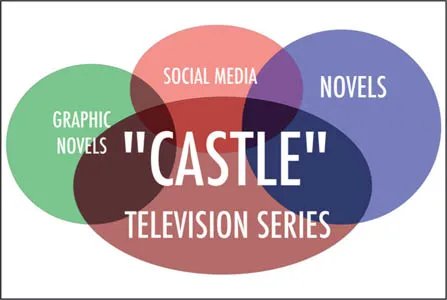
ABC’s Castle, the tale of mystery writer Richard Castle (Nathan Fillion) doing research with the NYPD, solving mysteries, and falling in love with his muse, Detective Kate Beckett (Stana Katic), has proven one of the most successful uses of transmedia storytelling—even though most audiences don’t realize that that’s what it is. It’s irresistible transmedia. Castle has his own Twitter account (@WriteRCastle), offering more insight into his thought process, and providing little winks to the show’s past and future. And, as is logical with a series about a mystery writer, Hyperion Press has published Castle’s books including Heat Wave, Naked Heat, and Heat Rising. Each of these books lay bare Castle’s infatuation with and love for Beckett (by fantasizing about their relationship and idealizing her as the bad-ass lead protagonist Nikki Heat) as well as character layers beyond the capabilities of a television show (after all, the true feelings of a writer are most often revealed in their work). Castle is a perfect example of transmedia flowing from character. All of these elements make character sense and are organic to the rules of the world set forth by the writers of the show.
FIG 1.1 ABC’s Castle represented as a nodal transmedia project.
Most recently, Marvel Comics released Richard Castle’s Deadly Storm: A Derrick Storm Mystery, a graphic novel written by Ultimate Spider-Man, Halo: Uprising and Avengers writer Brian Michael Bendis. To further blur the lines between fiction and reality, the graphic novel (or “OGN”—Original Graphic Novel—in comic book parlance) features an introduction by “Richard Castle,” where he mentions his concerns about adaptation but how thrilled he is that Brian Michael Bendis is the man adapting the work, and how happy he is that Marvel Comics is the publisher. The graphic novel was then featured in a recent episode of the television show, about a murderous, sword-wielding, comic-inspired vigilante.
Transmedia storytelling is like playing with building blocks—construct a solid foundation and build your story skyscraper. But be careful—the more clever you try to be, the more perilous your game of Jenga.
“… in which Each Piece Interacts with the Others to Deepen the Whole …”
Transmedia does not simply mean breaking up a movie or game into multiple pieces. We’re letting these story pieces play with one another. The interplay of various story pieces is what makes transmedia such a fascinating means of storytelling (and distinguishes it from a franchise). Interplay and depth are the second and third linchpins of transmedia storytelling.
Think of the whole as a Wikipedia page. Think of the transmedia elements as the other articles you link to. Now take that page and deepen it from there. How can you deepen the lives of characters in a film through a web series? Or through a blog? A short film?
“… But is Capable of Standing on Its Own …”
Each and every piece of your transmedia building blocks must be a complete story in its own right. There’s an old adage in comics, “every comic book is somebody’s first” (as well as someone’s last). This applies to transmedia storytelling as well.
Your objective is to create multiple gateways into your storyworld, and disperse those gateways to the devices they use to consume media. It doesn’t matter if that’s a movie theater, a smartphone, a comic book, or a television show. Every piece has the chance to be somebody’s first (or last) and we have to give them a complete narrative that not only enthralls with its own story, but entices the viewer/consumer to become engrossed in the world and dig deeper.
However, we must keep in mind that the last thing we want is for our audience to feel lost or overwhelmed. Remember—Jenga. Many people will consume your project in a non-linear fashion (not in the release schedule you have laid out—this is a key element of giving up a degree of control, and a true realization of Jean-Luc Godard’s line that a story must have a beginning, middle, and end, but not necessarily in that order). There’s a fine line between curiosity and complete frustration, and we have to walk that tightrope carefully because we want our audience to be pulled into our world, not buried alive.
Confusing them with half-stories and boring them with less-than-involving characters isn’t the way to do that. So, how do we prevent it?
“… Giving the Audience the Choice as to How Deep into the Story Experience They Go”
Choice is the fourth linchpin of transmedia storytelling. Your audience won’t be filled exclusively with obsessive fans who want to consume every piece of your project. Some may want to consume only one piece. They just want a simple distraction and good time. What both categories desire is choice; the choice of casual consumption or obsessive immersion and participation. We have to make sure we satisfy both by giving them pieces that will move, inspire, and invite them to grab a shovel and dig as deep as they please. Audiences love being rewarded for their expertise. Play to that need and your chances of success will increase exponentially.
The Three Types of Transmedia
• | Native transmedia—stories conceived to be transmedia from the start. My own Whiz!Bam!Pow! project is a native transmedia project. Pokemon. The Matrix. Avatar. These stories are crafted from the very beginning to be spread across multiple media forms. |
• | Additive transmedia—stories that began life in another medium and had transmedia elements added to them: ABC’s Lost with The Lost Experience ARG*; Castle with the “Nikki Heat” novel series, the @WriteRCastle Twitter feed, and the Derrick Storm graphic novel; Twin Peaks (a very early form of televised additive transmedia) with the book The Secret Diary of Laura Palmer; NBC’s Heroes with graphic novels and webisodes; The Office with Dundler Mifflin Infinity. For the most part, these are not … |
• | Crap transmedia—what we’re trying to avoid: transmedia just for the sake of it or solely for marketing purposes because it’s “in.” If it comes from the wallet instead of from the story, it’s crap transmedia—which can be native or additive, though usually additive. |
How to Avoid Play...