eBook - ePub
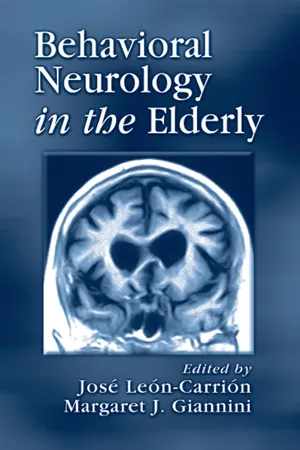
Behavioral Neurology in the Elderly
- 488 pages
- English
- ePUB (mobile friendly)
- Available on iOS & Android
eBook - ePub
Behavioral Neurology in the Elderly
About this book
It is important to understand the relationship between the brain, cognition and behavior when providing care to the elderly. Behavioral Neurology in the Elderly provides a comprehensive overview of this significant relationship, one of the most important topics concerning medical and behavioral gerontology today. It provides insight into how the ag
Information
Part I
Fundamentals
1 The Psychology of Aging in Historical Perspective
Helio Carpintero
CONTENTS
1.1 Introduction
1.2 Old Age through the Ages
1.2.1 Greece
1.2.2 Rome
1.2.3 The Middle Ages
1.2.4 The Modern Age
1.2.5 The 19th Century: Cabanis, Quételet
1.3 Hall’s Senescence (1922)
1.4 Some Analytic Perspectives on Aging
1.4.1 Charlotte Bühler’s “Course of Life”
1.4.2 Erikson’s Views on Aging
1.5 Some Modern Developments
1.8 Coming into the Present
References
1.1 INTRODUCTION
Scientific psychology first emerged as a study of the relationship between the mind and the biological structures of an organism. As William James put it, scientific psychology is the science of mental states and their antecedent and consequent physiological processes.1 Further, according to Wilhelm Wundt, this science focuses on the adult mind, in which all intervening elements and forces are operating according to general laws.
Evolutionary theory, as conceived by Charles Darwin, introduced new and important considerations. The theory focused on mental processes as instruments for adaptation, with new developments and variations deeply affecting all mental activities. Because the human mind had evolved from more primitive structures through adaptation and toward greater control, only through a developmental approach could it be fully understood. Such a view stressed the relevance of the study of child psychology as a means to obtain a deeper understanding of those processes from which the adult mind is formed. The study of developmental psychology soon followed the Wundtian steps toward the construction of the new science of mind. Notwithstanding, the main focus of study was placed on the early years of life, when habits, feelings, and learning receive a lasting impact and an acquired structure.
Little by little, attention was directed to other age levels, as new adaptive problems and social needs appeared and demanded the intervention of psychologists. In addition, social changes had taken place in Western societies, among them a substantial increase in life expectancy for both men and women. As a result, substantial variations have appeared in the social structure. Different age groups, for example, tend to interact more exclusively among themselves. As a consequence of these changes, elderly people are confronted with the challenge of adapting to today’s very different living conditions. The social adaptation of the elderly population is beginning to rely more and more on scientific knowledge and new resources emerging from new technologies.
Humans are historical beings, and all of the different human dimensions are of a historical nature.2 All these dimensions must be viewed in a certain historical context, within which they are to be interpreted and evaluated. Age is no exception to the rule. It has been noted that “a form of collective life is, among other things, a particular way of spending one’s allotted time.” This fits in quite well with the different views of old age described as follows: “old age sometimes functions as an empty wait for death, while in other societies it is an age of positive attributes, sure of itself, perhaps even proud and hopeful.”2 The meaning of old age is based on each society’s general outlook regarding old age. A valuable aspect of life, it has at times been deemed positive, at times negative. The following overview of the different ways in which old age has been valued through the annals of time emphasizes the historical, and not purely biological, nature of aging.
1.2 OLD AGE THROUGH THE AGES
In classical times, elderly people, scarce in number, were often valued as living receptacles of wisdom. Positive considerations, however, have not always prevailed. As Sumner put it, “older people are generally the possessors of power and authority, but they lose physical power, skill and efficiency in action.”3 The dual nature of this attitude toward old age underlies the two morally opposite ways in which societies treat their aged: one of conventional respect and consideration, and one of physical suppression, as some sort of social liberation.
1.2.1 GREECE
In classical Greece, old age was largely viewed as a declining stage of human life. In the Homeric poems, youth symbolized strength and power, whereas elderly people were limited to giving counsel and advice. Going one step farther, Greek comedy treated elderly people as objects of ridicule. Sparta alone put the political direction of the city-state in the hands of the Gerusia, the Council of Elders, in what appears to have been an exception among the Greek cities.4
According to historical data it is the philosophers who seem to have been most interested in the peculiar quality of the various stages of life. Pythagoras presents a broad view of the different stages of life, each stage comprising 20 years, and characterizing old age as the fourth period (which spanned from 60 to 80 years of age).4
Plato (427–347 B.C.) is generally known as having maintained a positive view of old age. In his Republic, he stressed the relevance of the knowledge and experience of the elders to governing the city. This was based on the transmission of good habits and manners from the aged to the young, and in the establishment of an order dominating the whole. When Socrates queried one of his older friends about his experience of life, as a person well advanced in life’s path, he was told that, while for a few, the proximity of death was felt as a liberation, for others it was a source of anxiety and fear, impelling them to believe in the fables about life after death in Hades. The fables held that each would experience in the afterlife what was merited from the present life. However, for wise men and philosophers, the real wisdom was to leave this world of sensation behind and to return to the world of ideas, the world of reality and truth. The aged were closer to such a desired end (Republic, 329 e sqq.).
In contrast, Aristotle (384–322 B.C.) offered a view critical of the aged. In Rhetoric, he presents a vividly negative image of elderly people. This Aristotelian idea of old age would reappear many times in the centuries to follow. The image of elderly people was that of doubtful, spiteful, stingy, cowardly persons, their temperaments having become cold, their strength and warmth lost. They are portrayed as having minds that could only be captivated by thoughts of their own profit. The philosopher argues that most experience in life is that of failure, and that the aged have learned that gain is a difficult task, while loss is easy. He maintains that elderly people experience weak passions, and that their minds are turned toward the past instead of looking into the future (Rhetoric, 1389 b 13 sqq.). He sees weakness, egocentrism, and concentration on past life as the main traits of this stage of life. While Plato conceived of elderly people as approaching the highest human goals in life after death, Aristotle took a much more worldly and empirical stance in viewing old age as full of limitations and problems. The respective and contrasting philosophies of the two philosophers clearly represent the dual face of aging.
1.2.2 ROME
The Romans have been characterized as a pragmatic, nontheoretic society, interested in human affairs and in dominating the world. Notwithstanding, their roots were in the home and the family was revered. Ancestors were honored above all, and old age was mainly viewed as a stage of wisdom to be honored. Such a view seemed to decline as the Empire supplanted the old Republic, and military power supplanted democracy.
In early Roman times, elderly people were seen as vessels of tradition and virtue. In De Senectute, Cicero (106–43 B.C.) raised his voice in praise of the aged. In parallel with the Platonic model, he stressed that the negative view of aging was mainly due to four factors: the loss of control of business, the weakening of the body, the tendency of life’s pleasures to disappear, and the approach of death.5 Cicero discarded these factors as unacceptable, arguing that many aged people lead an active life5 and that, although the strength and force of their youth have been lost, they are able to endure. The aged, he argued, continue to experience the pleasures of friendship and philosophy; while the burning desires of youth vanish, the mind achieves freedom and calm. Cicero maintained that death is a natural process, not to be feared or viewed as an ending if a new life awaits beyond. Cicero’s outlook was based on the idea that nature is both the fate and cause of real processes. Hence, the assumption that aging and death are natural processes inspired him to regard both as propitious, driving him to raise his voice in praise (laudatio). The arguments set forth by Cicero would endure for centuries, reappearing in one form or another up to the present, where they can be found as recurring themes in literature on the subject of aging.
Later, under the Empire, there is a contrasting view of age, where an old man, “after losing his family and political power, … is left alone, retaining only his aches, ugliness and weakness.”3
Still, the earlier position persists, and praise of old age may be found in the famous Letters to Lucilius from Seneca (4 B.C.–A.D. 65), a man of the Stoa, a Stoic. Stoicism relies on the acceptance of nature, the ultimate reality from which everything flows and to which everything returns. Age is considered a natural condition affecting the body and soul differently. With age, the body feels tired (lassum), or, toward the end, more than tired, decrepit (decrepitum). The soul, however, is regarded as full of power (viget) and as experiencing the pleasures of thinking and being alive. Life is an expectation of its end, and wisdom is coincident with nature. When that which must disappear has vanished, it is right and must be felt as right, in keeping with the ordinance of nature. The wise man must say: “accipio conditionem”; i.e., I accept the rule, that is the law of nature.6 Seneca offers a positive view, old age signifying nearing the end, the end signifying freedom from body and the return to nature. Such a doctrine, although Stoic in origin, was readily accepted by religious groups that also believed in a life after death and facing the Supreme Being. Stoicism has had a long-lasting influence, through medieval and up to modern times. This philosophy, which regards old age as a time to prepare oneself for the end of this life, has been an important contribution toward a positive outlook on old age.
1.2.3 THE MIDDLE AGES
In Western civilization, medieval times were defined by the interactions between Roman civilization, which emerged and developed in the Mediterranean, and northern peoples, such as the Germans, whose mentality was based on totally different grounds. The elements of the ancient culture were lost, and a period of Dark Ages spread over the known world. Christianity spread and with it the view of the world as a temporary stage for humans, and a means to obtain final “salvation.”
St. Isidore of Seville (c. 560–636), a bishop and theologian from the Visigoth Kingdom of Spain, set forth one of the first compilations of knowledge during the Middle Ages. His Etymologiae is an encyclopedia that offers a synthesis of c...
Table of contents
- Cover
- Half Title
- Title Page
- Copyright Page
- Dedication
- Preface
- Editors
- Contributors
- Table of Contents
- PART I Fundamentals
- PART II Cognition and Behavior in Elderly People
- PART III Neurobehavioral Assessment
- PART IV Advances in Treatment
- Index
Trusted by 375,005 students
Access to over 1.5 million titles for a fair monthly price.
Study more efficiently using our study tools.
Frequently asked questions
Yes, you can cancel anytime from the Subscription tab in your account settings on the Perlego website. Your subscription will stay active until the end of your current billing period. Learn how to cancel your subscription
No, books cannot be downloaded as external files, such as PDFs, for use outside of Perlego. However, you can download books within the Perlego app for offline reading on mobile or tablet. Learn how to download books offline
Perlego offers two plans: Essential and Complete
- Essential is ideal for learners and professionals who enjoy exploring a wide range of subjects. Access the Essential Library with 800,000+ trusted titles and best-sellers across business, personal growth, and the humanities. Includes unlimited reading time and Standard Read Aloud voice.
- Complete: Perfect for advanced learners and researchers needing full, unrestricted access. Unlock 1.5M+ books across hundreds of subjects, including academic and specialized titles. The Complete Plan also includes advanced features like Premium Read Aloud and Research Assistant.
We are an online textbook subscription service, where you can get access to an entire online library for less than the price of a single book per month. With over 1.5 million books across 990+ topics, we’ve got you covered! Learn about our mission
Look out for the read-aloud symbol on your next book to see if you can listen to it. The read-aloud tool reads text aloud for you, highlighting the text as it is being read. You can pause it, speed it up and slow it down. Learn more about Read Aloud
Yes! You can use the Perlego app on both iOS and Android devices to read anytime, anywhere — even offline. Perfect for commutes or when you’re on the go.
Please note we cannot support devices running on iOS 13 and Android 7 or earlier. Learn more about using the app
Please note we cannot support devices running on iOS 13 and Android 7 or earlier. Learn more about using the app
Yes, you can access Behavioral Neurology in the Elderly by Jose Leon-Carrion, Margaret Giannini, Jose Leon-Carrion,Margaret Giannini in PDF and/or ePUB format, as well as other popular books in Medicine & Geriatrics. We have over 1.5 million books available in our catalogue for you to explore.