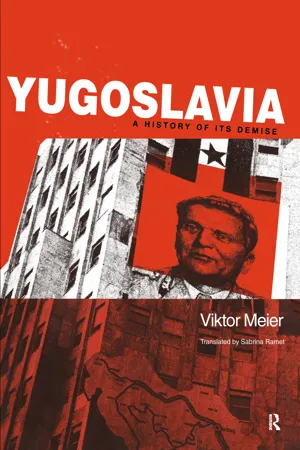
Yugoslavia: A History of its Demise is a new history of the disintegration and collapse of the former Yugoslavia. Commencing with the death of Tito, Meier presents an insider's guide to all the regions of Yugoslavia, including Macedonia, and in particular, emphasizes the crucial part played by Slovenia before the outbreak of war in 1991. Drawing on official federal and republican archives, but also sources which are not yet officially open for scholarly use, the book covers:
* the legacy of Tito's regime
* the personalities who dominated the Yugoslav stage during its dismemberment
* the military threat against Slovenia in the late 1980s
* the attempts to find a peaceful solution
* the political conditions in Macedonia and Bosnia-Herzegovina
* Western policy towards Yugoslavia's disintegration and terror.
- 304 pages
- English
- ePUB (mobile friendly)
- Available on iOS & Android
eBook - ePub
Yugoslavia: A History of its Demise
About this book
1
Fateful weaknesses after Tito’s death
Tito’s political legacy
On 4 May 1980, Josip Broz Tito, President of the Socialist Federated Republic of Yugoslavia, died. An American professor, who had known Tito since the Second World War, had the opportunity to ask the Yugoslav president, during his last trip to America (in 1978), what he, Tito, considered to have been his greatest political failure. Tito answered that his greatest failure was to have failed to bring together the peoples of Yugoslavia in a real community.1
Tito’s great and widely acknowledged political accomplishments had their deficiencies and distortions. The Yugoslav marshal was a practical politician. Economics was foreign to him. Even after the introduction of the system of self-management and the socialist market economy, he always resolved such issues as arose from the tension between demands for economic freedom for the enterprises and the political monopoly of the party in favor of the latter. In this behavior, he enjoyed the support of his close collaborator, Slovene Edvard Kardelj; the latter composed numerous treatises concerning self-management and socialist democracy but never found his way out of the dilemma posed by the dual aspiration to party dictatorship and democracy.
The Law on Associated Labor, adopted in 1976 under Kardelj’s influence, was supposed to transform the principles of self-management, and aimed above all at the atomization of the economic enterprises and at their control through complicated institutions. This was supposed to prevent the enterprises or banks from developing into “centers of alienated power” and to prevent their managers from becoming rivals to the party functionaries. This system, developed during almost two decades, came to be known as “contract economy” (dogovorna ekonomija). Its organizational principle had notched some successes in the late 1950s and 1960s, insofar as it signified a liberalization of the hitherto Stalinist planned economy. Later on it became a factor for stagnation. Kardelj’s amateurish pedantry made it difficult to introduce rational management in Yugoslav enterprises or a rational investment policy.
Although not without personal magnanimity, Tito had a low opinion of political democracy. Until his last years, he could not reconcile himself to his expulsion from the Soviet camp; he saw in the “communist family” a uniquely serious form of power politics. Included in this was also the technique of playing potential opponents against each other. Tito’s political style showed the stamp of his experience working in the Comintern. Indeed, he remained, to the end, a Comintern man who could not make peace with the subordination of the Comintern to the interests of the Soviet Union and Stalin. A Slovenian politician, Mitja Ribičič, who collaborated with Tito over a long period, would state in retrospect that whenever there was a rapprochement between Tito and the given leadership in Moscow, democratization and reform in Yugoslavia were set aside. That was the case in 1955 and after 1965, and in a weaker form also after 1971.2
Until the summit meeting of the nonaligned states in Havana in 1979, Tito’s leadership among the nonaligned had been founded on the aspiration to restrain Third World countries from “capitalist error” and to lead them to the altar of world socialism. Only when Fidel Castro tried to hem his leadership role and to promote the thesis that the nonaligned were “natural allies of the socialist camp” did Tito decide on a completely independent foreign policy. Among the Western states, he basically respected only the United States, whose power he recognized even though he did not comprehend the country and its ways. Aside from that, he cherished, from the war years, a respectful affection for certain people in England. He considered the Western social democrats to be babblers and disdained them. This attitude entailed, among other things, a certain neglect of the emerging European Economic Community.
Tito’s political power system rested, until well after his death, on the “trinity” of party, police, and army. These three elements were supposed to serve to hold the federalized state structure, which Tito had reluctantly accepted, in check. This was not successful. One should take into account also the way in which the entire Yugoslav system rotated around the person of Tito. The oft-used term, “Titoist Yugoslavia” (Titova Jugoslavija), was supposed to encapsulate everything which characterized Yugoslavia as a state and power system, from the Partisan tradition to socialist self-management, to state federalism and to the nonaligned policy. The strong emphasis on Tito’s person is partially responsible for the fact that “Yugoslav consciousness” showed itself to be utterly void, soon after Tito’s death.3 Tito’s personal authority could not be replaced. This was understood even in his lifetime, as indicated in the proclamation of the principle of “collective leadership” as the mechanism for succession. But this would develop in a direction entirely contrary to the original intention.
The Communist Party of Yugoslavia, renamed the League of Communists of Yugoslavia (Savez komunista Jugoslavije) in 1952, retained the political monopoly until the end of the 1980s, despite all its professions of democratization. Its “leading role” was anchored also in the constitution of 1974 (Preamble VIII). In certain areas, above all in the law on emergency, the party’s role was formally acknowledged. The instrument of the party’s dominion was “democratic centralism”. This signified that all decisions which were reached in party organs, regardless at what level, were binding on the members of these organs and for all party members concerned, even if they had voted against the decision and did not approve of it. This “Leninist” principle of democratic centralism entailed also an obligation for party members in state and communal organs, for example in enterprises, to vote and work in accordance with party decisions. For the constitutional life of the Yugoslav federal state, this signified that important decisions were always taken in the highest party organs, in the Party Presidium or in the Central Committee, and were then supposed to be binding on the state and administrative organs. In the final phase, this principle continued to work only to a limited degree, although party leaders tried to maintain this principle until the actual death of the LCY in early 1990.
Mitja Ribičič said that democratic centralism and its role already stood in contradiction to the constitution of 1963, insofar as it attempted to concede an independent role to the parliaments at both federal and republic levels. Until almost the end, democratic centralism and the ban on factions were used to exert a pressure on the republics.4 The first great error on the part of Milovan Djilas consisted in the fact that he earnestly believed that the Sixth Party Congress of 1952, with its renaming of the party, was an honest effort in the direction of liberalization and democratization.
For all that, there were certain special developments within the Yugoslav communist party. These showed themselves already at the time of the Second World War, insofar as the Partisan struggle had to be conducted on a decentralized basis reflecting the multiethnic composition of Yugoslavia. There was an effort during the early period of democratization to revive some of these developments, which had been most marked in Slovenia, Croatia, and Macedonia. They were largely eliminated after 1945, but the party apparatchiks in the republics retained considerable organizational independence. These relatively independent apparatchiks created, on the other hand, independent power bases for the leaders in the republics and provinces.5 The federalization of the party was in this way practically pre-programmed. It assumed practical form as a certain identity of interest between leadership and population developed, first in the economic sphere, subsequently also in the political and national domain.
After the death of Tito there developed a vacuum of authority also in the central party apparatus. To be sure, there continued to be a central party apparatus, but it retained real power only within circumscribed limits. Political life shifted to the republics and provinces (Kosovo and Vojvodina). The political life in the federal League of Communists consisted almost entirely of in-fighting between representatives of the republics in its sundry organs. Compromises were reached which often evaporated before the functionaries from the republics and provinces had even reached the Belgrade airport or railroad station to begin the trip home. Djilas committed the second great error of his life when he thought that the problem of democracy in Yugoslavia could be solved after the English prototype through the establishment of a general dualism of ruling party and opposition. There was, quite simply, no general Yugoslav framework any more which could have made possible such a path. Those politicians who tried to make their careers in the central apparatus, such as Slovene Stane Dolanc or certain functionaries from Croatia, ended up shipwrecked.
The central organs of the party were the Central Committee, with about 110 to 120 members, and the Party Presidium, with 23 members at the end. The members of both organs were elected in the republics and provinces. The Central Committee had a somewhat liberal face in the last phase of Yugoslavia but could not really determine policy. The Presidium consisted of three members from each republic and two from each province, along with the party chiefs of the federal units ex officio. A representative of the army leadership completed the composition. The principle of consensus, anchored on the state level in the federal constitution of 1974, did not hold in the party organs. The party decided by majority vote. Equally important was the constant rotation of cadres, a principle introduced in the name of collective leadership and more marked in federal organs than in the republics. For an elective party post, the usual mandate was four years, but for the chairs of the party and also in the state organs, a one-year mandate was customary.
The police, the second pillar of the regime, found itself largely under the control of republic and provincial party leaderships after Tito’s death. This was not true merely of the ordinary police, but also of the political police, generally called UDBa (short for Uprava Državne Bezbednosti, or Administration of State Security). This development began in 1966 with the overthrow of Security Chief Aleksandar Ranković. To be sure, there continued to be a federal UDBa, but it occupied itself above all with relations with abroad and with foreigners. Serbs predominated in its ranks; the federal apparatus of UDBa maintained relations with the police apparatchiks of other communist states and, up to a point, with international terrorists.
The decentralization of the political police did not improve the situation, but made the police dependent upon concrete relationships in the individual republics and provinces. The entire police apparatus was oriented to the maintenance of communist rule and saw in the West the chief enemy. The police moved especially repressively in Croatia, as part of the consequences of 1971. People were imprisoned there for singing patriotic Croatian songs, while similar Serbian songs had long belonged to the repertoire of coffee-house orchestras in Belgrade. The situation in Bosnia-Herzegovina was even worse. In that republic, authorities sought a solution by fighting with equal brutality all national stirrings among any of the three peoples living in the republics. Gastarbeiter living abroad saw themselves exposed to especial repression. They were interrogated when they returned home on visits and were maltreated in other ways. Police authorities conducted active terror against emigrants.
Tito’s real darling was the army, officially named the Yugoslav People’s Army (Jugoslovenska Narodna Armija, or JNA). Tito accorded it the status of a state within a state. The Slovene Mitja Ribičič believed that the favoritism which Tito displayed toward his army, which he bound in obligation to himself personally and whose officers he overwhelmed with privileges, was the most evil and most grave legacy of Tito’s dominion. It had the consequence that the army, i.e., its leadership, considered itself a kind of collective successor to Tito and viewed socialism and the unified Yugoslav state as the prerequisite for its own existence. The problem was sharpened by the fact that the officer corps was not only communist and centralist in orientation, but also predominantly Serbian and Montenegrin (60 per cent of the officer corps consisted of Serbs and Montenegrins).6 These two factors began to become mixed in the final phase of Yugoslavia. Only at the highest command posts was a certain minimum of national parity maintained.
The army was not only a military but also a political and economic factor and even served as a surrogate police force. Mitja Ribičič, who himself spent time in the police apparatus but who later developed into a reform-oriented politician, reported from his own experience that as the police developed into instruments of republic leaderships, the army developed its counter-espionage service (Kontraobaveštajna Služba, or KOS) as its own political police, with the assignment of keeping an eye on the political forces of the republics and provinces.7 Many conflicts between individual republic leaderships and the Army were, in fact, conflicts with KOS. As important was the fact that the army had control of a considerable arms industry which, in the late 1980s, totalled some 56 enterprises, with about 70,000 employees. Four-fifths of these enterprises lay in Bosnia-Herzegovina. As long as weaponry constituted an important part of Yugoslavia’s exports—above all to nonaligned states—this factor strengthened the political weight of the Army, especially where the budget was concerned. Later, however, when the relaxation of tensions resulted in a decline in arms exports, this became a debit.
It was difficult to oppose the financial demands of the army, which had long insisted on obtaining 6 per cent of the national income. Ribičič considered it a great success that, between 1969 and 1972, he was able to obtain the abolition, in spite of Tito’s opposition, of the so-called extraordinary state budget. Another politician from Slovenia, Janko Smole, considered it a great success that he was able to reduce the army’s budget in 1970 to 5.6 per cent of the national income.8
The Soviet invasion of Czechoslovakia in 1968 provided a certain validation of the army’s importance, but, on the other hand, provoked reflections on the tradition of the Partisan war and on the concept of people’s defense, embodied mainly in the so-called Territorial Defense Forces (Teritorijalna Obrana in Serbo-Croatian; Teritorialna Obramba in Slovenian). Ribičič said that this concept was not Tito’s idea, but had to be wrested out of him. The fear that these reserve units would develop into instruments of power of the republics was on the minds of army leaders from the start. In reality, the republic leaderships did not have complete control over the Territorial Defense Forces or over their weapons, and especially not over any heavy weaponry. But the organization was, strictly speaking, subordinate to the republics.
The legal basis for the functioning of Yugoslavia as a state in the late-and post-Tito era was the new constitution adopted in 1974. Viewed juristically, it was a pastiche of imprecisions and contradictions. Its most important “father”, Edvard Kardelj, had conceived it chiefly as an ideological tract concerning self-management. Viewed politically, it was of great significance, for it attempted to constitute Yugoslavia as a federal state with democratic outlines, as it would have functioned if ever the political monopoly of the communist party had been cast aside. Its core element was the new definition of the republics and provinces as constituent units of the joint state. The constitution of 1974 pointed rather unambiguously also in the direction of confederation; it constituted Yugoslavia, as one of its critics remarked, as a kind of midpoint between federation and confederation, as a “Yugoslav exception”.9
In contrast to the earlier constitutions, the constitution of 1974 defined the republics explicitly as states (Article 3) and made them into independent agents of political decision-making, who could not be outvoted. Both of the provinces in union with the Republic of Serbia—Kosovo and Vojvodina—were, indeed, not defined as states, but were given equality with the republics at the level of the common state. Both houses of the Yugoslav Federal Assembly (Skupština SFRJe)—the Federal Chamber (Savezno veće) and the Chamber of Republics and Provinces (Veće republika i pokrajina)—were in fact bodies representing the republics and provinces; it is of note that the Federal Chamber did not provide a direct representation of the citizens. The members of both houses of the Federal Assembly were appointed by the parliaments of the republics or provinces or by other republic organs.
Legislative procedure and the procedure in all important affairs were based on the principle of consensus among the republics and provinces. This signifies, formulated in reverse, that every republic or province enjoyed a veto right in practically all affairs of any importance. Even for the Federal Chamber, for which majority rule had been foreseen, Article 29410 stipulated in all matters “of general interest for a republic or province or for the equality of peoples and nations” a special procedure which, for all practical purposes, provided a veto right for the republics and provinces. The Chamber of Republics and Provinces, even in formal terms, expressly represented the parliaments of the republi...
Table of contents
- Cover
- Halftitle
- Title
- Copyright
- Contents
- Foreword
- Preface to the English edition
- Preface
- Chronology of events
- Glossary
- Maps
- 1 Fateful weaknesses after Tito’s death
- 2 The turning point: 1986–87
- 3 The beginning of the end
- 4 Western Yugoslavia reacts
- 5 Irreconcilable positions
- 6 Unwanted independence—the fate of Macedonia and Bosnia-Herzegovina
- 7 From the Yugoslav tragedy to the tragedy of the West
- Epilogue
- Bibliography
- Notes
- Index of Names
- Subject index
Trusted by 375,005 students
Access to over 1.5 million titles for a fair monthly price.
Study more efficiently using our study tools.
Frequently asked questions
Yes, you can cancel anytime from the Subscription tab in your account settings on the Perlego website. Your subscription will stay active until the end of your current billing period. Learn how to cancel your subscription
No, books cannot be downloaded as external files, such as PDFs, for use outside of Perlego. However, you can download books within the Perlego app for offline reading on mobile or tablet. Learn how to download books offline
Perlego offers two plans: Essential and Complete
- Essential is ideal for learners and professionals who enjoy exploring a wide range of subjects. Access the Essential Library with 800,000+ trusted titles and best-sellers across business, personal growth, and the humanities. Includes unlimited reading time and Standard Read Aloud voice.
- Complete: Perfect for advanced learners and researchers needing full, unrestricted access. Unlock 1.5M+ books across hundreds of subjects, including academic and specialized titles. The Complete Plan also includes advanced features like Premium Read Aloud and Research Assistant.
We are an online textbook subscription service, where you can get access to an entire online library for less than the price of a single book per month. With over 1.5 million books across 990+ topics, we’ve got you covered! Learn about our mission
Look out for the read-aloud symbol on your next book to see if you can listen to it. The read-aloud tool reads text aloud for you, highlighting the text as it is being read. You can pause it, speed it up and slow it down. Learn more about Read Aloud
Yes! You can use the Perlego app on both iOS and Android devices to read anytime, anywhere — even offline. Perfect for commutes or when you’re on the go.
Please note we cannot support devices running on iOS 13 and Android 7 or earlier. Learn more about using the app
Please note we cannot support devices running on iOS 13 and Android 7 or earlier. Learn more about using the app
Yes, you can access Yugoslavia: A History of its Demise by Viktor Meier, Sabrina Ramet in PDF and/or ePUB format, as well as other popular books in History & Eastern European History. We have over 1.5 million books available in our catalogue for you to explore.