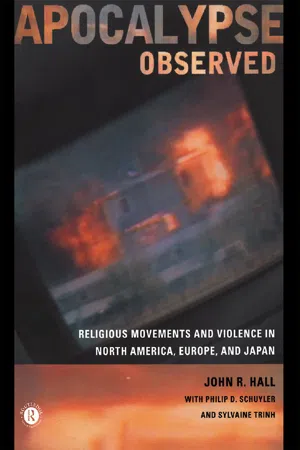
Apocalypse Observed is about religious violence. By analyzing five of the most notorious cults of recent years, the authors present a fascinating and revealing account of religious sects and conflict. Cults covered include:
* the apocalypse at Jonestown
* the Branch Davidians at Waco
* the violent path of Aum Shinrikyo
* the mystical apocalypse of the Solar Temple
* the mass suicide of Heaven's Gate.
Through comparative case studies and in-depth analysis, the authors show how religious violence can erupt not simply from the beliefs of the cult followers or the personalities of their leaders, but also from the way in which society responds to the cults in its midst.
eBook - ePub
Apocalypse Observed
Religious Movements and Violence in North America, Europe and Japan
- 240 pages
- English
- ePUB (mobile friendly)
- Available on iOS & Android
eBook - ePub
Apocalypse Observed
Religious Movements and Violence in North America, Europe and Japan
About this book
Information
1
THE APOCALYPSE AT JONESTOWN
Two years to the day after the 19 April 1993 conflagration at the Branch Davidians’ Mount Carmel compound near Waco, Texas, a bomb destroyed the federal building in Oklahoma City, Oklahoma, killing at least 167 people and injuring hundreds more. Two years after that, in April 1997, jury selection finally began in the trial of Timothy McVeigh, the man eventually convicted of the bombing. Anticipating the upcoming trial, The New Yorker magazine’s “Talk of the Town” section led with a piece where Scott Malcomson (1997) recounted his visit to “Elohim City,” a dirt-poor white-separatist Christian fundamentalist community in the Ozarks. Over supper after church on Sunday, the sect’s founder, Robert G.Millar, mentioned to Malcomson that he had met a Pastor Jones in the 1950s, “a good pastor,” he called him. Did the New Yorker writer remember Jones? “Oh yes, the man in Guyana,” Malcomson replied, ending his piece, “Yes, I remembered him.”
Thus readers encountered yet another allusion to the first mass suicide in modern times. Jonestown was the communal settlement founded by Peoples Temple in the small, poor, socialist country of Guyana, on the Caribbean coast of South America. On 17 November 1978, a congressman from California, Leo Ryan, arrived there on an investigative expedition, accompanied by journalists and some sect opponents who called themselves the “Concerned Relatives.” The next day, Ryan and four other people—three newsmen and a young defector— were murdered at an airstrip several miles from Jonestown as they prepared to depart with more than a dozen defectors that the visitors had brought out of the jungle utopian community. While this carnage unfolded, back at Jonestown, the Temple’s white charismatic leader, Jim Jones, orchestrated a “revolutionary suicide” where the members of the agricultural community—mostly black, some white—drank a deadly potion of Fla-Vor Aid laced with poison. Counting the murders at the airstrip, 918 people died.1
Well before Timothy McVeigh’s trial, “Jonestown” had become so infamous as the ultimate “cult” nightmare that Malcomson could invoke the mere name of its leader as a chilling conclusion to his story about an isolated, radically antiestablishment religious community of true believers. In his short, sophisticated New Yorker report, Malcomson symbolically aligned Waco, the Oklahoma City bombing, and Jonestown with the racist survivalist sect he had visited, all without saying much of substance about any of these episodes. He offered no reflection on even the most immediately intriguing question raised by Elohim leader Robert Millar’s mention of Jim Jones: why was a right-wing racist fundamentalist praising the founder of Peoples Temple, a left-wing religious movement dedicated to racial integration?
The power of Malcomson’s piece hinges on the mention of Jim Jones, but the rhetorical form of this mentioning depends on glossing any understanding of what happened at Jonestown. Instead, it plays to a generalized collective memory that has enshrined Jones in popular culture as the image incarnate of the Antichrist, and Peoples Temple as the paragon of the religious “cult.” Fed by a flood of news articles, a film, a television docudrama, more than twenty books, and countless oblique allusions, this collective memory now floats free from what, in a simpler era, historians liked to think of as facts. But when we search for the sources of this memory, they trace back to the “Concerned Relatives,” the organization that had opposed Peoples Temple in the first place, and to the representatives of the media whom the Temple opponents drew into the ill-fated journey to Jonestown. After the murders and mass suicide, the Concerned Relatives became the outsiders with the most knowledge about a group that had carried out an appalling act of mass suicide. Indeed, because the Concerned Relatives had consistently sought to raise the alarm against Peoples Temple before 18 November 1978, they could take the mass suicide as a sad validation of their concerns. But by the same token, popular accounts of Jonestown depended heavily on the accounts of the Concerned Relatives, and these accounts tended to suppress a crucial question. Did the actions of the Concerned Relatives and the media in any way contribute to the grisly outcome of events in which they were not only observers, but also participants?
Given the tragic deaths, the cultural opponents had a vital interest in denying that their actions had any consequences. This interest may help account for their consistent promotion of a doctrine of cult essentialism, whereby the dynamics of religious movements are treated as wholly internal, and unaffected by interaction with the wider social world. Such an analysis would free the cultural opponents and the media from any responsibility for incidents of religious-movement violence. But precisely because the proponents of cult essentialism themselves participated in the events, it is important to give their actions consideration along with other factors that may have contributed to the outcome of murder and mass suicide.
In the absence of this analysis, Jonestown becomes, as Roland Barthes wrote of myths more generally, “a story at once true and unreal” (Barthes 1972, p. 128). In this case, the story is one of a sick and fiendish man who plotted the deaths of those who would expose his sham community, capping the murder of opponents with the ritualized ceremonial murder of followers, many of them perhaps well-intentioned, but too naive or powerless to break the hold of Jim Jones, a man sufficiently obsessed with his orchestration of events to die of an apparently self-inflicted gunshot to the head.
Treatment of Peoples Temple as the cultus classicus headed by Jim Jones, psychotic megalomaniac par excellence drifts on a sea of memory, only loosely tied to any moorings of history. Still, like other myths that maintain their power, the one signified by “Jonestown” must be culturally powerful, and perhaps even necessary, for it remains evocative even today. In Barthes’s terms, the power of Jonestown is the power of the unreal to offer a meaningful narrative of an event that is otherwise difficult to reconcile with the world as we understand it. The myth of Jonestown has a long half life because it serves vital needs not to understand the murders and mass suicide historically. In effect, the myth of Jonestown displaces history by suppressing alternative narratives that might debunk ideology. Only when this ideological lens is broken can we search for historical explanations.
Devil, psychopath, con artist, Antichrist, Jim Jones was also a discomforting critic of American society, embraced by followers as a prophet, redeemer, and friend. His strongest countercultural images borrowed old Protestant ideas about the Church of Rome as the whore of Babylon, ideas that themselves come from deeper apocalyptic wellsprings of Western thought. But Jones transmuted these ideas into a new religious dispensation: of the United States as Babylon, the Apocalypse as race and class warfare that would engulf a society trapped in its own hypocrisy. An unrelenting iconoclast, Jones sought to forge a militant movement of people committed to the vision of a utopian alternative to a racist, class-dominated, imperialist society. Peoples Temple thus carried a double onus: it was a countercultural communal group and a militant anti-American social movement.
Communalism per se has long been viewed as a way of life alien to mainstream America. Legitimate organizations such as religious orders and the military may rightly require submission to collective authority, but in public discourse, the collectivism of countercultural organizations flies in the face of the dominant American ideology that embraces capitalism, individualism, and the nuclear family, and it is thus vulnerable to becoming coded as antidemocratic and subversive (cf. Alexander and Smith 1993).
Like other religious social movements, Peoples Temple practiced a communal socialism. Yet unlike most countercultural hippie communes and utopian communal groups of the 1960s and early 1970s, Peoples Temple located its communalism in a leftist political vein of crude communism. Jones simultaneously evoked apocalyptic imagery that appealed to members of his audience steeped in the codes of religious rhetoric, and used the political language of class and race to amplify latent resentment among those drawn to his cause. By this dual strategy, he forged a religious radicalism that attracted true believers to a movement framed in militant opposition to American capitalist society. Because Jones so sharply opposed the predominant ideology, that ideology requires that his movement and its demise be misunderstood.
The Jonestown myth can be deconstructed if we ask a straightforward question: “why did the murders and mass suicide occur?” To answer this question without recourse to the lens of ideology brings into view a complex relationship between Peoples Temple and the established social order. As we will see, the carnage in Guyana was not simply the product of the politically-infused apocalyptic mentality that took hold within Peoples Temple. Nor can it be explained as wholly the result of Jim Jones’s demented manipulations. Jones was more complex than the caricature of him, and Peoples Temple was both utopia and anti-utopia. “Jonestown” was the disastrous outcome of a protracted conflict between Peoples Temple and a loosely institutionalized but increasingly effective coalition of opponents. But the myth of Jonestown has had consequences of its own. It did not simply arise after apocalyptic history. It has contributed to apocalyptic history.
Jim Jones and the origins of Peoples Temple
Peoples Temple began, like many American religious groups, in the mind of a self-styled prophet. James Warren Jones was born in east central Indiana in the time of the Great Depression on 13 May 1931. The only child of poor white working parents (his mother was later rumored to have Indian ancestors), Jones grew up with a strong sense of resentment toward people of wealth, status, and privilege. Exposed as a child to a variety of Protestant churches—from the mainstream Methodists to the pacifist Quakers and the holiness-movement Nazarenes—Jones found himself especially impressed by the religious enthusiasm, revival-style worship, and speaking in tongues that he encountered in the fellowship of the then-marginal Pentecostalists, where he later described finding a “setting of freedom of emotion.”
During his high school years Jim Jones preached on the streets in a factory neighborhood of Richmond, Indiana, to an audience of both whites and blacks. In the summer of 1949, he married Marceline Baldwin, a young nurse from a Richmond family of Methodists and Republicans. Marcie was shocked, Jim later recounted, when he revealed the views that he seems to have taken from his mother, namely his sympathies with political communism and his disdain for the “sky god.”
In 1951 Jim and Marcie Jones moved to Indianapolis. Although Jim Jones was barely twenty years old at the time, he quickly became a preacher and created a volatile mix of theology and practice. Exposed variously to the Methodists’ liberal social creed, communist ideology, and the broadly apocalyptic vision of the Pentecostalists, Jones would promote racial integration and a veiled communist philosophy within a Pentecostal framework that emphasized gifts of the spirit, especially faith healing and the “discerning” of spirits. He displayed a knack for preaching, and he learned some tricks already in use in the mid-South Pentecostal revival circuit: how to convince audiences of his abilities in matters of “discernment” and faith healing by sleights of hand, spying, and fakery. Jones was hardly the first faith healer on the circuit to cause elderly ladies confined to wheel-chairs to rise up and walk again, though he may have been the first to come up with the idea of having a perfectly sound leg bone placed in a plaster cast so that it could be removed after a faith healing. Yet for all the deceit, some followers swore that the young minister had the gift of healing, and independent observers later acknowledged that hokum aside, Jones could produce results with a person whose condition “had no major physiological basis.”
On the grounds of his religious chicanery alone, Jones would have been hard to distinguish from other self-styled Pentecostalist faith healers of his day. But the audiences attracted by Jones’s gifts of the spirit encountered something far different from other tent-camp evangelists and small-time preachers who operated in the mid-South.
Organizationally, Jones started in Indianapolis with a small church called Community Unity. His first important break came when visitors from the Pentecostalist Laurel Street Tabernacle in Indianapolis took in his services following a successful revival appearance that he had made in Detroit, Michigan. In September 1954 some of the visitors invited Jones to preach at Laurel Street. Jones created a stir by bringing blacks to the service of the racially segregated church, but after his preaching and healing performance a substantial segment of the Tabernacle voted with their feet, leaving their congregation in order to walk with Jones. Together, on 4 April 1955, they established Wings of Deliverance, the corporate vehicle of what was later named Peoples Temple.
In his ministry, Jones extended the always-strong Pentecostalist ethic of a caring community toward racial integration, and he initiated urban ministry programs more typically associated with the social gospel of progressive middle-class Protestant denominations like the Methodists. Peoples Temple became a racially integrated self-help community of believers in practical service under the umbrella of a church. Out of this unlikely amalgamation of disparate ideas and practices, Jones gradually built the church into a communalistic social movement. Beginning as a somewhat unconventional preacher, he increasingly took on the mantle of a prophet who warned of an impending capitalist apocalypse and worked to establish a socialist promised land for those who heeded his message.
The movement grew up around the Jones family itself. Already by 1952 Jim and Marcie had adopted a ten-year-old girl. Then in 1955, they capitalized on Marcie’s nursing experience, bringing an older follower to live in their own home, thereby establishing a nursing home under a formula whereby their ever-widening family could be supported in part by cash payments from outside. In the late 1950s the couple adopted children who had been orphaned by the Korean War, initiating what they would call their multi-ethnic “rainbow family.” Two years after the birth of their natural son Stephan Gandhi Jones in 1959, the Joneses became the first white couple in Indianapolis, and perhaps in the state of Indiana, to adopt a black child. At the time, when the civil rights movement was just gaining steam in the US, Jones remarked, “Integration is a more personal thing with me now. It’s a question of my son’s future.”
For all the dynamism of Jones’s early family-centered ministry, however, he was hardly original in developing strategies, practices, and organizational forms. Instead, Jones was something of a living syncretist sponge who could absorb ideas, people, and their energies from the most diverse sources into the development of his organization.
Most importantly, Jones connected to the legacy of blacks’ search for redemption in the United States. Several times in the late 1950s, he visited the Philadelphia Peace Mission of the American black preacher Father M.J.Divine, who, in the 1920s and 1930s, had established himself at the center of a racially integrated religious and economic community. Father Divine himself stood in a long tradition of “black messiahs” who promoted migration from the Old South Black Belt after the American Civil War. The cultural sources are even deeper, going back to the time of slavery, and from it, to cultural memories drawn from the Bible. “The rhetoric of this migration” from the South, as James Diggs has noted, “was often reminiscent of antebellum Black nationalism, with its talk of escape from the land of bondage and quest for a promised land” (quoted in Moses 1982, p. 135). Like the biblical Jews under Moses, nineteenth-century black ministers had sometimes portrayed the collective suffering of their people and their quest for redemption as part of a higher religious purpose to history. Collective migration could serve as a vehicle to this purpose, for example, in the departure of “exodusters” from the South to settle in Oklahoma and Kansas during the latter part of the nineteenth century. In the early twentieth century, Marcus Garvey took up the theme anew with his back-to-Africa movement (which never repatriated a single US black to Africa while Garvey operated in the US). And then there was Father Divine. During the 1930s, he dabbled with the Communist Party but, more centrally, he relocated the destination of back-to- Africa dreams by setting up his peace missions in major Eastern US cities and establishing “The Promised Land”—rural, interracial cooperative communities — in upstate New York (Weisbrot 1983).
Jim Jones borrowed much from the Peace Mission model (and stole some of its members). Like Father Divine, he took to a patriarchal style of organization, with himself at the center, surrounded by a staff that included a heavy concentration of attractive, white women. Like Divine, Jones took to being called “Father,” or sometimes, “Dad.” Over the years, he would vacillate between operating an urban human-service ministry akin to Divine’s peace missions and establishing an exurban settlement in California not unlike the black messiah’s upstate New York communities. But Jones’s mission eventually took a more radical direction: emigration to escape the degradation of racism and class inequality in the United States. Again borrowing from Divine, the community that Peoples Temple founded in Guyana—Jonestown—would sometimes be called the Promised Land.
In the 1950s and 1960s, Jones shaped Peoples Temple in Indianapolis as an extended family that offered the shelter of communal fellowship from an uncertain world beyond. Like Divine, Jones worked to develop Peoples Temple as an agent of social action, establishing care homes for the elderly, running a free restaurant to feed the hungary, and maintaining a social service center to help people get their lives back together. In time, the unconventional congregation attracted the notice of the Christian Church (Disciples of Christ), which had long been committed to a social ministry. By 1960, Peoples Temple had affiliated with the Disciples, and in 1964 Jones was officially ordained a minister.
Peoples Temple thrived in Indianapolis, but it also gained a certain notoriety. Jones was more political than Father Divine, and he seemed to go out of his way to precipitate public controversies, seizing on opportunities to dramatize how racial segregation in Indianapolis extended even to its hospitals and its cemeteries. Indianapolis was not a progressive place and bitter resistance to integration surfaced in some quarters. By publicly challenging segregationist policies from the 1950s onwards, Jones enhanced his own status as a civil-rights leader. Seeing the benefit of having reactionary opponents, he also sometimes staged incidents which made him, his family, and his church look like the targets of racist hate crimes. Nonetheless, some of the harassment was real, and Jones does not seem to have held up well under the pressure. In the face of the public tensions, his doctor hospitalized him for an ulcer during the fall of 1961. After...
Table of contents
- Cover Page
- Title Page
- Copyright Page
- Illustrations
- Acknowledgements
- Abbreviations
- Introduction
- 1 The Apocalypse at Jonestown
- 2 From Jonestown to Waco
- 3 The Violent Path of Aum Shinrikyō
- 4 The Mystical Apocalypse of the Solar Temple
- 5 Finding Heaven’s Gate
- Epilogue
- Notes
- Bibliography
Trusted by 375,005 students
Access to over 1.5 million titles for a fair monthly price.
Study more efficiently using our study tools.
Frequently asked questions
Yes, you can cancel anytime from the Subscription tab in your account settings on the Perlego website. Your subscription will stay active until the end of your current billing period. Learn how to cancel your subscription
No, books cannot be downloaded as external files, such as PDFs, for use outside of Perlego. However, you can download books within the Perlego app for offline reading on mobile or tablet. Learn how to download books offline
Perlego offers two plans: Essential and Complete
- Essential is ideal for learners and professionals who enjoy exploring a wide range of subjects. Access the Essential Library with 800,000+ trusted titles and best-sellers across business, personal growth, and the humanities. Includes unlimited reading time and Standard Read Aloud voice.
- Complete: Perfect for advanced learners and researchers needing full, unrestricted access. Unlock 1.5M+ books across hundreds of subjects, including academic and specialized titles. The Complete Plan also includes advanced features like Premium Read Aloud and Research Assistant.
We are an online textbook subscription service, where you can get access to an entire online library for less than the price of a single book per month. With over 1.5 million books across 990+ topics, we’ve got you covered! Learn about our mission
Look out for the read-aloud symbol on your next book to see if you can listen to it. The read-aloud tool reads text aloud for you, highlighting the text as it is being read. You can pause it, speed it up and slow it down. Learn more about Read Aloud
Yes! You can use the Perlego app on both iOS and Android devices to read anytime, anywhere — even offline. Perfect for commutes or when you’re on the go.
Please note we cannot support devices running on iOS 13 and Android 7 or earlier. Learn more about using the app
Please note we cannot support devices running on iOS 13 and Android 7 or earlier. Learn more about using the app
Yes, you can access Apocalypse Observed by John R. Hall,Philip D. Schuyler,Sylvaine Trinh in PDF and/or ePUB format, as well as other popular books in Theology & Religion & Religious Fundamentalism & Cults. We have over 1.5 million books available in our catalogue for you to explore.