eBook - ePub
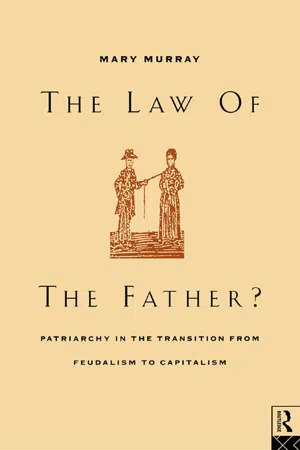
The Law of the Father?
Patriarchy in the transition from feudalism to capitalism
- 176 pages
- English
- ePUB (mobile friendly)
- Available on iOS & Android
eBook - ePub
About this book
A coherent and focussed exploration into how Patriarchy constructed pre-capitalist and capitalist society, and its role in the transition from feudalism to capitalism.
Information
Chapter 1
The debate
This chapter comprises an analysis of the class-patriarchy debate. The debate dominated much feminist discussion during the 1970s and well into the 1980s. But it has never been satisfactorily resolved. It is a debate which can ultimately only be resolved empirically and historically. The purpose of this chapter however is to outline the theoretical debate within which class and patriarchal relations have been analysed.
The structure of the chapter is as follows. Initially, the ways in which theorists have understood the concept of ‘patriarchy’ will be considered. The chapter will then examine what the various theorists consider to be the root causes of women’s oppression. Finally, the extent to which and ways in which the various theorists view the articulation of patriarchal relations with class relations will be analysed. Throughout, it will be demonstrated that the various accounts are fundamentally flawed in both historical and analytical terms.
THE CONCEPT OF PATRIARCHY
In ‘The Origins of the Family, Private Property and the State’, Engels refers to patriarchy as a form of the family whose essential features were the incorporation of bondsmen, and power vested in the paternal head of the family.1 Similarly in The Communist Manifesto Marx and Engels refer to ‘the little workshop of the patriarchal master’.2 Here patriarchy is understood as a social relation of domestic production.
However, we can see that the definition of patriarchy advanced by Marx and Engels is a limited one. Patriarchy refers to the system under pre-capitalist modes of production, in which the means of production and organisation of labour was owned and controlled by the head of household, rather than a more generalised system of female subordination and male domination. Although they certainly did recognise that women were oppressed under capitalism they defined patriarchy at the level of the labour process within pre-capitalist modes of production. Thus in the ‘Communist Manifesto’ they assert that ‘the bourgeoisie, wherever it has got the upper hand, has put an end to all feudal, patriarchal idyllic relations…and has left remaining no other nexus between man and man than naked self-interest, than callous “cash payment” ’.3
Although some feminists reject the use of the concept of patriarchy, many, if not most, ‘second wave’ feminists consider that it gives definition to the nature of women’s subordination. Kate Millet, a leading exponent of ‘radical’ feminism—which brought the concept of patriarchy to the forefront of contemporary feminist debate—in Sexual Politics utilises Max Weber’s concept of ‘Herrschaft’—a relationship of dominance and subordination—to understand the concept of patriarchy. Patriarchy for Millet refers to the male domination of women, and the domination of younger males by older males. Patriarchal power is thus sex- and age-specific.4
Shulamith Firestone, writing in The Dialectic of Sex, is the foremost exponent of ‘revolutionary feminism’—which developed the radical feminist analysis of the sexual imbalance of power5 which operates in the interests of men.
Heidi Hartmann, the most influential exponent of the dual systems approach, describes patriarchy in The Unhappy Marriage of Marxism and Feminism, as ‘a set of social relations between men…which, though hierarchical, establish or create interdependence and solidarity among men that enable them to dominate women’.6 Hartmann argues that men, through these relations, derive considerable personal and material benefits, e.g. sexual servicing and a higher standard of living in comparison to women.7 Christine Delphy, who attempts to develop a materialist feminism in ‘The Main Enemy’, and whose position is in many ways analogous to that of the dual systems approach, understands patriarchy as a system of exploitation of women by men, through the ‘marriage contract’, from which men derive considerable material benefits.8 Similarly, Sylvia Walby who also adopts a dual systems type approach, in Theorizing Patriarchy defines patriarchy as ‘a system of social structures and practices in which men dominate, oppress and exploit women’.9
The concept of patriarchy has also been used by theorists who would classify themselves as Marxist feminists. McDonough and Harrison, for example, in ‘Patriarchy and Relations of Production’ hold ‘a dual notion of patriarchy as, first, the control of women’s fertility and sexuality in monogamous marriage and, second, the economic subordination of women through the sexual division of labour (and property)’.10 Zillah Eisenstein in Capitalist Patriarchy and the Case for Socialist Feminism refers to patriarchy as a sexual hierarchy in which the woman is mother, domestic labourer and consumer.11 Juliet Mitchell, who attempts to develop a Marxist-feminist analysis through the adoption of a neo-Freudian version of psychoanalytic theory, defines patriarchy in Psychoanalysis and Feminism as ‘the law of the father’.12 More recently, Michelle Barrett has ‘come to regret the aggressive tone of [her] criticisms of this concept…and [her] own very limited definition of its appropriate use…’.13 She sees the use of the concept of patriarchy as important for recognising the independent character of women’s oppression, to avoid explanations which reduce it to other factors.14 It will be clear from the ensuing discussion that the extent to which women’s oppression is ‘independent’ from other axes of social division is highly contentious. But I too feel that the concept of patriarchy gives definition to the nature of women’s oppression.
We can see, though, from the above by no means exhaustive account of the various definitions of patriarchy that there is no consensus as to the exact meaning of the concept. The discussion in this book is informed by an understanding of patriarchy as involving the economic, political and ideological domination of women by men, which may include but is by no means limited to sexual domination and paternal power. In its paternal form, especially, it is also a form of domination which can be exercised between men.
THE ORIGINS OF PATRIARCHY
It is not my intention in this book to identify the origins of patriarchy. However, I do want to look here at Marxist and some feminist accounts of the origins. The purpose of this is to provide examples of the kind of reasoning that I propose to avoid in this study.
The classic Marxist account of the origins of patriarchy was of course advanced by Engels in ‘The Origins of the Family, Private Property and the State’. In short, Engels’ thesis was that the position of women was determined by the mode of production; the institution of private property and class society being the crucial factor: ‘The first class antagonism which appears in history coincides with the development of the antagonism between man and woman in monogamian marriage, and the first class oppression with that of the female sex by the male….’15
Contemporary Marxist feminists McDonough and Harrison consider that ‘there remain immense problems surrounding the application and extension of that method to the subordination of women’. However, they argue that ‘the way forward for an analysis of patriarchy necessitates an engagement with historical materialism…a discussion of the concept of patriarchy in a materialist analysis’.16 Similarly, Eisenstein attempts ‘to formulate socialist feminist questions by using the Marxist method, transformed by feminist commitments’.17 Patriarchy for Eisenstein ‘derives from ideological and political interpretations of biological difference…Patriarchal culture is carried over from one historical period to another…Material conditions define necessarily ideologies’.18
In her attempt to develop a Marxist feminist analysis of the origins of patriarchy—the law of the father—by adopting a neo-Freudian version of psychoanalytic theory, Mitchell agrees with Althusser that psychology is a ‘science’, the content of which can be annexed to Marxism. Mitchell attempts to root patriarchy in relations of sexual differentiation and power as psychically constituted within the unconscious. According to Mitchell, Lévi-Strauss demonstrated that the biological family was not the distinguishing feature of human kinship structures. Rather, for society to be instituted, the biological base had to be transformed. In this context it is argued that exogamy, as opposed to endogamy, is the essential prerequisite for the inauguration of a cultural kinship system. In short, for humanity to establish itself as it has, certain rules of kinship exchange had to be enacted. In accordance with this, Lévi-Strauss argued that since it is communication and the act of exchange that bind human society together, women became the objects of exchange, representing a sign which is being communicated. Mitchell goes on to argue that such a reading of Lévi-Strauss is consistent with Freud’s definition of culture as patriarchal—Freud’s work is seen as an analysis of patriarchal society, not a recommendation for one—as culture is seen as predicated on the symbolic exchange of women by men. Mitchell argues that for Freud the Oedipal moment signifies the entry of man into culture, into everything that made him human. Patriarchy marks the beginning of culture. The ‘Oedipus complex’ represents the original exogamous incest taboo, the role of the father and the exchange of women and the consequent differentiation between the sexes. The ‘Oedipus complex’, then, represents the acquisition of sexed subjectivity—the process through which women are subjected to the intersubjective dominance of men. Moreover, Mitchell emphasises that Freud insisted that the ‘Oedipus complex’ cannot be limited to the nuclear family or the capitalist mode of production. She emphasises that he insisted that the ‘Oedipal crisis’ was a universal event, although its forms of expression vary historically, so that in advanced capitalist societies, its expression occurs within the nuclear family.19
Kate Millet feels that preoccupation with the origins of patriarchy can only be speculative. She does, however, argue that ‘there is insufficient evidence for the thesis that the present social distinctions of patriarchy (status, role, temperament) are physical in origin’.20 ‘Patriarchy’s biological foundations appear to be so very insecure’.21 Instead, she maintains that there is ‘fairly concrete positive evidence of the overwhelmingly cultural character of gender’.22
According to Shulamith Firestone, the roots of patriarchy are both pre-social and biological. They are pre-social insofar as the oppression of women is ‘an oppression which goes back beyond recorded history to the animal kingdom itself ‘.23 It is biological insofar as ‘the biological family—the vinculum through which the psychology of power can always be smuggled’,24 that is,
the basic reproductive unit of male/female/infant, in whatever form of social organisation—is characterised by these fundamental—if not immutable—facts:
- That women throughout history before the advent of birth control were at the mercy of their biology—menstruation, menopause, and ‘female ills’, constant painful childbirth, wet-nursing and care of infants, all of which made them dependent on males (whether brother, father, husband, lover, or clan, government, community-at-large) for physical survival.
- That human infants take an even longer time to grow up than animals, and thus are helpless and, for some short period at least, dependent on adults for physical survival.
- That a basic mother/child interdependency has existed in some form in every society, past or present, and thus has shaped the psychology of every mature female and every infant.
- That the natural reproductive difference between the sexes led directly to the first division of labour at the origins of class, as well as furnishing the paradigm of caste (discrimination based on biological characteristics).25
Although dual systems theorist Heidi Hartmann does not set out to uncover the origins of patriarchy, she nonetheless feels that its basis is material: most fundamental is men’s control over women’s labour power ‘…the material base of patriarchy…does not rest solely on childrearing in the family, but on all the social structures that enable men to control women’s labour’.26 She argues that patriarchal social relations are reproduced in and by the domestic sphere as well as schools, churches, unions, sports clubs, factories, offices, armies, health centres and the media, etc.27
Similarly, Christine Delphy, in ‘The Main Enemy’, argues that the source of patriarchy is the marriage contract, in which the positions of husband and wife are supposedly analogous to that of capital and labour, though the position of the woman in this context is in fact apparently far worse than that of the wage labourer. She argues that the ‘marriage contract’ is equivalent to the labour contract. Within the ‘family mode of production’ (autonomous from the capitalist mode of production), we are told that men appropriate women’s labour and in so doing constitute their ‘class’ of oppressors. Women are thus a class. In return for domestic labour—saving men the expense of purchasing it on the market—we are told that women get only the costs of their own subsistence. She further argues that if women are engaged in waged work, then domestic labour is performed for free.28 For Walby similarly,
women’s household labour is expropriated by their husbands or cohabitees. The woman may receive her maintenance in exchange for her labour, especially when she is not also engaged in waged labour. Housewives are the producing class, while husbands are the expropriating class.29
PROBLEMS WITH ACCOUNTS OF THE ORIGINS OF PATRIARCHY
Engels has been frequently criticised, with some justification, for armchair anthropology and conjectural history. These factors may, in part, account for reductionist tendencies in Engels’ account: the specificity of women’s oppression is never fu...
Table of contents
- Cover page
- Title page
- Copyright page
- The law of the father?
- Introduction
- Chapter 1: The debate
- Chapter 2: A way forward
- Chapter 3: Marxism and the transition from feudalism to capitalism
- Chapter 4: Property and patriarchy
- Chapter 5: From ‘the law of the father’ to ‘capitalist fraternity’?
- Chapter 6: Sisters, daughters and subordinate wives
- Chapter 7: Women as property
- Conclusion
- Notes
Trusted by 375,005 students
Access to over 1.5 million titles for a fair monthly price.
Study more efficiently using our study tools.
Frequently asked questions
Yes, you can cancel anytime from the Subscription tab in your account settings on the Perlego website. Your subscription will stay active until the end of your current billing period. Learn how to cancel your subscription
No, books cannot be downloaded as external files, such as PDFs, for use outside of Perlego. However, you can download books within the Perlego app for offline reading on mobile or tablet. Learn how to download books offline
Perlego offers two plans: Essential and Complete
- Essential is ideal for learners and professionals who enjoy exploring a wide range of subjects. Access the Essential Library with 800,000+ trusted titles and best-sellers across business, personal growth, and the humanities. Includes unlimited reading time and Standard Read Aloud voice.
- Complete: Perfect for advanced learners and researchers needing full, unrestricted access. Unlock 1.5M+ books across hundreds of subjects, including academic and specialized titles. The Complete Plan also includes advanced features like Premium Read Aloud and Research Assistant.
We are an online textbook subscription service, where you can get access to an entire online library for less than the price of a single book per month. With over 1.5 million books across 990+ topics, we’ve got you covered! Learn about our mission
Look out for the read-aloud symbol on your next book to see if you can listen to it. The read-aloud tool reads text aloud for you, highlighting the text as it is being read. You can pause it, speed it up and slow it down. Learn more about Read Aloud
Yes! You can use the Perlego app on both iOS and Android devices to read anytime, anywhere — even offline. Perfect for commutes or when you’re on the go.
Please note we cannot support devices running on iOS 13 and Android 7 or earlier. Learn more about using the app
Please note we cannot support devices running on iOS 13 and Android 7 or earlier. Learn more about using the app
Yes, you can access The Law of the Father? by Mary Murray in PDF and/or ePUB format, as well as other popular books in Social Sciences & Social History. We have over 1.5 million books available in our catalogue for you to explore.