eBook - ePub
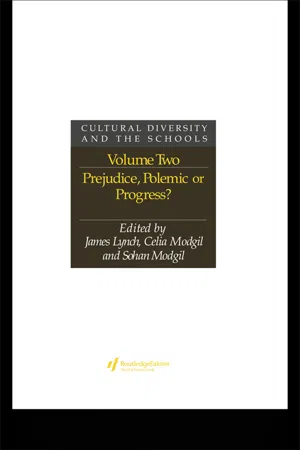
Cultural Diversity And The Schools
Volume 2: Prejudice, Polemic Or Progress?
- 428 pages
- English
- ePUB (mobile friendly)
- Available on iOS & Android
eBook - ePub
Cultural Diversity And The Schools
Volume 2: Prejudice, Polemic Or Progress?
About this book
First published in 1992. One of the major problems facing societies in almost all parts of the world is the inadequate accommodation of social equity with cultural diversity. The crisis emanating from neglect of this issue can be seen in societies as different and wide apart as the Soviet Union, India, Pakistan, the United States and the United Kingdom. This series of books is committed to the premise that racism and all other forms of negative prejudice are detrimental to a harmonious and healthy pluralist world society, and that it is the duty of all good democratic citizens to combat them, but that there are many valid routes by which such prejudice can be challenged, and that there are other kinds of prejudice and abuse which must also be combatted. This is Volume Two of a series of four on Cultural Diversity in Schools.
Information
Part One: The Roots of Prejudice
1.: Roots of Prejudice: Genetic or Environmental?
H.J.EYSENCK
INTRODUCTION
In this chapter I propose to consider certain fundamental problems relating to the causes of prejudice. In particular, I shall examine the almost universal assumption that prejudice is based on an individual’s historical experiences, i.e., is due to environmental factors. As we shall see, this is not so; genetic factors are at least as important as environmental ones. I shall also look at some theories concerning the hypothesized environmental causes of prejudice, in particular the famous frustration/aggression hypothesis, and seek to show to what extent that hypothesis is applicable, and to what extent it can be used to reduce prejudice.
Prejudice has been defined as ‘an antipathy based on faulty and inflexible generalization. It may be felt or expressed. It may be directed toward a group as a whole, or toward an individual because he is a member of that group’ (Allport, 1954, p. 9). Similarly, Ashmore defined it as ‘a negative attitude toward a socially defined group and toward any person perceived to be a member of that group’ (Ashmore, 1970, p. 253). Thus prejudice is an attitude which may or may not lead to discrimination, depending on many external circumstances. A fuller discussion of prejudice, discrimination and racism is given in a recent book by Dovidio and Gaertner (1986).
Prejudice is often linked with stereotyping, as in a definition given by Jones (1986), who uses the term ‘prejudice’ in the sense of ‘a faulty generalization from a group characterization (stereotype) to an individual member of the group irrespective of either (a) the accuracy of the group stereotype in the first place, and (b) the applicability of the group characterization to the individual in question.’ Stereotyping may be regarded as one of the cognitive components of prejudice; there are also affective components, such as dislike, and conative components, such as avoiding behaviour (Harding et al., 1969). The recent book on Stereotyping and Prejudice by Bar-Tal, Graumann and Kruglandski (1989) spells out in detail the assumed connections between these variables.
Two assumptions are often made in the definition of ‘prejudice’ and ‘stereotypes’, namely that prejudices are always negative, i.e., disfavour a particu-lar group, and that ‘stereotypes’ are always incorrect. Both these assumptions are false. Hitler had an obvious prejudice against the Jews, but he had an equal and contrary prejudice in favour of the hypothetical ‘Aryan’ race which was positive and extremely favourable. Prejudice against a given group normally implies a prejudice favourable to another group, and both should be considered. This is equally true of actions taken against or for a given group. Thus those in the apartheid tradition discriminate against Blacks, which is evidence of prejudice against them; in a similar way laws favouring Blacks, such as ‘affirmative action’, might be regarded as prejudice in favour of Blacks. Both types of law have been defended by its supporters on what are supposed to be rational grounds, but insofar as the laws favour one group against another they must be considered prejudicial.
As regards stereotypes, Eysenck and Crown (1948) have drawn attention to the dubious methodology on which many of the studies that have been carried out in this area depend. However that may be, stereotypes should not be considered ‘true’ or ‘false’ unless there is compelling evidence one way or the other; the fact that an attitude is stereotyped in a given group does not say anything about its truth or falsity. We have a stereotype of Japanese as hard workers, and it seems that this stereotype is perfectly valid. To act on this assumption would, therefore, not be evidence of prejudice, although an assumption that every Japanese is more hardworking than any American or European would of course be absurd. In Malaysia the stereotype of the bright Chinese and the dull Malays is widespread, but it does seem to have strong evidence in its favour, from IQ studies, from scholastic achievement, etc. Thus the whole field is very much more complex than is often assumed, and these assumptions themselves may be evidence of stereotype thinking and of prejudice.
American psychologists (e.g., Allport, 1954) identified a variety of approaches to the understanding of racial prejudice. These embraced (1) the historical approach, (2) the socio-cultural approach, (3) the situational approach, (4) personality structure and dynamics, (5) the phenomenological approach, (6) the stimulus-object approach. Theories based on these different approaches have burgeoned in recent years, and a detailed listing of some of them will be found in Dovidio and Gaertner’s book on Prejudice, Discrimination, and Racism (1986). Here let us merely note that all these approaches without exception emphasize environmental determinants, whether related to the family or to the wider en-vironment, and here, as in other books on prejudice, there is no mention of the possibility that genetic factors might exert an influence on the person’s standing as far as prejudice is concerned.
GENETIC FACTORS IN THE GENESIS OF PREJUDICE
In an early study of monozygotic and dizygotic twins, Eaves and Eysenck (1974) found evidence for a strong genetic component of the two major factors in the attitude field, namely, radicalism-conservatism and tough-vs.-tendermindedness, and more recently much more extensive studies of the field, with particular reference to prejudice, have been published in a book entitled Genes, Culture and Personality by Eaves, Eysenck and Martin (1989). Let us consider some major findings from the studies there summarized, which have bearing on the problem in question.
The instruments used for thses studies were the Eysenck Public Opinion Inventory, taken from The Psychology of Politics (Eysenck, 1954), and the Wilson-Patterson Conservatism Scale, taken from The Psychology of Conservatism by Wilson (1973). The former contained a series of attitude questions, the latter a series of fifty words presumably having positive or negative meaning for the respondent, such as ‘chastity’, ‘royalty’, ‘socialism’, etc. Subjects are requested to say ‘yes’ or ‘no’ in response to each item, according to whether they favour or believe in that item. Both the Eysenck and Wilson-Patterson scales contain items relevant to the question of prejudice. Details concerning the questionnaires, the factors they give rise to, their application in many different countries, etc., may be found in The Psychological Basis of Ideology by Eysenck and Wilson (1978).
The questionnaires were administered to large groups of monozygotic and dizygotic twins in England (the Eysenck Social Attitudes Scale only) and in Australia (both questionnaires). An analysis of the Australian data in particular has been published by Martin et al. (1986). Details concerning populations, selection, etc., as well as details of the genetical analyses made, can be obtained from these sources; this is not the place for a detailed discussion of these matters.
Essentially, the analysis consisted of constructing models embodying varying combinations of possible genetic and environmental factors, and then testing these models against the observed variables. Personality studies in general have shown that models containing only two major components are sufficient to account for the observed phenotypic values with sufficient accuracy (Eaves, Eysenck and Martin, 1989). These variables are first of all additive genetic variance (VA), and secondly within-family environmental variance (Ew). There was little evidence for between-family environmental variance (EB). Analysis of the various items reflecting prejudice in our study seemed to conform to a similar model.
The difference between within-family environmental variance and between-family environmental variance is implicit in the description of Ew and EB. Between-family environmental variance refers to those variables which, in the environment of the child, differentiate one family from another, i.e., the personalities and abilities of the parents, their socio-economic status, their living conditions, the amount of encouragement or otherwise they give to the scholastic endeavours of their children, the number of books and newspapers in the house, the interaction between parents and children, the schooling these children achieve, etc. Within-family environmental variance refers to those more or less accidental factors in the life of the child which differentiate him from other children in the same family, such as, for instance, having a particularly good or bad teacher, suffering or not suffering some illnesses, marrying a suitable or unsuitable partner, being in a satisfactory or unsatisfactory type of employment, etc.
In the nature of things, EB factors are much easier to study than Ew factors, because the former can be defined systematically, whereas the latter are much more specific, random and unclassifiable. It is perhaps for this reason that EB factors have been researched much more readily than Ew factors, and in relation to intelligence, for instance, it seems to be true that EB factors are more important than Ew factors (Eysenck, 1979). However, for personality and social attitudes, conditions seem to be different, and however difficult the field of Ew factors may be, we have no choice but to attempt to postulate and test the importance of such factors.
Table 1. Six Items from the Eysenck Social Attitudes Scale Relating to Prejudice, together with a Proportion of the Total Variance Explained by Genetic Factors (Va), Between-Family Environmental Factors (EB) and Within-Family Environmental Factors (Ew)
Table 2. Three Items from the Wilson-Patterson Conservatism Scale Dealing with Prejudice, together with the Proportion of the Total Variance Explained by VA, EB and Ew
Table 1 shows the six items of the Eysenck Social Attitudes Scale which are related to racial prejudice, and the results of the genetic analysis carried out on these items. It will be clear that genetic factors VA are somewhat less potent than within-family environmental factors Ew, but that between-family environmental factors EB are almost non-existent. These data establish the importance of genetic factors, although they underestimate the importance of the VA as compared to EB and Ew; as I shall show later, certain corrections need to be made.
Table 2 gives three main items from the Wilson-Patterson Conservatism Scale which are relevant, and again shows that VA is just slightly less important than Ew, with EB practically non-existent. The factor analysis of the Wilson-Patterson Conservatism Scale isolated a prejudice factor (Wilson, 1973; Eaves, Eysenck and Martin, 1989), and this factor showed a genetic contribution of 59 per cent, a within-family environmental component of 41 per cent and no evidence of a between-family environmental component.
The Eysenck Social Attitudes Scale, when factor analyzed, gives rise to a conservatism factor which is related to prejudice, and three studies have been done to demonstrate the environmental and genetic factors entering into its determination. On average, the VA amounts to 41 per cent, Ew to 31 per cent and EB to 28 per cent. However, as previously pointed out, all these values require some correction because two additional factors have to be included in the calculation. One of these is measurement error (unreliability of the measure-ment), which is compounded with Ew, and assortative mating, which is com-pounded with EB.
Table 3. Sources of Variance for Age-corrected Conservatism Scores (percentages)
Table 3 shows a typical analysis carried out on the Eysenck Social Attitudes Scale. The results are given separately for females and males, and it will be seen that when correction is made for errors of measurement and for assortative mating, VA increases from 35 per cent to 49 per cent for females, and from 27 per cent to 38 per cent for males. This is not the place to describe how models are tested, or to discuss in detail the statistical methods employed; all these details will be found in Eaves, Eysenck and Martin (1989). The important point is that when these corrections are made for the values in Tables 1 and 2, it becomes clear that VA is at least as important in determining prejudice as is Ew, while EB is eliminated completely. Even without these corrections it is quite clear that genetic factors play a very important part in predisposing individuals to express opinions prejudical to the various racial groups in question, i.e., Jews and Blacks, and that between-family environmental variance plays little if any part in determining these prejudices.
The genetic determination, in part, of prejudice and ethnocentrism suggests that perhaps socio-biological evidence might be relevant, and that such prejudice might be the inevitable effect of group formation (Eibl-Eibesfeldt, 1986), i.e., the universal tendency for human beings to organize themselves into tribal national units, which are normally in competition with each other, thus creating a certain amount of enmity between them. When differences between groups become emphasized through racial characteristics, enmity and prejudice would seen to be magnified by easily recognizable features of the groups in question, such as skin colour. Prejudice would thus seem to have a biological, evolutionary root, which at the other extreme would give rise to friendship and altruism. A detailed discussion of the theory has been given by Rushton (1985, 1986, 1989; Rushton et al., 1986) who provides a good deal of evidence in its favour, as well as supporting the hypothesis that genetic factors are involved in friendships and altruistic be-haviour towards people in groups similar in gene structure. Genetic findings related to attitudes thus fit well into a broader socio-biological and evolutionary picture.
These findings, replicated several times, throw a good deal of light on the roots of prejudice, and lead us to re-evaluate previous conceptions. It is curious that students of prejudice have themselves shown evidence of a very marked prejudice, namely, an avowal of 100 per cent environmentalism, and a refusal even to consider the possibility of genetic determination of prejudice. A reading of the now very large literature on the topic reveals hardly any mention of the very possibility that genetic causes might have been important in causing racial and other types of prejudice; the environmentalist position has been taken without any evidence in its favour, and in the absence of any effort to determine whether such a view was in fact justified. We may with justification call that position ‘stereotyped’.
Equally, most writers have assumed, again in the absence of any evidence, that between-family environmental variance was a crucially important cause of individual differences in prejudice. This is particularly true of the ‘dynamic’ theories which rely heavily on parent-child relations, particularly during early life, and thus would seem to imply very strongly EB type factors as contributing to the total variance. Our studies have shown that this belief is mistaken, and would thus seem to rule out of court a number of widely popular theories, such as those associated with the concept of the ‘authoritarian personality’ (Adorno et al., 1950).
One reason for these failures to take into account important research possibilities and methodologies is that psychologists often misperceive the way in which behaviour geneticists work, and the kind of problem they attempt to solve. It is often assumed that behaviour geneticists are concerned only to discover the degree of heritability of a given ability, trait or attitude pattern, a task which may easily appear unimportant to social psychologists, and which indeed would be of limited use. However, this is not how behaviour geneticists look upon their work. Faced with the phenotypic expression of certain abilities, personality traits or attitudes, they seek to partition the total variance into a number of portions, such as additive genetic variance, dominance, epistasis, or assortative mating on the genetic side, within-family environmental effects and between-family environmental effects on the environmental side, and various interaction factors between the two sides. Thus it may be argued (Eaves, Eysenck and Martin, 1989) that no model other than the type of model tested by behaviour geneticists is adequate for the causal analysis of any behaviour pattern whatsoever. It will be equally clear that behavioural geneticists do not concentrate on genetic factors but are equally concerned with environmental ones. Indeed, they are concerned with phenotypic behaviour and forces, and they are paying attention to both sides of the coin, as it is impossible to carry out any meaningful analysis paying attention only to one side. The implication is that no analysis revying only on environmental features can tell us very much about the roots of prejudice, or indeed about causal factors in the field of personality and ability; such partial analyses rely entirely on unrealistic assumptions and on improbable interpretations of partial data. This is a vital co...
Table of contents
- Cover Page
- Title Page
- Copyright Page
- Contributors
- Editors’ Introduction
- Part One: The Roots of Prejudice
- Part Two: Intergroup Relations and Prejudice Reduction
- Part Three: Educational Approaches to Reduce Prejudice
- Part Four: Values and Prejudice Reduction
- Part Five: Cooperative Learning, Prejudice Reduction and Effective Education
- Epilogue
Trusted by 375,005 students
Access to over 1.5 million titles for a fair monthly price.
Study more efficiently using our study tools.
Frequently asked questions
Yes, you can cancel anytime from the Subscription tab in your account settings on the Perlego website. Your subscription will stay active until the end of your current billing period. Learn how to cancel your subscription
No, books cannot be downloaded as external files, such as PDFs, for use outside of Perlego. However, you can download books within the Perlego app for offline reading on mobile or tablet. Learn how to download books offline
Perlego offers two plans: Essential and Complete
- Essential is ideal for learners and professionals who enjoy exploring a wide range of subjects. Access the Essential Library with 800,000+ trusted titles and best-sellers across business, personal growth, and the humanities. Includes unlimited reading time and Standard Read Aloud voice.
- Complete: Perfect for advanced learners and researchers needing full, unrestricted access. Unlock 1.5M+ books across hundreds of subjects, including academic and specialized titles. The Complete Plan also includes advanced features like Premium Read Aloud and Research Assistant.
We are an online textbook subscription service, where you can get access to an entire online library for less than the price of a single book per month. With over 1.5 million books across 990+ topics, we’ve got you covered! Learn about our mission
Look out for the read-aloud symbol on your next book to see if you can listen to it. The read-aloud tool reads text aloud for you, highlighting the text as it is being read. You can pause it, speed it up and slow it down. Learn more about Read Aloud
Yes! You can use the Perlego app on both iOS and Android devices to read anytime, anywhere — even offline. Perfect for commutes or when you’re on the go.
Please note we cannot support devices running on iOS 13 and Android 7 or earlier. Learn more about using the app
Please note we cannot support devices running on iOS 13 and Android 7 or earlier. Learn more about using the app
Yes, you can access Cultural Diversity And The Schools by James Lynch,Celia Modgil,Sohan Modgil in PDF and/or ePUB format, as well as other popular books in Education & Education General. We have over 1.5 million books available in our catalogue for you to explore.