eBook - ePub
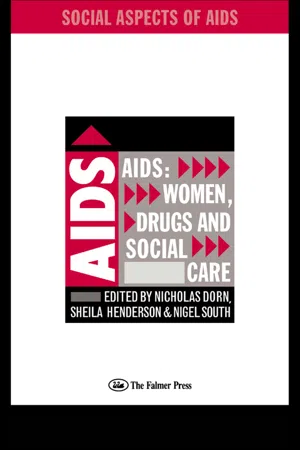
AIDS: Women, Drugs and Social Care
- 142 pages
- English
- ePUB (mobile friendly)
- Available on iOS & Android
eBook - ePub
AIDS: Women, Drugs and Social Care
About this book
Examines the circumstances, experiences and needs of HIV-positive people in Britain and Ireland, and particularly focuses on female drug-users and ex drug-users.
Information
Chapter 1
Introduction: The Research in Context
Nicholas Dorn, Sheila Henderson and Nigel South
The short programme of research reported in these pages and carried out in 19891 was conceived at a time when—despite mounting evidence that HIV/AIDS was an important issue for heterosexual women and men—the image of HIV/AIDS uppermost in the mind of the British public was still predominantly associated with gay men. The picture of HIV/ AIDS worldwide, even at that time, suggested otherwise, as most dramatically illustrated on the international stage by the epidemic in the African continent, which indicated that the virus was very much a sexual, medical, economic and social threat to heterosexuals—men and women alike. Meanwhile, US statistics suggested that AIDS was the leading cause of death in New York City among women from 20–40 years of age. In Britain, figures up to the end of March 1989 showed sixty-eight women with AIDS (@3 per cent of a total of 2,192) and 614 women who were HIV-positive (@7 per cent of a total of 8,638 people with HIV). Though comparatively small, these numbers both represented the potential shape of things to come in the epidemic and registered a growing set of needs perhaps substantively different from those currently being addressed in the HIV context.
Very little social research and very few service providers had addressed these needs and women with the virus in the UK were still finding themselves largely invisible when it came to appropriate HIV-related service delivery, general public and social policy responses.2 Given the situation, three things seemed clear to the editors: that the needs of women in the HIV context would, out of sad necessity, need to rise on the public agenda, that these needs were likely to differ in some ways from the needs of men with the virus and that social research had an important role to play in informing appropriate responses at the level of both service delivery and prevention. The Women, Risks and AIDS Project (Holland et al.,1990a, 1990b; Ramazanoglu, 1990; Thomson and Scott, 1990, 1991), which began in 1988 and still continues, was significant in seeking to contribute to HIV prevention strategy by investigating the sociological complexities of young women's sexuality. The editors, on a much smaller scale, sought to contribute to the process of developing appropriate social care responses to women with the virus via a preliminary insight into women's needs as viewed by a range of people actually or potentially affected (see note 1).
At the time, the majority of women with the virus in this country had become infected through injecting drug use—either directly through using infected equipment themselves or indirectly through unprotected sex with drug-injecting partners. It therefore seemed fitting to address the social care needs of women involved in illicit drug cultures. While this question had been addressed prior to the advent of HIV by some drug workers and researchers in the late 1970s and early 1980s (e.g. Perry, 1980; Gomberg, 1982; Cuskey, 1982) with the concrete result of DAWN (Drugs, Alcohol, Women, Nationally), both the profile of (continuing) work with women drug users and the literature had grown very little during the 1980s (for a recent study and overview of this literature see Taylor, 1991). An exception at the policy level (preceding the major rethink of drug services precipitated by HIV/AIDS) figured in the Advisory Council on the Misuse of Drugs 1984 ‘Prevention’ report (Advisory Council on the Misuse of Drugs, 1984):
Researchers and policy makers have often assumed that hypotheses and policies drawn up in response to male drug misuse are equally applicable to women…the women's movement has drawn attention to the need to conceptualise ‘social problems’ (such as the drug problem) from the point of view of women's interest and position in society…we consider that this literature raises important issues not adequately dealt with in earlier, male-centred work (p.23).
The policy response to HIV/AIDS among drug users brought with it a further official spur to consider the needs of women drug users. The Advisory Council on the Misuse of Drugs 1988 report (Advisory Council on the Misuse of Drugs, 1988), which warned that HIV was overtaking illicit drug use as a danger to public health, lent official support to a shift in drug treatment policy and practice away from purely abstinence goals and towards an emphasis upon reducing harm from drug use. The 1989 report recognized that ‘Drug services should review their policies to ensure they are receptive to the needs of women’ (Advisory Council on the Misuse of Drugs, 1989, p. 41) as an important part of the response to HIV. Since that time, important initiatives have attempted to address women drug users (Henderson, 1990) but the public profile and scope of such work have far to go, not least in addressing the specific and differing needs of women from black communities and lesbians.
Focusing upon the social care needs of women often involves striking another seam of care, the less public and often invisible range of tasks conducted by many women in the home and community. The editors considered that women within illicit drug cultures would be no exception to this role and that a partner with HIV would add to what the feminist sociological literature on informal caring has termed women's ‘double burden of care’ (e.g. Groves and Finch, 1983; Glendinning, 1983). The wider context added a sharper edge to this consideration in that the 1980s had seen the ongoing debate about community care take new shape amid policies which dramatically altered the balance between public and private responsibility for health and welfare—with major implications for the informal caring roles played by many women.
About the Book
The reader may find some further contextualization of the contributions which follow useful. The contents of this volume are based upon reports from some of the cities in which our study was conducted. They trace a path through the highly variable societal and professional reactions to women, HIV and drugs in the late 1980s. Beginning with an overview of some of the issues as expressed by women living with the virus, they move from those professional and lay carers relatively experienced in responding in constructive and supportive ways, through those still struggling to overcome their initial stereotypes, fears and lack of knowledge, to those who have no direct experience.
First, the chapter by Sheila Henderson focuses upon the issues as reported by HIV-positive women in London in early 1989. The problems facing them are given special focus—isolation, stigmatization (of self and children), coping with their own and others' fears, making decisions about pregnancy, continuing to care for themselves, their children and any male partner, and trying to pull together resources. Some attempt was made to include women with the virus in most discussion groups but at the time of the study, it (understandably) proved difficult for regional and other national researchers to encourage them to come forward and speak about their needs in a group setting. While some researchers dealt with this situation by interviewing women individually, the overall effect was such that representation of their views and experiences in other chapters is patchy. In London, the more extensive infrastructure around HIV and AIDS made such an exercise more possible.
It is clear that while HIV has made an impact worldwide, there have been considerable national variations in the way it is perceived which have tended to reflect the pattern of infection. The contribution from Shane Butler and Marguerite Woods (chapter 4) demonstrates how very particular cultural and religious factors in another country in close geographical proximity to Great Britain can shape perceptions of and responses to HIV differently.
It is also clear that, while a wave of sentiment about HIV has been articulated within Britain at a national level, there were considerable regional variations depending upon local circumstances, moral climates and campaigns. The existence of a local drug scene involving much sharing of unsterilized injection equipment has been one of those factors which, in cities such as Edinburgh, has provided a distinct profile of HIV problems. Because of the relatively high chances of transmission of the virus to a woman who may both use her partner's injection equipment and have unsafe sex, it is in such centres that rates of HIV among women climbed fastest in the 1980s. Two of the following chapters lend different dimensions to this regionalized recognition of the needs around women, drugs and HIV, highlighting the concerns of professionals, volunteers, family members and HIV-positive women in these cities in early 1989. The work of Val Morrison in Edinburgh (chapter 3) adds a new dimension to the well-publicized Edinburgh experience.
Additionally, Malcolm Colledge and Sandy Maddison (chapter 5) describe the response in the city of Newcastle in north-east England where, the researchers believed, there may have been a not entirely recognized expansion of HIV transmission by way of sharing injection equipment. Common to all these accounts are concerns with women's access to services, the question of having children, and the general need for better information at all levels.
Those professionals, voluntary workers and family members who have involvement with HIV-positive women demonstrated an ability to draw upon that direct experience and hence be less reliant upon the information and imagery conveyed by the mass media. Not so those members of the general population who have no such contact. Their judgments and opinions would appear to be more directly shaped by public images. Even members of the health and caring professions were often unsure of their feelings and the facts in respect of HIV if they had no direct experience of caring for people with HIV. These less informed responses are discussed in chapter 6, an edited report based on market research carried out by NOP Market Research Ltd. In various sites in the Southeast and Midlands of England, NOP conducted four group discussions with members of the general public, one with lay carers (by default, rather than design, all female) and four with professionals—all relatively unfamiliar with people with HIV.
As the NOP material shows, the responses of men in the general population to the hypothetical prospect of a female member of their family being HIV-positive ranged from initial incredulity (‘my wife is not a gay man, so how can she have AIDS?’), through to helplessness (‘what can I do, apart from drive her to and from the hospital?’) and outright rejection. Many of these respondents had difficulty in sustaining a discussion on the needs of women with HIV. This is hardly surprising since there clearly has been resistance to the idea that HIV and AIDS could be other than a problem affecting gay and bisexual men.
Public understandings of HIV/AIDS have arguably changed since this work was conducted. Having moved through a period where the ‘myth of heterosexual AIDS’ (re)gained significant public attention,3 the messages about HIV/AIDS have become more mixed. Equally, the quality of services for women with the virus has improved to some degree (see chapter 7). Regrettably, these developments parallel an increase in the numbers of women becoming infected. Reported HIV figures to the end of June 1991 showed that out of a total of 4,758 people with AIDS, 266 were women—an increase of 93 per cent for the year—and that there were 1,807 women with HIV out of a total of 15, 837. These reports have always been recognized as underestimates and recent anonymized screening surveys (Communicable Disease Report, 1991) have painted a more disturbing picture. In Inner London the rates of seropositivity among sexually active women would appear to be doubling every twelve months and 1 in 500 pregnant women are infected. It is much clearer now than when the research reported here was conducted that the needs of women, both in terms of prevention and service delivery, should be considered seriously in the context of HIV/AIDS. It is the hope of the editors that this collection will make some small contribution to the advancement of that process.
Notes
1 Conducted in seventeen locations in Britain and in Dublin, Ireland. In extended group discussions and individual interviews, a wide variety of people (199 in all) talked about their perspectives on women, HIV, drugs and ‘care’. The research involved members of the general population, professionals and lay carers without direct experience of HIV issues, those with some years of experience, and HIV-positive women themselves.
HIV-positive women were always seen individually or in women-only groups by a woman interviewer. There was a loose structure for the interviews and group discussions.
HIV-positive women were always seen individually or in women-only groups by a woman interviewer. There was a loose structure for the interviews and group discussions.
2 The Scottish experience was a significant exception in that, in the context of the Edinburgh experience where drug-related HIV infection was much higher than elsewhere in Britain, many more women were infected.
3 Headlines such as ‘AIDS—The Hoax of the Century’ (The Sun, 18 November 1989) were typical of many in the wake of statements publicly attributed to Lord Kilbracken (a member of the All Party Parliamentary Group on AIDS whose previous eccentric campaigns without the HIV ingredient had gone unnoticed) to the effect that ‘straight sex cannot give you AIDS’. This revival was boosted by coverage of Michael Fumento's book, The Myth of Heterosexual AIDS (1990, Basic Books) particularly in the Sunday Times.
Chapter 2
Living with the Virus: Perspectives from HIV-Positive Women in London
Sheila Henderson
Introduction
1990 saw the World Health Organization's (WHO) World AIDS Day and the international array of accompanying events and activities focus on women and AIDS. In publicity material following up this theme (WHO Global Programme on AIDS, 1990) the WHO estimated that at least eight million people were infected with HIV at that time, approximately three million of whom were women. It also predicted a cumulative total of over 600,000 women with AIDS by the end of 1992 and equal numbers of men and women with AIDS by the year 2000. WHO (WHO Features, 1990) also put AIDS as the leading cause of death for women aged between 20 and 40 years living in major cities of the Sub-Saharan region, Western Europe and the Americas. This WHO initiative to draw world attention to the impact of HIV/AIDS upon women—those infected and those involved at all levels of care—served as a prompt for policy makers and service providers and was welcomed by many who had been involved in relatively long-standing and committed activity (for Britain, see London Strategic Policy Unit, 1987) on the ground through to the official level. Its long term effect, however, has been difficult to gauge not least because there appears to have been little evaluation of local events and activities on the day, never mind their impact on policy infrastructures locally, nationally or internationally.
Turning to the national context, 1990 in Britain, although marked by ongoing attempts to explode ‘the myth of heterosexual AIDS’, also saw some revival of flagging AIDS coverage in popular magazines (Take a Break, 5 May 1990; Hello! 28 April 1990; Cosmopolitan, May 1990; 19, 12 May 1990; Vogue, April 1990; Company, May 1990), a growth in HIV posts with some remit for women, and conferences and meetings on the topic of women and AIDS. Weary readers of the Evening Standard were greeted in May by the headline ‘AIDS: Women in the Front Line. Diana hears of epidemic's second wave’ (Evening Standard, 16 May 1990, p. 15), while the following day, The Independent readers mused over ‘Why condoms are a woman's best friend’ (The Independent, 17 May, 1990, p. 16) and learnt that ‘Women infected with AIDS have doubled in last year’ (The Independent, 17 May 1990, p. 8).
A number of loose networks and groupings, formed with the aim of sharing experience and information among women affected by the virus, have also emerged. Local support groups for HIV-positive women are on the increase, although Positively Women based in London is the only national service for HIVpositive women. There has been some move among local and health authorities towards developing prevention and service strategies for women with regard to HIV and some drug agencies are attempting to improve their services for women (Henderson, 1990). Surveys of HIV-related service development for women are a growing phenomenon (Rights and Humanity, 1989; DAWN, 1992; Ryan, 1991).
Pictures of the impact of HIV upon the lives of British women are still, however, very sketchy. What follows represents an initial attempt to fill in some important details—which only women living with the virus can describe. It is directly based upon material...
Table of contents
- Cover Page
- Title Page
- Copyright Page
- Social Aspects of AIDS
- Series Editor's Preface
- Acknowledgments
- Chapter 1: Introduction: The Research in Context
- Chapter 2: Living with the Virus: Perspectives from HIV-Positive Women in London
- Chapter 3: Responding in a Crisis: Perspectives on HIV, Drugs and Women’s Needs from Edinburgh
- Chapter 4: Drugs, HIV and Ireland: Responsesto Women in Dublin
- Chapter 5: ‘Tempered Optimism’: Perspectives from Professional and Voluntary Carers in Newcastle upon Tyne
- Chapter 6: ‘It Came from Outer Space! ’: Perspectives from the General Population and Generic Health and Welfare Professionals in England
- Chapter 7: Conclusion: Progress, Prospects and Possibilities
- Bibliography
- Notes on Contributors
- Falmer Press Books on the Social Aspects of AIDS
Trusted by 375,005 students
Access to over 1.5 million titles for a fair monthly price.
Study more efficiently using our study tools.
Frequently asked questions
Yes, you can cancel anytime from the Subscription tab in your account settings on the Perlego website. Your subscription will stay active until the end of your current billing period. Learn how to cancel your subscription
No, books cannot be downloaded as external files, such as PDFs, for use outside of Perlego. However, you can download books within the Perlego app for offline reading on mobile or tablet. Learn how to download books offline
Perlego offers two plans: Essential and Complete
- Essential is ideal for learners and professionals who enjoy exploring a wide range of subjects. Access the Essential Library with 800,000+ trusted titles and best-sellers across business, personal growth, and the humanities. Includes unlimited reading time and Standard Read Aloud voice.
- Complete: Perfect for advanced learners and researchers needing full, unrestricted access. Unlock 1.5M+ books across hundreds of subjects, including academic and specialized titles. The Complete Plan also includes advanced features like Premium Read Aloud and Research Assistant.
We are an online textbook subscription service, where you can get access to an entire online library for less than the price of a single book per month. With over 1.5 million books across 990+ topics, we’ve got you covered! Learn about our mission
Look out for the read-aloud symbol on your next book to see if you can listen to it. The read-aloud tool reads text aloud for you, highlighting the text as it is being read. You can pause it, speed it up and slow it down. Learn more about Read Aloud
Yes! You can use the Perlego app on both iOS and Android devices to read anytime, anywhere — even offline. Perfect for commutes or when you’re on the go.
Please note we cannot support devices running on iOS 13 and Android 7 or earlier. Learn more about using the app
Please note we cannot support devices running on iOS 13 and Android 7 or earlier. Learn more about using the app
Yes, you can access AIDS: Women, Drugs and Social Care by Nicholas Dorn, Sheila Henderson, Nigel South, Nicholas Dorn,Sheila Henderson,Nigel South in PDF and/or ePUB format, as well as other popular books in Social Sciences & Education General. We have over 1.5 million books available in our catalogue for you to explore.