
- 339 pages
- English
- ePUB (mobile friendly)
- Available on iOS & Android
eBook - ePub
About this book
Business success hinges on successfully creating products with the right features. You must correctly analyze the needs of the customer and match these needs with your resources to not only produce a product and but also deliver it in a timely manner. An in-depth understanding of systematic release planning can put you on this path. Authored by ren
Information
Part B: Methods



Chapter 4
Planning for Product Releases: An Overview
4.1 Introduction
Already being late in the process of creating the next release of an evolving product, your customers and stakeholders are continuously changing their opinion, are asking for new or revised features and services. Their actual expectations are different from what the product manager thought they were. In total, their wish list far exceeds the capacity of the development resources available. Some of the resources originally planned for are at risk of not being available. Looking at the individual customer’s wish lists in more detail, their preferences differ quite substantially between each other. But how can you satisfy the needs of one stakeholder without ignoring the needs of the others?
Most critical product decisions are made in the early phases of the product life-cycle. Any failures or omissions done at this stage usually have a larger impact compared to later stages. Consequently, qualifying the early stage process may affect directly the product success [Smith and Reinertsen ‘98]. Planning the right sequence of product releases is an essential part of this effort. The challenge of the product managers is to make release decisions in consideration of multiple criteria such as time-to-market, customer satisfaction, business value, competitiveness, and risk. Under the pressure of time and project complexity, the release decisions are often done ad hoc, mainly relying on intuition and experience. The result of this might be one or more of the following deficits:
Deficit in quality: Because of having committed to the “wrong” set of features and the lack of resources available to realize them, trade-offs need to be made in the quality of the delivered product releases in order to maintain the agreed upon release dates.
Deficit in business: Your products do not really penetrate the market as your competitors are more successful in bringing the right features at the right time to the right customers. Key business opportunities have been missed, resulting in a lack of profit.
Deficit in process: In the course of implementing the committed next release, it becomes clear that there is a lack of resources to provide all the announced features at the announced release date. Re-planning and process changes have to be implemented, creating additional risks for timely shipping of the product.
Deficit in customer satisfaction: The product delivered is not what the customers expected, leading to customer dissatisfaction. Satisfied customers are critical for the business and the image of the company.
In this chapter, an overview about product release planning is given. In Section 4.2, release planning is positioned as part of a hierarchy of planning activities. An overview of the process and content of release planning is the content of Section 4.3. Some rigorous release planning methods are explained and compared to each other in Section 4.4. As a result of performing a series of semi-formal interviews and doing a questionnaire, a reflection of the current state-of-the-practice is given in Section 4.5.
4.2 The Planning Onion
Planning of product releases is part of a hierarchy of planning activities. Their principal relationship is described by the planning onion introduced by [Cohn ‘06] and is illustrated in Figure 4.1.
The planning onion describes the hierarchical relationship between the different objects of planning. This relationship is valid independent of the actual product development paradigm. Daily operational planning is the refinement of planning for iterations. Different iterations constitute a release, and releases describe the evolution of a product. This evolution is often also called a product roadmap. A combination of different products constitutes a product portfolio. At the highest level, planning is done based on portfolios constituting the company’s strategy.
The planning onion has an operational perspective at the core and gradually moves to a strategic perspective. Daily planning assigns human resources to specific tasks and sub-tasks. Strategic planning looks into the future, for example, three years from now. The overall business success of a company depends on a synchronized process between all these layers. Daily and operational planning becomes difficult if the proper release plan is missing. In the same way, release plans need to be well-aligned with the product and portfolio strategy of a company.
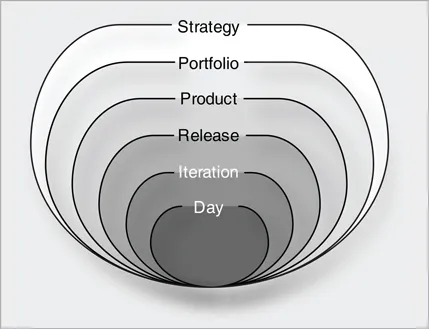
Figure 4.1 The planning onion ([Cohn’06] Agile Estimating and Planning, 1st, ©2006. Electronically reproduced by permission of Pearson Education, Inc., Upper Saddle River, New Jersey)
Release planning differs from iteration planning in the scope and the level of detail. Roughly speaking, release plans are major milestones in the evolution of a product. The time periods for a release depend on the type of the product, the underlying business model, and the type of development processes applied. Iteration plans (again, independent of the development paradigm) are refinements of a release plan. For the next release period, iterations are defined in which the sequence of the release functionality will be developed. This includes assignment of resources to individual tasks, as studied in Chapter 8 of this book. Iteration planning and release planning are going hand-in-hand. One without the other will result in weaker results.
4.3 Release Planning in a Nutshell
As software and other products are getting more and more complex and larger in size, incremental and iterative development is rapidly replacing monolithic product creation approaches [Larman and Basili ‘03]. The key difference between phased (subsuming iterative and incremental) development and the monolithic approach is the concept of creating the overall product in different stages. The key idea of incremental development is the delivery of a sequence of increments. Developing systems through incremental releases first requires providing essential operating functions, then providing system users with improved and more and more capable versions of a system at regular intervals [Basili and Turner ‘75]. One of the most prominent issues involved in incremental and iterative software development is to plan for its releases.
Release planning is the critical process of deciding which features are implemented in which releases. In reality, the set of features is permanently updated because new features continually arrive and become integrated into the product. Other (existing) features need to be revised. In most cases, both the resources and the timing are not sufficient to implement everything in one release. Consequently, features need to be postponed or sometimes even completely rejected.
Release planning needs to be continued as long as the product evolves. In Figure 4.2, release planning is illustrated as part of an ongoing product evolution process. In this example, planning is done for the next three release periods. These periods are generally called k, k+1 and k+2. Let’s assume that 13 versions of an evolving product have already been released. The feature repository maintains all features proposed, all the ones existing, and all the ones requested for an update. The product planning is then done for releases k = 14, k+1 = 15 and k+2 = 16. At the end of each period, the resulting release is called product release 14, 15 and 16, respectively.
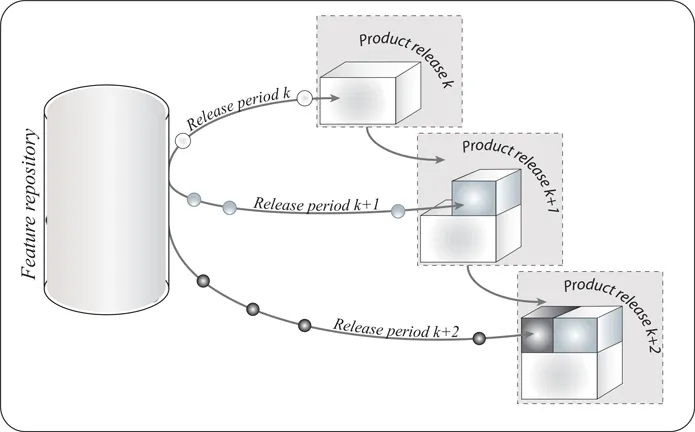
Figure 4.2 Release planning as the selection and assignment of features to releases
4.4 Rigorous Release Planning Methods
4.4.1 Overview
Different models and related release planning methods have been proposed over the last decade. In this chapter, six methods are briefly explained. All these methods use some formalized problem description. As such, they are different from informal planning, also called planning on-the-fly. More specifically, the following methods are studied:
- Greedy release planning
- Optimizing value and cost in requirements analysis [Jung ‘98]
- The next release problem [Bagnall et al. ‘01]
- The incremental funding method [Denne and Cleland-Huang ‘04]
- Software release planning: An evolutionary and iterative approach [Greer and Ruhe ‘04]
- Software product release planning through optimization and what-if analysis [van den Akker et al. ‘08]
4.4.2 Greedy release planning
Creating a release plan based on the information of both the feature priority and the resource consumption is often done in reality using some form of a greedy approach. Greedy algorithms are a widely applied iterative solution technique aimed at finding a good global solution by determining the local optimum choice at each stage [Cormen et al. ‘06].
What is provided here is an easy variant of the general greedy algorithm which does not consider any type of dependencies between fe...
Table of contents
- Cover
- Half Title
- Title Page
- Copyright Page
- Table of Contents
- Foreword
- Acknowledgments
- Part A: Foundations
- Part B: Methods
- Part C: Tools
- Part D: Applications
- References
- Index
Trusted by 375,005 students
Access to over 1.5 million titles for a fair monthly price.
Study more efficiently using our study tools.
Frequently asked questions
Yes, you can cancel anytime from the Subscription tab in your account settings on the Perlego website. Your subscription will stay active until the end of your current billing period. Learn how to cancel your subscription
No, books cannot be downloaded as external files, such as PDFs, for use outside of Perlego. However, you can download books within the Perlego app for offline reading on mobile or tablet. Learn how to download books offline
Perlego offers two plans: Essential and Complete
- Essential is ideal for learners and professionals who enjoy exploring a wide range of subjects. Access the Essential Library with 800,000+ trusted titles and best-sellers across business, personal growth, and the humanities. Includes unlimited reading time and Standard Read Aloud voice.
- Complete: Perfect for advanced learners and researchers needing full, unrestricted access. Unlock 1.5M+ books across hundreds of subjects, including academic and specialized titles. The Complete Plan also includes advanced features like Premium Read Aloud and Research Assistant.
We are an online textbook subscription service, where you can get access to an entire online library for less than the price of a single book per month. With over 1.5 million books across 990+ topics, we’ve got you covered! Learn about our mission
Look out for the read-aloud symbol on your next book to see if you can listen to it. The read-aloud tool reads text aloud for you, highlighting the text as it is being read. You can pause it, speed it up and slow it down. Learn more about Read Aloud
Yes! You can use the Perlego app on both iOS and Android devices to read anytime, anywhere — even offline. Perfect for commutes or when you’re on the go.
Please note we cannot support devices running on iOS 13 and Android 7 or earlier. Learn more about using the app
Please note we cannot support devices running on iOS 13 and Android 7 or earlier. Learn more about using the app
Yes, you can access Product Release Planning by Guenther Ruhe in PDF and/or ePUB format, as well as other popular books in Computer Science & Business General. We have over 1.5 million books available in our catalogue for you to explore.