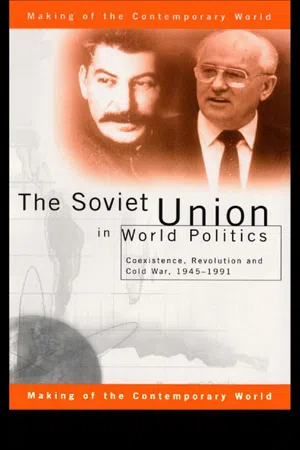
The Soviet Union in World Politics provides an introductory history of Soviet foreign policy and international relations from 1945 to the end of the Cold War and the break up of the USSR. The book summarizes historical and political controversies about Soviet foreign policy and brings the latest research to bear on these debates.
The Soviet Union in World Politics interprets the latest evidence available from the Soviet archives and includes
* summaries of the main events in Soviet Policy from 1917-1945
* a framework for student discussion of relevant issues
* guides to further reading and research
* exploration of the role of ideology in the Cold War
* discussion of Stalin's role in the formulation of policy.
eBook - ePub
The Soviet Union in World Politics
Coexistence, Revolution and Cold War, 1945–1991
- 142 pages
- English
- ePUB (mobile friendly)
- Available on iOS & Android
eBook - ePub
About this book
Information
1
Perspectives on postwar Soviet foreign policy
INTRODUCTION
For nearly 50 years after the Second World War the Soviet Union played a decisive role in defining the shape and pattern of world politics. Before the Second World War the Soviet state was only an intermittently important actor in European politics, often ignored or marginalised by the other great powers. After the war, however, the Soviet Union came to head a powerful military-political bloc of states in eastern Europe. In the 1960s and 1970s the Soviet Union emerged as a global, nuclear superpower—involved in all the major developments, issues and crises of world politics. At the same time the Soviet Union remained a communist state, officially committed to the establishment of a global socialist system. Indeed, at times during the postwar period—as Soviet and communist influence spread across the world—it seemed that Moscow’s trumpeting of the historical inevitability of socialism was more than mere hyperbole. In the late 1980s, however, it was not capitalism but communism that collapsed, first in eastern Europe and then in the Soviet Union itself.
The dramatic fall of communism and then the break up, in 1991, of the Union of Soviet Socialist Republics (USSR)—the multinational state ruled by the communists for over 70 years—was a surprising end to a story that begins (for the purposes of this text) with the Soviet victory over Nazi Germany in 1945. The Red Army’s repulse of the German invasion of Russia and its victorious march to Berlin was the mightiest feat of arms the world had ever known. The communist system survived the supreme test of war and, by the end of hostilities, the Red Army occupied half of Europe. Stalin, the Soviet dictator, was a figure of admiration and adulation at home and abroad. Across the continent there was a massive upsurge of popular support for communism and left-wing politics. In these circumstances no one doubted the importance and centrality of the USSR to the future of domestic and foreign politics in Europe.
But the USSR was not the only victor of the Second World War, and not the only arbiter of the peace. In 1945 it was expected that the wartime coalition of Britain, the Soviet Union and the United States would continue in peacetime—that the Grand Alliance which had won the war would jointly shape and safeguard a new, peaceful, postwar world order. That was the prospect proclaimed by the leaders of the Grand Alliance at the Yalta and Potsdam conferences and the vision acclaimed by the citizenry of the victorious allied nations. But the peacetime Grand Alliance proved to be short-lived. By 1947–8 what was called a ‘cold war’ broke out between the Soviet Union and its erstwhile coalition partners. From that point on, the postwar history of Soviet foreign policy was intimately bound up with the USSR’s involvement in the cold war.
SOVIET FOREIGN POLICY AND THE COLD WAR
The ‘cold war’ is a term that refers to the state of tension, hostility, competition and conflict which characterised Soviet-western, and more particularly, Soviet-American, relations for much of the postwar period. The most overt face of the cold war was the east-west division of Germany, a Europe divided by the so-called ‘iron curtain’ into competing liberal-democratic and communist camps, and the emergence of two antagonistic military-political alliances, NATO and the Warsaw Pact. Then there were the great international crises of the cold war era— Berlin, Korea, Cuba, Vietnam—which at times seemed to threaten the outbreak of a new world war. Adding to the drama of these moments of cold war confrontation was the perception of a deeper economic, political and ideological competition between the Soviet and western blocs—a competition not just of power blocs but between capitalism and socialism, between different socio-economic and cultural systems and traditions.
To those who fought the cold war—the much-maligned ‘cold warriors’—there was far more at stake than geopolitical position or economic interests. The ‘other side’ was viewed as threatening not just vital interests, but one’s core values and identity as well. In the Soviet case the stakes were seen as high indeed: the survival of the socialist system, the maintenance of working-class power and communist party leadership, humanity’s future in a collectivist, communist utopia.
But, sharp and intense as the conflict was, both sides had an interest in constraining the cold war, in limiting and controlling the rivalry and competition, in achieving a degree of stability, order and predictability in world politics. Not the least compelling reason for containing the conflict was the existence of nuclear weapons—which threatened mutual annihilation in the event of the outbreak of a ‘hot war’ between the great powers. There were also various economic, political and ideological incentives to relax the tension, to foster what became known in the 1960s as ‘détente’. Peace was, among other things, good for trade, good propaganda value and good for domestic and international political prestige.
The history of the cold war is a story, as John Lewis Gaddis has put it (Gaddis, 1987), of a ‘long peace’, as well as a protracted and dangerous conflict, of strivings for co-operation as well as competitive advantage. Indeed, conceptualising postwar international relations purely in terms of the cold war is a very western perspective. Viewed from Moscow, the story of postwar Soviet-western relations should, perhaps, be recast as a story of the struggle for peaceful coexistence and détente interrupted by the periodic outbreaks of cold war.
It is conventional to date the cold war as lasting from the mid-1940s to the late 1980s. But, as we shall see, for many of those years something approximating a détente (or attempts at a détente) was characteristic of east-west relations. Much of the 1950s, most of the 1960s, the first half of the 1970s and the second half of the 1980s were periods of reducing international tension, indeed of political and ideological relaxation in the capitalist-communist struggle.
From the Soviet leadership’s point of view—from Stalin to Gorbachev—the periodic outbursts of cold war were something thrust upon them by an aggressive and threatening western alliance. Their preferred option was the coexistence of capitalism and socialism, mutually beneficial co-operation between the two systems, and peaceful competition to determine which side was economically, socially and culturally superior. Of course, Moscow believed in and desired the achievement of socialism on a world-wide scale and saw the building of the communist system in the USSR as part of an inexorable historical transition from capitalism to socialism. The Soviet leadership believed, too, that peaceful coexistence and détente provided a favourable context for the revolutionary struggle for socialism in the capitalist and imperialist world—a struggle which the Soviet Union would aid ideologically, politically and materially. But, so the Soviets believed, the future march of history did not mean that you could not do business with the capitalists in the present, nor did it preclude inter-state and inter-system co-operation on matters of common interest.
PEACEFUL COEXISTENCE AND REVOLUTION
As its subtitle and contents indicate, this book is organised around the dual theme of the Soviet pursuit of peaceful coexistence and the linked aspiration to the revolutionary spread of socialism on a world-wide scale. This doctrine-cum-policy of ‘peaceful coexistence’ dated back to the early 1920s when the Bolshevik revolutionaries who had seized power in the Tsarist Russian Empire in 1917 began to seek a modus vivendi with the capitalist world. The capitalist states which the Bolsheviks sought to develop relations with were the same countries that had aided their ‘counter-revolutionary’ enemies in the Russian civil war of 1918–21. At first, therefore, the pursuit of peaceful coexistence was conceived as a short-term tactic designed to inhibit further capitalist attacks on the USSR, pending the spread of revolution to other countries. But, as the prospect of world revolution receded even further, as the peace with the capitalist states lasted longer than expected, and as the building of socialism in the USSR came to assume ever-greater priority, a temporary tactic was transformed into a permanent strategy. Socialism in the USSR would be safeguarded not by the revolutionary overthrow of capitalism on a world-wide scale but by peaceful coexistence with the capitalist states.
After the Second World War the doctrine of peaceful coexistence underwent many modifications. Of prime importance in the early postwar years was the fact that the socialist camp now consisted not of an isolated and vulnerable USSR, but a bloc of communist-controlled countries headed by an emerging global superpower. Peaceful coexistence was, therefore, recast in more assertive and aggressive terms as a relationship imposed on capitalism and imperialism by the superior strength of socialist forces. In the 1950s, more and more emphasis came to be placed on peaceful coexistence as a means of avoiding a catastrophic nuclear war that would make redundant the political and economic competition between the socialist and capitalist systems. In the 1960s and 1970s—in the heyday of détente—peaceful coexistence came to mean positive co-operation, collaboration and interchange with the west. But that did not mean the abandonment of the USSR’s global socialist aspirations; détente was seen as part of the process of consolidating the position of the socialist camp and as the harbinger of further shifts to the left in world politics. The revolutionary-political dimension of peaceful coexistence was abandoned only in the very last years of the Soviet regime when the communist reformer Mikhail Gorbachev radically redefined the USSR as a status quo power committed more to the spread of humanism than socialism.
This focusing on peaceful coexistence as an ideology of coexistence and revolution is only one way of conceptualising postwar Soviet foreign policy. It should certainly not be seen as providing a neat explanation for everything Moscow did in the international arena. Peaceful coexistence was a doctrinal and strategic context for action— a referential framework for the main orientations of Soviet foreign policy, not a dictator of specific decisions. To explain the particular actions and patterns of Soviet foreign policy it is necessary to take other factors into account. In order to tease out some of these other explanatory factors it will be useful to consider some alternative perspectives on the main thrust and pattern of Soviet foreign policy in the postwar period. These we will call the perspectives of ‘security’, ‘power’, ‘ideology’ and ‘politics’.
SECURITY, POWER, IDEOLOGY AND POLITICS
The security perspective is the view that the driving force of Soviet foreign policy was the search for national security in what was perceived to be a hostile and threatening world. The cold war, it should be noted, was always an unequal struggle, which the Soviet Union waged from a position of relative economic and military weakness. Within this perspective the emphasis is on the defensive and reactive character of Moscow’s foreign decision-making, on the limits of Soviet international ambitions, and the centrality of security considerations to calculations of foreign policy.
This security perspective has much to commend it: it captures the essential insecurity of the Soviet orientation to the outside world; focuses attention on the very real national security issues and dilemmas confronting Moscow; and provides an analytical key to explain most, if not all, the major acts of postwar Soviet foreign policy. The limitation of this perspective is that it underestimates the extent to which the USSR was a revolutionary state committed to a radical transformation of the international status quo. Such a commitment meant that in practice the USSR pursued political aims which went far beyond what was required for the sake of security. It meant continued adherence to a Marxist-Leninist view of international relations and world politics. It meant proclaiming and speaking the language of revolutionary politics. All this lent Soviet foreign policy a very particular and peculiar character—one which eludes analysis solely in terms of traditional diplomacy and statecraft in pursuit of national security.
Calculations, relations and necessities of power dominate the second of the two perspectives. The power perspective is the view that, in the postwar period, the Soviet Union was locked in a power struggle with the United States. That power struggle was a consequence of the Second World War which saw the destruction of the traditional European state-system, the decline and fall of the European great powers and the creation of a geopolitical power vacuum in the very heart of Europe which was filled by the emergent competing interests of the American and Soviet superpowers. In this view the cold war conflict was characterised by the pursuit of power as a means of achieving security in the face of the threat of expansionary encroachments by the other side.
Viewing the cold war as a power contest has its attractions. Power calculations and manoeuvres were certainly an important dimension of postwar Soviet foreign policy. Like their counterparts in the west, the Soviets fought the cold war with the aim of gaining a competitive edge that was, more often than not, defined in power terms. It is also true that the available resources of power—military, political, economic— could be either a crucial constraint on or an enabler of action. The power perspective can also help to explain how it was that the cold war became a global rivalry and competition. The cold war game of seeking power and influence knew no geographical bounds.
But recognising the power factor in Soviet foreign policy, in the cold war and in world politics is not the same as endorsing the power perspective. That would require the endorsement of one or other version of ‘realism’—the view that international relations is fundamentally about power politics, that the actions of states are best understood in terms of systems and relations of power. However, Soviet foreign policy is better conceived as being part of a system of action and interaction rather than a structure of power. Soviet policy-makers acted within a context which was not entirely of their making and over which they had only limited control. But the most important part of that context consisted of other human actors, their actions and the states and organisations they represented. The cold war was a human conflict that was initiated, sustained and brought to an end by human beings acting on the basis of changed perceptions and attitudes. Of course, sometimes Soviet actions conformed (or appeared to conform) to realist power-politics models of state behaviour, but often they did not. It is impossible, for example, to explain Gorbachev’s foreign policy actions —his voluntary relinquishment of vital Soviet interests and positions— within a realist framework of analysis. Gorbachev’s giving up of power can be explained away by realist analysis, but not truly accounted for by it. To explain Gorbachev’s foreign policy it is necessary to refer to the revolution in Soviet ideology that occurred after he became leader.
Both the security and the power perspectives would tend to downplay the role of ideology in Soviet foreign policy. ‘Ideology’ in this context refers to the Soviet regime’s official doctrine of Marxism-Leninism and associated views and analyses of international relations and foreign policy. Ideology’s role was to define certain international goals for the Soviet state and to act as the conceptual framework through which to filter perceptions and experience.
One example of an ideology perspective on Soviet foreign policy is this book, whose basic argument is that ideologically informed conceptions of peaceful coexistence provided a strategic context of action for Soviet decision-makers. But there are other perspectives— which offer competing accounts of what the content of Soviet ideology was and how it related to policy practice. For example, a view popular in the west during the cold war era was that the USSR was a state driven by a messianic ideology which directed a programme of territorial and political expansionism in order to achieve a communist world in the Soviet Union’s own image. Variations of that view included the argument that Soviet communist ideology was reinforced by a preexisting tradition of foreign expansionism—notably, Tsarist Russia’s drive for security by the occupation of space. Yet others emphasised the importance of the Marxist-Leninist conceptual apparatus which viewed world politics in terms of capitalism, imperialism and the class struggle.
What unites these different accounts of the role of ideology is the view that the self-proclaimed ideological bases of Soviet foreign policy should be taken seriously. The USSR was an ideological state. It had an ideologically driven programme for the transformation of world politics; an ideological view of international relations; and an ideological self-image of Soviet foreign policy. The great strength of an ideology perspective is that it is able to focus on what is most obvious about Soviet foreign policy: its ideological character. The main problem with this perspective is that while it might offer a series of plausible explanations and interpretations of Soviet foreign policy, the connections posited between abstract ideas and concrete foreign policy actions are often difficult to establish. While there is sometimes clear evidence of ideological motive and reasoning, it is often impossible to disentangle the ideological factor from calculations of power and security in the making of Soviet foreign policy.
Another problem for this perspective is that while ideology may be the prompter and shaper of action it also, in the Soviet case, performed a complex of other functions: political propaganda, policy legitimation, popular mobilisation domestically and internationally. To what extent, then, was ideology an instrument rather than a shaper of Soviet foreign and domestic policy? Nor is specifying the content of the ideology without its difficulties because Soviet ideology was not static but ever-changing, subject to different interpretations by its adherents, and not always internally consistent and coherent. Finally, ideology is a very individual and personal thing. The character and depth of ideological beliefs and commitments and how these express themselves in practice varies from person to person. The question always has to be posed: whose ideology, whose action, whose purpose?
The analysis of ideology is further complicated by considerations emanating from the politics perspective on Soviet foreign policy. This is the view that emphasises...
Table of contents
- COVER PAGE
- TITLE PAGE
- COPYRIGHT PAGE
- MAPS
- ACKNOWLEDGEMENTS
- CHRONOLOGY OF HIGHLIGHTS IN SOVIET FOREIGN POLICY, 1945–91
- 1: PERSPECTIVES ON POSTWAR SOVIET FOREIGN POLICY
- 2: COEXISTENCE, REVOLUTION AND THE COLD WAR, 1945–56
- 3: COEXISTENCE, CRISIS AND SCHISM: THE KHRUSHCHEV ERA, 1956–64
- 4: THE RISE AND FALL OF DÉTENTE, 1964–85
- 5: FROM COEXISTENCE TO COLLABORATION: THE GORBACHEV REVOLUTION, 1985–91
- 6: CONCLUSION: THE SOVIET FACTOR IN WORLD POLITICS, 1945–91
- BIOGRAPHICAL NOTES ON MAJOR SOVIET FIGURES
- GLOSSARY OF KEY TERMS
- GUIDE TO FURTHER READING
- SELECT BIBLIOGRAPHY
Trusted by 375,005 students
Access to over 1.5 million titles for a fair monthly price.
Study more efficiently using our study tools.
Frequently asked questions
Yes, you can cancel anytime from the Subscription tab in your account settings on the Perlego website. Your subscription will stay active until the end of your current billing period. Learn how to cancel your subscription
No, books cannot be downloaded as external files, such as PDFs, for use outside of Perlego. However, you can download books within the Perlego app for offline reading on mobile or tablet. Learn how to download books offline
Perlego offers two plans: Essential and Complete
- Essential is ideal for learners and professionals who enjoy exploring a wide range of subjects. Access the Essential Library with 800,000+ trusted titles and best-sellers across business, personal growth, and the humanities. Includes unlimited reading time and Standard Read Aloud voice.
- Complete: Perfect for advanced learners and researchers needing full, unrestricted access. Unlock 1.5M+ books across hundreds of subjects, including academic and specialized titles. The Complete Plan also includes advanced features like Premium Read Aloud and Research Assistant.
We are an online textbook subscription service, where you can get access to an entire online library for less than the price of a single book per month. With over 1.5 million books across 990+ topics, we’ve got you covered! Learn about our mission
Look out for the read-aloud symbol on your next book to see if you can listen to it. The read-aloud tool reads text aloud for you, highlighting the text as it is being read. You can pause it, speed it up and slow it down. Learn more about Read Aloud
Yes! You can use the Perlego app on both iOS and Android devices to read anytime, anywhere — even offline. Perfect for commutes or when you’re on the go.
Please note we cannot support devices running on iOS 13 and Android 7 or earlier. Learn more about using the app
Please note we cannot support devices running on iOS 13 and Android 7 or earlier. Learn more about using the app
Yes, you can access The Soviet Union in World Politics by Geoffrey Roberts in PDF and/or ePUB format, as well as other popular books in Historia & Historia del mundo. We have over 1.5 million books available in our catalogue for you to explore.