- 176 pages
- English
- ePUB (mobile friendly)
- Available on iOS & Android
eBook - ePub
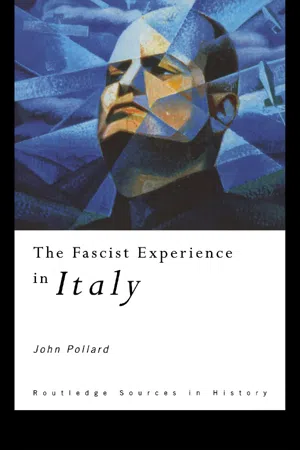
The Fascist Experience in Italy
About this book
This source book examines the development of Italian Fascism, and surveys the themes and issues of the movement. It spans from the emergence of the united Italian state in the nineteenth century, to the post-war aftermath of fascism. It provides:
* analysis of propaganda and Mussolini's journalism
* new documentary material, previously unavailable in English
* an extensive range of other source material, including images
* thematic coverage of major topics such as the transformation of agrarian and urban society
* analysis of the political, social, and economic status of Italy
* the legacy of fascism in modern Italy.
John Pollard also includes extensive notes on sources as well as a glossary and guide to further reading.
Information
1
The ‘pre-history’ of Italian Fascism
Introduction
Though Italian Fascism was to a great extent a child of Its time, it did not suddenly appear from nowhere. It had roots in pre-First World War political and cultural movements, and also in the war itself. Moreover, its success cannot be properly understood outside the broader context of Italy’s political, economic and social development following its emergence as a unified state in the middle of the nineteenth century. Denis Mack Smith, for example, sees it as the logical consequence of all the weaknesses and defects of the Liberal state created at unification, and above all the failure after unification to bridge the gap between ‘legal’ Italy, the rulers, and ‘real’ Italy, the ruled (Mack Smith, in A.W.Salamone, 1970, pp. 103–1 1). Fascism was not inevitable in this historical context, but it would have been impossible without it.
The Unification of Italy
The emergence of the united Italian state between 1861 and 1870 was ultimately the outcome of a complex of interrelated processes of cultural, social and political change known as the ‘Risorgimento’, meaning the resurgence or rebirth of Italy, stretching back into the mid-eighteenth century. Though the great prophet and leader of Italian nationalism, Giuseppe Mazzini, had urged that Italy would only win her freedom from foreign rule and achieve unification through popular revolution, Italian independence and unification were brought about by a small, dynamic elite, the moderate Liberals led by Camillo Cavour, and a pre-national state, Piedmont, using the unrevolutionary means of diplomacy and war in 1859–61 (unification of all Italy except Venetia and the area around Rome), 1866 (incorporation of Venetia) and 1870 (conquest of Rome). Despite popular participation in the manning of the barricades in the revolts of 1848, and the romantic role played by Garibaldi, his ‘Thousand Redshirts’ and their peasant followers in 1860, the masses were notably absent from the events which brought about independence and unification.
Liberal Italy and its Problems
The unified state—‘Liberal Italy’—which emerged from the Risorgimento was largely the creation of a tiny elite, the northern and central Italian ruling class. The failure to involve the masses in the struggles for independence and unification was primarily due to that class’s fear of social revolution on the one hand, and the lack of an agrarian programme by the more radical, Mazzinian, wing of the national movement on the other. This ‘failed’ or ‘passive revolution’ was to have serious consequences, for the unified state was really two Italys rather than one—‘real’ Italy and ‘legal’ Italy. According to Christopher Seton-Watson, “‘Legal” Italy was the King and parliament, the politicians and bureaucrats concentrated in a distant capital: “real” Italy was the mass of the peasant population. Communication between the two was rare and unfriendly’ (Seton-Watson 1967, p. 25). Contact between the two Italys was most rare in the Southern regions, and indeed became extremely hostile during the ‘Great Brigandage’, a virtual civil war that ravaged the South in the years immediately following unification. The brigands were a mixture of organised criminal bands, demobilised soldiers from the Neapolitan and Garibaldinian armies and peasants escaping both the taxes and conscription imposed by the new state and the exactions of their grasping landlords. Setting the pattern for the future treatment of lower-class discontent by the state, the new national government suppressed the brigands by brute, military force. This reinforces claims by later commentators, most notably the Southerner Gramsci, that the South was ‘conquered’ by the North, rather than united to it, and had thus become its ‘colony’ rather than an integral part of a new nation state.
The failure of successive governments to solve the appalling problems at the root of recurrent peasant discontent and violence in the South was the result of the alliance which the Northern ruling class had concluded with its Southern counterpart, an alliance which was one of the main bases of the Italian political system after unification. This ruling class was given a virtually free hand in its relations with the peasantry and its corrupt control of local government in return for supporting national government at election time. One long-term consequence was that some of the worst features of Southern society, clientelism and even collusion with organised criminality—mafia—eventually passed into the general Italian political culture and practice.
Given the leading role played by Piedmont during the struggles for independence and unity, it is hardly surprising that the political system of the new Italy should have been fashioned in her image. Thus, Italy in 1861 received not a new ‘tailor-made’ constitution drawn up by a widely elected constituent assembly, as Mazzini and the republicans had desired, but the Statuto, the existing constitution of Piedmont. Under this constitution, D’Azeglio, Cavour and their moderate liberal successors in the premiership developed a system of parliamentary government in which, in practice, the power of the monarch was limited. But the King still retained considerable powers, should he choose to use them.
Document 1.1
The Statuto Albertino: 1848
The ministers are responsible… The executive power belongs to the King alone. He is the supreme head of the state: he commands all the land forces and naval forces; he declares war, he makes treaties of peace, alliance, commerce, etc., informing parliament of them as soon as the interests and security of the state permit.
Source: S.J.Woolf, The Italian Risorgimento, 1969, pp. 51–3
The document does not say to whom the ministers were responsible but it did provide a constitutional basis for the King to play a decisive role in Italian politics at times of national emergency, which is exactly what he did during the ‘End of Century Crisis’, in the Intervention Crisis of 1915, at the time of the March on Rome in October 1922 and at the collapse of Fascism in July 1943. Monarchs always held themselves a little aloof from the hurly-burly and ‘squalor’ of parliamentary politics; more closely involved, in fact, in what Martin Clark has described as ‘high politics’, the activities of the diplomatic and military elites (Clark, 1996, p. 44).
Though parliament was undoubtedly Italy’s most truly national institution, it was also a weak, flawed one, its main weakness lying in the very narrow franchise which was restricted by age, gender, literacy, tax and property qualifications to less than 2 per cent of the population. Even after the electoral reform of 1882 a mere 8 per cent had the vote. In these circumstances, until the suffrage was extended to the bulk of the male population in 1912, Italy was ruled by a tiny, exclusive political class whose essential homogeneity of ideology and socio-economic class interests, that is, those of the urban upper bourgeoisie and the landed aristocracy, prevented the emergence of a party system. Apart from the Radicals and Republicans (and after 1892 the Socialists and 1903 a handful of Catholics), almost all Italian politicians before the First World War were merely of different shadings of a broadly liberal-conservative hue. As a result of small constituencies, electoral corruption and clientelism was commonplace, especially in the South. At a national level, political leaders, most notably Agostino Depretis, who was prime minister three times between 1876 and 1887, resorted to ‘transformism’, a superior form of bribing their opponents, in order to create and sustain parliamentary majorities. Francesco Crispi, a leading politician of the ‘Left’ between 1861 and 1896, provided a description of transformism in action in a speech to his constituents.
Document 1.2
Transformism in Operation
You should see the pandemonium at Montecitorio (the Chamber of Deputies) when the moment approaches for an important division. The agents of the government run through the rooms and corridors, to gather votes. Subsidies, decorations, canals, bridges, roads, everything is promised: sometimes an act of justice long denied, is the price of a parliamentary vote.
Source: quoted in C. Seton-Watson, Italy from Liberalism to Fascism, 1967, p. 92
It should be pointed out, however, that Crispi was to use exactly the same methods himself when he became prime minister. Clientelism, the winning of votes at a constituency level through the distribution of favours to ‘clients’ was the other side of the coin of ‘transformism’. As one member of parliament wrote in 1886, ‘A Deputy has to find jobs for people, secure verdicts for his supporters in criminal and civil cases alike, help others to pass their examinations or get pensions, promote or oppose public and private contracts. He has to get convicts released, civil servants punished or removed, obtain roads and bridges for his constituents’ (quoted in King and Okey, 1909, p. 24). Such was the stuff of Italian politics in the Liberal era.
It also has to be said that some of Italy’s most powerful leaders, most notably Cavour between 1854 and 1861, Francesco Crispi in the 1880s and 1890s and Giovanni Giolitti in the early 1900s, while paying lipservice to parliamentary institutions, often treated them with scant respect. Cavour has frequently been condemned for his ‘parliamentary dictatorship’, which included a habit of arbitrarily quashing his opponents’ elections wholesale; Crispi both reduced the electorate and shut down parliament for long stretches when it suited him; and Giolitti achieved political stability through a parliamentary majority which, in the South at least, was largely produced by extensive bribery and corruption. As a result, parliament enjoyed little prestige, even among sections of the political class itself.
The other most characteristic feature of the new Italian state was the rigidly centralised control of local government through the Napoleonic system of prefects (provincial governors) and the police. Initially, the adoption of this system was largely a matter of administrative convenience, but it was also seen as an essential corrective to the strong, centrifugal tendencies of regionalism and localism that survived from the pre-unification period. In the 1860s at least, Italy’s rulers were afraid that without it the new state which they had created would fall to pieces. Later it also served as a defence for the country’s tiny ruling class against the violent protests of the discontented and disenfranchised masses, and in the late 1920s it would serve as an ideal base on which the Fascists could build their one-party police state.
The Roman Question
The isolation of the ruling class of Liberal Italy was exacerbated by the hostility of the Catholic Church, which could have been such a powerful source of moral support and legitimacy for the new state, as it was in Austria and the France of Napoleon III. The conflict between Church and state, which after 1870 was conventionally referred to as the ‘Roman Question’, originated in the Risorgimento. The moderate Liberals’ modernising programme led to the enactment of legislation which wrested control of marriage law and education from the Church and severely cut back its property and legal privileges. But the Church-state conflict in Italy possessed a dimension which differentiated it from similar disputes elsewhere, for the process of unifying the Italian states necessarily involved the destruction of the Pope’s ‘temporal power’: his territorial sovereignty over the Papal States of Central Italy. Despite all the attempts of Cavour and his successors to fin...
Table of contents
- Cover Page
- Title Page
- Copyright Page
- Series Editor’s Preface
- Acknowledgements
- Glossary
- Introduction
- 1. The ‘Pre-History’ of Italian Fascism
- 2. The Crisis of the Liberal State and the Rise of Fascism
- 3. The Conquest and Consolidation of Power
- 4. The Fascist Regime
- 5. Fascist Economic and Social Policies
- 6. Fascist Foreign Policy, 1922–39
- 7. War, Defeat and the Fall of Fascism
- 8. The Ideology of Italian Fascism
- 9. The Legacy of Italian Fascism
- Further Reading
- Bibliography
Trusted by 375,005 students
Access to over 1.5 million titles for a fair monthly price.
Study more efficiently using our study tools.
Frequently asked questions
Yes, you can cancel anytime from the Subscription tab in your account settings on the Perlego website. Your subscription will stay active until the end of your current billing period. Learn how to cancel your subscription
No, books cannot be downloaded as external files, such as PDFs, for use outside of Perlego. However, you can download books within the Perlego app for offline reading on mobile or tablet. Learn how to download books offline
Perlego offers two plans: Essential and Complete
- Essential is ideal for learners and professionals who enjoy exploring a wide range of subjects. Access the Essential Library with 800,000+ trusted titles and best-sellers across business, personal growth, and the humanities. Includes unlimited reading time and Standard Read Aloud voice.
- Complete: Perfect for advanced learners and researchers needing full, unrestricted access. Unlock 1.5M+ books across hundreds of subjects, including academic and specialized titles. The Complete Plan also includes advanced features like Premium Read Aloud and Research Assistant.
We are an online textbook subscription service, where you can get access to an entire online library for less than the price of a single book per month. With over 1.5 million books across 990+ topics, we’ve got you covered! Learn about our mission
Look out for the read-aloud symbol on your next book to see if you can listen to it. The read-aloud tool reads text aloud for you, highlighting the text as it is being read. You can pause it, speed it up and slow it down. Learn more about Read Aloud
Yes! You can use the Perlego app on both iOS and Android devices to read anytime, anywhere — even offline. Perfect for commutes or when you’re on the go.
Please note we cannot support devices running on iOS 13 and Android 7 or earlier. Learn more about using the app
Please note we cannot support devices running on iOS 13 and Android 7 or earlier. Learn more about using the app
Yes, you can access The Fascist Experience in Italy by John Pollard in PDF and/or ePUB format, as well as other popular books in Histoire & Histoire de l'Italie. We have over 1.5 million books available in our catalogue for you to explore.