Geoarchaeology in Action provides much-needed 'hands on' methodologies to assist anyone conducting or studying geoarchaeological investigations on sites and in landscapes, irrespective of date, place and environment.
The book sets out the essential features of geoarchaeological practice and geomorphological processes, and is deliberately aimed at the archaeologist as practitioner in the field. It explains the basics - what can be expected, what approaches may be taken, and what outcomes might be forthcoming, and asks what we can reasonably expect a micromorphological approach to archaeological contexts, data and problems to tell us.
The twelve case studies are taken from Britain, Europe and the Near East. They illustrate how past landscape change can be discovered and deciphered whether you are primarily a digger, environmentalist or soil micromorphologist.
Based on the author's extensive experience of investigating buried and eroded landscapes, the book develops new ways of looking at conventional models of landscape change. With an extensive glossary, bibliography and more than 100 illustrations it will be an essential text and reference tool for students, academics and professionals.
eBook - ePub
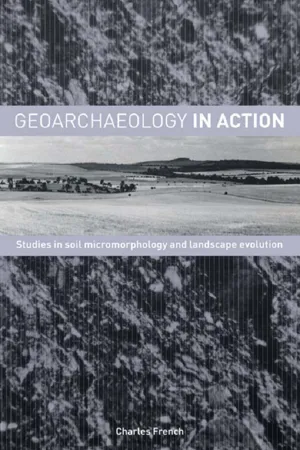
Geoarchaeology in Action
Studies in Soil Micromorphology and Landscape Evolution
- 320 pages
- English
- ePUB (mobile friendly)
- Available on iOS & Android
eBook - ePub
About this book
Information
Part 1
Some essential elements of geoarchaeology
Method and practice
1 Issues and aims in geoarchaeology
Definitions
What is geoarchaeology? Perhaps, it is best to ask what is geomorphology first, then to address the meaning of geoarchaeology second. Geomorphology is the study of the arrangement and differentiation of landforms, and the processes that shape and alter them. This includes everything from sea to river, coast to valley to hillside to mountainside. Some of the major processes responsible for shaping our environment are climate, relief and time, along with snow and ice, water and flooding, volcanic activities and earthquakes, landslides and human activities such as forest clearance and agriculture (see Goudie 1990).
Geoarchaeology is the combined study of archaeological and geomorphological records and the recognition of how natural and human-induced processes alter landscapes. The main aim of geoarchaeology is to construct integrated models of human-environmental systems and to interrogate the nature, sequence and causes of human versus natural impacts on the landscape. It is really only one major strand of environmental archaeology, which generally needs the collaborative and corroborative support of several other sets of data, but a good understanding of it is essential for reading landscapes.
The foregoing is rather a narrow definition of geoarchaeology when compared with say Rapp and Hill (1998: 1–17) who would emphasize that there is much more than the study of soils and sediments to geoarchaeology. It serves as the starting point when studying landscape and its transformations. Rapp and Hill's (1998: 1–2) definition states that ‘geoarchaeology refers to any earth-science concept, technique, or knowledge base applicable to the study of artefacts and the processes involved in the creation of the archaeological record’. But they, like myself, would see geoarchaeology as part of archaeology, inextricably linked, and not just geological research. If anything, my theoretical stance is probably closer to Waters' (1992) view that field stratigraphy, site formation processes and landscape reconstruction are the most fundamental tenets of geoarchaeology, which in many respects is a further development of the approach begun by Butzer (1982).
In terms of British archaeology, geoarchaeology is a newly developing field of research that has grown rapidly over the past decade. In fact, however, geologists were applying geological principles and knowledge to archaeological problems as long ago as 1863 as can be seen from Sir Charles Lyell's Geological Evidences of the Antiquity of Man. From my own perspective, and I suspect that of many practising archaeologists in the United Kingdom, it would be seen as more an essential branch of landscape archaeology than anything else that uses a variety of techniques and approaches borrowed from geographers, earth and natural scientists. Indeed, these views on the potential and increasing value of scientific approaches to archaeological endeavours were stated by Mortimer Wheeler himself (Wheeler 1954: 2). In many respects, the principal development of this sub-discipline within archaeology has occurred in the United States in, for example, the work of Butzer (1982), Waters (1992), Ferring (1994) and Holliday (1997). These geomorphologists addressed specific archaeological problems, and their analyses were instrumental in shaping new interpretations of the archaeological data. Their work has greatly affected the content and workings of current research project design. But some of the major advances in certain methodological approaches — such as the use of soils in archaeology — have been made by practitioners on this side of the Atlantic such as Cornwall (1958), Limbrey (1975), Davidson (1982), Fitzpatrick (1984), Courty et al. (1989). It is this latter route that I will be exploring and adding to in this book.
Data acquisition
Four main types of data collection are regularly used by most geoarchaeological practitioners. Qualitative and quantitative records and measurements are taken in the field. For example, this could take the form of anything from a full-scale, multi-disciplinary field project investigating the nature and effects of early prehistoric clearance to generating modern analogue data (see Chapter 5 below). The full-scale field project could involve geomorphological drift and soil mapping, palaeobotanical and modern vegetational survey and investigations, the use and cross-correlation of deep sea core palaeo-climatic data. It would attempt to establish dated sequences of environmental change and suggest possible major influences on the environmental record of the area. The models thus generated could then be set against the archaeological record using Geographical Information System techniques (Burrough 1986) and further hypotheses of landscape development tested.
To set up a model of landscape change and to add other, more specific, interpretative layers to such a model, it might be necessary to conduct some modern field experiments. For instance, to gather information on possible erosion rates, it would be possible to set out a series of sediment traps across and down a hill-side on the chalk downlands of southern England for several periods in the year fixed in order to recover data on the ability of soil to move downslope under different environmental parameters (Small and Clark 1982; Morgan 1979, 1986). This work would provide data on the amount of sediment moved over a landform type under known conditions over time, and would be essential if one wished to begin to create an erosion model for a specified area of land.
In addition to this type of information, it is often essential to carry out experiments both in the laboratory and in the field to attempt to recreate, or at least create, situations analogous to past conditions. This might involve setting up a series of experiments in the laboratory to mimic natural processes: a wave tank could be used to simulate the effect of wind, water and shore amplitude on the movement of artefacts and animal bone on a lake margin (Morton 1995), or the behaviour of a soil of known composition and moisture content in a soil bin when ploughed with a replica Bronze Age ard could be studied in great detail (Lewis 1998a). To back up these laboratory experiments, either experimental situations in the field could be designed or possible ethnographic parallels be sought out. So, for example, Gebhardt (1992) observed ard, spade and hoe cultivation techniques in three known but different soils, and Lewis (1998a) sampled simulated ard cultivation plots under different ploughing and fertilization regimes but all on the same subsoil at Butser experimental farm in Hampshire (Reynolds 1979). In order to find greater interpretative detail about the repeated fine plastering events observed in the structures at the Neolithic tell site of Çatalhöyük, Boivin (2000) investigated a modern rural community in Rajasthan, northwestern India, who were found to repeatedly replaster different rooms in their houses according to various rules of hygiene as well as major social events in the calendar whether religious or civil (births, deaths, marriages), rather than being indicative of constructional method or necessity. This ‘soil ethnographic’ work is now essential in order to be much more sure of the effects on soil characteristics and to differentiate between the consequences of different processes, as well as to elucidate possible reasoning behind the activity and the time frame over which observed events may be occurring.
Third, there is laboratory analysis and quantification. To continue with the erosion model example, one might measure the particle size, bulk density, shear strength and plasticity index of the soil material (Avery and Bascomb 1974; Goudie 1990). This would provide information on how easily a particular soil type would move, given a certain set of environmental parameters, especially the degree of saturation/rainfall and slope required to cause overland flow erosion.
Fourth, there is structured manipulation of the data with the application and testing of models on the basis of the observations derived from the different sources of data retrieval. This work would create models of the probable different intensities of soil/sediment movement occurring with a soil of a certain texture, subject to a certain soil moisture content and degree of slope, and allow the construction of predictive models of how much soil could be lost over a period of years in that type of landscape. Obviously, these figures and models will only give a general idea of what might occur under a given set of circumstances, not hard and fast rules. In many respects, this type of field experimental prediction is rather like an ethnographic analogy, it only gives a possible idea of, not an absolute interpretation.
Scales of resolution
There are four scales of resolution for which environmental data may be obtained with which to address archaeological landscape contexts. The macro-environment or regional context tends to be a large chunk of landscape, say 10–20 km in length, from watershed to watershed. At this level one could be looking at the effects of climate, geology and topography as important controlling factors. The meso-environment involves the immediate region of the site, say for example an arbitrary 2 sq km block around the site. Here, land-use and position in the landscape might be major controlling factors in determining the preservation and survival of environmental and archaeological data. The immediate site environment is the area around the site and roughly equates with something field-sized and smaller. In this case, landscape position is crucial as is the proximity to the groundwater table, and both are major determinants for preservation. The last and finest scale of resolution is one that is not generally considered by most archaeologists but includes the within-soil micro-environment, and is essentially at the level of the soil profile. Here all potential soil forming and transformation factors come into play (pp. 36–8) and can either destroy or skew the evidence and thus affect the validity of the interpretations placed upon the data.
A good example of different scales related to an archaeological project is in the lower Welland valley (see Chapter 6) (Pryor and French 1985; Pryor 1998a) (Figures 6.2 and 6.3). Here the macro-region was the whole of the lower Welland valley from Stamford to the fen-edge over a distance of some 20 km, which was the subject of the fieldwalking transect survey. The meso-scale was represented by the c. 6 hectares around the Maxey great henge that was excavated at the same time (Pryor and French 1985: fig. 40). The micro-scale equates to the enclosed area within the great Maxey henge, for example, and the within-soil micro-scale relates to the buried soil and ditch sediment profiles associated with this same monument.
These scales of resolution are extremely important when related to the type of data acquired. For example, there is no point in using vegetational interpretations based on molluscan analyses alone to postulate extensive clearance, as snail data really only tells one about the feature-specific and immediately surrounding field. It would be far better to develop a series of well-dated pollen datasets taken from several positions along a transect across the region to the site, combined with archaeological survey data and the geochemical and micromorphological analyses of associated sediments and buried soils in order to suggest the timing, nature and extent of any clearance, and to relate this event to the distribution of human settlement and their living activities.
Modification processes
The type of data and the scale of resolution are subject to a variety of modification processes which are often associated with and driven by the actual forces motivating landscape change.
Landscape change can result from the influence of major climatic, relief, drainage system changes and land-use (Ward and Robinson 1990; Bell and Walker 1992; Gerrard 1992; Evans and O'Connor 1999). In particular, there are those changes associated with former glacial, periglacial and interglacial environments. Just the extremes of temperature over relatively short time periods at transition periods would have led to major landform, climatic, soil and vegetational changes. In the Holocene itself, effectively just another interglacial period, major climatic and vegetational shifts have been taking place over the past 10,000 years. For example, there is good and extensive evidence for the growth of the earlier Holocene deciduous wood...
Table of contents
- Cover
- Geoarchaeology in Action
- Full Title
- Copyright
- Dedication
- Contents
- List of illustrations
- List of tables
- Acknowledgements
- Preface
- PART 1 Some essential elements of geoarchaeology: method and practice
- PART 2 Geoarchaeology in action: case studies and syntheses
- Conclusions
- Glossary
- Bibliography
- Index
Trusted by 375,005 students
Access to over 1.5 million titles for a fair monthly price.
Study more efficiently using our study tools.
Frequently asked questions
Yes, you can cancel anytime from the Subscription tab in your account settings on the Perlego website. Your subscription will stay active until the end of your current billing period. Learn how to cancel your subscription
No, books cannot be downloaded as external files, such as PDFs, for use outside of Perlego. However, you can download books within the Perlego app for offline reading on mobile or tablet. Learn how to download books offline
Perlego offers two plans: Essential and Complete
- Essential is ideal for learners and professionals who enjoy exploring a wide range of subjects. Access the Essential Library with 800,000+ trusted titles and best-sellers across business, personal growth, and the humanities. Includes unlimited reading time and Standard Read Aloud voice.
- Complete: Perfect for advanced learners and researchers needing full, unrestricted access. Unlock 1.5M+ books across hundreds of subjects, including academic and specialized titles. The Complete Plan also includes advanced features like Premium Read Aloud and Research Assistant.
We are an online textbook subscription service, where you can get access to an entire online library for less than the price of a single book per month. With over 1.5 million books across 990+ topics, we’ve got you covered! Learn about our mission
Look out for the read-aloud symbol on your next book to see if you can listen to it. The read-aloud tool reads text aloud for you, highlighting the text as it is being read. You can pause it, speed it up and slow it down. Learn more about Read Aloud
Yes! You can use the Perlego app on both iOS and Android devices to read anytime, anywhere — even offline. Perfect for commutes or when you’re on the go.
Please note we cannot support devices running on iOS 13 and Android 7 or earlier. Learn more about using the app
Please note we cannot support devices running on iOS 13 and Android 7 or earlier. Learn more about using the app
Yes, you can access Geoarchaeology in Action by Charles French in PDF and/or ePUB format, as well as other popular books in Social Sciences & Geology & Earth Sciences. We have over 1.5 million books available in our catalogue for you to explore.