- 240 pages
- English
- ePUB (mobile friendly)
- Available on iOS & Android
eBook - ePub
About this book
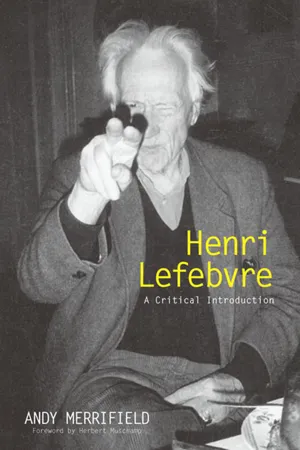
Philosopher, sociologist and urban theorist, Henri Lefebvre is one of the great social theorists of the twentieth century. This accessible and innovative introduction to the work of Lefebvre combines biography and theory in a critical assessment of the dynamics of Lefebvre's character, thought, and times. Exploring key Lefebvrian concepts, Andy Merrifield demonstrates the evolution of Lefebvre's philosophy, while stressing the way his long and adventurous life of ideas and political engagement live on as an enduring and inspiring interrelated whole.
Information
1
EVERYDAY LIFE
One finds all one wants in the Grand Magasins of everyday adventure, which never close, even on Sundays and holidays.—Pierre Mac Orlan, Chroniques de la fin d’un monde
It’s astonishing to think that Henri Lefebvre began Volume 1 of Critique of Everyday Life with the founding of the United Nations and finished it with Volume 3, in 1981, during the first term of Ronald Reagan. In between, in 1961, just as mass consumerism really took off, he penned Volume 2. (He also wrote, as some of his students barricaded Paris’s boulevards, Everyday Life in the Modern World.) It was quite a stretch, quite a project: beginning in the age of peace and consensus, continuing through a cold war and a counterculture, and sealing it amidst a neocon backlash. His opening salvo in 1947 was that of a man of the countryside, even though he found himself back pacing Paris’s streets, working for the Centre National de Recherche Scientifique (CNRS), after a period teaching in the provinces.1 At CNRS, Lefebvre focused on the peasant question, conducting research on agricultural reform in France, Italy, and Eastern Europe and on “primitive accumulation” of capital, as well as on the rural rent issues that Marx left dangling in Volume 3 of Capital. Lefebvre always felt that the peasantry figured prominently in socialist history; Mao’s 1949 revolution in China offered dramatic confirmation. (The French Communist Party, though, was less impressed with poor Lefebvre’s peasant labors. Rural rent, they scoffed, was a Ricardian problematic not a Marxist one!)
An even more amazing aspect of Lefebvre’s notion of everyday life, one overlooked by many commentators, is that it germinated when everybody’s daily life, Lefebvre’s included, was about to be blown to smithereens. Therein lies its most fundamental message: everyday life is so precious because it is so fragile; we must live it to the full, inhabit it as fully sensual beings, as total men and women, commandeering our own very finite destiny, before it’s too late. The life and death everyday drama for Lefebvre really began in December 1940, when he quit his teaching post as “a little prof de philo in a little provincial collège” (high school) at Montargis, one hundred kilometers south of Paris, and accepted another at Saint-Étienne, further south in the Loire.2 Married with four kids, Lefebvre’s already fraught personal situation soon worsened when the pro-Nazi Vichy government began purging public offices, schools, and colleges of Jews, Freemasons, and Communist Party members. Too old to be drafted, without job or means, the almost fortysomething philosopher fled to Aix-en-Provence, where he joined the Resistance Movement and lived in a tiny house a few kilometers out of town. In winter, it was freezing cold. For fuel he burned wood that created more fumes than warmth, bringing on a bout of bronchitis; the ailment periodically recurred throughout his life.3
At Aix’s Café Mirabeau, Lefebvre met other maquisands,organized clandestine conspiracies and sabotage, and befriended railway men who helped him derail enemy trains and sniff out collaborators.4 “We worked to give an ideology to the Resistance,” Lefebvre remembers. “Vichy held up the flag of Revolution and Empire and said to the Germans that they’d guard the colonies for Hitler. … In Vichy, there’d been those who sincerely believed in preserving the independence of a part of France, controlled between Germany and a zone to the south. … The Resistance explained that this independence was a fiction.”5 Lefebvre also descended regularly on Marseille, the real hotbed of struggle, and frequented the café Au Brûleur de Loup, where militant wolves, free-spirit wanderers, on-the-run refugees, and those seeking departure for America all found warm sanctuary. Surrealist André Breton hung out there before sailing to New York; ditto Victor Serge, the Russian anarchist and veteran revolutionary, who later eloped to Martinique. In Marseilles, Lefebvre befriended Simone Weil, the devout philosopher-martyr; he was pained as he watched her battle for interns in nearby camps while starving herself to death. (Weil eventually died of tuberculosis in a Kent sanatorium in England in 1943.)
In Memoirs of a Revolutionary, Victor Serge lets us feel the spirit and guts of those times, of the Frenchmen, whether intellectuals or workers, who had no intention of emigrating. “Various militants tell me,” Serge said, “quite simply, ‘Our place is here,’ and they were right.”6 But André Breton opted to leave just as Lefebvre risked life and limb to stay. To visit his parents back in Navarrenx he made daring, stealth night raids. They were terrified for their son, and for themselves; somebody might see him, somebody might inform on him, and on them. He went underground, and then, at the beginning of 1943, Lefebvre hid himself away in an isolated Pyrenean peasant community in the valley of Campan, near Tarbes. He laid low with locals, and with local maquisands,until the Liberation. He got to know mountain shepherds on the slopes, studied them, learned their rituals and folklore and façon de vivre, and even spotted a sort of primitive communism in their daily life. He didn’t know it then, but he’d already embarked on everyday life research, pregnant in his doctorate on peasant sociology, Les Communautés Paysannes Pyrénéennes (eventually defended in Paris in June 1954).7
Methodologically, Lefebvre deployed a sort of “participant observation,” which, coupled with long sessions in the archives of Campan’s Town Hall, led him to discover a passion for historical excavation he never knew he had. Jean-Paul Sartre, for one, appreciated the virtues of Lefebvre’s rural “regressive-progressive” methodology—a methodology informing his work on urbanism and space decades later. “In order to study complexity and reciprocity of interrelations—without getting lost in it—Lefebvre,” Sartre noted, “proposes ‘a very simple method employing auxiliary techniques and comprising several phases: (a) Descriptive. Observation but with a scrutiny guided by experience and a general theory. … (b) Analytico-Regressive. Analysis of reality. Attempt to date it precisely. … (c) Historical-Genetic. Attempt to rediscover the present, but elucidated, understood, explained.’ ” “We have nothing to add to this passage,” Sartre added, “so clear and so rich, except that we believe that this method, with its phase of phenomenological description and its double movement of regression followed by progress, is valid—with the modifications which its objects may impose upon it—in all the domains of anthropology.”8
As Lefebvre documented the plight of the rural peasant and the agrarian question under socialism, his “critique of everyday life” took shape. After 1947, this became both a methodology and a political credo: an insistence that dialectical method and the Marxist dialectician confront the everyday, that they begin and end analysis in the quotidian. For Lefebvre, everyday life became a bit like quantum theory: by going small, by delving into the atomic structure of life as it is really lived, you can understand the whole structure of the human universe. A politics that isn’t everyday, Lefebvre says, is a politics without a constituency. Therein lay the problems of party Marxism, with its preoccupation with building an abstract economy rather than reinventing a real life. On the other hand, an everyday life without historical memory, without any broader notion of its dialectical presentness, is forever prey to mystification. “When the new man has finally killed magic off,” Lefebvre says in Volume 1 of Critique of Everyday Life, with trademark rhetorical flush, “and buried the rotting corpses of the old ‘myths’—when he is on the way towards a coherent unity and consciousness, when he can begin the conquest of his own life, rediscovering or creating greatness in everyday life—and when he can begin knowing it and speaking it, then and only then will we be in a new era.”9

Much in Critique of Everyday Life seemed like light relief, like Lefebvre’s romp through cherished books and sunny, open meadows. He seems deliberately to want to put those war years aside, out of sight and out of mind. His debut volume is discursive, free flowing, and formless—a welter of ideas and muses, allusions and alliterations, spiced up with playful doses of polemicism. At times, we have to work hard to keep up. He gives us a recapitulation of “some well-trodden ground,” reconsidering questions about alienation and surrealism: André Breton’s clarion call, Lefebvre jokes, is “Snobs of the World Unite!” Once again, he tussles with the party, defending humanism and “Marxism as Critical Knowledge of Everyday Life.” A lot unfolds like a stream of consciousness, as Lefebvre breezes through the “French countryside on a Sunday afternoon,” demystifying the “strange power” of a village church— a church that could exist anywhere today: “O Church, O Church, when I finally managed to escape from your control I asked myself where your power came from. Now I can see through your sordid secrets. … Now I can see the fearful depths, the fearful reality of human alienation! O holy Church, for centuries you have tapped and accumulated every illusion, every fiction, every vain hope, every frustration.”10
Elsewhere, Lefebvre juggles with this concept he labels “everyday life,” typically weary of laying it down solid. Literature and art, he says, as opposed to politics and philosophy, have better grappled with understanding the everyday.11 Brecht’s “epic drama” gives us a theater of the everyday, where all the action is stripped of ostentation and where all truth, as Brecht liked to say, citing Hegel, “is concrete.” “Epic theater,” Lefebvre quotes Brecht preaching, “wants to establish its basic model at the street corner.” Brecht has his great hero of knowledge, Galileo, begin by a process of “de-heroization”: “GALILEO (washing the upper part of his body, puffing, and good-humored): Put the milk on the table.”12
The films of Charlie Chaplin, meanwhile, whose image of the tramp strike as both “Other” and universal in “modern times,” reveals bundles about everyday alienation, and, just like life itself, its drama is a slapstick that makes us laugh and cry, sometimes at the same time. (In the 1950s, Chaplin and Brecht both felt the heat from Senator Joseph McCarthy’s “red” witch hunts. Their power to disgruntle and critically inform was thereby acknowledged.) Chaplin, according to Lefebvre, “captures our own attitude towards these trivial things, and before our very eyes.”
He comes as a stranger into the familiar world, he wends his way through it, not without wreaking joyful damage. Suddenly he disorientates us, but only to show us what we are when faced with objects; and these objects become suddenly alien, the familiar is no longer familiar (as for example when we arrive in a hotel room, or a furnished house, and trip over furniture, and struggle to get the coffee grinder to work). But via this deviation through disorientation and strangeness, Chaplin reconciles us on a higher level with ourselves, with things and with the humanized world of things.13
The other brilliant spokesperson of the everyday is, of course, James Joyce. His masterpiece Ulysses, Lefebvre notes, “demonstrates that a great novel can be boring. And ‘profoundly boring.’ Joyce nevertheless understood one thing: that the report of a day in the life of an ordinary man had to be predominantly in the epic mode.”14 The bond between Leopold Bloom, one ordinary man during a single, ordinary day in Dublin, and the heroic epic journey of Odysseus is precisely the bond that exists between Lefebvre’s ordinary man and his “total man,” between the present and the possible. The former is pregnant with the latter, already exists in the former, in latent embryonic state, waiting for Immaculate Conception, for the great, epochal imaginative leap. Thus, while Lefebvre’s utopian vision of the total man seems way out, and grabs us an idealist mixture of hope and wishful thinking, his model is really anybody anywhere, any old Leopold or Molly Bloom or Stephen Dedalus. What appears to be stunningly abstract is, in reality, mundanely concrete: the ordinary is epic just as the epic is ordinary. In Ulysses, “Blephen” and “Stoom” find a unity of metaphysical disunity, just as the ordinary man and total man can find their unity of metaphysical disunity; the poet-artist son and the practical-man-of-the-world father conjoin. Two world-historical temperaments—the scientific and the artistic—become one and soon wander empty darkened streets, wending their way back home to where Molly sleeps in Ithaca, at 7 Eccles Street.
In a stunning literary, psychological, and—perhaps—revolutionary denouement, Ulysses ends with Molly’s tremendous stream of unpunctuated consciousness; visions and opinions, fragments and perceptions, judgments and recollections gush forth in one of modern literature’s greatest set pieces. He “kissed me under the Moorish wall and I thought well as well him as another … would I yes to say yes my mountain flower and first put my arms around him yes and drew him down to me so he could feel my breasts all perfume yes and his heart was going like mad and yes I said yes I will Yes.”15 The Ulysses that says Yes to life is an “eternal affirmation of the spirit of man,” a great gust of generosity that is indeed the spirit of Lefebvre’s total man. Yet Lefebvre knew it bespoke a more commonplace theme: everyday passion. These, both he and Joyce knew, match the dramatic successes and failures of Greek heroes. Life at its most mundane level is as epic and spiritual as any official history or religion. History, as Stephen reminds his boss Mr. Deasy, the bigoted, protofascist headmaster, is really “a shout in the street.” Lefebvre, the Marxist everyman, would doubtless concur: total men and women are found on a block near you.
Lefebvre’s sensitivity to everyday life also smacks as a French thing. The daily round is deep...
Table of contents
- Cover
- Half Title
- Title Page
- Copyright Page
- À Corinna, avec une jeunesse du cœur ...
- Excerpts
- Table of Contents
- Foreword: Something Cool
- Acknowledgments
- Preface: "A Youthfulness of Heart"
- 1 Everyday Life
- 2 Moments
- 3 Spontaneity
- 4 Urbanity
- 5 Urban Revolution
- 6 Space
- 7 Globalization and the State
- 8 Mystified Consciousness
- Afterword: The End of History or the "Total Man"?
- Notes
- Index
Trusted by 375,005 students
Access to over 1.5 million titles for a fair monthly price.
Study more efficiently using our study tools.
Frequently asked questions
Yes, you can cancel anytime from the Subscription tab in your account settings on the Perlego website. Your subscription will stay active until the end of your current billing period. Learn how to cancel your subscription
No, books cannot be downloaded as external files, such as PDFs, for use outside of Perlego. However, you can download books within the Perlego app for offline reading on mobile or tablet. Learn how to download books offline
Perlego offers two plans: Essential and Complete
- Essential is ideal for learners and professionals who enjoy exploring a wide range of subjects. Access the Essential Library with 800,000+ trusted titles and best-sellers across business, personal growth, and the humanities. Includes unlimited reading time and Standard Read Aloud voice.
- Complete: Perfect for advanced learners and researchers needing full, unrestricted access. Unlock 1.5M+ books across hundreds of subjects, including academic and specialized titles. The Complete Plan also includes advanced features like Premium Read Aloud and Research Assistant.
We are an online textbook subscription service, where you can get access to an entire online library for less than the price of a single book per month. With over 1.5 million books across 990+ topics, we’ve got you covered! Learn about our mission
Look out for the read-aloud symbol on your next book to see if you can listen to it. The read-aloud tool reads text aloud for you, highlighting the text as it is being read. You can pause it, speed it up and slow it down. Learn more about Read Aloud
Yes! You can use the Perlego app on both iOS and Android devices to read anytime, anywhere — even offline. Perfect for commutes or when you’re on the go.
Please note we cannot support devices running on iOS 13 and Android 7 or earlier. Learn more about using the app
Please note we cannot support devices running on iOS 13 and Android 7 or earlier. Learn more about using the app
Yes, you can access Henri Lefebvre by Andrew Merrifield in PDF and/or ePUB format, as well as other popular books in Social Sciences & Urban Planning & Landscaping. We have over 1.5 million books available in our catalogue for you to explore.