Freedom's Sword is the first history to detail the remarkable, lasting achievements of the NAACP's first sixty years. From its pivotal role in overturning the Jim Crow laws in the South to its twenty-year court campaign that culminated with Brown v. the Board of Education, the NAACP has been at the forefront of the struggle against American racism. Gilbert Jonas, a fifty-year veteran of the organization, tracks America's political and social landscape period by period, as the NAACP grows to 400,000 members and is recognized by both blacks and whites as the leading force for social justice.
Jonas recounts the historic combined efforts of ordinary citizens and black leaders such as W.E.B. Dubois, James Weldon Johnson, and Thurgood Marshall to root out white-only political primaries, separate schools, and segregated city buses. Freedom's Sword is a vivid and passionately written account of the single most influential secular organization in black America.
eBook - ePub
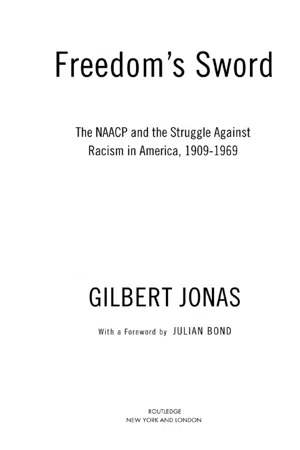
Freedom's Sword
The NAACP and the Struggle Against Racism in America, 1909-1969
- 554 pages
- English
- ePUB (mobile friendly)
- Available on iOS & Android
eBook - ePub
About this book
1. Creating a Change Agent: The NAACP’s Early Years
Necessity is the mother of invention.
Anonymous
A (True) American folk tale
It was exactly a century ago this year that Sam Hose left his home in rural Georgia for Atlanta. A literate and hard-working black man needing money to help care for his ill mother and his mentally retarded brother, Hose ended up laboring for a white landlord on a plantation outside the city. In the spring of the next year, the two had a falling out over wages. The white man threatened the black man with a pistol and the black man defended himself with the ax he was using to chop wood. Hose accidentally killed his employer and fled to his mother’s cabin.
The white-owned newspapers of the South had long gorged themselves with exaggerated or fabricated accounts of such violence. In the papers’ version, the fight between Sam Hose and his boss became transformed into the most enraging crime of them all: the rape of the white man’s wife. White Georgians tracked Hose down and prepared for his lynching. Two thousand people gathered for the killing, some taking a special excursion train from Atlanta for the purpose. The leaders of the lynching stripped Hose, chained him to a tree, stacked wood around him, and soaked everything in kerosene. The mob cut off Hose’s ears, fingers and genitals; they peeled the skin from his face. They watched, a newspaper reported, “with unfeigning satisfaction,” as the man’s veins ruptured from the heat and his blood hissed in the flames. “Oh, my God! Oh, Jesus,” were the only words Hose could manage. When he finally died, the crowd cut out his heart and liver from his body, sharing the pieces among themselves, selling fragments of bone and tissue to those unable to attend. No one wore a disguise, no one was punished. Subsequent investigation showed that Hose had never entered the white home, much less committed a rape there.
Edward L. Ayers on Trouble in Mind: Black Southerners in the Age of Jim Crow, by Leon F. Litwack, The New York Times Book Review, May 3, 1998
On February 12, 1909, the NAACP was born, on the one hundredth anniversary of Lincoln’s birthday. The choice of the date was no accident. The popular literature of the period still displayed a strong interest in Lincoln’s life, 44 years after his assassination. Ida Tarbell’s classic biography had been published only 14 years earlier— in McClure’s Magazine—and was still widely read in book form. Perhaps most important of all, on August 14, 1908, Springfield, capital of Illinois, Lincoln’s home town for most of his adult years, had been devastated by racial riots during which two Negroes had been lynched, six killed, more than fifty injured, and several thousand forced to flee the city, as a militia of 4,200 struggled to control the chaos.
Neither the NAACP nor the Springfield riots arose in a vacuum. Throughout the first decade of the twentieth century, Americans of African descent had been growing increasingly alarmed at the steadily escalating level of violence directed against them by segregationists. Fueled by racial and religious hatred, the Ku Klux Klan (KKK) was spreading throughout the Midwest and South while creating pockets of influence in the North and West. Four months after the riots—on December 26, 1908—Jack Johnson defeated Tommy Burns for the heavyweight boxing championship of the world, the first black man to hold that crown, though not the first black boxing champion.1 The audaciousness of Johnson, who had publicly consorted with a white woman, further inflamed the minds of whites, especially men, throughout the nation, and thus was born the search for the “Great White Hope.” For the next decade, the inability of white challengers to unseat Johnson helped to focus white enmity toward Negroes.
By way of contrast, the most popular Negro of the period, especially among whites, was Booker T. Washington. His accommodationist message to his people—eschewing agitation and political action in order to learn a vocation or a trade as the path to freedom—was comforting to white Americans and transformed him into a respected White House guest. His autobiography, Up from Slavery, was perhaps the Negro equivalent of the Horatio Alger stories, assuaging the consciences of the white majority even as the number of lynchings increased.2
The Springfield riots produced shock waves among the republic’s intellectual and spiritual leaders, primarily because of William English Walling’s graphic and stirring article “The Race War in the North,” which described the scope and brutality of the Springfield violence and was published in The Independent magazine. Walling and his wife, Anna Strunsky, were well-known and well-respected progressives who had recently returned from Russia, where they had opposed the Czar’s blatant attacks on the Russian Jews. In Walling’s view, the attacks on Springfield’s Negroes were even worse than the Czar’s anti-Semitic pogroms. After the riots, he could find no regret or shame among the white citizens of the state capital of Illinois. At least in Russia, he observed, a pogrom was the product of the Czar’s active manipulation. Walling expressed deep distress over the sanguine white response to the increasing attacks on Negroes and predicted that, without active intervention, the ubiquitous lynching of Southern blacks would spread to the North. He called upon all Americans to join hands in a new campaign to halt the attacks on Negroes and to punish the perpetrators. The prestige of both Walling and the magazine, which was a prominent human rights advocate, combined with the increasing incidents of violence against Negroes, not only got the attention of liberals and intellectuals but also impelled them to act.3
Prior to the Springfield riots, prominent Negro leaders had sought to form an organized campaign to protect and advance African Americans. Four years before the NAACP’s inception, 29 Negro professionals and leaders, led by the activist and scholar Dr. W.E.B. DuBois, responded to the increased violence against blacks by attempting to form a new organization, the Niagara Movement, to lead the racial struggle in the twentieth century. They met July 11 to 13, 1905, without evident result except for agreeing to meet again. The objectives set forth by DuBois at the second meeting in 1906 were unequivocal: “We shall not be satisfied with less than full manhood rights . . . . We claim for ourselves every right that belongs to a free-born American—political, civil and social—and until we get these rights, we shall never cease to protest and assail the ears of America with the story of its shameful deeds towards us.”4
Unfortunately, the Niagara Movement failed to attract enough adherents or financial support; but the initiatives DuBois and his colleagues set forth reflected the emergence of Negroes in many fields of endeavor and accomplishment. At the onset of the twentieth century, Negro men and women were making their mark in almost all the professions and the arts, albeit in tiny numbers. In addition to DuBois and scores of doctors and lawyers, such professionals included Booker T. Washington, the scientist George Washington Carver, the poet Paul Laurence Dunbar, the composer Scott Joplin, and the crusading journalist Ida B. Wells.
In spite of these advances, the Negro gains from the decade of the Reconstruction, which followed the Civil War, had been virtually extinguished, exchanged for an entrenched pattern of repressive Jim Crow laws, which legally required segregation in almost every aspect of life in the South and in many of the border states. The Abolitionist sentiment of the North and Midwest had greatly dissipated and was replaced by growing humanitarian and political concerns for the massive influx of vulnerable European immigrants, who were to fuel the industrial revolution in the post—Civil War years. Causes like the right of trade unions to organize; the right of dissidents (Marxists, anarchists, even utopians, who were later joined by pacifists during World War I) to exercise free speech, as guaranteed by the First Amendment; municipal reform; and the Suffragette movement, which led the struggle to enfranchise women, were front-burner issues during the first decade of the twentieth century. For the most part, the disappearing gains of the freed Negro slaves were of lesser concern to the liberal and progressive forces outside the South—that is, until the Springfield riots.
Then, early in 1909, in response to Walling’s eloquent plea, a fascinating group of American intellectuals, mostly white, together with Protestant and Jewish religious leaders, activist social workers, muckrakers, and veterans of the Abolitionist struggle, came together with individuals from DuBois’s lapsed Niagara Movement to found what was later to be called the National Association for the Advancement of Colored People. Recounting the fresh assaults on Negroes in every sphere of life, 60 distinguished Americans, including several Negro leaders, signed a historic document written by Oswald Garrison Villard of the renowned Abolitionist family and editor of the New York Evening Post and its weekly supplement, The Nation,5 calling for the formation of an organization to “renew the struggle for political and civil liberty.” Known in civil rights lore as “The Call,” this stirring manifesto described what a resurrected Lincoln would have seen in 1909: “If Mr. Lincoln could revisit this country in the flesh, he would be disheartened and discouraged.” “The Call” enumerated the forms of segregation, oppression, and deprivation to which Negroes were again subjected 44 years after the Emancipation Proclamation.
Though later critics, especially black nationalists and radicals, would read negative meanings into the word “colored,” those who chose it in 1910 had no ideological tinge, nor did anyone perceive the NAACP as a moderate or less militant organization because of this word. Later, the word’s utility was accepted as an umbrella defense for the rights of “all peoples of color.”6
“The Call” itself was not a concrete agenda for action, except by implication. It lamented the oppressive conditions under which most Negroes subsisted, arguing that the nation needed to assure “each and every citizen, irrespective of color, equality of opportunity and equality before the law.” Again by implication, it urged the elimination of Jim Crow state laws, including those that barred Negroes from mixing publicly with whites; the reversal of Negro disenfranchisement throughout the South; and the eradication of segregated transportation and other public institutions. Above all, “The Call” demanded an end to the “spread of lawless attacks upon the Negro, North, South, and West . . . often accompanied by revolting brutalities, sparing neither sex nor age nor youth.” Although “The Call” did not set specific goals or spell out a long-term plan, it did identify the critically important areas of human endeavor on which the NAACP would focus for the next half-century: voting rights, employment opportunity, equality before the law, desegregation of key civil institutions such as public schools and public services, and the same property rights enjoyed by the white majority. Each of these general objectives would at various times emerge as a specific public organizational goal for the NAACP. They comprised, after all, the commonsense aspects of decent living for all free men and women.
In conclusion, “The Call” appealed to “all believers in democracy to join in a national conference for discussion of present evils, the voicing of protests, and the renewal of the struggle for civil and political liberty.” Given that “The Call”’s author was a newspaper editor during the age of muckraking journalism, as well as an heir to a great Abolitionist family, it is no surprise that the obvious means for furthering the Negro’s cause would be that of advocacy—what Garrison termed “the voicing of protests.” Garrison and his supporters were eager to get a new organization up and running and to publicize the founding of the NAACP, as it later became known.
More than 1,000 individuals were invited to sponsor the initial meeting, and some 150 agreed. At this first National Negro Conference, which was held at the Charity Organization Hall on New York City’s Lower East Side from May 31 to June 1, 1909, more than a 100 attendees responded enthusiastically to the reformer’s rhetoric. Villard concluded reading his “Call” with this admonition: “Silence under these conditions means tacit approval. The indifference of the North is already responsible for more than one assault upon democracy, and every such attack reacts unfavorably upon whites as upon blacks.”7
This persuasive rhetoric and the cause itself resulted in an endorsement from W.E.B. DuBois and such leaders of the Niagara Movement as George W. Crawford, George W. Cooke, William Monroe Trotter, New York clerics Hutchins Bishop and Walter H. Brooks, and Dr. V. Morton Jones, a black woman physician. This support would be vital in reaching the nation’s Negroes.8
The signers of “The Call,” including DuBois and his followers and the original founders of the NAACP (these groups were not totally identical), were a virtual Who’s Who of progressive American thinkers and activists, white and black. They included the Abolitionist William Lloyd Garrison; the famed social workers Jane Addams and Lillian Wald; Livingston Ferrand, the president of Cornell University; Mary E. Wooley, the president of Mount Holyoke College; the philosopher John Dewey; the muckraking newsman Lincoln Steffens; Brand Willock, the mayor of Toledo; the philanthropist J.G. Phelps Stokes; the journalist and Southerner William English Walling and his firebrand wife, Anna Strunsky, both socialists; the Boston Brahmins Moorefield Storey and Albert E. Pillsbury; Alexander Walter, Bishop of the African Methodist Zion Church; Rabbi Stephen E. Wise; the journalists Mary White Ovington and Ida Wells Barnett; the social reformers John Haynes Holmes and Henry Moscowitz; Charles Edward Russell; and the Spingarn brothers (the academic Joel and the attorney Arthur). Together, they were to attract many more.
Conspicuously absent from this list of names was that of Booker T. Washington. The individuals composing the small committee that organized the founding conference debated whether to invite Washington, concerned that his absence would discourage fundraising among white sympathizers. Villard himself was engaged in distancing himself from Washington, whom he had come to regard as too conservative. The tepid invitation he issued to Washington was designed to be rejected, and it was. However, some of the committee members were apprehensive about the consequences of Washington’s absence, since the Tuskegee sage was close to President William Howard Taft and the leaders of the Republican Party as well as to many of the leading philanthropists of the day. Ultimately, principle carried the day: the committee members understood that the race riots and lynchings were now so widespread that they had invalidated Washington’s accommodationism. The founders were staking the future of the new organization, and of the nation’s Negroes, on the radical demands outlined by DuBois and his associates.9
The initial conference adjourned and instructed a smaller committee to reconvene when it had completed a plan for a permanent organization and compiled a list of officers to direct it. Implicit in “The Call,” the 1909 conference, and the follow-up conference that officially founded the organization on May 12 to 14, 1910, at the same site in New York City, was the notion of mobilizing grassroots support for the NAACP. This would serve both as a means of proliferating its advocacy mission and as a way of establishing a solid financial structure to underpin its activities and its growth. During its first three decades, the leadership was intent on building the largest, most powerful organization possible. This meant exploiting every opportunity to recruit members and, where they were clustered, to organize active branches. Later, these branches would form state conferences, and, still later, major regional groupings, every phase enhancing the organization’s political and social power. Each of these acts, from the simplest, an individual paying his or her annual dues of one dollar, to the organization of massive interracial rallies, during which the staff literally passed the hat around to raise thousands, to the staff leader’s strong solicitation of the local units for contributions and assessments, involved the generation of funds to maintain the engine of racial change.10 Not until the mid-1960s—more than a half century after its inception—would the NAACP become the beneficiary of corporate gifts, foundation grants, and large contributions from wealthy individuals; virtually all these funds were dispensed by white Americans. Until then the nickels and dimes of African Americans provided almost all the NAACP’s financial support.
In addition to agreement on the name—National Association for the Advancement of Colored People—the 1910 conference established a 100-member National Committee to raise money, an Executive Committee of Thirty (derived from the interim Committee of Forty) to conduct the organization’s affairs and set policies, and a series of officers to run the organization between meetings. These were Morefield Storey, president; William E. Walling, chairman; John Milholland, treasurer; and Oswald G. Villard, disbursing treasurer. In the only significant clash among the committee members, the so-called radicals overcame conservatives by electing Dr. W.E.B. DuBois the full-time paid executive committee chairman, whose principal jurisdictions were education and publicity. (At the new organization’s first executive committee meeting, DuBois’s title was changed to director of publicity and research, a more appropriate title for a full-time paid staff executive. His salary was guaranteed for at least the first year. Meanwhile, Frances Blascoer, the white woman who had been in charge of administrative functions, was named acting executive secretary, with responsibility for organizing work and fund-raising.)11 Dues were set as one dollar for the basic membership, escalating in steps to the highest category, life membership, at $500. (This lofty sum remained in place for the next seven decades.)12 In 1911 (when the NAACP’s membership was a meager 179), the executive committee adopted formal by-laws, establishing the association’s permanent governing structure. The governing body became a 30-member board of directors. Virtually the same leadership that guided the new organization from “The Call” onward became the national officers—president (Moorefield Storey), vice presidents (John Milholland and Bishop Alexander Watts), chairman (Oswald Garrison Villard), secretary (Mary Ovington), and treasurer (Walter Sachs). DuBois was kept on as director of publicity and research. At that time, the total membership of the NAACP was 329, ensuring imminent financial distress.13
At the same time, several Negro branches were opposed to including white members. Villard and DuBois, among others, rose to the challenge and insisted that all branch memberships be open to whites. They reasoned that, in addition to the public relations and fund-raising values that white membership offered, it was essential at that time to counteract the widespread Southern notion of racial superiority and to promote understanding between the races by maximizing personal contact. That principle informed the NAACP’s policies and programs for some eight decades.14
But before the NAACP could, in its early years, begin to resemble the powerful institution it would later become, it would have to demonstrate to African Americans that it could produce a noticeable impact on their lives. The two issues that most gripped black Americans in the second and third decades of the twentieth century were lynching and segregation, especially within the armed forces during World War I. Hardly a week went by that some black American—almost always a male in his prime years—was not hung from a tree or burned at the stake by an angry mob of white men, women, and children. These transgressions were almost always a way of circumventing the nominal legal system; all too often, a black man would be accused of a crime that involved the honor or person of a white woman. While awaiting trial, he would be dragged from his cell by armed vigilantes who meted out their own brand of justice. More often than not, the Ku Klux Klan (KKK) was behind these outbreaks of violence directed at helpless individuals. (The local law enforcement personnel either actively assisted the mobs or conveniently found themselves absent from the scene at the very moment of the mob’s break-in.)
In a book published by the NAACP in 1919, the author Franklin Morton found that during the 30 years between 1889 and 1918, a t...
Table of contents
- Cover Page
- Title Page
- Copyright Page
- Acknowledgments
- Foreword
- Introduction
- 1. Creating a Change Agent: The NAACP’s Early Years
- 2. The Law as a Weapon Against Unjust Laws
- 3. Southern Retaliation Against Negro Determination
- 4. Leading the African-American Quest for Political Power
- 5. Comes the Revolution: The Struggle Between the NAACP and the Communist Party USA
- 6. World War II and its Consequences for Race
- 7. The Politics of Political Advancement
- 8. Revolution at the Ballot Box
- 9. Black Workers, White Unions, and the Struggle for Job Equality
- 10. Head to Head with the Garment Workers Union
- 11. The End of Pretense: Organized Labor Refuses to Desegregate
- 12. Roy Wilkins: The Gentle Giant
- 13. The NAACP Develops Financial Muscle
- Epilogue
- Notes
- Bibliography
- Photo Credits
Trusted by 375,005 students
Access to over 1.5 million titles for a fair monthly price.
Study more efficiently using our study tools.
Frequently asked questions
Yes, you can cancel anytime from the Subscription tab in your account settings on the Perlego website. Your subscription will stay active until the end of your current billing period. Learn how to cancel your subscription
No, books cannot be downloaded as external files, such as PDFs, for use outside of Perlego. However, you can download books within the Perlego app for offline reading on mobile or tablet. Learn how to download books offline
Perlego offers two plans: Essential and Complete
- Essential is ideal for learners and professionals who enjoy exploring a wide range of subjects. Access the Essential Library with 800,000+ trusted titles and best-sellers across business, personal growth, and the humanities. Includes unlimited reading time and Standard Read Aloud voice.
- Complete: Perfect for advanced learners and researchers needing full, unrestricted access. Unlock 1.5M+ books across hundreds of subjects, including academic and specialized titles. The Complete Plan also includes advanced features like Premium Read Aloud and Research Assistant.
We are an online textbook subscription service, where you can get access to an entire online library for less than the price of a single book per month. With over 1.5 million books across 990+ topics, we’ve got you covered! Learn about our mission
Look out for the read-aloud symbol on your next book to see if you can listen to it. The read-aloud tool reads text aloud for you, highlighting the text as it is being read. You can pause it, speed it up and slow it down. Learn more about Read Aloud
Yes! You can use the Perlego app on both iOS and Android devices to read anytime, anywhere — even offline. Perfect for commutes or when you’re on the go.
Please note we cannot support devices running on iOS 13 and Android 7 or earlier. Learn more about using the app
Please note we cannot support devices running on iOS 13 and Android 7 or earlier. Learn more about using the app
Yes, you can access Freedom's Sword by Gilbert Jonas in PDF and/or ePUB format, as well as other popular books in History & 20th Century History. We have over 1.5 million books available in our catalogue for you to explore.