From the refugee camps of the Lebanon to the relative prosperity of life in the USA, the Palestinian diaspora has been dispersed across the world. In this pioneering study, Helena Lindholm Schulz examines the ways in which Palestinian identity has been formed in the diaspora through constant longing for a homeland lost. In so doing, the author advances the debate on the relationship between diaspora and the creation of national identity as well as on nationalist politics tied to a particular territory. But The Palestinian Diaspora also sheds light on the possibilities opened up by a transnational existence, the possibility of new, less territorialized identities, even in a diaspora as bound to the idea of an idealized homeland as the Palestinian. Members of the diaspora form new lives in new settings and the idea of homeland becomes one important, but not the only, source of identity. Ultimately though, Schulz argues, the strong attachment to Palestine makes the diaspora crucial in any understandings of how to formulate a viable strategy for peace between Israelis and Palestinians.
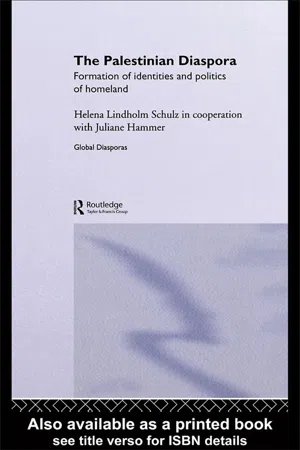
- 288 pages
- English
- ePUB (mobile friendly)
- Available on iOS & Android
eBook - ePub
The Palestinian Diaspora
About this book
Information
1
BETWEEN NATIONALISM AND GLOBALISM
- But I am the exiled one behind wall and door,
Shelter me in the warmth of your gaze.
Take me, wherever you are,
Take me, however you are.
To be restored to the warmth of face and body,
To the light of heart and eye,
To the salt of bread and song,
To the taste of earth and homeland.
Shelter me in the warmth of your gaze,
Take me, a panel of almond wood, in the cottage of sorrows,
Take me, a verse from the book of my tragedy,
Take me, a plaything or a stone from the house,
So that our next generation may recall
The path of return to our home.
(Mahmoud Darwish 1966, 1970, ‘A Lover from Palestine’, in Elmessiri 1982)
Introduction
One of the grim paradoxes of the Palestinian-Israeli conflict is that the foundation of the state of Israel, intended to create a safe haven for the ‘archetypical’ Jewish diaspora, spelt the immediate diasporisation of the Arab Palestinians. The territorialisation of the Jewish diaspora spurred a new ‘wandering identity’ and the Palestinians became a ‘refugee nation’ (Siddiq 1995:87). To the Palestinians, the birth of Israel is thus remembered as the catastrophe, al-nakba, to imprint the suffering caused by dispersal, exile, alienation and denial. Cohen (1997) adequately labels both Jewish and Palestinian diasporas ‘victim diasporas’ to indicate the ways in which they have been formed as a consequence of disasters befalling them.
In 2001 the United Nations Relief and Works Agency for Palestine Refugees in the Near East (UNRWA) estimated the number of Palestinian refugees at almost 3.9 million (UNRWA 2001). The Palestinian diaspora is spread throughout the world, with the bulk residing in the Arab world. Many Palestinians, however, live in Europe, the USA and Latin America. The nakba is the root cause of the Palestinian diaspora. However, migration from Palestine began in the late eighteenth century, at that time primarily constituted by Christians and primarily oriented towards the ‘new world’. As most people aspire for a better life for themselves and their children, Palestinian migration has also been caused by attempts at securing improved living conditions. Their destitution is, however, in itself a cause of the exodus and, later, of the Israeli occupation, as well as of impossible life situations. The majority of the Palestinian population live in the diaspora and most are refugees.
Experiences in exile have been building blocks in shaping Palestinian national identity. Fragmentation, loss of homeland and denial have prompted an identity of ‘suffering’, an identification created by the anxieties and injustices happening to the Palestinians because of external forces. In this process, a homeland discourse, a process of remembering what has been lost, is an important component. It was, furthermore, in exile that the ‘resistance’ was formulated, that the ideology of ‘armed struggle’ and ‘revolution’ was asserted as a strategy to overcome processes of victimisation and to transcend the state of dispossession, denial and statelessness (R. Sayigh 1979, 1994a; Peteet 1991, 1993; Y. Sayigh 1997). It was thus in the diaspora that the two central poles of ‘suffer’ and ‘struggle’, composing the (main) narrative of Palestinian identity (cf. Lindholm Schulz 1999), took form.
Therefore the dispersal (shatat in Arabic) and fragmentation of the Arab population of Palestine have served as uniting factors behind a modern Palestinian national identity, illuminating the facet of absence of territory as a weighty component in creations and recreations of ethnic and national identities in exile. Deterritorialised communities seek their identity in the territory, the Homeland Lost, which they can only see from a distance, if at all. The focal point of identity and politics is a place lost.
It is in the placeless space1 of exile that the political struggle has been mounted. It is in the deterritorialised context of dispersal that nation- and proto-state-building a la Palestine Liberation Organisation (PLO) have occurred. Consequently, with the ‘territorialisation’ of the PLO as a result of the peace process and the self-rule arrangements from 1993 onwards, both the meaning and the function of the diaspora in Palestinian nationalism changed. The peace process further illuminated the predicament of the Palestinian refugees. Although the PLO has officially continued to demand fulfilment of UN resolution 194 and a return to homes lost and compensation, there is not substantial international support for such a solution. Yet it is around the hope of return that millions of Palestinian refugees have formed their lives. This hope has historically been nurtured by PLO politics and its tireless repetition of the ‘right of return’—a mantra in PLO discourse. In addition, for hundreds of thousands (or even millions) of Palestinian refugees, there are no prospects (or desires) for integration into host societies. In Lebanon, the Palestinians have been regarded as ‘human garbage’ (Nasrallah 1997), indeed as ‘matters out of place’ (cf. Douglas 1976), and as unwanted.
To other members of the Palestinian diaspora, the homeland in concrete terms long ago lost its ultimate significance, and remains but a symbol to gather around in the land of exile. Many are ‘integrated’ into host societies to the extent that a return is not important. For others, a return process would require difficult decisions.
Nevertheless, the neglect of the refugees that characterised the Oslo process galvanised a new movement for the right of return and set the PLO leadership further apart from the refugee population. The failure of the negotiations in Camp David in the summer of 2000 was to no little extent the result of the diverging views on how to proceed on the refugees. Much more attention was given to the refugee issue during the Taba talks in December that year. The refugee question was then acknowledged as perhaps the central issue. Therefore, there is a vital necessity to engage in studies and research on what constitutes the reality for Palestinian refugees and migrants.
About this book
Although there exists a large number of important works on specific Palestinian refugee situations, there is, perhaps somewhat oddly, a lack of comprehensive studies on the Palestinian diaspora so far. Most studies on Palestinian society have focused on PLO politics, the conflict with Israel and the Israeli occupation. With some noteworthy exceptions,2 the people living the ordeal of Palestinian exile have been conspicuously absent from academic undertakings.3 What is more, only seldom is the Palestinian predicament treated from a diaspora perspective. This absence is becoming more of an anomaly as the need to analyse the plight of the refugees are becoming ever more acute. To the Palestinians, the nakba and the prolonged refugee situation are the core of the conflict with Israel and there is an urgent call for a link between studies on the ideas, perceptions and life-situations of refugees with policy-oriented works.
The purpose of this book is to look further into the relationship between diaspora and the creation of national identity,4 as well as nationalist politics related to a particular territory, but also to explore the possibilities incumbent in a transnational existence and new, less territorialised identities even among a diaspora community as tightly knitted around the idealised homeland as the Palestinian. It will do this by the following means:
- describing the dispersal in itself, i.e. its history as well as the very different settings of Palestinian diaspora(s);
- analysing the meanings of place/homeland in relation to identity;
- investigating the role that the exile has played in the mounting politics of struggle, as well as the changing impact of the exile on PLO politics from the early 1980s;
- providing an analysis of the peace process in the 1990s as well as its collapse from the perspective of the refugee question,
- analysing the impact of the fact of transnationalisation on Palestinian lives and experiences—to what extent do Palestinians in exile create identities not solely shaped by the context of remembering, longing and struggling, but also crafted by new contexts and the potentials of forming new homes in host societies?;
- investigating the meanings inherent in the notion of ‘return’, as well as different strategies to cope with actual homecoming.
Chapter summary
In Chapter 2, ‘Catastrophe and beyond’, we will account for the history of the Palestinian diaspora, the factors leading to the Palestinian exodus, and the multiple forms of migration and mobility that do exist. The following chapter, ‘Palestinians in the world’, provides an overview of the whereabouts and the different political, social and economic circumstances of the Palestinian diaspora.5
Chapter 4, ‘Stateless, rootless, homeless: meanings of homeland in exile’, brings us to the meaning of homeland to identity-formation in the diaspora. What are the prevalent discourses on the territory/homeland of Palestine?
Chapter 5, ‘Resistance and return: the politics of the homeland’, discusses the role of the diaspora in Palestinian nationalist politics as well as how an identity as victims was transformed into an identity of strugglers and resistance fighters. This chapter thus also considers the relationship between diaspora and nationalism and marginality as a site of resistance.6
Chapter 6, ‘Right of return, the refugees and the collapse of the peace process’, focuses on trends in relation to the peace process initiated in the early 1990s.7 What did the self-rule arrangements and the territorialisation of the PLO imply in terms of the meaning and function of refugees in PLO politics and in terms of the right of return? Also, the break-out of the al-Aqsa intifada in late September 2000 will be accounted for.8
Chapter 7, ‘New homes and identities in motion’, brings us to the issue of transnational activities as influential factors in shaping people’s conceptualisations of home and identity, moving away from mythical imaginings of the homeland.
Chapter 8, ‘Coming home?’, turns our focus to ‘return’ as a vision for the future. The peace process has also implied an unprecedented opportunity for return for a number of ‘displaced persons’ from 1967, and in particular for PLO cadres and officials. How has the return taken place and how have ideas of ‘outside-inside’9 been dealt with in this process?
Chapter 9, ‘Nationalism through transnationalism’, provides some conclusions on the role that diasporas might play in a nationalist, territorialist movement. It intends to shed some light on how diasporas may form identities both in relation to perceived ‘roots’ and in relation to experienced travels. In this last, concluding, chapter the profound meaning of return as a life-coping strategy is also underlined, along with the political consequences of this.
A note on sources and methodology
The study is based on a variety of sources. Documentary material provided by the PLO caters for one important category of sources. Extensive use has been made of exile literature in terms of novels, short stories, poetry and autobiographies. The national poets and writers Mahmoud Darwish, Fadwa Tuqan, Ibrahim Jabra and Ghassan Kanafani and authors who have written extensively in the English language, like Fawaz Turki and Edward Said, are examples of the rich body of texts conceptualising Palestine and exile. It should be noted, however, that, although this constitutes a treasure trove in terms of accessibility and information, the sophistication of this literature is not a style of expression that is altogether typical of the Palestinian experience. To be sure, many Palestinians know of famous poets (such as Mahmoud Darwish) but much fewer are acquainted with novels and short stories. In addition, the experience of Edward Said and Fawaz Turki, in their globalised (although differently defined) lifestyles, may to some extent be rather ‘untypical’. On the other hand, the rich variety of this literature together portrays important aspects of Palestinian lives in the diaspora.
Oral stories will serve as a third form of narrative, where discourses about homeland, identity and politics are articulated. Series of interviews have been conducted with Palestinians in Lebanon, Jordan, the USA and Sweden.10 The intention is not to accommodate a detailed account of any of those settings, but, rather, through these varied stories to provide something that might amount to a narrative of the Palestinian diaspora as such. The stories collected are as diverse as the Palestinians we talked to. Most of the interviews were conducted in 2001–2, although material collected in the West Bank and Gaza during earlier periods (1994–511, 199712 and 199813) has also been brought into play in order to shed further light on the issues reflected upon. Many of these earlier interviews were centred on similar issues and questions. All in all, we have spoken to well over 150 people.14 In Jordan, 15 people residing in Rusaifah, Ramtha and the camp of Hitteen were interviewed in May 2001.15 In Lebanon, 25 interviews were conducted in Shatila, Ein el-Hilweh, Burj Shemali and Mar Elias, as well as among Palestinians living in Beirut, outside of the camps, in July—August 2001. In the case of the Arab countries it has to be emphasised that highly insightful sociological and anthropological studies are available. Our own interviews served the purpose of complementing and updating existing works and allowing us to gain our own impressions of the situations in Jordan and Lebanon. The interviews in the USA were concentrated on Washington, DC,16 where 26 interviews were conducted in April—May 2001.17 This material was vital, since the situation of Palestinian Americans has rarely been described in more detail.18 In Sweden, 12 interviews were conducted, for the most part in Göteborg, between January and April 2001 and in February—March 2002.19
People have shared with us their often painful experience of being refugees as well as the everyday experience of transnational facets of life. Sometimes the accounts are highly personal. Often, the building of trust was, however, only possible with the help of friends and acquaintances, who introduced us and our project. Sometimes the knowledge of Arabic and previous travel experiences in the West Bank and Gaza helped in opening doors. At other times it was difficult, if not impossible, to establish trust. People remained suspicious and the narratives, as a consequence, were more distant and impersonal. Many of the interviews were conducted in a highly charged political atmosphere as the violence in the West Bank and Gaza became a backdrop to the research. Almost daily news on violence occurring in the West Bank and the Gaza Strip made the violence an ever-present topic for discussion, and probably informed many of the answers. This was particularly true for the material collected in camps in Lebanon and Jordan.20
The intention is to capture both the grand narrative of Palestinian identity and life in exile as that story is constantly reconstructed and repeated, as well as the potential discrepancies and dissonances existing between an official, highly pitched politicised discourse, on the one hand, and individual and collective ‘small stories’ of everyday coping and management, on the other.
Telling other people’s stories
Any project claiming the validity of ‘representing’ ‘others’, of presenting stories told by ‘others’, requires reflection on the ways in which this is conducted. Clearly, and as is so often underlined in recent post-colonially influenced texts on culture, identity and people’s lives, it is problematic that the narratives of the ‘other’ come about through the works of, in the words of the Palestinian writer Suheir Hammad, ‘sympathetic anthropologist[s] talking for’ them (Hammad 1996a:88).
One example of the problems inherent in a research project such as this one is revealed by how an informant in Shatila told of frustrations over foreigners who visit the camps. In a sort of ‘misery tourism’, they walk around for a while, take some pictures and, yes, some even cry about the desolation, but then they leave again and everything is as before. In his view, the camps have become like ‘zoos’ and the refugees like ‘animals to stare at’. Some come for research and to write articles, but, he asked, have all these writings ever changed anything about the situation, have they brought help or at least some money into the camps? As researchers come to visit over and over again, the inner wounds of people are constantly reopened. As for this ...
Table of contents
- COVER PAGE
- TITLE PAGE
- COPYRIGHT PAGE
- THE PALESTINIAN DIASPORA
- GLOBAL DIASPORAS
- PREFACE
- ABBREVIATIONS
- 1: BETWEEN NATIONALISM AND GLOBALISM
- 2: CATASTROPHE AND BEYOND
- 3: PALESTINIANS IN THE WORLD
- 4: STATELESS, ROOTLESS, HOMELESS Meanings of homeland in exile
- 5: RESISTANCE AND RETURN the politics of homeland
- 6: RIGHT OF RETURN, THE REFUGEES AND THE COLLAPSE OF THE PEACE PROCESS
- 7: NEW HOMES AND IDENTITIES IN MOTION
- 8: COMING HOME?
- 9: NATIONALISM THROUGH TRANSNATIONALISM
- NOTES
- BIBLIOGRAPHY
Trusted by 375,005 students
Access to over 1.5 million titles for a fair monthly price.
Study more efficiently using our study tools.
Frequently asked questions
Yes, you can cancel anytime from the Subscription tab in your account settings on the Perlego website. Your subscription will stay active until the end of your current billing period. Learn how to cancel your subscription
No, books cannot be downloaded as external files, such as PDFs, for use outside of Perlego. However, you can download books within the Perlego app for offline reading on mobile or tablet. Learn how to download books offline
Perlego offers two plans: Essential and Complete
- Essential is ideal for learners and professionals who enjoy exploring a wide range of subjects. Access the Essential Library with 800,000+ trusted titles and best-sellers across business, personal growth, and the humanities. Includes unlimited reading time and Standard Read Aloud voice.
- Complete: Perfect for advanced learners and researchers needing full, unrestricted access. Unlock 1.5M+ books across hundreds of subjects, including academic and specialized titles. The Complete Plan also includes advanced features like Premium Read Aloud and Research Assistant.
We are an online textbook subscription service, where you can get access to an entire online library for less than the price of a single book per month. With over 1.5 million books across 990+ topics, we’ve got you covered! Learn about our mission
Look out for the read-aloud symbol on your next book to see if you can listen to it. The read-aloud tool reads text aloud for you, highlighting the text as it is being read. You can pause it, speed it up and slow it down. Learn more about Read Aloud
Yes! You can use the Perlego app on both iOS and Android devices to read anytime, anywhere — even offline. Perfect for commutes or when you’re on the go.
Please note we cannot support devices running on iOS 13 and Android 7 or earlier. Learn more about using the app
Please note we cannot support devices running on iOS 13 and Android 7 or earlier. Learn more about using the app
Yes, you can access The Palestinian Diaspora by Helena Lindholm Schulz in PDF and/or ePUB format, as well as other popular books in Social Sciences & Human Rights. We have over 1.5 million books available in our catalogue for you to explore.