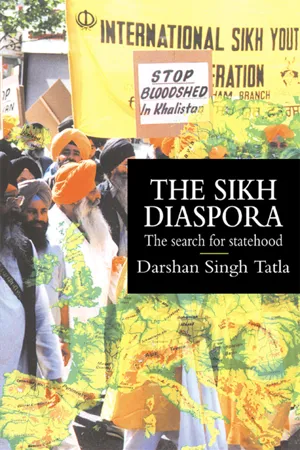
This book offers an overview of the Sikh diaspora, exploring the relationship between home and host states and between migrant and indigenous communities. The book considers the implications of history and politics of the Sikh diaspora for nationality, citizenship and sovereignity.; The text should serve as a supplementary text for undergraduates and postgraduates on courses in race, ethnicity and international migration within sociology, politics, international relations, Asian history, and human geography. In particular, it should serve as a core text for Sikh/Punjab courses within Asian studies.
Fairest of all, o’ chums, is this land of Punjab Like a rose, among flowers all1
Bestow upon Sikhs a pilgrimage to Amritsar, a bath in the sacred pool2
As an Indian religious community, Sikhs number about 16 million, forming a majority community of Punjab province, but just 2 per cent of India’s total population. Until 1984, Sikhs’ loyalty towards India seemed unproblematic at least in its political expression; while maintaining patriotic feelings, they nurtured a strong sense of a separate community, based on a distinct religion, a regional culture and language of the Punjab. This duality posed no heart-searching contradiction for most Sikhs, until June 1984, when as a reaction to the central government’s action in the Golden Temple, a wave of strong Sikh nationalism found expression in a militant campaign for a Sikh homeland. Although the movement has been brutally repressed by the security forces, and Sikh politics has been forcibly “restructured” to rejoin the “political process", deep-rooted sentiments remain for a secure Sikh homeland in the Punjab. As the underlying causes remain unaddressed, the issue of Sikh nationalism is unlikely to disappear.
A sect, a community or a nation?
The emergence of Sikh nationalism in the 1980s, especially in its most virulent form of demand for Khalistan, a Sikh homeland in the Punjab, touches on some complex issues of ethnic conflict in the postcolonial nation-building process in South Asia. It raises issues concerning the nature of Sikh ethnicity, which in a short period of time has moved from group consciousness to political community and staked a claim for a statehood. The form of conflict also calls for an examination of the emerging nature of the Indian state, which despite having evolved a common framework for democratic political bargaining, has faced several regional nationalisms and remains locked in ethnic conflicts.
The Sikh demand for statehood has a number of explanations: economic factors, the crisis of India’s federal state relations and the eruption of Sikh ethnonationalism. Economic explanations broadly focus on radical agrarian changes ushered in by the “green revolution", changes that have fuelled many layers of contradictions between the rich peasantry and the unemployed youth. Small farmers have been marginalized by squeezed profits and rich peasantry have railed against central government for better terms of trade. The Akalis have exploited these contradictions by turning it into a communal issue, identifying central government or the Hindu bourgeoisie as the real culprit. The federal state thesis attributes the Punjabi crisis to increasing centralization of power in New Delhi, and manipulation by the Congress Party of a regional elite for its electoral base. Thus the central government of the Congress Party led by Indira Gandhi maximized its poll returns by depicting the Sikh demands as antinational. A third explanation finds Sikh ethnonationalism responsible for the troubled Punjab. By focusing on Sikhs as a nationality, the Akali Dal first fought for a culturally congruent region in the 1960s, extending its claim for statehood in the 1980s. This hypothesis finds much corroboration in Sikhs’ own rhetoric and writings, which emphasize their distinctive religious traditions, the Sikh rule over Punjab and a political community destined for independence.
While these perspectives are valuable, the puzzle of Sikh nationalism has thrown up more serious issues. First, in the past decade, several thousand Sikh youths took up arms and died for a “homeland". What moved them? Can rational and economic reasons explain the psychological pull of a nation that “joins a people, in the sub-conscious conviction of its members from all its non-members in a most vital way?” (Connor 1993:377). Then there is the Akali Dal, a major political party of Sikhs, and how it could mobilize its supporters by invoking certain features of the Khalsa Panth, invariably historic shrines and religious rhetoric, even while pursuing essentially secular pursuits of power sharing. Thirdly, why have even moderate demands by a minority religious community been repeatedly projected by the Indian leaders as antinational? Indeed, what is the nature of the nation-building project undertaken by the postcolonial Indian state which has turned several regional nationalisms into intractable problems? Finally, what is the Sikhs’ perception of Punjab as a Sikh homeland, how has it evolved and how widely is this sentiment shared among its constituents, who are divided by economic, social and caste cleavages? How have Sikh leaders articulated regional identity as part of Indian federalism while owing allegiance to political parties, including the Congrcss Party, the Communists and the Akali Dal? Alternatively, one could follow Brass’s (1991) pioneering analysis of a general schema for ethnic communities and ask: how does ethnic consciousness transform into an ethnic community? And how does it express itself as a nationality through changes in its culture, behaviour and boundaries? Finally, under what conditions does an ethnic community claim itself as a nation and demand a homeland; and what are its consequences for ethnic conflict and management?
The making of Sikh ethnic consciousness
The previous section has obviously posed too many questions to form a viable hypothesis for this short survey. It is suggested that Sikh ethnic conflict should be viewed as a “nationalist project” thrown up by the modernization of a traditional Sikh society in contact and in conflict with certain imperatives of hegemonic features of Indian state nationalism. In order to understand an apparent and dramatic shift in Sikhs’ political and social outlook due to the events of 1984, it is necessary to trace the development of Sikh identity and the idea of a Sikh homeland during the recent past. The idea of Punjab as a Sikh homeland goes back to several discrete elements of Sikh history. Punjab, the land of five rivers, is the community’s birthplace; it is dotted with historic shrines and it is the cradle of the Punjabi language.
The Sikh identity is rooted in a religious tradition of the Khalsa Panth, which subsumes social, cultural, political and territorial identities. Sikh identity is not based on an abstract creed, but discrete elements of history, myths and memories, intertwined within the region of Punjab. Sikhs, literally the learners, trace their ancestry to ten gurus; the first of them was Nanak (1469-1539), born near Lahore in a Hindu family. Nanak’s life is now mixed in myths and memories of the janams
kh
(hagiographic) literature. What is certain is that his acquired charisma, superb poetical and musical gifts, simplicity of message, his emphasis on the equality of all men and women before God, rejection of rituals, denunciation of renunciation, and admonition of those in religious and political power became the foundation of a new sect. Nanak’s nine successors, through pious preaching in the local vernacular, and the institution of langar, a common kitchen to emphasize equality among a highly caste-conscious society, established new centres, including Amritsar, Hargobindpur and Katarpur. By compiling a book of sacred scriptures in 1604, fifth guru Arjan placed it at the centre of the Harimandir, a temple by a pool in Amritsar.
Institutionalization of the faith by the fifth guru attracted the wrath of Punjab’s governor, and Mogul Emperor Jahangir ordered him to death. Arjan’s successor, Hargobind, added a further building, the Akal Takhat facing the Harimandir; he wore two swords, miri and phi, signifying temporal and spiritual aspects of faith. By the time of Aurangzeb, a zealot Mogul ruler, keen on conversion, the ninth guru was beheaded in Delhi in 1675. The tenth and last guru, Gobind, was born into this conflict. He built a fort in a hilly area far from Amritsar, at Anandpur. In April 1699, according to Sikh narrative, he founded the Khalsa Panth, a “society of the pure", through an initiation ritual and a dress code; they became the faithful carriers of the new sect. After fighting many battles with Mogul authority, he tried a settlement with the Mogul emperor Bahadur Shah, but was assassinated in 1708. The birth of Khalsa and the Guru Granth, the sacred book, were the two most important events in the sect’s history, and they consolidated its followers.
In 200 years a sect was transformed into a religious organization; the universality of Nanak’s message was constrained and interpreted by the interests of the community and its survival in a hostile environment. The value system of the Khalsa was to be egalitarian, with collective and spiritual authority vested in the Guru Granth, and it was inspired to wage a just struggle against domination. Sikhs were mainly drawn from lower social classes of Punjab’s Jat peasantry; the new sect’s distinction lay in combining spiritual pursuits with earthly powers by challenging the local rulers. Where other sects, such as the Kabirpanthis and Gorakhnathis failed, Nanak’s followers organized themselves into the Khalsa Panth, with a distinct dress code, the slogan w
he gur
j
d
Khalsa w
hegur
j
k
fateh, the greeting sat sr
ak
l and a religious zeal. Cunningham (1849: 34), writing in 1846, was perhaps impressed by the military valour of the Khalsa when he compared the Sikhs’ transition with the followers of Kabir, Gorakh and Ramanand; the latter
perfected forms of dissent, rather than planted the germs of nations, and their sect remain to this day as they left them. It was reserved for Nanak to perceive the true principles of reform, and to lay those broad foundations which enabled his successor Gobind to fire the minds of his countrymen with a new nationality.
The eighteenth century became a period of suffering, martyrdom and resistance against the Mogul tyranny. Banda Singh, a disciple of Gobind, was executed and followed by a vigorous persecution ordered by Lahore’s Mogul governors, especially by Zakria Khan, who announced awards for Sikhs’ unshaved heads. Ahmad Shah Abdali, the Afghan ruler, pursued them in two major battles, killing 5,000 in 1746 followed by a second battle in 1762 when Sikhs were defeated almost to a man; the two battles are remembered as ghallugharas (holocausts). By the 1760s, the Afghan invaders’ destruction of Mogul power allowed Sikh chiefs to dominate the central Punjab through 12 Misls (confederacies). During the century some new traditions were invented, and an annual gathering at Amritsar by Sikh chiefs became the Sarbat Khalsa, the supreme body, where through gurmatas and hukamanamas differences were resolved and collective tasks set. From these Misls, emerged the one-eyed “lion of Punjab", Ranjit Singh (1779-1839), who established the Sikh empire (Chopra 1928; Cunningham 1849; Khushwant Singh 1962). His liberal monarchy patronized many Hindu, Muslim and Sikh historic shrines; the latter were controlled by Udasis, descendants of the first guru3 (Banga 1978). As befitted a Sikh sovereign, he granted lavish expenditure for the Harimandir. Its buildings were greatly expanded with royal princes’ bungas and serais, while the maharajah’s skilled technicians fixed gilded gold and copper plates on to the roof of its central shrine; various European visitors popularized a new name for it, the Golden Temple (Madanjit Kaur 1983). With the death of Ranjit Singh, this “majestic fabric” collapsed but memories of a sovereign Punjab became part of Sikh folklore. The Punjab was annexed to British India in 1849 following two Anglo-Sikh wars.4
The colonial encounter
Colonial rule introduced widespread changes into the continent. Three major ingredients of imperial policy affected the Punjab’s “village republics". First, a mutiny by Purbia sepoys in 1857 prompted retired Sikh chiefs and soldiers to join the British in quelling the rebellion. In the newly drawn imperial security map, among the newly classified “martial races", Punjabis became favourite recruits. By the First World War, Sikhs constituted a third of the armed forces and Punjab provided three-fifths of army recruits. Second, Punjab’s peasantry, the Muslims and Sikhs, also benefited through the development of Canal Colonies; a network of canals spread through the unpopulated lands in western Punjab (Ali 1988). The British administrators developed a special concern for Punjab’s rural peasants, a client-patron relationship whose interests were jealously protected through the Land Alienation Act of 1900, shielding them from the powerful urban moneylenders, mostly Hindus. Whatever the reality of imperial “divide and rule” policy in the subcontinent, in Punjab it amounted to little more tha...
Table of contents
Cover
Half Title
Global diasporas
Full Title
Copyright
Table of Contents
Foreword by the Series Editor
Preface
List of tables
Maps
Introduction
1 The Sikhs: the search for s tatehood
2 The Sikh diaspora: a history of settl ement
3 The Sikh diaspora and Ihe Punjab: dialectics of ethniclinkages
4 The Sikh diaspora and the Punjab: political linkages
5 Demand for home land: Sikhs in North America
6 Demand for homeland: Sikhs in Britain
7 Mediating between slates; Sikh diplomacy and interstate relations
8 Call of homeland: models and reality of ethnic mobilization
Conclusion
Appendices
Notes
Glossary and abbreviations
Bibliography
Index
Trusted by 375,005 students
Access to over 1.5 million titles for a fair monthly price.
Study more efficiently using our study tools.
Frequently asked questions
Yes, you can cancel anytime from the Subscription tab in your account settings on the Perlego website. Your subscription will stay active until the end of your current billing period. Learn how to cancel your subscription
No, books cannot be downloaded as external files, such as PDFs, for use outside of Perlego. However, you can download books within the Perlego app for offline reading on mobile or tablet. Learn how to download books offline
Perlego offers two plans: Essential and Complete
Essential is ideal for learners and professionals who enjoy exploring a wide range of subjects. Access the Essential Library with 800,000+ trusted titles and best-sellers across business, personal growth, and the humanities. Includes unlimited reading time and Standard Read Aloud voice.
Complete: Perfect for advanced learners and researchers needing full, unrestricted access. Unlock 1.5M+ books across hundreds of subjects, including academic and specialized titles. The Complete Plan also includes advanced features like Premium Read Aloud and Research Assistant.
Both plans are available with monthly, semester, or annual billing cycles.
We are an online textbook subscription service, where you can get access to an entire online library for less than the price of a single book per month. With over 1.5 million books across 990+ topics, we’ve got you covered! Learn about our mission
Look out for the read-aloud symbol on your next book to see if you can listen to it. The read-aloud tool reads text aloud for you, highlighting the text as it is being read. You can pause it, speed it up and slow it down. Learn more about Read Aloud
Yes! You can use the Perlego app on both iOS and Android devices to read anytime, anywhere — even offline. Perfect for commutes or when you’re on the go. Please note we cannot support devices running on iOS 13 and Android 7 or earlier. Learn more about using the app
Yes, you can access The Sikh Diaspora by Darsham Singh Tatla in PDF and/or ePUB format, as well as other popular books in Social Sciences & International Relations. We have over 1.5 million books available in our catalogue for you to explore.