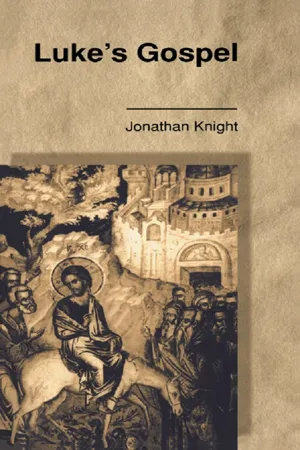
Luke's Gospel provides a comprehensive and schematic reading of Luke's Gospel, one of the most important books detailing the life and works of Christ, in six main parts. Knight introduces the Gospel and the narrative theory on which the Gospel rests. He offers a detailed, chapter-by-chapter exposition of the Gospel and also alternative perspectives, such as feminism and deconstruction. He considers the principal motifs of the Gospel, particularly the theme of the temple, which has been previously overlooked in Luke scholarship, arguing that Jesus pronounces the present temple forsaken by God to introduce himself as the cornerstone of the eschatological temple. Finally, he examines earlier readings of Luke's Gospel.
Jonathan Knight presents an accessible and jargon-free introduction to the Gospel and makes a valuable addition to the New Testament Readings series.
- 240 pages
- English
- ePUB (mobile friendly)
- Available on iOS & Android
eBook - ePub
Luke's Gospel
About this book
Information
Chapter 1
An introduction to the text
This book sets out to provide a reading of Luke’s Gospel.1 Of the writing of books on the Gospels there has been no end, especially not in the last ten years. It is therefore incumbent on a new author to explain where his work differs from the rest and doubtless to acknowledge the many areas of overlap and the sources from which his ideas have been culled. This book is motivated by the belief that it is helpful to read Luke as a narrative – that is to say, as a text which tells a story – and that much can be learned from this approach, which has assumed increasing prominence in New Testament scholarship over the past decade.2 The Gospels, after all, do tell a story. Recent research has shown that they have much in common with the so-called ‘Lives’ of Hellenistic figures (see below). There is a need for a reading of Luke which examines the nature of its narrative, including matters of structure and content, within the confines of a single volume.3 This aim shapes the way in which this book has been written. Chapter 1 is an introduction to Luke which explores the Gospel’s major features and argues for a common authorship with the Acts of the Apostles (a theory which has implications for the wider interpretation of the Gospel). Chapter 2 offers an introduction to Luke as a narrative and suggests some areas which ought to be considered in a reading of the Gospel. Chapter 3 presents a reading of Luke which works through the Gospel on a chapter-by-chapter basis. Chapter 4 considers some alternative readings of Luke – notably, deconstructive and feminist readings. Chapter 5 examines the themes of the Gospel in the light of this earlier discussion. Finally, Chapter 6 offers a reading of some of Luke’s interpreters, beginning with Hans Conzeimann and ending with Stephen Moore, and offers a metacommentary on readings of Luke which tries to guide the unfamiliar reader through the growing maze of secondary material.
It is doubtless true to say that a ‘literary’ approach to the Bible arose from the recognition that much scholarship was dominated by a theological agenda (which generally meant a Christian theological agenda) that ignored developments in other fields of literary research and concentrated on themes in the text rather than on the text itself. Much of what has been done from this perspective in New Testament studies so far has been of the nature of ‘catching up’ on approaches which have already profitably been adopted in English, Classics and Philosophy. This observation raises an important question of method for the present study. The approach that will be adopted in Chapters 2 and 3 of this book is to read Luke as a text and to ask what holds it together and makes it function as a work of literature. This is a different approach from many previous studies which have asked mainly about Luke’s place in the development of Christian ideas. There is a coherent reason for this shift in emphasis. The Gospels certainly illustrate the development of early Christian ideas but they are not in themselves theological treatises. First and foremost, they tell a story about Jesus which (meta)comment(ate)s on his significance as it was perceived in the late first century CE. They incorporate earlier material which each Evangelist arranges in a certain way. Readers interact with this material to form the meaning which they take from each Gospel. It is through this process of reading that the meaning of the text is forged out for the reader.
This book works from the assumption that, since Luke is a narrative, the methods which have been used to interpret secular narratives can and should be applied to Luke as well. This means that we must pay careful attention to issues of plot and characterization which stand at the heart of all narratives. Whatever sources lie behind Luke – and I shall argue that Mark and Matthew were two of them – our interest lies with the interpretation of Luke as it stands and not with an analysis of the elements from which it was composed. This approach does not mean that Luke is without its gaps and problems. Far from it. There are some very obvious gaps in the story, like what Jesus did in his childhood and what he thought about a variety of issues. A continual tension surrounds the character of Jesus in the Gospel. Throughout, the figure of the heavenly Lord dances with the human Jesus because the narrative hero who dies is also the Lord in heaven. Moreover, Luke’s Jesus seems to adopt a different perspective from Luke’s narrator. The author himself sides in places with Jesus against the narrator.4 This is an invitation by the author to the reader to ponder the meaning of the text. The gaps and problems are in many ways the most interesting parts of the story for they force the reader to grapple with its meaning and to construct an interpretation which explores and explains the signs that the author has embedded in the narrative.
This approach means that a consideration of the author’s theological purpose has been (partially) upstaged in my book by a consideration of what makes Luke’s story work. This book draws on a variety of methods in which narrative criticism is aided by composition criticism (especially in Chapters 1 and 5) and by redaction criticism too. The nature of Luke as a Gospel – as a work that uses earlier tradition – makes this multi-faceted approach essential. Narrative criticism is a valuable new approach but, in the opinion of this writer, the older methods have not lost their value. This book will therefore study how Luke works as a narrative and also ask about the themes of Luke’s story and about Luke’s relation to the other Gospels.
A word is in order about how I as the author would like you as the reader to use what I have written. There are several different ways of reading this book. Some readers may want to read it from cover to cover and digest its contents in the order I have devised. This is a perfectly satisfactory way of reading and I hope that I have placed enough signposts in the text to guide my readers along their way. On the other hand, some readers may find themselves impatient with what has turned out to be quite a lengthy introduction (Chapters 1 and 2). I regard it as equally satisfactory if readers want to begin with Chapters 3 and 4, where some different readings of Luke are explored, and then return (or choose not to return…) to the introduction. Chapter 3 contains the real meat of the book (readers may find my summary of Luke’s plot in Chapter 2 a helpful preliminary to this chapter). I hope that readers will come to share the sense of enthusiasm which I have gained for Luke’s Jesus with his denunciation of the present temple (13.35) and self-introduction as the corner-stone of the eschatological temple (20.17).
LUKE AS A GOSPEL
The first question we must consider is the question of Luke’s genre. What kind of text are we dealing with? The answer is that Luke is ‘a Gospel’. A Gospel is a written record of the life of Jesus which tells the story of his adult ministry (or at least what are considered the significant parts of it) and concludes with his death and resurrection (uniquely in Luke with the ascension of Jesus). Matthew and Luke describe the birth of Jesus. All the Gospels omit the substantial details of his childhood (apart from one sparse Lucan anecdote). There are four Gospels in the New Testament; Luke is the third in sequence. These Gospels must be distinguished, both in form and in content, from the other so-called ‘Gospels’ which lie outside the New Testament canon.5 These non-canonical Gospels were written later than the canonical Gospels and they lack the narrative structure which gives the canonical Gospels their character. In the analysis of the genre, the observation that the New Testament Gospels ‘tell a story’ – that they have a fundamental narrative structure – is an important one.
Luke was not the first Gospel to be written. That distinction probably rests with (a form of) Mark. It seems virtually certain that Luke knew Mark. It is probable that he also knew Matthew. Luke must be evaluated in the context of the emerging Gospel tradition and in deference to the possibility that some of what he says may be a deliberate recasting of the earlier Gospels, for whatever reason this was done (as for instance in the temptation story, chapter 4). Luke did not come to birth in isolation from a literary or from an oral tradition. The latter continued to circulate even in the second century.6 The author picks up both traditions and gives them new shape and focus through his own distinctive touches.
The Gospel form was an innovation in first-century Christianity but it is broadly related to other ancient literary types. Since Mark was the first Gospel to be written, it is by his standards that the other Gospels must be judged. It is clear that when Mark wrote, some forty years after the resurrection of Jesus, the need was felt to write down the facts about Jesus to yield a more permanent record than was provided by the oral tradition. One can only admire the simplicity with which the earliest Gospel is written. Mark’s narrative moves from the story of John the Baptist through Jesus’ ministry in Galilee, his identification as the Messiah by the disciples, to the journey to his death in Jerusalem, which is followed in turn by the resurrection. This basic plot supplies the narrative framework which the other Gospels adopt.
The body of Mark’s Gospel contains both sayings and deeds of Jesus. The presence of both to the exclusion of neither gives the Gospel its character. Mark’s record of the sayings of Jesus is presented in a narrative framework, even if the links at times seem rather perfunctory. His narrative moves towards the trial and death of Jesus which occupy a disproportionately large part of the Gospel. Mark ends, almost mysteriously, with a description of the empty tomb and the women’s vision of the angels (16.8).7 The other Gospels add to this the resurrection appearances of Jesus which allude to the Christian belief in his heavenly existence; Luke also adds the ascension of Jesus to heaven.
The question has been raised of how far the Gospels conform to the style of ancient biography. Comparison has often been made with the ‘Lives’ of Hellenistic figures written by the classical historians. Richard Burridge examines five such ‘Lives’ which were written before Mark.8 Burridge shows that all exhibit a similar range of features within a flexible pattern. He mentions the following points of comparison. Their flexibility operates within perceptible boundaries. The ‘Lives’ are generally called by their subject’s name (cf. Mark 1.1). Their subject dominates the narrative. The way in which the story is told varies from example to example. Some texts adopt a strict chronological sequence. Others mix this with topical analysis. Their scale is limited to the subject’s life, deeds and character. The anecdote (’a brief biographical narrative that relates a striking or unusual feature of the hero’s character’) plays a significant role in them. Many such works conclude with the story of the hero’s death. Its cause is sometimes described in much detail. Burridge discerns a variety of reasons for the writing of these Lives, including the need to preserve the hero’s memory and to pass on his teaching. He shows that they were read at public occasions such as festivals. They were not originally intended for private consumption but for public edification.
These points of comparison are instructive but we must not ignore some significant differences between the Gospels and the Lives. Graham Stanton observes that only a small number of the features of Mark can be found either in any one ancient biography or in any single type of biography.9 Moreover, many features of Mark would have puzzled the readers of ancient biography. These include the Evangelist’s concentration on the death of Jesus, his seemingly abrupt ending and his evident dislike of anecdotes. In the case of Luke, the Gospel presents something more than the life of Jesus tout court for it begins with the birth of John the Baptist and offers a theological commentary on what Jesus does, which paves the way for the writing of Acts, which narrates the sequel to his ministry. The Gospels certainly contain elements of biography, and it may be that this broad Hellenistic influence allowed Luke to conceive of a work in two volumes.10 Yet the impression remains that Luke describes not so much the life of Jesus as such but what Acts 2.11 calls ‘the mighty works of God’ (RSV). This is an altogether broader view even though the story of the life of Jesus gives initial shape and coherence to the project.
Perhaps the most important difference between the Gospels and the Lives is the status accorded the heroes in the respective literature. Charles Talbert thinks that Luke has close parallels to those Lives of philosophers which show where the living voice’ of the tradition can be found once the founder has passed on.11 This is doubtless true to the extent that Luke provides a more permanent record of Jesus’ deeds and sayings than the oral tradition but this comparison potentially obscures a most important point. For the first readers of Luke, Jesus was the heavenly Lord whose presence was experienced whenever they met for worship. He was not a dead prophet but the living Lord whose installation as a heavenly being is symbolized by the ascension in the Gospel and celebrated in the gathered community. The belief that Jesus is ‘seated at the right hand of Almighty God’ (22.69) colours Luke’s narrative to the extent that belief in his divinity is read back into the story of his life. There is thus a dialectical relationship between Luke’s story of the historical Jesus and the readers’ perception of him as Lord. The experience of reading the Gospel affects the experience of meeting Jesus in worship and vice versa. Talbert’s comparison must be qualified by the observation that the living voice of the Jesus tradition was provided as much by the promptings of his Spirit in the Christian community, whatever that meant in practice, as by the reading of an authoritative text. We can now only speculate on the nature of the relationship between the reading of the text and the perception of the heavenly reality which these early readers enjoyed.
Nor should the comparison between the Gospels and the Lives be allowed to yield the conclusion that the Gospels are biographies as we understand the term today. Biographies are two-a-penny at the moment. They fall into different forms ranging from serious historical scholarship to romantic or fictional reconstruction. Those who look to the Gospels to provide a full-blown life of Jesus will be sadly disappointed. Much of the crucial information is missing: what Jesus’ parents did, what were the formative influences on his life, and so on. Moreover, some of the information that is included is unconvincing. It is incredible that Jesus should predict his fate in the terms suggested by 9.22 (although I accept that 9.44 is a more convincing prediction). The discrepancies between the Gospels, notably in the trial narrative, pose a serious problem for historians which must not be ignored. This demonstrates the point that the Gospels must be read on their terms and not on ours (even though we bring our agenda to the act of reading). When this point is acknowledged it is possible to make snatches at the elusive Jesus of history, even to reconstruct an outline of his career. But there is much that we cannot say from a reading of the Gospels, and much that we might not want to say. This problem of information is created by the texts themselves.
One of the problems with some research in this area is that it tends to treat the Gospels as uniform documents and to ignore the differences between them.12 Luke is by no means necessarily the same kind of text as Mark or Matthew. Luke has his own interests and methodology, notably his avowed contact with Hellenistic literature. These parallels with Graeco-Roman writing, and the nature of the text which they produce, distinguish Luke among the Gospels. This point must be duly acknowledged in the discussion of genre.
Luke’s affinity with Hellenistic literature is historiographical as well as biographical. Luke self-consciously sets his work in a tradition of research which supplies the meaning of the facts recorded (1.1–4). Comparisons are often drawn with the opening part of Josephus’ Against Apion (a near contemporary of Luke’s) which is dedicated to Epaphroditus and which initially sets out the author’s purpose in writing.13 There is a similar Preface at the beginning of Apion Book II which recalls the Preface that opens Acts (Luke’s second volume). Several features of Greek historiography are mirrored in the Gospel.14 Luke attempts to fix his history with reference to various authorities in 1.5 and (especially) 3.1. He follows Hellenistic conventions in translating foreign words (e.g. 8.54; 23.33) and in assimilating Jewish concepts to more familiar Greek ones (e.g. the reference to ‘tiles’ in 5.19). Hellenistic too is Luke’s interest in moral topics, such as his attitude to wealth in 16.14. His writing of Acts as a companion to the Gospel supports the theory that Luke conceives his work as history of a kind. This again distinguishes him from Mark and Matthew and br...
Table of contents
- Cover
- Title
- Copyright
- Contents
- Series editor’s preface
- Preface
- List of abbreviations
- 1 An introduction to the text
- 2 Luke as a narrative
- 3 A reading of Luke
- 4 Alternative readings of Luke
- 5 The themes of Luke’s Gospel
- 6 A reading of readings
- Notes
- Bibliography
- Biblical index
- Index of ancient authors
- General index
Trusted by 375,005 students
Access to over 1.5 million titles for a fair monthly price.
Study more efficiently using our study tools.
Frequently asked questions
Yes, you can cancel anytime from the Subscription tab in your account settings on the Perlego website. Your subscription will stay active until the end of your current billing period. Learn how to cancel your subscription
No, books cannot be downloaded as external files, such as PDFs, for use outside of Perlego. However, you can download books within the Perlego app for offline reading on mobile or tablet. Learn how to download books offline
Perlego offers two plans: Essential and Complete
- Essential is ideal for learners and professionals who enjoy exploring a wide range of subjects. Access the Essential Library with 800,000+ trusted titles and best-sellers across business, personal growth, and the humanities. Includes unlimited reading time and Standard Read Aloud voice.
- Complete: Perfect for advanced learners and researchers needing full, unrestricted access. Unlock 1.5M+ books across hundreds of subjects, including academic and specialized titles. The Complete Plan also includes advanced features like Premium Read Aloud and Research Assistant.
We are an online textbook subscription service, where you can get access to an entire online library for less than the price of a single book per month. With over 1.5 million books across 990+ topics, we’ve got you covered! Learn about our mission
Look out for the read-aloud symbol on your next book to see if you can listen to it. The read-aloud tool reads text aloud for you, highlighting the text as it is being read. You can pause it, speed it up and slow it down. Learn more about Read Aloud
Yes! You can use the Perlego app on both iOS and Android devices to read anytime, anywhere — even offline. Perfect for commutes or when you’re on the go.
Please note we cannot support devices running on iOS 13 and Android 7 or earlier. Learn more about using the app
Please note we cannot support devices running on iOS 13 and Android 7 or earlier. Learn more about using the app
Yes, you can access Luke's Gospel by Jonathan Knight in PDF and/or ePUB format, as well as other popular books in Theology & Religion & Ancient History. We have over 1.5 million books available in our catalogue for you to explore.