- 252 pages
- English
- ePUB (mobile friendly)
- Available on iOS & Android
eBook - ePub
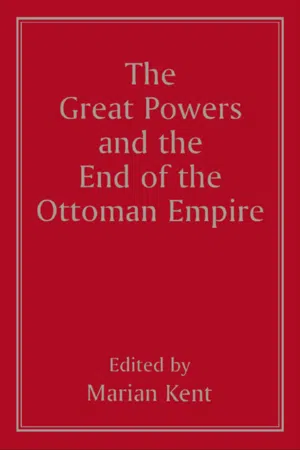
The Great Powers and the End of the Ottoman Empire
About this book
How far was the end of the Ottoman Empire the result of Great Power imperialism and how far the result of structural weaknesses within the Empire itself? These studies of the foreign policy of each of the Great Powers and the Ottoman Empire examine these fundamental issues.
Information
1
The Late Ottoman Empire
Feroz Ahmad, University of Massachusetts—Boston
The meeting at Reval between King Edward VII and Tsar Nicholas II in June 1908 suggested to Turkish minds that the two great antagonists of the Eastern Question might be burying their differences and reaching agreement to dismember the Ottoman Empire.1 The fear of dismemberment was never far from Turkish thoughts, especially after the Congress of Berlin in 1878. There the Great Powers abandoned the principles of maintaining the integrity of the Ottoman Empire and non-interference in its internal affairs—principles they had adopted at the Paris Congress in 1856.2 At Berlin, the Ottoman Empire not only lost territory, it was also forced to reconcile itself to foreign intervention, ostensibly to supervise reform on behalf of the Porte’s non-Muslim subjects though more usually to further the interests of one Power or the other. That encouraged nationalism and separatism among subject peoples and created an explosive situation for the Porte. It may therefore be argued that the Powers were responsible for hastening the collapse of the Empire if only because they exploited a situation not of their making.
The Ottoman Empire, like the other multi-national, multi-religious empires, had become an anachronism in a Europe dominated by nation states. Its rulers tried to meet the challenges of industrial capitalism and a rapidly emerging world market by reforming their own state and society. If they failed, they were not alone. A far more homogeneous Chinese empire succumbed to the same challenges, as did the empires of Austria-Hungary and Tsarist Russia. It seems as though reform alone could not stave off the fatal day of final destruction, and none of the ruling classes, least of all the Ottoman, could go beyond reform to the restructuring of society; only the Bolsheviks did that after they seized power and therefore still had an ‘empire’, albeit in a new form. Nevertheless, the Ottoman Turks tried till the very end to reform and struggle for survival. Ultimately they were forced to accept the inevitable; to abandon the idea of empire and settle for a national republic.
The end of the Ottoman Empire ought not to be any cause for surprise; the puzzle is that it survived as long as it did. One authority on the Eastern Question has noted that ‘The Ottoman Empire in 1774 was still stagnant and archaic. Its chances of survival now seemed to many observers very small.’3 If the Empire survived for almost another century and a half, that was due more to the rivalries of the Great Powers and their failure to reach agreement on how to divide ‘the sick man’s’ legacy than to the patient’s will and determination to survive. Yet Ottoman state and society as they approached the end of empire were very different from the description of 1774. In the century and a half that had elapsed, major changes were introduced into the entire structure of the Empire. These changes did not save it but they did lay new foundations without which there could have been no nation state.
The Empire at the beginning of the nineteenth century may best be described as a ‘tributary state’.4 The military-bureaucratic ruling class rested on no specific socioeconomic foundations (as did the ruling class in pre-industrial Europe whose power was based on land ownership). Instead, it appropriated surplus in the form of revenue from all sectors of the economy: the land, internal and foreign trade, and manufacturing. Out of their own self-interest, Ottoman rulers protected all these sectors without allowing any one of them to influence state policy and to emerge dominant over the others. Thus, while landholders and merchants acquired great wealth and were vital to the economy, they were never permitted to exercise political power. These economic groups failed therefore to develop as a political class.
The great Ottoman transformation coincided with the Napoleonic episode in the Levant. The state was threatened internally by reactionary rebellions against reform and externally by Napoleon’s invasion of Egypt. In the ensuing turmoil, new political forces—namely, the landed provincial élite supported by the reformist bureaucracy—intervened on behalf of the sultan. After defeating the reactionaries—at least, temporarily—they forced the sultan to confirm their own rights and privileges.5
The signing of the ‘deed of agreement’ (sened-i ittifak), Turkey’s Magna Carta, in 1808 marked the emergence of landed interests as a political force at the centre. Despite setbacks, by 1826 the alliance of sultan, landed élite, and bureaucracy had succeeded in defeating the reactionaries. Soon after, the bureaucracy at the Sublime Porte virtually seized control of the affairs of state. It launched a series of reforms whose aim was to create a modern state apparatus and limit the autocratic powers of the sultan.6 In the years 1840–70 three statesmen—the Grand Vezirs/Foreign Ministers Mustafa Re id Pasha (1800–58), Âli Pasha (1815–71), and Fuad Pasha (1815–69)—ran the Empire and conducted its foreign relations. They were convinced ‘Westerners’, who, having seen Europe at close quarters, concluded that it was futile to resist her advance and wiser to emulate her by adopting her ideas and institutions. Better still, they believed, make the Empire a part of the European system by letting it be integrated into the rapidly expanding world economy, the impact of whose exports was painfully apparent in the Ottoman economy as early as the 1820s.7 The policies of these ‘Westerners’ soon created modern-sounding state institutions, but they also had a disastrous effect on the economy and society, leading to bankruptcy and foreign control.
There was a popular reaction against these men and their policies because they were held responsible for making the Empire subservient to the West. Âli Pasha was described as ‘the ambassador of that European power which was most influential in Istanbul rather than the foreign minister of the Ottoman Empire’.8 As a result, the sultan became a popular figure, the symbol of opposition to the West, and regained the initiative from the bureaucrats. For the next generation, Sultan Abdul Hamid II (1876–1909) ruled the Empire from Yildiz Palace, aided by a clique of favourites and sycophants who created their own closed ‘palace system’. There was a marked degeneration in the power of the Grand Vezirate and the Foreign Ministry, both being closely associated with the discredited ‘Westerners’.9 Such ministers became creatures of the sultan, dependent for their official survival upon patronage and intrigue within the Palace clique. Thus, in the years 1871–85 there were more than twenty changes at the Foreign Ministry; only thereafter was there a semblance of stability with Kürd Said Pasha and Ahmed Tevfik Pasha acting as foreign ministers during the years 1885–95 and 1895–1909 respectively.10 The Foreign Ministry had become a technical appendage to the Palace where policy was actually made. In such circumstances, the Under-Secretary at the Ministry, especially if he were as talented as Artin Dadian Pasha, became more important than the Minister, for he supplied the information on which policy was based. By and large, career diplomats played a secondary role, while Abdul Hamid used his confidants as negotiators and ambassadors. This state of affairs lasted until the constitutional revolution of 1908.11
The Young Turk revolution marked the end of the Hamidian system and the temporary resurgence of the Sublime Porte to its former glory. With the establishment of political parties and parliamentary politics, the element of ideology was injected into the bureaucracy, including the Foreign Ministry. It is thus possible to chart the course of the revolution by the changes at the Grand Vezirate and the Ministry of Foreign Affairs alone.
Even though the Constitution was restored in July 1908, Abdul Hamid’s Grand Vezirs, Said and Kâmil Pashas, and his Foreign Minister, Tevfik Pasha, continued in office. It is true that they were now independent of the sultan and were taking measures to strengthen the Porte against the encroachments of both the Palace and the Committee of Union and Progress (CUP)—the most radical organisation in the Young Turk movement—but Said and Kâmil were nevertheless men of the old regime. Only after the CUP had engineered the fall of Kâmil Pasha in February 1909 were the Unionists able to replace Tevfik, who, ‘perhaps because of his long habituation of the Hamidian system, did not seem to know anything about the regulations supposed to govern his ministry’.12
Tevfik’s successor, Mehmed Rifat Pasha (1860–1925), was a career diplomat. He joined the translation bureau of the Foreign Ministry in 1882, became minister to Athens in 1897 and Ambassador to London in 1905, whence he was recalled to be Foreign Minister. Rifat’s sympathy for Unionist aspirations was as important as his professionalism in leading to his appointment. Socially he belonged to the declining class of Turkish Muslim merchants whose fortunes the CUP hoped to revive by instituting protectionism and abolishing the privileges of foreigners. Rifat’s father and brother were merchants of the Balkapi district in Istanbul, and his brother efik joined the CUP and was elected to Parliament. Rifat himself was considered sufficiently loyal to the Committee to be given a safe parliamentary seat for Istanbul.13
Rifat Pasha was succeeded in September 1911 by Mustafa Asim, another career diplomat with Unionist sympathies, who was immediately replaced by the anti-Unionist government of Ahmed Muhtar Pasha (1839–1918) in July 1912. This Liberal government brought to the Foreign Ministry Gabriel Noradunghian, an Armenian nationalist, in the fond hope of swaying the Great Powers towards Turkey during the Italo-Turkish and the First Balkan wars.14 After the Unionist coup d’état of January 1913, except for the interim appointment of Muhtar Bey, the Foreign Ministry was always occupied by someone from the inner circle of the CUP. Said Halim Pasha (1863–1921), the Egyptian prince from the house of Muhammad Ali, who was already Foreign Minister, became Grand Vezir in June 1913 and remained in office until October 1915. He was succeeded in the Ministry by Halil (who adopted in 1934 the family surname Mente e), a key member of the Committee, who was replaced by Ahmed Nesimi, a confidant of Talât Pasha, when the latter became Grand Vezir in February 1917.
The Unionists considered diplomacy to be too important to be left to diplomats. Thus, even when they were not in power they engaged in diplomatic manoeuvres independently of and unknown to the government. Until they came to power in 1913, the Unionists were the self-appointed guardians of the new regime, exercising power without responsibility. They were often impatient with official procedures and suspicious of the Foreign Ministry, which they regarded as being both cautious and timid in its dealings with foreign states. Moreover, they believed that many of their professional diplomats had leanings towards Liberal political groups which made them willing to reach compromise with the Powers over the Empire’s sovereignty—the very thing the CUP was determined to regain.15 The Committee, therefore, sent its emissaries and deputations to convey its views to foreign embassies and governments. Even after the Unionists had gained control of the Foreign Ministry, their delegations, supported in technical matters by career men, continued to deal with matters of war and peace, as well as with the search for alliances. The same methods were used throughout the war, until the resignation of Talât Pasha’s Cabinet in October 1918. It was replaced by a government untainted by association with the war party in the hope that the Allies would give better armistice terms to such a ministry.
The fall of the CUP allowed the Palace to regain the initiative once again, though only for less than a year. In those months, Sultan Mehmed VI Vahdettin (1918–22) reverted to the diplomacy of the Liberal Young Turks and that meant total reliance on and subservience to Great Britain. Old and discredited members of the Ottoman ancien regime were resurrected in order to form ephemeral governments and conduct personal diplomacy. Thus, Tevfik Pasha formed two ministries between November 1918 and March 1919, to be followed by Abdul Hamid’s brother-in-law Damad Ferid Pasha (1853–1923), who led three cabinets in seven months. Damad Ferid, having served in diplomatic missions throughout Europe during the Hamidian era, and having been acquainted with European statesmen during his tenure as a Liberal politician, was considered an asset in the negotiations for the very survival of the Ottoman state and dynasty. Such hopes proved illusory. The Britishbacked Greek invasion of Anatolia on 15 May 1919 and the paralysis of the Istanbul government ended any hope that the sultan’s regime had of gaining popular acceptance.16
Meanwhile, local notables had begun organising resistance to the foreign occupation of Anatolia. By the summer of 1919, a national movement was taking shape under the leadership of Mustafa Kemal Pasha (1881–1938), named Atatürk, or ‘Father Turk’, in 1934. The nationalist movement’s Representative Committee soon became an alternative focus of power and a direct challenge to the Istanbul government. After the capital was occupied by Allied troops on 16 March 1920, the nationalists announced the formation of a government in Ankara on 23 April. They claimed, with much justification, that the sultan was a ‘prisoner’ of the Allies and was therefore no longer capable of acting on behalf of the Turkish people. So far, nationalist diplomacy had been confined to unofficial contacts with representatives of foreign powers in Anatolia. But, having declared themselves a government, the nationalists had to organise a Foreign Off...
Table of contents
- Cover Page
- Title Page
- Copyright Page
- Preface to the Second Edition
- Preface
- Introduction
- 1 The Late Ottoman Empire
- 2 The Habsburg Monarchy and the Ottoman Empire, 1900–18
- 3 Italy and the End of the Ottoman Empire
- 4 Russia and the End of the Ottoman Empire
- 5 Germany and the End of the Ottoman Empire
- 6 France and the End of the Ottoman Empire
- 7 Great Britain and the End of the Ottoman Empire 1900–23
- Bibliography
Trusted by 375,005 students
Access to over 1.5 million titles for a fair monthly price.
Study more efficiently using our study tools.
Frequently asked questions
Yes, you can cancel anytime from the Subscription tab in your account settings on the Perlego website. Your subscription will stay active until the end of your current billing period. Learn how to cancel your subscription
No, books cannot be downloaded as external files, such as PDFs, for use outside of Perlego. However, you can download books within the Perlego app for offline reading on mobile or tablet. Learn how to download books offline
Perlego offers two plans: Essential and Complete
- Essential is ideal for learners and professionals who enjoy exploring a wide range of subjects. Access the Essential Library with 800,000+ trusted titles and best-sellers across business, personal growth, and the humanities. Includes unlimited reading time and Standard Read Aloud voice.
- Complete: Perfect for advanced learners and researchers needing full, unrestricted access. Unlock 1.5M+ books across hundreds of subjects, including academic and specialized titles. The Complete Plan also includes advanced features like Premium Read Aloud and Research Assistant.
We are an online textbook subscription service, where you can get access to an entire online library for less than the price of a single book per month. With over 1.5 million books across 990+ topics, we’ve got you covered! Learn about our mission
Look out for the read-aloud symbol on your next book to see if you can listen to it. The read-aloud tool reads text aloud for you, highlighting the text as it is being read. You can pause it, speed it up and slow it down. Learn more about Read Aloud
Yes! You can use the Perlego app on both iOS and Android devices to read anytime, anywhere — even offline. Perfect for commutes or when you’re on the go.
Please note we cannot support devices running on iOS 13 and Android 7 or earlier. Learn more about using the app
Please note we cannot support devices running on iOS 13 and Android 7 or earlier. Learn more about using the app
Yes, you can access The Great Powers and the End of the Ottoman Empire by Marian Kent in PDF and/or ePUB format, as well as other popular books in Histoire & Histoire du Moyen-Orient. We have over 1.5 million books available in our catalogue for you to explore.