eBook - ePub
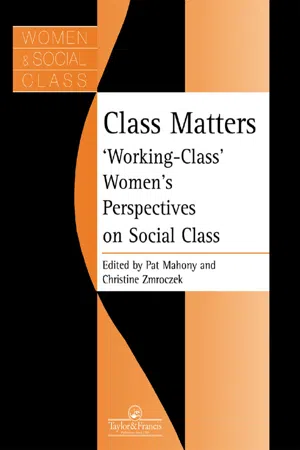
Class Matters
"Working Class" Women's Perspectives On Social Class
- 192 pages
- English
- ePUB (mobile friendly)
- Available on iOS & Android
eBook - ePub
Class Matters
"Working Class" Women's Perspectives On Social Class
About this book
This text focuses on the theory of class as it relates to women. It debates questions such as: how do women define themselves in terms of social class and why?; is definition important or not?; what part does education play in our understanding of class?; and how does class affect relationships?
Information
Publisher
Taylor & FrancisYear
2005Print ISBN
9780748405411
9780748405404
Edition
1eBook ISBN
9781135741594
Chapter 1
Why Class Matters
Pat Mahony and Christine Zmroczek
This collection represents, for us, a celebration of ten years of work on the subject of women and social class and in particular on the experiences of women from working-class backgrounds now living and working in a variety of contexts.
In this chapter we will briefly review our work to date, concentrating on the main reasons for our interest and the processes through which our understandings have developed. We will identify the major themes which have emerged, many of which are explored in greater depth by the authors in this volume, and point to those areas where, in our view, further work needs to be done.
There were three main reasons for our initial interest in women and social class. First, as two women from working-class backgrounds, the experience of going through university as students and then working in the academy as teachers and researchers left us confused about our own class positioning. Though both of us were told repeatedly that by virtue of our education and our ‘position in the labour market’ we were not working-class, we did not feel middle-class nor believe that we had necessarily ‘gone up in the world’. While we believed that it was insulting to other working-class people to pretend that our lives were the same as theirs, given the relative privileges bestowed on us by our middle-class occupations, neither did we feel that we inhabited the world of the university in the same ways as the majority of our colleagues (including other feminists). In addition, the social and cultural assumptions underpinning and permeating some of our worlds seemed to be very different from those of our middle-class feminist colleagues and friends. As we began talking about these issues in the mid 1980s, we discovered that we shared a massive sense of confusion about where we fitted in (if anywhere) and as we talked more, we were relieved to learn that we tended to have similar reactions (outrage) to the subtle reminders of our ‘difference’, sometimes ascribed as inferiority.
The second stimulus to our work occurred at a conference where we heard, yet again, that ‘radical feminism is middle-class and not interested in exploring difference between women’. Our objections to this assertion were twofold. First, the statement was made from a position described by the speaker as ‘one perspective within postmodernism’, the virtues of which were, apparently, to avoid the theoretical inadequacy of radical feminism with its alleged ‘tendency to deal in universalizing truth claims about all women’. This is not the place to enter into debate about the merits or otherwise of postmodernisms (Mies and Shiva, 1993; Bell and Klein, 1996) but the irony was not lost on us in this instance, of the tendency of postmodernism to deal in universalizing truth claims about radical feminism. Our second objection related to our own work. We had spent some twenty years as radical feminists, during which we had attempted to explore differences in women’s social, cultural and political circumstances through our own teaching and writing (for example, Mahony, 1989,1992; Zmroczek, 1992). We were not pleased (to put it mildly) to have our contribution rendered invisible; we may have been confused about our own complicated social class positioning, but the claim that we were middle-class simply did not fit with our experiences.
The third impetus for our work came from our dissatisfaction with writing on social class. Although a great deal has been written, much of it is by and about men and it did not have the power or resonance of feminist writing. We could find only a few books (hooks, 1981; Steedman, 1986 and later Taking Liberties Collective, 1989; Walkerdine, 1990) about the experiential level of class oppression which would enable us to grasp the nature of the influences on the formation of working-class women’s identities and the ways in which these in turn affect our possibilities, real and perceived. Some people have mistakenly taken our project to be an exploration of identity. It is more than that. It is a search for theory which can begin to describe the relationships between the classed nature of our lives and our positionings within the broader material structures. For if we do not understand the processes which undermine us, steal our creativity and marginalize us, we cannot interrupt or challenge them. Our exploration is based on a feminist perspective which seeks to understand how class power both structures our lives and is reconstituted through them.
For all these reasons it seemed urgent to find out how to place ourselves as two white women distanced from our undoubtedly working-class backgrounds but certainly not always comfortable in and at times positively enraged by the oppressive behaviour of the largely middle-class world which we now inhabited.
We knew two more women who were also concerned about these issues and in the mid 1980s we formed a group. We consisted of three ex-Catholics (an African/Asian Scot, an English Pole and an English Irish woman) and an Asian Muslim woman. One of us had children, two identified as heterosexual, one as (sort of) heterosexual and one as lesbian. Our ages ranged from late forties to early twenties, all of us had working-class backgrounds which seemed to live on with us into the present, all of us had been to university and were in middle-class occupations. In such a group the two of us who described ourselves as radical feminists had little difficulty in resisting any urge to universalize our experience.
We learned a great deal about our similarities as well as the very real differences for black and white, lesbian and heterosexual women, living in a racist and heterosexist society. We began to clarify the ways in which the constant drip of negative and oppressive experience operates at a personal level to re-create gendered class and race divisions in Britain. We shared our strategies for coping with and overcoming the obstacles which had faced us at school and in higher education, at home and in our workplaces and we rediscovered and revalued some of the strengths we had developed by virtue of our working-class backgrounds. We had been meeting for two years when new jobs, house moving, family illness and pressure of work combined to make it impossible for the group to continue.
Some time later the two of us attended a workshop for working-class women, given by Jo Stanley at a Women’s Studies Network conference (Stanley, 1995). We were inspired by the energy, strength, anger and humour of the women we met and resolved to resurrect our own work and develop it.
The major themes which emerged from this stage of our work have been discussed elsewhere (Zmroczek and Mahony, 1996a, 1996b) and it has been particularly exciting to see many of them explored further in this volume. The authors here write powerfully on the basis of their own experiences, of their confusion and ambivalence in locating themselves as ‘working-class’. Others contest the category itself while still giving voice to their dissatisfaction with the claim that Britain is not a class-ridden and class-determined society. How to find a place (or places) within the variety of worlds we inhabit, what counts as a place and a desire to make a place of one’s own are all discussed in ways which will take the debate further.
The ways in which the lack of material resources not only affected us while we were growing up, but linger on into the present, shaping our consciousness, attitudes and behaviour, is another theme which is developed in the book. Closely related to this are the differences in cultural capital, awareness of which persists long after we have acquired many of the trappings of a middle-class lifestyle. The part that language and accent play in signifying our histories is particularly complex. Some black women of African and African-Caribbean origin, for example, have told us that despite their middle-class accents, it is frequently presumed that they are working-class and that all kinds of assumptions follow from this. In this volume, issues of class difference between black women are discussed and questions raised which clearly need to be pursued in a future volume. The ways in which white women from working-class backgrounds continue to be marked out by accent (if the enforced elocution lessons failed) also constitute areas of particular sensitivity. It is surely no accident that many of us have learned to play with accent, to ‘use’ it in quite self-conscious ways as a political tool to expose the pompous, to undermine the snobbish and to challenge the stereotypes about us.
And stereotypes there are, in plenty. In the course of preparing a conference paper (Zmroczek, 1996) in which she wanted to explain current conceptions of class in Britain to an international audience, Chris was surprised to notice the plethora of offensive, stereotyped representations of working-class people appearing in the British media over a relatively short period of time. There were also television programmes and newspaper articles which offered more positive images. This has raised questions for us about the kinds of representations which predominate, the social and political agendas set by them and their effects in determining attitudes about class. Dave Hill, for example, writing in the Sunday Observer Life Magazine(31 March 1996), noted that ‘a recent Gallup Poll showed that 81 per cent of people believe there is a class struggle in this country compared with 66 per cent 15 years ago’ (p. 26). This finding was borne out by a small survey of first degree students who responded to a questionnaire in a Women’s Studies course (Zmroczek, forthcoming). In answer to the questions ‘Does social class matter in today’s Britain?’ and ‘Is everyone equal these days?’, all but one of the forty students who responded were unambiguously of the view that class does matter and that people are not equal. The one remaining student proceeded to define three classes: ‘the aristocracy, the middle-class majority and the underclass e.g. the homeless’. Some students expressed their distaste for class divisions in comments such as ‘it shouldn’t make a difference but it does’ and others were clearly confused about the contradictions between their own experiences and the myths which bombard them. Some, possibly influenced by John Major’s fantasy of a classless society, doubted whether they could still call themselves working-class now that they were (first-year) students. Perhaps there is some mileage in the claim that ‘Class distinctions remain a red-hot British issue, partly because we’re encouraged to believe they no longer exist’ (Hill, 1996, p. 24).
As well as developing new perspectives on some more familiar themes, this volume raises issues which urgently need to be put on the agenda. Women write about retaining their working-class identities as a positive choice and of rejecting the common assumption that they strive to rise out of or escape from their working-class beginnings. This refusal to ‘step up the ladder’ has led us to question whether the ladder image is helpful at all in theorizing women’s relationship to class. For all of us in this volume, class experience is deeply rooted, retained and carried through life rather than left behind (or below). In this sense it is more like a foot which carries us forward than a footprint which marks a past presence. How else should we understand the difficulties we experience within our families when we are perceived as ‘getting above’ ourselves? Why would we encounter such difficulty with the stereotypes of us if we had ‘left it all behind’? And conversely, having absorbed elements of other class identities, why else would we experience so many contradictions in locating ourselves fully and clearly within our working-class communities? Such contradictions are particularly sharp for those with immigrant or refugee backgrounds and when combined with the experience of racism and nationalism, the workings of British society become transparent in all their ugliness.
Authors speak with pride and pain about their working-class origins, about the struggles of their parents, families and communities. They discuss the advantages of being working-class in relation to the development of what we would call good ‘crap detectors’ (for example, in the role of education in creating class difference and division) or of being in a position to obtain rich research data through a deeper understanding and connection with working-class interviewees. There are celebratory recognitions of group activities, of having deep connections to histories which are full of women’s opposition, solidarity and struggle. They write too of the ability to ‘cross’ classes, to ‘play’ with accent, vocabulary and demeanour; of ‘performance’, ‘masquerade’ and ‘passing’ and the richness gained from seeing the world from different vantage points.
In contrast to this, authors write of their feelings of anger and guilt at being part of the academy, at the same time as being excited by intellectual work. Women who have gone through higher education often see themselves as being required to continue an ethic of service to others less ‘lucky’ than themselves. At the same time there are feelings of insecurity about positions attained but not ‘deserved’ and these are often expressed in the fear that one day the ‘fraud’ will be exposed. Overwork is of course frequently the solution to these feelings; as proof that we are worthy of our places in the academy and as fulfilment of the service ethic (especially since this often connects with wanting to decode the ‘rules of the game’ for those students in whom we see ourselves). This notion of ‘being in service’ has particular connotations for teachers (clustered at the lower ends of pay scales) and for researchers (on temporary or short-term contracts) from working-class backgrounds.
The difficulties of exploring class within feminism should not be underestimated. Debates around class seem to sometimes provoke reactions of guilt, defensiveness or even hostility from middle-class colleagues and friends. This does not make it easy to develop new ways of understanding the diversity of women’s lives nor to explore how we might act on social mechanisms which increasingly condemn large proportions of new generations to economic hardship, inadequate housing, ill-health and under-resourced schools and colleges. Our silences have needed to be broken so that by gaining confidence from each other we could explore new ideas and rework old topics from new perspectives. As can be seen from this volume, these new perspectives derive from diverse positions in which what it means to have a working-class background is different in each case. But it is not so different that we do not recognize each other and not so different that our connectedness (at least on this issue) disappears. As feminists we would also hope that women from other class positions will also begin to explore what class means for them and that this may lead to better understandings between women across class difference. This would be an important step in enabling all feminists to challenge oppressive and damaging class structures, mechanisms and institutions.
The period during which we have been thinking, discussing and writing about women and social class has seen the publication of new, relevant material from the USA (hooks, 1989; Tokarczyk and Fay, 1993; Penelope, 1994; Zandy, 1995). It has been particularly exciting to find that the UK material also has relevance for women living in very diverse cultures and countries (Mahony and Zmroczek, 1994, 1996). New themes have emerged, we have learned of significant omissions in knowledge and understanding about class and the need for perspectives to broaden to include recognition of an international dimension to the debate on class. The result is that this book, which was to be the culmination of our work to date, has now become the first of a series.
It has been a privilege and a pleasure to work with the authors in this volume. Our hope is that our readers will feel similarly enriched in concluding —classmatters.
References
BELL, D. and KLEIN, R. (Eds) (1996) Radically Speaking: Feminism Reclaimed, Melbourne, Spinifex, and London, Zed.
HILL, D. (1996) ‘She Is… Are You?’, Sunday Observer Life Magazine,31 March, p. 24.
HOOKS, B. (1981) Ain’t I a Woman, Boston, Mass., South End Press.
HOOKS, B. (1989) Talking Back: Thinking Feminist, Thinking Black, London, Sheba Press, and Boston, Mass., South End Press.
MAHONY, P. (1989) ‘Sexual Violence and Mixed Schools’, in JONES, C. and MAHONY, P. Learning our Lines: Sexu...
Table of contents
- Cover Page
- Title Page
- Copyright Page
- Chapter 1 Why Class Matters
- Chapter 2 Class Matters, ‘Race’ Matters, GenderMatters
- Chapter 3 The Double-Bind of the ‘Working-Class’ Feminist Academic: The Success of Failure or the Failure of Success?
- Chapter 4 Women, Education and Class: The Relationship Between Class Background and Research
- Chapter 5 Academic as Anarchist: Working-Class Lives into Middle-Class Culture
- Chapter 6 Something Vaguely Heretical: Communicating across Difference inCommunicating across Difference in the Country
- Chapter 7 ‘You’re not with your common friends now’: Race and Class Evasion in 1960s London
- Chapter 8 Contested Categorizations: Auto/ Biography, Narrativity and Class
- Chapter 9 Missing Links: Working-Class Women of Irish Descent
- Chapter 10 Switching Cultures
- Chapter 11 A Class of One’s Own: Women, Social Class and the Academy
- Chapter 12 Classifying Practices: Representations, Capitals and Recognitions
- Chapter 13 Northern Accent and Southern Comfort: Subjectivity and Social Class
- Chapter 14 Interpreting Class: Auto/Biographical Imaginations and Social Change
- Chapter 15 To Celeb-rate and Not to Be-moan
- Chapter 16 Finding a Voice: On Becoming a Working- Class Feminist Academic
- Notes on Contributors
Trusted by 375,005 students
Access to over 1.5 million titles for a fair monthly price.
Study more efficiently using our study tools.
Frequently asked questions
Yes, you can cancel anytime from the Subscription tab in your account settings on the Perlego website. Your subscription will stay active until the end of your current billing period. Learn how to cancel your subscription
No, books cannot be downloaded as external files, such as PDFs, for use outside of Perlego. However, you can download books within the Perlego app for offline reading on mobile or tablet. Learn how to download books offline
Perlego offers two plans: Essential and Complete
- Essential is ideal for learners and professionals who enjoy exploring a wide range of subjects. Access the Essential Library with 800,000+ trusted titles and best-sellers across business, personal growth, and the humanities. Includes unlimited reading time and Standard Read Aloud voice.
- Complete: Perfect for advanced learners and researchers needing full, unrestricted access. Unlock 1.5M+ books across hundreds of subjects, including academic and specialized titles. The Complete Plan also includes advanced features like Premium Read Aloud and Research Assistant.
We are an online textbook subscription service, where you can get access to an entire online library for less than the price of a single book per month. With over 1.5 million books across 990+ topics, we’ve got you covered! Learn about our mission
Look out for the read-aloud symbol on your next book to see if you can listen to it. The read-aloud tool reads text aloud for you, highlighting the text as it is being read. You can pause it, speed it up and slow it down. Learn more about Read Aloud
Yes! You can use the Perlego app on both iOS and Android devices to read anytime, anywhere — even offline. Perfect for commutes or when you’re on the go.
Please note we cannot support devices running on iOS 13 and Android 7 or earlier. Learn more about using the app
Please note we cannot support devices running on iOS 13 and Android 7 or earlier. Learn more about using the app
Yes, you can access Class Matters by Pat Mahony, Christine Zmroczek, Pat Mahony,Christine Zmroczek in PDF and/or ePUB format, as well as other popular books in Social Sciences & Gender Studies. We have over 1.5 million books available in our catalogue for you to explore.