- 196 pages
- English
- ePUB (mobile friendly)
- Available on iOS & Android
eBook - ePub
About this book
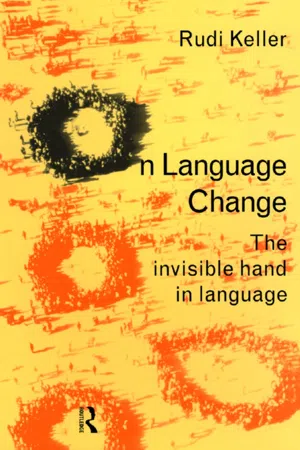
In the twentieth century paradigms of linguistics have largely left language change to one side. Rudi Keller's book is an exciting contribution to linguistic philosophy becuase it puts language change back on the linguistics agenda and demonstrates that, far from being a remote mystery, it can and should be explained.
Information
Part I
Exposition of the problem
Chapter 1
The problem of language change
1.1
WHY DOES LANGUAGE CHANGE?
In central Australia, where the rivers Murray and Darling meet, there lives a small group of aborigines who were forced to change their word for water nine times in five years, each time because the man had died whose name had been the accepted word for water while he was alive.1
We find it difficult to imagine such a situation. Australian aborigines, on the other hand, would probably find it difficult to understand why numerous people in Germany started to run after the English word jogging had come into fashion. Whatever the case, these two examples show that a language has other uses besides the exchange of thoughts or the making of true statements about the world.
Languages are always changing. Twenty generations separate us from Chaucer. If we could board a time machine and visit him in the year 1390, we would have great difficulties in making ourselves understood —even roughly.
With Jane Austen, from whom we are separated by only 180 years, we would not have the same fundamental difficulties of mutual comprehension as with Chaucer, but we would hesitate quite often and ask for the meaning of a word. When Jane Austen described a man as being ‘in person and address most truly the gentleman’,2 she was not referring to the ‘gentleman’s’ residence, but rather admiring his bearing and deportment. We would not understand ‘on the catch’ or ‘nuncheon’.3 If a schoolboy wrote ‘It is amazingly’4 in an essay today, it would be considered a grammatical mistake. To ‘lay out a half-guinea’5 meant, in Jane Austen’s time, to spend a halfguinea, but it is no longer expressed in this way.
Even in newspapers and magazines from one generation ago, shortly after World War II, for example, some things strike us as decidedly odd today. ‘What would an auto accident cost you?’ is the wording of an insurance advertisement on page 37 of Time news magazine on 7 July 1947. Today we would write car accident. ‘America’s largest selling ale’ appears on page 67 of the same edition. We would write best selling ale today.
Language has changed in the fashion world, too. ‘Furs—A splendid collection at keenest prices’ is how haute coûture described its wares to the wealthy in the (London) Times on 19 July 1950. Today we would write a top-quality collection at competitive prices. ‘Neckties’ have become ‘ties’, ‘overcoats’ simply ‘coats’. In the property world, ‘main bedrooms’ and ‘secondary bedrooms’ have become just ‘bedrooms’. It is anyone’s guess how ‘sufferers from the painful ailments in the rheumatic group can now obtain PROMPT relief would sound in an advertisement today. The stilted style would certainly go.
In short, we find in newspapers printed about forty years ago a wide range of expressions that would be inappropriate nowadays in a similar context, although this varies slightly with the subject.
Why is this? Why does language change at all? Is the language of today not good enough as it is? Do you have anything to complain about, or do you want anything changed? No, in general, we are more suspicious of changes that have recently taken place than with the old ways of talking. Consider the uproar about sentences like You need to know Spanish to fully understand Cervantes. Ninety per cent of the English-speaking world does not know or care that to fully understand is a split infinitive. Quite a number among the other 10 per cent see this as a crass grammatical mistake and are not prepared to admit that it is, in this sentence at least, the most sensible word order.
This is just the same in the fashion world: novelties seem outlandish at first, but when they have become run of the mill, we just smile condescendingly at the previous version. This seems to be a universal game and a never-ending one at that. Could we imagine a language that does not change? Is this even a reasonable question? Instead, should we not ask ourselves if we could imagine a people that never changes its language? I shall come back to this alternative later.
Imagine for a moment that you are a linguist participating in the exploration of an unknown country. Would you expect to find a language that has remained the same throughout the ages? Surely not; but why not? Such a constant language would certainly have some advantages. Communication throughout the generations would be free of ‘unnecessary’ problems; the transmission of traditions would be easier; old people could not attribute their problems with the young to their language, and those theoreticians of language decay, as well as the purists, would have time to do more useful things.
But one can quite easily imagine a disadvantage, too: should the language of a people not keep in step with its social evolution? ‘To cope linguistically with a world that is always changing, human beings need a vocabulary that is continually expanding.’6 Is this really true? Let us play for a bit with our imagined scenario. Suppose you meet a tribe of people whose environment and civilisation had not changed as far back in history as one can look. Would you be justified in expecting to find that the language of these people had not changed either?
No, not even in this case. We can easily demonstrate this by looking at our own language.
What changes in our environment forced us to replace ‘underpants’ with ‘briefs’, ‘cheap’ with ‘low-cost’ and ‘swell’ with ‘super’? On the other hand, we still use ‘dashboard’ for the panel in front of the driver inside a car, although it originally protected the coachman from the flying mud of the horse’s hooves. To designate the departure time of an ocean liner today, we say it sails at such and such an hour, but no one expects to see sails hoisted.
Changes in our world are neither necessary nor sufficient to bring about changes in our language. The idea that this should be the case is part of the ideology which claims that language is supposed to represent the world (if possible unequivocally), and the task of communication is to make true statements about the world. But this is only one aspect of communication. To communicate means above all to have the intention to exert an influence.
1.2
ORGANISM OR MECHANISM?
One thing should have become clear by now: it is not as easy as it seems to ask the right questions about language change. However, in the formulation of theories, it is of the utmost importance to avoid from the start questions that could later lead one astray. ‘Our questions fix the limits of our answers.’7 The problem here is that perceptions and cognitive models which permeate the vocabulary of our everyday language are not adequate to describe processes of permanent change.
As far as I can make out, no linguist has ever had any doubt about the universality of change in natural languages. If it is right to say that all languages undergo continuous change, we also suspect that it is an essential attribute of natural languages to change all the time (although this does not necessarily follow!). ‘That language undergoes continuous change is an inseparable part of its nature’, wrote Hermann Paul.8 But up to now, the arguments offered to explain why this is the case have been weak.
I shall come back to these arguments in more detail later. First, a word of warning about a fallacy: there are those who argue successfully that variability (i.e., changeability) is essential to language by putting forward the correct argument, for example, that this follows from its conventionality or arbitrariness. But they have proved neither that a language actually changes, nor that all languages actually change and even less that this should necessarily be the case. The facticity of change does not follow from its possibility, as do neither the universality nor the necessity of change. It is not a contradiction to say that although something is changeable, it has never changed. And it is no contradiction, either, to say that all languages are subject to permanent change, but that this is not necessarily the case (just as Coca-Cola is drunk in all industrialised nations, without this being an essential feature of industrialised nations).
Indeed, the changeability of language follows from its arbitrariness, which again follows from its conventionality. (If an equally good alternative for a certain form of behaviour did not exist, we would not call it conventional.9)
The universality of change seems first and foremost to be an empirical statement.
The arguments for the necessity of change have yet to be discovered.
People have always found it very difficult, it seems, to understand processes of permanent change.10 The reason for this probably lies in the fact that there are no obvious models of this type of change in ordinary life. We possess only concrete models of the process of growth: ontogenesis in living nature and the activity of the artisan. These have something in common. They are goal-orientated pro cesses, those which presuppose the idea of a product before its completion. We shall see that both models have been used in linguistic theory.
The vocabulary of our ordinary language bears the stamp of these cognitive models. We have a vocabulary for creation and one for growth, but we lack one for evolution. What Konrad Lorenz said of biology applies just as well to linguistics:
If we try to describe the process of global organic growth and at the same time do justice to nature, we always encounter obstacles, because the vocabulary of our language developed at a time when ontogenesis, the individual growth of living creatures, was the only kind of development known to man.11
The individual creative act of the artisan was the only means known to mankind of making non-natural products; the same could be said about the realm of culture. The words development and evolution’ themselves evoke the idea of unpacking something, of the unfolding of something which already pre-exists in embryo, a conception which runs counter to the idea of evolution. (This might have been the reason why Darwin did not use the word evolution in the first edition of his work The Origin of Species.12)
Either the processes of permanent change which could serve us as models take place too slowly to be observed during one life span, such as the evolution of animate nature, or we do not perceive the changes as processes of permanent change, although their speed in relation to our life span would allow this. This is true of changes in morals and customs, in religion, conceptions of beauty, and for the changes in language itself.
We usually regard these phenomena as cases of decay. They allow us to exercise our cultural pessimism.
It is sometimes claimed that human beings are not aware of the change in their language because it takes place too slowly and in steps that are much too small. Both claims are wrong. There are actually very fast and sudden changes. I believe that we do indeed notice language change, but that we do not perceive it as a permanent process. The typical way in which we perceive change in language seems to be as decay. Is it not odd that the various theoreticians of decay have been complaining for thousands of years about the decay of their respective mother tongues without ever having been able to show us a really decayed language? There also seems to be no one who is prepared to regret the decay of his or her own individual language: ‘Oh dear, what dilapidated English I write compared to that of my grandparents!’ Language decay is always perceived as a decay of others’ language. This should make us suspicious.
In the matter of language change, we have a choice between two questions: ‘Why does language change?’ or ‘Why do speakers change their language?’ I shall call the first question the organismic version, the second the mechanistic one.
Both concepts have hidden traps. They invite us to give inappropriate answers.
Let us look at the organismic version first. Hypostatisations, metaphors, and anthropomorphisms are common in both scientific and ordinary language. We say of electricity that it runs, of genes that they are selfish; changes in air pressure are hypostatised as highs and lows which travel along, build up fronts, and are pushed back. These are convenient abbreviations. They are not problematic in so far as the respective experts, at least, have non-hypostatised, non-metaphorical, or non-anthropomorphic explanations available.
The question ‘Why does language change?’ presupposes that ‘Language changes’. Particular to this hypostatisation is the fact that even the experts do not have at their disposal a solution which could be taken literally. We know, of course, that it is not the English language which does something when it changes. We know that this has something to do with the people who use it. But what?
History shows that the reification of language leads almost inevitably to its vitalisation. If language is indeed a thing, it is not a dead one, at least. Language lives. In it, forces are ‘at work’13; it ‘grows’, ‘alters’, and ‘dies’.14 Again, the vitalisation of language openly invites its anthropomorphisation: the language ‘searches for a solution’, ‘eradicates’, ‘seduces’, ‘fights for survival’, and ‘wins’.15 As language does all this quite intelligently and skilfully, it ends up being provided with a ‘spirit’ (Grimm’s Sprachgeist), which ‘reigns’ in it.16 Thus, what was initially the basic communication form of Homo sapiens sapiensis unintentionally turned into an animal rationale with all sorts of wondrous capacities.17
The thesis that it is the speakers who change their language, presupposed by the mechanistic version of the question, is no less misleading. ‘That is, have you or I “made” English?’, asks Chomsky rhetorically.18 My grandmother would certainly take the statement that she had changed the German language—even if only a little bit —as a reproach, and would reject it quite vehemently.
Both approaches to the question, organismic and mechanistic, have something misleading about them. ‘Why does language change?’ is too reifying, as if language were a thing with some vital inner force; an organism, as one used to say in the nineteenth century.
‘Why do the speakers change their language?’ sounds too active, too intentional, as if they had planned it and then set out to execute their plan; as if language were a man-made artefact, a mechanism that people could build and modify.
Both manners of speaking are fashioned in accordance with the two models of development mentioned above: ontogenesis and artisanship. Both are unsuitable as models for a language undergoing permanent change, and this essentially for three reasons:
- Both ontogenesis and the activity of the artisan are goalorientated; that is, the end product is genetically or conceptually anticipated. This is not the case in language.
- Both ontogenesis and the activity of the artisan have an aim. (This follows from 1.) It is reached when the anticipated endproduct has come into being. However, the ‘life’ of language is a potentially endless story.
- Both ontogenesis and the activity of the artisan are individual processes. If an artefact cannot be produced by an individual, this has purely contingent reasons. Collectively goal-orientated actions are quasi-individual; in most cases there is a central planning instance to which the act can be attributed: ‘Brunelleschi built the dome’. Both language change and biological evolution are collective phenomena. They are characterised by the fact that populations are involved in the process.
1.3
INTENTIONS, PLANS, AND CONSCIOUSNESS
Quite a number of ...
Table of contents
- Cover Page
- Title Page
- Copyright Page
- Preface
- Part I: Exposition of the problem
- Part II: Solution and discussion
- Notes
- References
Trusted by 375,005 students
Access to over 1.5 million titles for a fair monthly price.
Study more efficiently using our study tools.
Frequently asked questions
Yes, you can cancel anytime from the Subscription tab in your account settings on the Perlego website. Your subscription will stay active until the end of your current billing period. Learn how to cancel your subscription
No, books cannot be downloaded as external files, such as PDFs, for use outside of Perlego. However, you can download books within the Perlego app for offline reading on mobile or tablet. Learn how to download books offline
Perlego offers two plans: Essential and Complete
- Essential is ideal for learners and professionals who enjoy exploring a wide range of subjects. Access the Essential Library with 800,000+ trusted titles and best-sellers across business, personal growth, and the humanities. Includes unlimited reading time and Standard Read Aloud voice.
- Complete: Perfect for advanced learners and researchers needing full, unrestricted access. Unlock 1.5M+ books across hundreds of subjects, including academic and specialized titles. The Complete Plan also includes advanced features like Premium Read Aloud and Research Assistant.
We are an online textbook subscription service, where you can get access to an entire online library for less than the price of a single book per month. With over 1.5 million books across 990+ topics, we’ve got you covered! Learn about our mission
Look out for the read-aloud symbol on your next book to see if you can listen to it. The read-aloud tool reads text aloud for you, highlighting the text as it is being read. You can pause it, speed it up and slow it down. Learn more about Read Aloud
Yes! You can use the Perlego app on both iOS and Android devices to read anytime, anywhere — even offline. Perfect for commutes or when you’re on the go.
Please note we cannot support devices running on iOS 13 and Android 7 or earlier. Learn more about using the app
Please note we cannot support devices running on iOS 13 and Android 7 or earlier. Learn more about using the app
Yes, you can access On Language Change by Rudi Keller, Brigitte Nerlich in PDF and/or ePUB format, as well as other popular books in Languages & Linguistics & Linguistics. We have over 1.5 million books available in our catalogue for you to explore.