- 304 pages
- English
- ePUB (mobile friendly)
- Available on iOS & Android
eBook - ePub
About this book
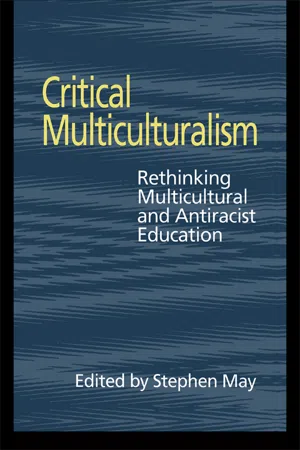
This book aims to bring together two movements - multiculturalism and anti- racism - which, though having aims in common, have been at arms length in the past. Differences of emphasis have meant that classroom practice has been the natural realm of multiculturalism, while anti-racism has been dissatisfied with an approach that accentuates life-style at the expense of challenging or changing the racism that minority students experience. In these debates, there has been a concentration on culturally specific topics and this book goes beyond national boundaries to find how international concerns and contexts might provide answers to problems faced in single countries. Leading figures in the USA, Canada, South Africa, the UK and Australasia write on the issues.
Information
1
Critical Multiculturalism and Cultural Difference: Avoiding Essentialism
Stephen May
The theory and practice of multiculturalism, of which multicultural and antiracist education form a central part, currently faces opposition on two key fronts. The first constitutes an alliance of conservative and some liberal commentators whose principal aim is to defend orthodox liberalism against a politics of difference represented by multiculturalism (see, for example, Bullivant, 1981; Hughes, 1993; Ravitch, 1992; Schlesinger, 1991, 1992). Building on a post second world war consensus of orthodox liberalism in social and political theory (see Claude, 1955; Glazer, 1975; Porter, 1965, 1975), these commentators argue that only the current organization of nation-states—represented most clearly by the neutrality of the civic realm—can ensure personal autonomy, equality, and common citizenship (at least in theory). In contrast, they argue that the politics of multiculturalism—which they equate directly with the increasing public recognition of various minority ethnic, cultural and/or religious identities—is inherently destabilizing and destructive of the common bonds of nationhood. In their view, multiculturalism is an approach which replaces universalism with particularism and which introduces ethnicity unnecessarily and unhelpfully into the civic realm—that is, ‘civil society’ in Gramsci’s (1971) sense of the term.1 Indeed, at their most apocalyptic, these critics suggest that the accommodation of multiculturalism may result in the immolation and/or ‘balkanization’ of previously quiescent, harmonious nation-states. And all because the ‘cult of ethnicity’, to use Schlesinger’s (1992) pejorative phrase, unnecessarily hardens ethnic group boundaries; bringing difference and division where once was unity and common purpose. The spectres of Rwanda and the former Yugoslavia provide convenient and seemingly salutary examples here of where multiculturalism might eventually take us.
Opposition to multiculturalism also comes from the Left, however. In relation to education, this has centred historically on the inability of multicultural education initiatives to address adequately the structural inequalities faced by minority students, most notably racism. The British antiracist movement, in particular, adopted a neo-Marxist critique of multiculturalism along these lines, arguing that a preoccupation with superficial culturalism left the life chances of minority students unchanged and the hegemony of majority students, their values and their forms of knowledge, unchallenged. This was most notable in the work of early antiracist proponents in Britain such as Chris Mullard (1982) and Godfrey Brandt (1986), and most consistently represented throughout the 1980s and early 1990s by the work of Barry Troyna and his collaborators (Troyna, 1982, 1987, 1993; Troyna and Hatcher, 1992; Troyna and Williams, 1986). Michael Apple, David Theo Goldberg and Cameron McCarthy have echoed these debates to some extent in the United States (Apple, 1996; Goldberg, 1994; McCarthy, 1990; McCarthy and Crichlow, 1993). However, the often vituperative and entrenched nature of British multicultural and antiracist (op) positions, particularly in the latter’s heyday in the 1980s, has not been replicated to the same extent in the US or elsewhere (see May, 1994; Sleeter, 1995).
Proponents of multiculturalism have responded to this broad antiracist left critique, not least in this volume, by acknowledging more directly the role of unequal power relations and the inequalities and differential effects that ensue from them. However, in so doing, they have also more recently come to face another, perhaps more intractable problem—a problem brought on to some extent by this very process of accommodation with antiracist theory. For example, the privileging of racism over other forms of discrimination in early conceptions of antiracism resulted in an increasing preoccupation with ‘colour racism’ and the black-white dichotomy. These emphases in antiracist theory considerably understate both the multiplicity of racisms and their complex interconnections with other forms of inequality (Gilroy, 1992; Modood, 1992; McLaren and Torres, this volume). Relatedly, they fail adequately to conceptualize and address the increasing articulation of new ‘cultural racisms’ where ‘race’ as a signifier is transmuted into the seemingly more acceptable discourse of ‘cultural differences’ (cf. Rattansi, 1992, this volume; Short and Carrington, this volume). In effect, essentialist racialized discourses are ‘disguised’ by describing group differences principally in cultural and/or historical terms—ethnic terms, in effect —without specifically mentioning ‘race’ or overtly racial criteria (Barker, 1981; Small, 1994; Wetherell and Potter, 1992). New racisms, in this sense, can be described as a form of ethnicism which, as Avtar Brah describes it:
defines the experience of racialized groups primarily in ‘culturalist’ terms: that is, it posits ‘ethnic difference’ as the primary modality around which social life is constituted and experienced. …This means that a group identified as culturally different is assumed to be internally homogeneous… ethnicist discourses seek to impose stereotypic notions of common cultural need upon heterogeneous groups with diverse social aspirations and interests. (1992, p. 129)
But the problems of cultural essentialism and the reification of group-based identities highlighted by Brah, and mobilized so effectively by racist proponents, also continue ironically to haunt much multicultural theory and practice. This is particularly evident within multicultural education where the regular invocation of ‘cultural difference’ often presents culture as sui generis (Hoffman, 1996). In the process, ethnicity is elided with culture and both come to be treated as ‘bounded cultural objects’, to borrow a phrase from Richard Handler (1988), which are seen to attach unproblematically to (most usually) ethnic minority students. This naive, static and undifferentiated conception of cultural identity, and the allied notion of the incommensurability of cultures, end up being not that dissimilar from the new racisms of the Right. Both appear to abandon universalist notions of individual choice, rights and responsibility in order to revalorize closed cultures, roots and traditions (Lloyd, 1994; Werbner, 1997a).
Multiculturalism in this conception also stands in direct contrast to much postmodern theorizing on identities which—with its related concepts of hybridity, syncretism, creolization, and new ethnicities—highlights the ‘undecidability’ and fluidity of much identity formation. Indeed, it is now almost de rigueur in this postmodern age to dismiss any articulation of group-based identity as essentialist2—a totalizing discourse that excludes and silences as much as it includes and empowers (see, for example, Anthias and Yuval-Davis, 1992; Bhabha, 1994; Gilroy, 1993; Giroux, 1992; Hall, 1992; Yuval-Davis, 1997a). Viewed in this way, multiculturalism’s advocacy of group-based identities, and any educational recognition attached to them, appears to be brought into serious question.
It is here then that critiques from the Left ally with those from the Right in highlighting the potential of multiculturalism unhelpfully to essentialize and reify ethnic and cultural difference(s). In what follows, I want to examine the veracity of these charges, from both quarters. In so doing, I will concentrate principally on the wider social and political issues surrounding the politics of multiculturalism. However, I will conclude by outlining some tentative thoughts on how these wider debates might lead to a theory of multicultural/antiracist education which incorporates both a critical and non-essentialist approach to cultural difference.
Defending Liberal Democracy: Mobilizing against Multiculturalism
Conservative and (some) liberal opponents3 of multiculturalism are particularly exercised by the implications that a group-based politics of difference might have on the current organization and legitimacy of modern nation-states. And they are right to be worried. The nation-state may still remain the bedrock of the political world order, exercising internal political and legal jurisdiction over its citizens, and claiming external rights to sovereignty and self-government in the present inter-state system. But the nation-state is also under increasing pressure— both from above and below. From above, the inexorable rise of globalization, along with the burgeoning influence of multinational corporations and supranational political organizations, have required modern nation-states to reevaluate the limits of their own political and economic sovereignty (cf. Kalantzis and Cope; McLaren and Torres, this volume). From below, and this is where the politics of multiculturalism plays an important part, minority groups are increasingly exerting the right to both greater private and, crucially, public recognition of their various ethnic, cultural and/or religious identities. In the process, the public discourse on national identity, its parameters, and its constituent elements, are opened up for debate. In short, the nation-state is being asked, even forced to reimagine itself along more plural and inclusive lines. And not before time.
But if opponents of multiculturalism are dismayed by its pluralizing implications, they are far from silent about them. In recent years, a vigorous counter-attack has been launched advocating the benefits of unity, universalism and nationhood over the fissiparous politics of difference and dissent that is multiculturalism. Or so the story goes. This counter-attack builds on a long tradition of orthodox liberalism and has come to be couched in terms of what Brian Bullivant (1981) has termed ‘the pluralist dilemma’.
The pluralist dilemma, for Bullivant, is ‘the problem of reconciling the diverse political claims of constituent groups and individuals in a pluralist society with the claims of the nation-state as a whole’ (1981: x; my emphasis); what he elsewhere describes as the competing aims of ‘civism’ and ‘pluralism’. Other commentators have suggested similar distinctions: ‘roots’ and ‘options’ (Rokkan and Urwin, 1983); ‘state’ and ‘community’ (Smith, 1981); and, drawing on Saussure, ‘parochialism’ and ‘intercourse’ (Edwards, 1994). All these distinctions emphasize, like Bullivant’s, the apparent polarities involved in the task of national integration; the difficulties of reconciling social cohesion on the one hand with, on the other, a recognition and incorporation of ethnic, linguistic and cultural diversity within the nation-state. In an earlier analysis, Schermerhorn has described these countervailing social and cultural forces as centripetal and centrifugal tendencies. As he observes:
Centripetal tendencies refer both to cultural trends such as acceptance of common values, styles of life, etc, as well as structural features like increased participation in a common set of groups, associations, and institutions…. Conversely, centrifugal tendencies among subordinate groups are those that foster separation from the dominant group or from societal bonds in one way or another. Culturally this most frequently means retention and presentation of the group’s distinctive tradition in spheres like language, religion, recreation etc. (1970, p. 81)
Historically, two contrasting approaches have been adopted in response to the pluralist dilemma which Gordon (1978, 1981) has described as ‘liberal pluralism’ and ‘corporate pluralism’. Liberal pluralism is characterized by the absence, even prohibition, of any ethnic, religious, or linguistic minority group possessing separate standing before the law or government. Its central tenets can be traced back to Rousseau’s conception of the modern polity as comprising three inseparable features: freedom (non-domination), the absence of differentiated roles, and a very tight common purpose. On this view, the margin for recognizing difference within the modern nation-state is very small (Taylor, 1992). Corporate pluralism, in contrast, involves the recognition of minority groups as legally constituted entities, on the basis of which, and depending on their size and influence, economic, social and political awards are allocated. Glazer (1975) and Walzer (1992a, 1992b) draw similar distinctions between an approach based on ‘non-discrimination’—which involves, in Glazer’s memorable phrase, the ‘salutary neglect’ of the State towards ethnic minorities— and a ‘corporatist’ (Walzer) or ‘group rights’ (Glazer) model.
It is clear, however, that for conservative commentators (and many liberal ones also) only liberal pluralism will do.4 In the end, civism must be favoured over pluralism while the corporatist intentions of multiculturalism must be specifically disavowed. As such, the ‘claims of the nation-state as a whole’— emphasizing the apparently inextricable interconnections between social cohesion and national homogeneity—are invariably invoked against more pluralist conceptions of the nation-state where ethnic, linguistic and cultural differences between different groups are accorded some degree of formal recognition. In this construction, individual and universal ‘citizenship’ rights are mobilized in opposition to collective and particularist ‘ethnic’ rights. As such, formal differentiation within the nation-state on the grounds of (ethnic) group association is rejected as inimical to the individualistic and meritocratic tenets of liberal democracy. Where countenanced at all, alternative ethnic affiliations should be restricted solely to the private domain since the formal recognition of collective (ethnic) identity is viewed as undermining personal and political autonomy, and fostering social and political fragmentation. As Will Kymlicka observes, ‘the near-universal response of [conservatives and] liberals has been one of active hostility to minority rights…schemes which single out minority cultures for special measures…appear irremediably unjust, a disguise for creating or maintaining…ethnic privilege’ (1989, p. 4). Any deviation from the strict principles of universal political citizenship and individual rights is seen as the first step down the road to apartheid. Or so it seems. The resulting consensus is well illustrated by Brian Bullivant:
Certain common institutions essential for the well-being and smooth functioning of the nation-state as a whole must be maintained: common language, common political system, common economic market system and so on. Cultural pluralism can operate at the level of the private, rather than public, concerns such as use of ethnic [sic] language in the home…. But, the idea that maintaining these aspects of ethnic life and encouraging the maintenance of ethnic groups almost in t...
Table of contents
- Cover Page
- Title Page
- Copyright Page
- List of Tables and Figures
- Preface
- Introduction: Towards Critical Multiculturalism
- 1: Critical Multiculturalism and Cultural Difference: Avoiding Essentialism
- 2: Racism and Multicultural Education: Rethinking ‘Race’ and ‘Whiteness’ in Late Capitalism
- 3: Racism, ‘Postmodernism’ and Reflexive Multiculturalism
- 4: Forging Partnerships for Multicultural Teacher Education
- 5: Antiracist Education through Political Literacy: The Case of Canada
- 6: Critical Antiracism in South Africa
- 7: Children’s Constructions of Their National Identity: Implications for Critical Multiculturalism
- 8: Critical Multicultural Education and Students’ Perspectives
- 9: Critical Multiculturalism in Science and Technology Education
- 10: Multicultural Education: Transforming the Mainstream
- Notes on Contributors
Trusted by 375,005 students
Access to over 1.5 million titles for a fair monthly price.
Study more efficiently using our study tools.
Frequently asked questions
Yes, you can cancel anytime from the Subscription tab in your account settings on the Perlego website. Your subscription will stay active until the end of your current billing period. Learn how to cancel your subscription
No, books cannot be downloaded as external files, such as PDFs, for use outside of Perlego. However, you can download books within the Perlego app for offline reading on mobile or tablet. Learn how to download books offline
Perlego offers two plans: Essential and Complete
- Essential is ideal for learners and professionals who enjoy exploring a wide range of subjects. Access the Essential Library with 800,000+ trusted titles and best-sellers across business, personal growth, and the humanities. Includes unlimited reading time and Standard Read Aloud voice.
- Complete: Perfect for advanced learners and researchers needing full, unrestricted access. Unlock 1.5M+ books across hundreds of subjects, including academic and specialized titles. The Complete Plan also includes advanced features like Premium Read Aloud and Research Assistant.
We are an online textbook subscription service, where you can get access to an entire online library for less than the price of a single book per month. With over 1.5 million books across 990+ topics, we’ve got you covered! Learn about our mission
Look out for the read-aloud symbol on your next book to see if you can listen to it. The read-aloud tool reads text aloud for you, highlighting the text as it is being read. You can pause it, speed it up and slow it down. Learn more about Read Aloud
Yes! You can use the Perlego app on both iOS and Android devices to read anytime, anywhere — even offline. Perfect for commutes or when you’re on the go.
Please note we cannot support devices running on iOS 13 and Android 7 or earlier. Learn more about using the app
Please note we cannot support devices running on iOS 13 and Android 7 or earlier. Learn more about using the app
Yes, you can access Critical Multiculturalism by Stephen May in PDF and/or ePUB format, as well as other popular books in Education & Education General. We have over 1.5 million books available in our catalogue for you to explore.