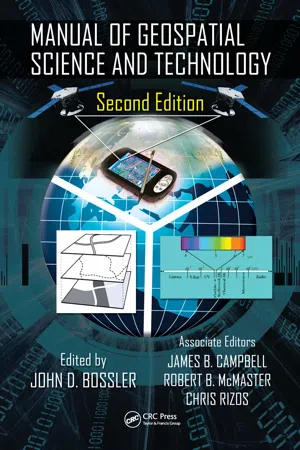
Following in the tradition of its popular predecessor, the Manual of Geospatial Science and Technology, Second Edition continues to be the authoritative volume that covers all aspects of the field, both basic and applied, and includes a focus on initiating, planning, and managing GIS projects. This comprehensive resource, which contains contributio
eBook - PDF
Manual of Geospatial Science and Technology
- 856 pages
- English
- PDF
- Available on iOS & Android
eBook - PDF
Manual of Geospatial Science and Technology
About this book
Information
Table of contents
- Front cover
- Contents
- Preface
- Acknowledgments
- Editors
- Contributors
- Part I: Prerequisites
- Chapter 1. An Introduction to Geospatial Science and Technology
- Chapter 2. Coordinates and Coordinate Systems
- Chapter 3. Datums and Geospatial Reference Systems
- Chapter 4. Coordinate Transformations
- Chapter 5. Basic Electromagnetic Radiation
- Chapter 6. Data Analysis
- Part II: Global Positioning System
- Chapter 7. Introducing the Global Positioning System
- Chapter 8. Fundamentals of GPS Signals and Data
- Chapter 9. GPS Positioning Models for Single Point and Baseline Solutions
- Chapter 10. GPS Instrumentation Issues
- Chapter 11. Making Sense of GNSS Techniques
- Chapter 12. GPS Projects: Some Planning Issues
- Chapter 13. Carrying Out a GPS Surveying/Mapping Task
- Chapter 14. Servicing the GPS/ GNSS User
- Chapter 15. GPS, GNSS, and the Future
- Part III: Remote Sensing
- Chapter 16. Photogrammetry for Remote Sensing
- Chapter 17. Remote-Sensing Analysis: From Project Design to Implementation
- Chapter 18. Remote-Sensing Systems for Operational and Research Use
- Chapter 19. Information Extraction from Remotely Sensed Data
- Chapter 20. Image Processing Software for Remote Sensing
- Chapter 21. How to Assess the Accuracy of Maps Generated from Remotely Sensed Data
- Chapter 22. Emerging Markets for Satellite and Aerial Imagery
- Chapter 23. Airborne LIDAR Mapping
- Chapter 24. Selected Scientific Analyses and Practical Applications of Remote Sensing: Examples from the Coast
- Chapter 25. Remote Sensing— A Look to the Future
- Part IV: Geographic Information Systems
- Chapter 25. Geographic Information Systems and Science
- Chapter 27. GIS Fundamentals
- Chapter 28. Geographic Data Structures
- Chapter 29. Spatial Analysis and Modeling
- Chapter 30. Spatial Data Quality
- Chapter 31. Cartography and Visualization
- Chapter 32. Carrying Out a GIS Project
- Chapter 33. Geographic Information Science and Society
- Part V: Applications
- Chapter 34. Biophysical and Human-Social Applications
- Chapter 35. Local Government Applications: Toward E-Governance
- Chapter 36. Geographic Information Technology in State Governments of the United States
- Chapter 37. National, International, and Global Activities in Geospatial Science: Toward a Global Spatial Data Infrastructure
- Chapter 38. Private Sector Applications
- Chapter 39. Geospatial Solutions for Utility Infrastructure: A Summary of the Use of GIT in Utilities Today
- Index
- Back cover
Trusted by 375,005 students
Access to over 1.5 million titles for a fair monthly price.
Study more efficiently using our study tools.
Frequently asked questions
Yes, you can cancel anytime from the Subscription tab in your account settings on the Perlego website. Your subscription will stay active until the end of your current billing period. Learn how to cancel your subscription
No, books cannot be downloaded as external files, such as PDFs, for use outside of Perlego. However, you can download books within the Perlego app for offline reading on mobile or tablet. Learn how to download books offline
Perlego offers two plans: Essential and Complete
- Essential is ideal for learners and professionals who enjoy exploring a wide range of subjects. Access the Essential Library with 800,000+ trusted titles and best-sellers across business, personal growth, and the humanities. Includes unlimited reading time and Standard Read Aloud voice.
- Complete: Perfect for advanced learners and researchers needing full, unrestricted access. Unlock 1.5M+ books across hundreds of subjects, including academic and specialized titles. The Complete Plan also includes advanced features like Premium Read Aloud and Research Assistant.
We are an online textbook subscription service, where you can get access to an entire online library for less than the price of a single book per month. With over 1.5 million books across 990+ topics, we’ve got you covered! Learn about our mission
Look out for the read-aloud symbol on your next book to see if you can listen to it. The read-aloud tool reads text aloud for you, highlighting the text as it is being read. You can pause it, speed it up and slow it down. Learn more about Read Aloud
Yes! You can use the Perlego app on both iOS and Android devices to read anytime, anywhere — even offline. Perfect for commutes or when you’re on the go.
Please note we cannot support devices running on iOS 13 and Android 7 or earlier. Learn more about using the app
Please note we cannot support devices running on iOS 13 and Android 7 or earlier. Learn more about using the app
Yes, you can access Manual of Geospatial Science and Technology by John Bossler, John D. Bossler,James B. Campbell,Robert B. McMaster,Chris Rizos, John D. Bossler, James B. Campbell, Robert B. McMaster, Chris Rizos in PDF and/or ePUB format, as well as other popular books in Tecnologia e ingegneria & Ingegneria civile. We have over 1.5 million books available in our catalogue for you to explore.