eBook - ePub
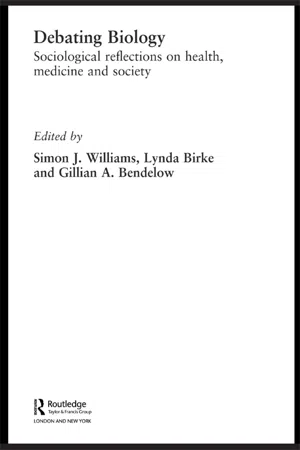
Debating Biology
- 336 pages
- English
- ePUB (mobile friendly)
- Available on iOS & Android
eBook - ePub
Debating Biology
About this book
Relations between the biological and social sciences have been hotly contested and debated over the years. The uses and abuses of biology, not least to legitimate or naturalize social inequalities and to limit freedoms, have rightly been condemned. All too often, however the style of debate has been reductionist and ultimately unfruitful. As we enter an age in which ultr-Darwinian forms of explanation gather momentum and the bio-tech revolution threatens a 'Brave New World' of possibilities, there is urgent need to re-open the dialogue and rethink these issues in more productive ways.
Debating Biology takes a fresh look at the relationship between biology and society as it is played out in the arena of health and medicine. Bringing together contributions from both biologists and sociologists, the book is divided into five themed sections:
- Theorising Biology draws on a range of critical perspectives to discuss the case or 'bringing back' the biological into sociology.
- Structuring Biology focuses on the interplay between biological and social factors in the 'patterning' of health and illness.
- Embodying Biology examines the relationship between the lived body and the biological body
- Technologizing Biology takes up the multiple relations between biology, science and technology.
- Reclaiming Biology looks at the broader ethical and political agendas.
Written in an accessible and engaging style, this timely volume will appeal to a wide audience within and beyond the social sciences, including students, lecturers and researchers in health and related domains.
Information
Part I
Theorizing biology
Critical perspectives
1 Evolution and human disease
Bridging the biology/culture gap
Basiro Davey
The starting point for this chapter is a desire to ‘clear the decks’ of some old cargo concerning the antipathy between sociology and biology in the hope of not tripping over it later. Without this baggage, it becomes easier to make the case in what follows that an evolutionary perspective helps to integrate biological and sociological perspectives on human disease. The proposition that human culture (used here as a shorthand for human social interactions, structures and the products of social organization) cannot be split off from biological processes, except as a temporary act of mind, is supported by examples of interactions between biological and cultural evolution which have profoundly influenced patterns of human disease. The chapter ends with some reflections on how a biological perspective might inspire sociological interest in human evolution.
Biological determinism versus the anthropocentric universe?
One of the most impenetrable barriers to communication between sociology and biology continues to be the unflinching reductionism that characterizes many molecular biologists, summed up in a remark attributed to James Watson, co-discoverer of the molecular structure of DNA, that ‘there are only atoms. Everything else is merely social work’ (quoted in Rose 1988: 161). In the last two decades, molecular biology has come to dominate biological thinking about human disease, but the molecular revolution has reached evolutionary biology too. Nineteenth-century taxonomists classified organisms on the basis of similarities and differences in their physical structures, but in the twenty-first century evolutionary relationships are being reconstructed on the basis of similarities and differences in their DNA. This technology has also shed light on the origins of infectious diseases in humans and other animals – a subject discussed later.
In similar vein, Darwin’s recognition of the driving force of evolution as competition between variant organisms for the resources that support their reproductive success, has been challenged by the proposition that the gene is the agent of evolutionary change. Since The Selfish Gene (1976), Richard Dawkins has argued that organisms are complex ‘survival machines’ controlled by their genes to behave in ways that maximize the propagation of those genes in subsequent generations. Influential critics of Dawkins’ version of evolutionary theory (Brian Goodwin, Steven Jay Gould, Richard Lewontin, Steven Rose, among others) have stepped forward from within biology to fight what has become known as the ‘Darwin wars’. But the gene remains the dominant biological motif at the start of the new millennium. Dawkins’ gene-dominated vision chimes with the sentiment expressed by Watson that everything beyond the molecular is subsidiary to the action of genes and that human culture is a consequence of genetic evolution. The main objective of this chapter is to present biological and cultural evolution as a two-way street.
The deterministic language with which biologists generally describe the body and ‘disease’ has come under much critical scrutiny from within sociology (for example, Martin 1987; Birke 2002; and Section III, this volume). Sociologists have sought to reclaim ‘illness’ or ‘dis-ease’ as the felt experience of an individual with a personal history unfolding in a dynamic social context. The body is envisioned as a socially constructed place under siege from a biomedical description that threatens to obliterate other perspectives. The focus on individual genes as the prime determinants of disease is refuted by social research revealing patterns of distribution along gradients of material circumstances. Comparative studies within and between societies consistently find evidence that health and illness are associated with cultural variables, for example in gender relations, self-esteem or social value, which cannot be explained by biological processes.
Yet biologists generally ignore the social perspective and focus solely on proximal causes of disease, i.e. those operating on, within or between material bodies (of other species as well as ourselves). The distal causes are situated further back in a web of undifferentiated ‘factors’ willingly conceded to the social sciences and thereafter disregarded. Most sociologists have accepted this mutually convenient arrangement, inhabiting an anthropocentric universe in which biological influences do not intrude on analyses of disease patterns based on material deprivation or the failure of entitlement to goods and services. The impact on human societies of other life forms as sources of food, transport, traction, clothing and shelter has, until recently, been conceded to anthropology.
However, biological perspectives have begun to be welcomed into the social arena, as this book demonstrates. Biologists and sociologists have united to oppose the ‘armchair theorizing’ of evolutionary psychologists who deduce that human acts such as rape and infidelity evolved in our hunter-gatherer ancestors as adaptations to ensure species survival (Rose and Rose 2000; Higgs and Rees Jones, Section I, this volume). The disciplines have joined forces to research the interaction of stress and nutrition during pregnancy on foetal ‘programming’, and to begin unravelling how low social value or lack of control in the workplace might lead to degenerative diseases in later life (Section II, this volume). The conviction that human disease cannot be divided into biological and cultural components forms the jumping off point for the next section of this chapter.
Biology/culture interactions and the evolution of infectious disease
Language that suggests ‘intentionality’ often contaminates discussions of evolutionary theory, particularly where infectious disease is involved. Bacteria and viruses are described as though they had foresight and could work out which adaptations of form or function would be a ‘good bet’ and worth the effort of evolving. This error obscures the random generation of variation between individuals, regardless of species, which is one of the necessary conditions for biological evolution. Without it, nothing more complex than a single cell could have evolved and every cell would be a member of an identical clone.
Evolutionary theory counsels that modern humans and their pathogens (a collective term for all kinds of infectious agents) are only the current versions of life forms that remain subject to random variation among their members, and on which natural selection continues to act, as it has done since the first cells evolved 4,000 million years ago. There is no progress towards perfection. HIV is not the ‘cleverest’ virus ever to infect us, but only the current and temporarily the best-adapted version of billions of less successful variants, any of which might become dominant in the future if altered environmental conditions increase their reproductive success. This proposition can be most powerfully illustrated by examining the origins of most human infectious diseases.
Agriculture, pastoralism and human disease
The agricultural revolution began around 8,000 bc in a few scattered places in present-day Iraq, Iran, China, Mexico, the Andes and coastal West Africa. The replacement of nomadic hunter-gatherer populations by largely settled communities subsisting on locally-grown crops and the products of herded livestock (pastoralism) occurred so slowly that 4,000 years later it had not reached most of Western Europe (including the UK), South-East Asia, the Americas or Africa south of the equator. Even at the end of the fifteenth century ad, when agricultural wealth funded the start of European colonization of other continents, the indigenous peoples whose lands were appropriated still lived mainly as hunter-gatherers.
The reason for emphasizing the slow pace at which agriculture and pastoralism spread from its origins is that this cultural shift had the necessary time to impact on the gradual evolution of humans and their pathogens for reasons outlined below. The domestication of poultry and large mammals for food and clothing, the building of shelters from skins and thatch, and the storage of surplus provisions in defended settlements, stoked the population explosion that followed the agricultural revolution wherever it spread. However, it also brought humans into contact for the first time with the microbes, parasites and vermin that were an inevitable consequence of fixed habitation and close proximity with domesticated livestock (for an unrivalled account, see Diamond 1998). Even as the fertility rate increased due to improved food security, the upsurge in infectious and parasitic diseases drove infant mortality rates to unprecedented heights and reduced the expectation of life at birth – a position that barely changed in Europe until the middle of the eighteenth century. The impact of infection can also be traced in the decline in average adult height that followed the adoption of agriculture, and which has still not been entirely recovered in European populations despite post-war improvements in nutrition.
At first sight it may appear obvious why settled communities are more subject than nomadic peoples to infectious disease. In the absence of modern sanitation systems, waste accumulates and makes food-borne diseases inevitable; it leaks into streams and spreads water-borne infections such as cholera and typhoid. The fleas of vermin attracted to stored food bring plague and typhus; flies that also take blood from livestock transmit sleeping sickness. Malaria and schistosomiasis extend their range because the mosquitos and snails that transmit them breed in irrigation ditches.
Yet this analysis ignores one important factor: some major pathogens that cause human infectious diseases originated in animals brought into domestication during the agricultural revolution. Genetic comparison of human pathogens and their counterparts in domestic species reveal that tuberculosis, diphtheria, smallpox and measles originated in cattle. Pathogens of pigs, ducks, dogs and horses adapted to give rise to several other human infections, including influenza, pertussis (whooping cough), polio and the common cold. Worms and flukes that infest humans depend on pastoralism because they complete their lifecycles by circulating between people and their cattle, pigs and sheep. Of the 1,415 species of infectious and parasitic organisms currently known to cause human diseases, over 60 per cent have already been identified as originating in other animals (Taylor et al. 2001).
For 10,000 years pastoral communities have been continuously exposed to pastoral pathogens as people milked, slaughtered, skinned and ate their livestock and fertilized crops with animal manure. They also acquired pathogens from non-domesticated species, including primates, as forests were cleared for agriculture and grazing land. An evolutionary perspective explains how a system of cooperative social organisation (agriculture and pastoralism) enabled pathogens from domesticated species to adapt to life in human hosts. The speed with which pathogens reproduce holds the key to this first ‘epidemiological exchange’ and to our inability to prevent it.
Bacteria take as little as twenty minutes to replicate by cell division, viruses can reproduce billions of times in a few hours, and parasites reproduce in a few days. When any organism replicates, small random changes occur in its genes, which are passed on to its progeny, creating endless variation in the fine details of physical structure and biochemistry between individuals. Genetic variation is created when humans (and all other organisms) reproduce, but pathogens replicate so much faster than humans that they can generate vastly more variants than we can. Additionally, bacteria can transfer genetic material ‘horizontally’ between neighbouring cells; and when two different strains of virus infect the same host their genes can sometimes combine, creating a virus with novel properties. If a variant of a ‘pastoral’ pathogen is generated that can survive long enough to reproduce in a human, the disease it causes can cross the species barrier. In the new host, natural selection winnows out the least-adapted pathogens, leaving the best-adapted to expand their numbers. Over thousands of years, some become totally adapted to infecting people.
However, the evolution of new pathogens also acts as a selection pressure on human populations. Although there have only been around 400 human generations since the agricultural revolution began, a degree of resistance to animal-derived pathogens evolved in human populations where pastoral-ismwas established at an early date. The European continent was swept by infectious diseases derived from other species, for example, losing 25 per cent of its population to plague in the fourteenth century as rats spread along trade routes from China to the English fens. The ‘more resistant’
individuals survived to produce more children than the ‘susceptibles’, passing on the genetic trait for infection resistance, so the proportion who could survive these epidemics increased in each generation. These complex evolutionary relationships exerted a profound influence on the globalization of infectious diseases in human populations.
European colonialism and the second epidemiological exchange
The accumulation of wealth from trading the products of agriculture and livestock enabled hierarchies of ownership to develop across Eurasia. There is no ‘social gradient’ in entitlement among hunter-gatherers, but material inequality is an insidious feature of settled cultures, evident in the current social patterning of disease and disability. Agricultural wealth created the social stratification and the distribution of political power in the ancient civilisations of Egypt, Greece and Rome. It supported the rise of medieval European societies and fuelled their colonial ambitions, which have shaped the global political economy of the modern world.
Biological influences on the current ethnic distribution of populations has received little attention compared with the impact of socioeconomic, cultural and political forces. Yet it is significant that more than 5,000 years of co-existence had already taken place between Europeans and their domestic livestock before they attempted to colonize the Americas. The first voyage of Columbus in 1492 began what the American historian Alfred Crosby has termed the ‘Columbian exchange’ (Crosby 1986). Within 100 years of Columbus landing in Hispaniola, the indigenous population of North America had fallen from an estimated eighteen million to under two million, wiped out by ‘European’ diseases. The tiny expeditionary forces begun by Cortès (1519) and Pizarro (1531) destroyed the Aztec and Inca civilisations of Mexico and Peru, in large measure due to the import of smallpox and measles.
Death rates from ‘European’ infections among the colonists were relatively low because their populations had evolved some resistance after 5,000 years of living with domestic species, but the indigenous people of the Americas had rarely kept animals. It is a curious geophysical accident that so few of the native mammals and birds of the American continents had proved amenable to domestication: in parts of the Andes, wild llamas and alpacas were herded on unfenced ranges, and guinea pigs, turkeys and ducks were kept in some places. But before the colonists arrived, indigenous populations had never encountered cattle, sheep, pigs and horses, and had very little by way of ‘novel’ infections to exchange for the smallpox, measles, influenza, diphtheria and the rest, which destroyed them. Perhaps only syphilis ma...
Table of contents
- Cover Page
- Title Page
- Copyright Page
- Contributors
- Introduction
- Part I Theorizing biology Critical perspectives
- Part II Structuring biology
- Part III Embodying biology
- Part IV Technologizing/medicalizing biology
- Part V Reclaiming biology
Trusted by 375,005 students
Access to over 1.5 million titles for a fair monthly price.
Study more efficiently using our study tools.
Frequently asked questions
Yes, you can cancel anytime from the Subscription tab in your account settings on the Perlego website. Your subscription will stay active until the end of your current billing period. Learn how to cancel your subscription
No, books cannot be downloaded as external files, such as PDFs, for use outside of Perlego. However, you can download books within the Perlego app for offline reading on mobile or tablet. Learn how to download books offline
Perlego offers two plans: Essential and Complete
- Essential is ideal for learners and professionals who enjoy exploring a wide range of subjects. Access the Essential Library with 800,000+ trusted titles and best-sellers across business, personal growth, and the humanities. Includes unlimited reading time and Standard Read Aloud voice.
- Complete: Perfect for advanced learners and researchers needing full, unrestricted access. Unlock 1.5M+ books across hundreds of subjects, including academic and specialized titles. The Complete Plan also includes advanced features like Premium Read Aloud and Research Assistant.
We are an online textbook subscription service, where you can get access to an entire online library for less than the price of a single book per month. With over 1.5 million books across 990+ topics, we’ve got you covered! Learn about our mission
Look out for the read-aloud symbol on your next book to see if you can listen to it. The read-aloud tool reads text aloud for you, highlighting the text as it is being read. You can pause it, speed it up and slow it down. Learn more about Read Aloud
Yes! You can use the Perlego app on both iOS and Android devices to read anytime, anywhere — even offline. Perfect for commutes or when you’re on the go.
Please note we cannot support devices running on iOS 13 and Android 7 or earlier. Learn more about using the app
Please note we cannot support devices running on iOS 13 and Android 7 or earlier. Learn more about using the app
Yes, you can access Debating Biology by Gillian Bendelow, Lynda Birke, Simon Williams, Gillian Bendelow,Lynda Birke,Simon Williams in PDF and/or ePUB format, as well as other popular books in Social Sciences & Health Care Delivery. We have over 1.5 million books available in our catalogue for you to explore.