eBook - PDF
Human Computer Interaction Handbook
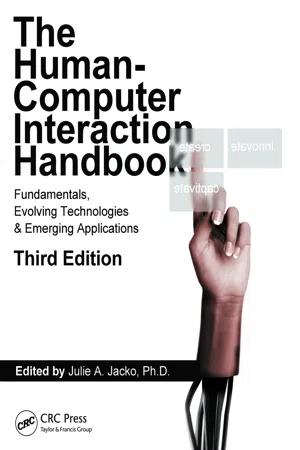
Fundamentals, Evolving Technologies, and Emerging Applications, Third Edition
- 1,469 pages
- English
- PDF
- Available on iOS & Android
eBook - PDF
Human Computer Interaction Handbook
Fundamentals, Evolving Technologies, and Emerging Applications, Third Edition
About this book
Winner of a 2013 CHOICE Outstanding Academic Title Award The third edition of a groundbreaking reference, The Human-Computer Interaction Handbook: Fundamentals, Evolving Technologies, and Emerging Applications raises the bar for handbooks in this field. It is the largest, most complete compilation of HCI theories, principles, advances, case st
Information
Table of contents
- Front Cover
- Contents
- Series Foreword
- Foreword : The Expanding Impact of Human–Computer Interaction
- Preface
- Editor
- Contributors
- Introduction : A Moving Target: The Evolution of Human–Computer Interaction
- Chapter 1 - Perceptual-Motor Interaction : Some Implications for Human–Computer Interaction
- Chapter 2 - Human Information Processing : An Overview for Human–Computer Interaction
- Chapter 3 - Mental Models in Human–Computer Interaction
- Chapter 4 - Task Loading and Stress in Human–Computer Interaction : Theoretical Frameworks and Mitigation Strategies
- Chapter 5 - Choices and Decisions of Computer Users
- Chapter 6 - Input Technologies and Techniques
- Chapter 7 - Sensor- and Recognition-Based Input for Interaction
- Chapter 8 - Visual Displays
- Chapter 9 - Haptic Interface
- Chapter 10 - Nonspeech Auditory and Crossmodal Output
- Chapter 11 - Network-Based Interaction
- Chapter 12 - Wearable Computers
- Chapter 13 - Design of Fixed, Portable, and Mobile Information Devices
- Chapter 14 - Visual Design Principles for Usable Interfaces : Everything Is Designed: Why We Should Think before Doing
- Chapter 15 - Globalization, Localization, and Cross-Cultural User-Interface Design
- Chapter 16 - Speech and Language Interfaces, Applications, and Technologies
- Chapter 17 - Multimedia User Interface Design
- Chapter 18 - Multimodal Interfaces
- Chapter 19 - Systems That Adapt to Their Users
- Chapter 20 - Mobile Interaction Design in the Age of Experience Ecosystems
- Chapter 21 - Tangible User Interfaces
- Chapter 22 - Achieving Psychological Simplicity : Measures and Methods to Reduce Cognitive Complexity
- Chapter 23 - Information Visualization
- Chapter 24 - Collaboration Technologies
- Chapter 25 - Human–Computer Interaction and the Web
- Chapter 26 - Human-Centered Design of Decision-Support Systems
- Chapter 27 - Online Communities
- Chapter 28 - Virtual Environments
- Chapter 29 - Privacy, Security, and Trust : Human–Computer Interaction Challenges and Opportunities at Their Intersection
- Chapter 30 - Human–Computer Interaction in Health Care
- Chapter 31 - Why We Play : Affect and the Fun of Games—Designing Emotions for Games, Entertainment Interfaces, and Interactive Products
- Chapter 32 - Motor Vehicle–Driver Interfaces
- Chapter 33 - Human–Computer Interaction in Aerospace
- Chapter 34 - User-Centered Design in Games
- Chapter 35 - Older Adults and Information Technology : Opportunities and Challenges
- Chapter 36 - Human–Computer Interaction for Kids
- Chapter 37 - Information Technology for Communication and Cognitive Support
- Chapter 38 - Perceptual Impairments : New Advancements Promoting Technological Access
- Chapter 39 - Universal Accessibility and Low-Literacy Populations : Implications for Human–Computer Interaction Design and Research Methods
- Chapter 40 - Computing Technologies for Deaf and Hard of Hearing Users
- Chapter 41 - User Experience Requirements Analysis within the Usability Engineering Lifecycle
- Chapter 42 - Task Analysis
- Contextual Design
- Chapter 44 - Grounded Theory Method in Human–Computer Interaction and Computer-Supported Cooperative Work
- Chapter 45 - An Ethnographic Approach to Design
- Chapter 46 - Putting Personas to Work : Employing User Personas to Focus Product Planning, Design, and Development
- Chapter 47 - Prototyping Tools and Techniques
- Chapter 48 - Scenario-Based Design
- Chapter 49 - Participatory Design : The Third Space in Human– Computer Interaction
- Chapter 50 - Unified User Interface Development : A Software Refactoring Perspective
- Chapter 51 - Usability + Persuasiveness + Graphic Design = eCommerce User Experience
- Chapter 52 - Human–Computer Interaction and Software Engineering for User Interface Plasticity
- Chapter 53 - Usability Testing
- Chapter 54 - Usability for Engaged Users : The Naturalistic Approach to Evaluation
- Chapter 55 - Survey Design and Implementation in HCI
- Chapter 56 - Inspection-Based Evaluations
- Chapter 57 - Model-Based Evaluation
- Chapter 58 - Spreadsheet Tool for Simple Cost-Benefit Analyses of User Experience Engineering
- Chapter 59 - Technology Transfer
- Chapter 60 - Augmenting Cognition in HCI : Twenty-First Century Adaptive System Science and Technology
- Chapter 61 - Social Networks and Social Media
- Chapter 62 - Human–Computer Interaction for Development : Changing Human–Computer Interaction to Change the World
- Back Cover
Trusted by 375,005 students
Access to over 1.5 million titles for a fair monthly price.
Study more efficiently using our study tools.
Frequently asked questions
Yes, you can cancel anytime from the Subscription tab in your account settings on the Perlego website. Your subscription will stay active until the end of your current billing period. Learn how to cancel your subscription
No, books cannot be downloaded as external files, such as PDFs, for use outside of Perlego. However, you can download books within the Perlego app for offline reading on mobile or tablet. Learn how to download books offline
Perlego offers two plans: Essential and Complete
- Essential is ideal for learners and professionals who enjoy exploring a wide range of subjects. Access the Essential Library with 800,000+ trusted titles and best-sellers across business, personal growth, and the humanities. Includes unlimited reading time and Standard Read Aloud voice.
- Complete: Perfect for advanced learners and researchers needing full, unrestricted access. Unlock 1.5M+ books across hundreds of subjects, including academic and specialized titles. The Complete Plan also includes advanced features like Premium Read Aloud and Research Assistant.
We are an online textbook subscription service, where you can get access to an entire online library for less than the price of a single book per month. With over 1.5 million books across 990+ topics, we’ve got you covered! Learn about our mission
Look out for the read-aloud symbol on your next book to see if you can listen to it. The read-aloud tool reads text aloud for you, highlighting the text as it is being read. You can pause it, speed it up and slow it down. Learn more about Read Aloud
Yes! You can use the Perlego app on both iOS and Android devices to read anytime, anywhere — even offline. Perfect for commutes or when you’re on the go.
Please note we cannot support devices running on iOS 13 and Android 7 or earlier. Learn more about using the app
Please note we cannot support devices running on iOS 13 and Android 7 or earlier. Learn more about using the app
Yes, you can access Human Computer Interaction Handbook by Julie A. Jacko in PDF and/or ePUB format, as well as other popular books in Computer Science & Human-Computer Interaction. We have over 1.5 million books available in our catalogue for you to explore.