eBook - ePub
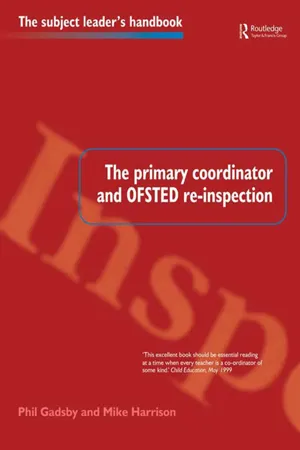
The Primary Coordinator and OFSTED Re-Inspection
- 208 pages
- English
- ePUB (mobile friendly)
- Available on iOS & Android
eBook - ePub
The Primary Coordinator and OFSTED Re-Inspection
About this book
Specifically designed for busy teachers who have responsibility for coordinating a subject area within their primary school. Each volume in the series conforms to a concise style, while providing a wealth of tips, case studies and photocopiable material that teachers can use immediately. subject they are called on to co-ordinate, these books provide guidance and examples to tackle the job.; There are special volumes dedicated to dealing with OFSTED, creating whole school policy and the demands of co-ordinating several subjects within a small school.; The entire set of 16 volumes is available.
Information

Your role as subject coordinator
Chapter 1
The development of the role and the inspection framework
Chapter 2
Your role in your school
Chapter 3
The primary coordinator as middle manager

The development of the role and the inspection framework

Harrison and Theaker (1989)
If you look at actual OFSTED inspection reports, which are now freely available and published via the Internet, you can gain a flavour of what the inspection process is about as far as subject reports are concerned. The following extract from a report shows you what you would be hoping to achieve for your subject or area of responsibility.
Leadership of the subject (science) is good, There is an effective whole school policy that was developed in collaboration with the rest of the staff. A well-structured long-term plan provides a framework for class teachers’ mid- and short-term planning. The curriculum fully meets the statutory requirements. There are regular meetings with staff from the secondary school receiving the majority of pupils. Staff from the feeder infant school are also consulted. This ensures effective planning for progression across the key stages. Long-term planning is done by the coordinator and discussed with staff at curriculum meetings. The coordinator organises and contributes to staff development activities although there is no opportunity for the coordinator to work alongside of her members of staff.
Extract from OFSTED report: junior shools, 1996
By contrast, you would not like to receive the following:
This subject (English) is insufficiently managed or monitored to support teaching, raise standards and identify resource needs.
Large primary school, 1997
We can see that the role of the subject coordinator has come to be regarded as central to the development and management of the curriculum and how it is taught; to the realisation of the school’s aims and policies; to the quality of the pupils’ learning and the standards they achieve.
The development of the role
The role of the subject coordinator in the primary school has not, of course, been invented by OFSTED. It has been a significant focus in education policy for some years. Back in 1978 the primary survey Primary Education in England: A Survey by HM Inspectors of Schools (DES, 1978) carried out by Her Majesty’s Inspectors (HMI) and published by the Department for Education and Science (DES) was saying:
(paragraph 4.1)
The report was clear and specific about the kinds of things these holders of posts of special responsibility might do:
(paragraph 8.46)
More recently Primary Matters: A Discussion on Teaching and Learning in Primary Schools, (OFSTED, 1994a) concentrated again on the subject coordinator:
(p. 9)
Subject coordinators (or subject managers in the terminology of Primary Matters) are seen as assuming delegated responsibility for subject management from the headteacher, (who has overall responsibility for managing the curriculum), which involves three clear strands: coordination, monitoring and evaluation. It is worth quoting the full list of responsibilities for each strand. Wh...
Table of contents
- Cover
- Half-Title
- Title Page
- Copyright Page
- Contents
- List of figures
- Series editor’s preface
- Introduction
- Part one Your role as subject coordinator
- Part two How the inspection process works
- Part three Developing quality in your subject
- Part four Monitoring your subject or area
- Bibliography
- Index
Trusted by 375,005 students
Access to over 1.5 million titles for a fair monthly price.
Study more efficiently using our study tools.
Frequently asked questions
Yes, you can cancel anytime from the Subscription tab in your account settings on the Perlego website. Your subscription will stay active until the end of your current billing period. Learn how to cancel your subscription
No, books cannot be downloaded as external files, such as PDFs, for use outside of Perlego. However, you can download books within the Perlego app for offline reading on mobile or tablet. Learn how to download books offline
Perlego offers two plans: Essential and Complete
- Essential is ideal for learners and professionals who enjoy exploring a wide range of subjects. Access the Essential Library with 800,000+ trusted titles and best-sellers across business, personal growth, and the humanities. Includes unlimited reading time and Standard Read Aloud voice.
- Complete: Perfect for advanced learners and researchers needing full, unrestricted access. Unlock 1.5M+ books across hundreds of subjects, including academic and specialized titles. The Complete Plan also includes advanced features like Premium Read Aloud and Research Assistant.
We are an online textbook subscription service, where you can get access to an entire online library for less than the price of a single book per month. With over 1.5 million books across 990+ topics, we’ve got you covered! Learn about our mission
Look out for the read-aloud symbol on your next book to see if you can listen to it. The read-aloud tool reads text aloud for you, highlighting the text as it is being read. You can pause it, speed it up and slow it down. Learn more about Read Aloud
Yes! You can use the Perlego app on both iOS and Android devices to read anytime, anywhere — even offline. Perfect for commutes or when you’re on the go.
Please note we cannot support devices running on iOS 13 and Android 7 or earlier. Learn more about using the app
Please note we cannot support devices running on iOS 13 and Android 7 or earlier. Learn more about using the app
Yes, you can access The Primary Coordinator and OFSTED Re-Inspection by Mr Phil Gadsby,Phil Gadsby,Mr Mike Harrison,Mike Harrison in PDF and/or ePUB format, as well as other popular books in Education & Education General. We have over 1.5 million books available in our catalogue for you to explore.