- 184 pages
- English
- ePUB (mobile friendly)
- Available on iOS & Android
eBook - ePub
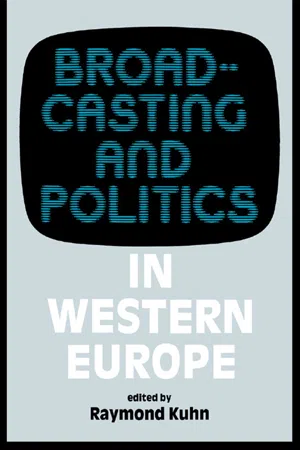
Broadcasting and Politics in Western Europe
About this book
First Published in 1985. The changing face of Western European broadcasting provides a fascinating subject of study for the contemporary observer. In part this is because the structures of different national broadcasting systems have altered over the past few years with the growth of new radio stations and television channels. Of particular interest to political scientists is the fact that in many cases the contemporary debate on broadcasting, as it affects both the 'old' and 'new' media, is taking place in a different political/ideological environment as well as a changing technological one. So now is an opportune moment to provide an up-to-date survey of broadcasting and politics in Western Europe. This is the objective of this special issue of West European Politics, which consists of eight single country studies and one cross-national comparative article.
Information
Proclaiming the Republic: Broadcasting Policy and the Corporate State in Ireland
Desmond Bell
BROADCASTING POLICY IN THE ‘INFORMATION AGE’
We are, it is argued, now witnessing the end of the era of broadcasting. The new media technologies—video, cable, satellite and data transmission systems—with their technical capacity for ‘narrow casting’ and ability to overspill national boundaries are perceived by many commentators as challenging the hegemony of state broadcasting agencies.
Increasingly the ‘footprints’ of direct broadcasting satellites spread beyond political territorialities. The volume of transborder data-flows under the control of transnational corporations grows exponentially. Accordingly the capacity of individual nation states to regulate the ‘free flow’ of information and cultural commodities lessens. In so far as the integrity of nation states rests on a degree of cultural hegemony within their political boundaries, national sovereignty is potentially eroded. Moreover, the willingness of a number of European states to regulate the proliferating new media and information technologies seems to be diminishing. We are experiencing in Europe, as in the US and Japan, a series of rapid technological and commercial developments which are leading to the integration of previously discrete systems of telecommunications, information processing and broadcasting—the so-called ‘tele-informatic revolution’.
The formulation of mass communications policy, traditionally an area characterised by a high degree of state regulation, is also being conditioned by a new ideological climate.
Neo-liberal economic thinking has sustained a social market doctrine committed to ‘rolling back the frontiers of the state’: a cause which a significant number of western governments have enthusiastically espoused. Such thinking challenges the public service model which has guided state broadcasting policy in Western Europe since the 1920s. For the deregulatory stance as regards the new media services now being taken by the current US and British governments would seem to involve a wider ideological commitment to open up the entire field of the mass media to the ‘discipline of the free market’.
Neo-liberal economic thinking has sustained a social market doctrine committed to ‘rolling back the frontiers of the state’: a cause which a significant number of western governments have enthusiastically espoused. Such thinking challenges the public service model which has guided state broadcasting policy in Western Europe since the 1920s. For the deregulatory stance as regards the new media services now being taken by the current US and British governments would seem to involve a wider ideological commitment to open up the entire field of the mass media to the ‘discipline of the free market’.
Indeed, in the current debate on cable and satellite technologies, the larger issues of economic development and industrial policy seem to have replaced traditional concerns about the content and impartiality of broadcasting as the central focus of state interest in the media.
As the report of the British government Information Technology Advisory Panel declared in 1981, ‘We believe cable to be an essential component of future communications systems, offering great opportunities for new forms of entrepreneurial activity and substantial direct and indirect industrial benefits’.1 In Britain public broadcasting has taken a back seat in the formulation of mass communication policy by a government politically committed to privatising nationalised industries in the telecommunication and information processing sectors and facilitating a deregulatory climate in the new media field. In Western Europe generally, cable is seen as a potential electronic grid, facilitating the convergence of previously discrete telecommunication and information processing systems. It is being hailed by a number of Western governments as the biggest infrastructural revolution in Europe since the building of the railways. As such it is heralded as a source of economic rejuvenation for their crisis-torn economies. Together with the wider electronic industry, cable is seen as the core sector around which industrial restructuring will occur. The development of an electronic grid with application in ‘tele-marketing’ and in vastly expanding the productivity of the commercial service sector (banking, insurance, etc.) via data networking services and, in addition, the expansion of consumer demand for electronic hardware and software, are seen as opening up vast new areas of potentially profitable capital investment.2 Cable, it would seem, is simply too big for broadcasters to have a monopoly over it.
Accordingly the debate on the new media technologies has much wider parameters than traditional policy discussions within broadcasting which focused on issues of cultural content, political bias and journalistic ethics. Broadcasting policy is now motivated by the wider concerns of political economy. Central to those wider concerns has been the growing scepticism of a number of western governments about the state’s capacity to regulate the economy—and indeed about the desirability of state management of this area. Parallel to the intellectual crisis in Keynesianism and social democracy has occurred a crisis in confidence in public service broadcasting. This has been occasioned not only by the very real budgetary constraints now faced by state broadcasting agencies (RTE, the state broadcasting service of the Irish Republic, had a current account deficit of £2.8 million in 1982 with a total income of £56.4 million; long-term indebtedness was the equivalent of 80 per cent of total assets), but also by an increased questioning of the legitimacy of the monopoly, or at least priority, of state broadcasting over the air waves.
In Ireland, however, the nationalisation of the communication sector in general, and the state monopoly of broadcasting in particular, did not find its ideological legitimation during the period of post-war growth (somewhat later in Ireland from around 1958 onwards) by reference to a ‘Keynesian’ model of the economy and a social democratic conception of the state.3 It is rather with reference to a nationalist political rhetoric, centring on issues of national sovereignty and cultural identity, that a statist approach to the management of the economy in general and the provision of public service broadcasting in particular has been justified. As the Broadcasting Review Committee, which reported in 1971, ten years after the introduction of the national television service, demanded:
The broadcasting system should be effectively owned and controlled by bodies to be set up under statute with responsibility for safeguarding, enriching and strengthening the cultural, social and economic fabric of Ireland…. The system should provide a service that is essentially Irish in character…and provide for a continuing expression of Irish identity.4
Issues of national identity and control over national resources still remain at the top of the agenda in political debates about mass communication policy in a country which since the 1920s has had to compete with British broadcasting stations for the attention of the national audience. Indeed it could be argued that in so far as the case for public service broadcasting is popularly perceived as resting on fundamental issues of national sovereignty and cultural identity, it has proved more resilient to political criticism from those who espouse neo-liberal economic policy options than in Britain where the entire public sector growth in the post-war period found its legitimation in ‘Keynesian’ and social democratic rhetoric. In Britain since the mid-1970s, in the context of the ongoing fiscal crisis of the state and the political ascendancy of Thatcherism, the public service ideal and its attendant claims to the privilege of priority over the air waves has increasingly come under scrutiny from a government programmatically committed to a ‘free market’ doctrine in the communication as in other fields.5 This has not been the case in Ireland.
THE IRISH SITUATION
In Ireland, despite the high degree of personal commitment to neo-liberal economic thinking on the part of members of the major political party in the current government coalition (Fine Gael), and indeed a consensus among all the three major parties (the Labour Party in the coalition and Fianna Fail in opposition) about the necessity to curtail public expenditure, there has been little serious political challenge to the corporate state in Ireland from the right. To date, RTE has been able to preserve its legal monopoly over the air waves, originally established for the pioneer radio service in 1926 and most recently confirmed for television and radio in the 1976 Broadcasting Authority (Amendment) Act.
1.
Cable
That Act also incorporated a series of regulations passed in the 1974 Wireless Telegraphy Act which made RTE the beneficiary of a 15-per cent levy on the rentals paid by subscribers to wired relay, that is, cable, systems. To date this privileged position of RTE vis-à-vis private cable operators has not been legally challenged. And, to the ire of those entrepreneurs competing for franchises to provide relayed broadcast services and additional pay-asyou-view entertainment channels, the state services RTE and An Bord Telecom (formerly P & T) retain their legal monopoly over point-to-point microwave transmission. Indeed, as significantly, RTE, who have run their own cable operation since 1970 (RTE Relays), have recently bought out the remaining private-cable company operating in the Dublin area, after receiving permission to do so from the Monopolies Commission! This currently gives RTE a monopoly in cable provision and servicing in the area of the country which contains over a third of the total population of the Republic and with the highest level of cable penetration (some 200,000 subscribers or 60 per cent of television owners/renters as opposed to a penetration figure of 40 per cent for the country as a whole).
Responding to a wider European interest in cable’s industrial implications, the Irish government has set up a ‘Cable Television Committee’ to advise on government policy for the development of cable in Ireland. The terms of reference of this committee are:
To examine and make recommendations on a national strategy for the development —on the most cost-effective basis possible—of cable systems, and on the design and technical standards that should be applied, bearing in mind advances in technology and the additional services that may be available for relay in the future.6
The terms of reference, like those of the British ITAP committee, include not only entertainment functions of the new medium, but also interactive information services and networking links with telecommunication systems including satellite broadcast and data transmission services. Like the ITAP, the committee is drawn from the world of industry and, in particular, the private communication sector rather than from the world of broadcasting.
However, unlike the ITAP or the later Hunt Committee on Cable in the UK, it now seems likely that the Cable Committee will recommend that RTE’s monopoly over broadcasting (including microwave relay) be maintained and envisages the state service having a major role in the development and regulation of cable services. Although the committee sees cable developing within a wider telecommunication context, it will apparently recommend that the semi-state Bord Telecom, rather than cable operators, should be the provider of data networking and interactive services as part and parcel of an integrated digital information system.7 In this the committee seems to be following the French model of entrusting telematic developments to the semi-state PTT, a national policy very much against the world trend towards deregulation and privatisation.
2.
Satellite Broadcasting
As for direct broadcasting by satellite, RTE was one of the 15 countries which participated in the pan-European tv programme experiment during 1982 and looks certain to be the body to manage the five channels allocated to Ireland within the proposed European satellite system, although as in Britain this may involve a partner relationship with a private enterprise consortium.8
Given the scale of the investment that would be required to establish a DBS service from Ireland (conservatively estimated at around £600 million), it is unlikely that a private investor could be found within Ireland in what is still seen universally as a high-risk business. RTE are somewhat reluctant to commit themselves to a satellite venture given their own straitened financial circumstances. However, the cultural and commercial possibilities of a DBS service with a footprint extending over the whole of Britain, as well as Spain and Portugal, clearly excites them. As Fred O’Donovan, chairman of RTE put it:
…the coverage of the UK reverses our historical situation. For the first time we in Ireland will be able to cover the whole of the United Kingdom with our own transmissions. Properly handled, and given our willingness to become aggressive programmers, I see RTE becoming totally sufficient within five years.9
As ever in discussions of broadcasting policy in Ireland, considerations of cultural integrity and national sovereignty never lie far below the surface. Such considerations would seem to serve to check the ideological drift towards a radically deregulated policy for the media. For a broadcasting service which throughout its entire history has had to compete with the much larger and much better-resourced BBC for the attention of the majority of the national audience who receive off-air or cable-relayed British television and radio (now an estimated 70 per cent of the population of the Republic), the possibilities of DBS transmissions to Britain is a particularly appealing one.
3.
Local Radio
In the field of radio it may not be generally known that Ireland has an illegal pirate broadcasting problem second in Europe only to Italy. Commercial stations with substantial advertising revenues10 broadcast daily on regularised frequencies, parasitically lifting news material from the national stations and newspapers—with little government interference. There is evidence that specific politicians from Fine Gael and Fianna Fail with business interests in the media and advertising fields have connived in this systematic illegality. Indeed a government minister has personally introduced a programme on a pirate station!
In 1981 the then Fianna Fail government introduced a Local Radio Authority Bill which envisaged the setting up of an independent, advertising-financed local radio network completely free of RTE control. The bill, which closely resembled the British Broadcasting Authority Act of 1973, represented a major break from the p...
Table of contents
- COVER PAGE
- TITLE PAGE
- COPYRIGHT PAGE
- NOTES ON CONTRIBUTORS
- INTRODUCTION
- POLITICS, PARTIES AND THE MEDIA IN BRITAIN
- PROCLAIMING THE REPUBLIC: BROADCASTING POLICY AND THE CORPORATE STATE IN IRELAND
- FRANCE AND THE ‘NEW MEDIA’
- POLITICAL AND MARKET FORCES IN ITALIAN BROADCASTING
- PLURALISM IN THE WEST GERMAN MEDIA: THE PRESS, BROADCASTING AND CABLE
- BROADCASTING AND POLITICS IN THE NETHERLANDS: FROM PILLAR TO POST
- BROADCASTING IN SPAIN: A HISTORY OF HEAVY-HANDED STATE CONTROL
- GREECE: A POLITICALLY CONTROLLED STATE MONOPOLY BROADCASTING SYSTEM
- THE POLITICS OF CABLE AND SATELLITE BROADCASTING: SOME WEST EUROPEAN COMPARISONS
- ABSTRACTS
Trusted by 375,005 students
Access to over 1.5 million titles for a fair monthly price.
Study more efficiently using our study tools.
Frequently asked questions
Yes, you can cancel anytime from the Subscription tab in your account settings on the Perlego website. Your subscription will stay active until the end of your current billing period. Learn how to cancel your subscription
No, books cannot be downloaded as external files, such as PDFs, for use outside of Perlego. However, you can download books within the Perlego app for offline reading on mobile or tablet. Learn how to download books offline
Perlego offers two plans: Essential and Complete
- Essential is ideal for learners and professionals who enjoy exploring a wide range of subjects. Access the Essential Library with 800,000+ trusted titles and best-sellers across business, personal growth, and the humanities. Includes unlimited reading time and Standard Read Aloud voice.
- Complete: Perfect for advanced learners and researchers needing full, unrestricted access. Unlock 1.5M+ books across hundreds of subjects, including academic and specialized titles. The Complete Plan also includes advanced features like Premium Read Aloud and Research Assistant.
We are an online textbook subscription service, where you can get access to an entire online library for less than the price of a single book per month. With over 1.5 million books across 990+ topics, we’ve got you covered! Learn about our mission
Look out for the read-aloud symbol on your next book to see if you can listen to it. The read-aloud tool reads text aloud for you, highlighting the text as it is being read. You can pause it, speed it up and slow it down. Learn more about Read Aloud
Yes! You can use the Perlego app on both iOS and Android devices to read anytime, anywhere — even offline. Perfect for commutes or when you’re on the go.
Please note we cannot support devices running on iOS 13 and Android 7 or earlier. Learn more about using the app
Please note we cannot support devices running on iOS 13 and Android 7 or earlier. Learn more about using the app
Yes, you can access Broadcasting and Politics in Western Europe by Raymond Kuhn in PDF and/or ePUB format, as well as other popular books in Politics & International Relations & European Politics. We have over 1.5 million books available in our catalogue for you to explore.