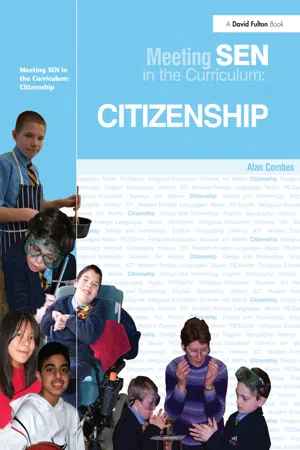
Teachers are meeting more pupils with special needs in mainstream classrooms and although there are general issues to be aware of, subject specialists will always want specific guidance and examples. This series combines SEN expertise with subject knowledge to produce practical and immediate support including: Policy writing and how to do it; Simple explanations of SEN labels; Creating an inclusive classroom environment; Monitoring and assessment; Working with TAs.
- 160 pages
- English
- ePUB (mobile friendly)
- Available on iOS & Android
eBook - ePub
Meeting SEN in the Curriculum: Citizenship
About this book
Information
CHAPTER 1
Meeting Special Educational Needs – Your Responsibility
Inclusion in education involves the process of increasing the participation of students in, and reducing their exclusion from, the cultures, curricula and communities of local schools. (The Index for Inclusion, 2000)
The Index for Inclusion was distributed to all maintained schools by the Department for Education and Skills and has been a valuable tool for many schools as they have worked to develop their inclusive practice. It supports schools in the review of their policies, practices and procedures, and the development of an inclusive approach and, where it has been used as part of the school improvement process – looking at inclusion in the widest sense – it has been a great success. For many people, however, the Index lacked any real teeth and recent legislation and non-statutory guidance is more authoritative.
The SEN and Disability Act 2001
The SEN and Disability Act 2001 (SENDA) amended the Disability Discrimination Act and created important new duties for schools. Under this Act, schools are obliged:
- to take reasonable steps to ensure that disabled pupils are not placed at a substantial disadvantage in relation to the education and other services they provide. This means they must anticipate where barriers to learning lie and take action to remove them as far as they are able;
- to plan strategically to increase the extent to which disabled pupils can participate in the curriculum, make the physical environment more accessible and ensure that written material is provided in accessible formats.
The reasonable steps taken might include:
- changing policies and practices
- changing course requirements
- changing the physical features of a building
- providing interpreters or other support workers
- delivering courses in alternative ways
- providing materials in other formats
Reasonable steps might, for example, mean that all pupil materials are produced in electronic form to ensure that they can easily be converted into large print, printed onto coloured paper or put into other alternative formats, such as Braille. The staff would then be anticipating ‘reasonable adjustments’ that might need to be made.
See Appendix 1 for an INSET activity, ‘What do we really think?’ and Appendix 2 for further detail on SENDA and a related INSET activity.
The Revised National Curriculum
The Revised National Curriculum (2002) emphasises the provision of effective learning opportunities for all learners, and establishes three principles for promoting inclusion:
- setting suitable learning challenges
- responding to pupils' diverse learning needs
- overcoming potential barriers to learning and assessment
The National Curriculum guidance suggests that staff may need to differentiate tasks and materials, and facilitate access to learning by:
- encouraging pupils to use all available senses and experiences
- planning for participation in all activities
- helping children to manage their behaviour, take part in learning and prepare for work
- helping pupils to manage their emotions
- giving teachers, where necessary, the discretion to teach pupils material from earlier key stages, providing consideration is given to age-appropriate learning contexts
The Qualifications and Curriculum Authority (QCA) have also introduced performance descriptions (P levels/P scales) to enable teachers to observe and record small steps of progress made by some pupils with SEN. These descriptions outline early learning and attainment for each subject in the National Curriculum, including citizenship and PSHE. They chart progress up to NC level 1 through eight steps. The performance descriptions for P1 to P3 are common across all subjects, and outline the types and range of general performance that some pupils with learning difficulties might characteristically demonstrate. From level P4 onwards, many believe it is possible to describe performance in a way that indicates the emergence of subject-focused skills, knowledge and understanding.
The Code of Practice for Special Educational Needs
The Revised Code of Practice (implemented in 2002) describes a cyclical process of planning, target setting and review for pupils with special educational needs. It also makes clear the expectation that the vast majority of pupils with special needs will be educated in mainstream settings. Those identified as needing over and above what the school can provide from its own resources, however, are nominated for ‘School Action Plus’ and outside agencies will be involved in planned intervention. This may involve professionals from the Learning Support Service, a specialist teacher or therapist, or an educational psychologist, working with the school's SENCO to put together an Individual Education Plan (IEP) for the pupil. In a minority of cases (the numbers vary widely between LEAs) pupils may be assessed by a multi-disciplinary team on behalf of the local education authority, whose representatives then decide whether or not to issue a statement of SEN. This is a legally binding document detailing the child's needs and setting out the resources which should be provided. It is reviewed every year.
Fundamental Principles of the Special Needs Code of Practice
- A child with special educational needs should have their needs met.
- The special educational needs of children will normally be met in mainstream schools or settings.
- The views of the child should be sought and taken into account.
- Parents have a vital role to play in supporting their child's education.
- Children with special educational needs should be offered full access to a broad, balanced and relevant education, including an appropriate curriculum for the Foundation stage and the National Curriculum.
Ofsted
Ofsted inspectors are required to make judgements about a school's inclusion policy, and how this is translated into practice in individual classrooms. According to Ofsted (2003) the following key factors help schools to become more inclusive:
- a climate of acceptance of all pupils;
- careful preparation of placements for SEN pupils;
- availability of sufficient suitable teaching and personal support;
- widespread awareness among staff of the particular needs of SEN pupils and an understanding of the practical ways of meeting these needs in the classroom;
- sensitive allocation to teaching groups and careful curriculum modification, timetables and social arrangements;
- availability of appropriate materials and teaching aids and adapted accommodation;
- an active approach to personal and social development, as well as to learning;
- well-defined and consistently applied approaches to managing difficult behaviour;
- assessment, recording and reporting procedures which can embrace and express adequately the progress of pupils with more complex SEN who make only small gains in learning and PSD;
- involving parents/carers as fully as possible in decision-making, keeping them well informed about their child's progress and giving them as much practical support as possible;
- developing and taking advantage of training opportunities, including links with special schools and other schools.
Policy into practice
Effective teaching for pupils with special educational needs is, by and large, effective for all pupils, but as schools become more inclusive, teachers need to be able to respond to a wider range of needs. The Government's strategy for SEN (Removing Barriers to Learning, 2004) sets out ambitious proposals to ‘help teachers expand their repertoire of inclusive skills and strategies, and plan confidently to include children with increasingly complex needs’.
In many cases, pupils' individual needs will be met through greater differentiation of tasks and materials, i.e school-based intervention as set out in the SEN Code of Practice. A smaller number of pupils may need access to specialist equipment and approaches or to alternative or adapted activities, as part of a School Action Plus programme, augmented by advice and support from external specialists. The QCA, on its website (2003) encourages teachers to take specific action to provide access to learning for pupils with special educational needs by:
(a) providing for pupils who need help with communication, language and literacy, through:
- using texts that pupils can read and understand
- using visual and written materials in different formats, including large print, symbol text and Braille
- using ICT, other technological aids and taped materials
- using alternative and augmentative communication, including signs and symbols
- using translators, communicators and amanuenses
(b) planning, where necessary, to develop pupils' understanding through the use of all available senses and experiences by:
- using materials and resources that pupils can access through sight, touch, sound, taste or smell
- using word descriptions and other stimuli to make up for a lack of first-hand experiences
- using ICT, visual and other materials to increase pupils' knowledge of the wider world
- encouraging pupils to take part in everyday activities such as play, drama, class visits a...
Table of contents
- Cover
- Half title
- Other titles in the Meeting Special Needs in the Curriculum series
- Full title
- Copyright
- Contents
- Foreword
- Contributors to the Series
- Contents of the CD
- Introduction
- 1. Meeting Special Educational Needs – Your Responsibility
- 2. Departmental Policy
- 3. Different Types of SEN
- 4. The Inclusive Citizenship Classroom
- 5. Teaching and Learning Styles
- 6. Monitoring and Assessment
- 7. Managing Support
- Appendices
- References
- Further Reading
Trusted by 375,005 students
Access to over 1.5 million titles for a fair monthly price.
Study more efficiently using our study tools.
Frequently asked questions
Yes, you can cancel anytime from the Subscription tab in your account settings on the Perlego website. Your subscription will stay active until the end of your current billing period. Learn how to cancel your subscription
No, books cannot be downloaded as external files, such as PDFs, for use outside of Perlego. However, you can download books within the Perlego app for offline reading on mobile or tablet. Learn how to download books offline
Perlego offers two plans: Essential and Complete
- Essential is ideal for learners and professionals who enjoy exploring a wide range of subjects. Access the Essential Library with 800,000+ trusted titles and best-sellers across business, personal growth, and the humanities. Includes unlimited reading time and Standard Read Aloud voice.
- Complete: Perfect for advanced learners and researchers needing full, unrestricted access. Unlock 1.5M+ books across hundreds of subjects, including academic and specialized titles. The Complete Plan also includes advanced features like Premium Read Aloud and Research Assistant.
We are an online textbook subscription service, where you can get access to an entire online library for less than the price of a single book per month. With over 1.5 million books across 990+ topics, we’ve got you covered! Learn about our mission
Look out for the read-aloud symbol on your next book to see if you can listen to it. The read-aloud tool reads text aloud for you, highlighting the text as it is being read. You can pause it, speed it up and slow it down. Learn more about Read Aloud
Yes! You can use the Perlego app on both iOS and Android devices to read anytime, anywhere — even offline. Perfect for commutes or when you’re on the go.
Please note we cannot support devices running on iOS 13 and Android 7 or earlier. Learn more about using the app
Please note we cannot support devices running on iOS 13 and Android 7 or earlier. Learn more about using the app
Yes, you can access Meeting SEN in the Curriculum: Citizenship by Alan Combes in PDF and/or ePUB format, as well as other popular books in Education & Education General. We have over 1.5 million books available in our catalogue for you to explore.