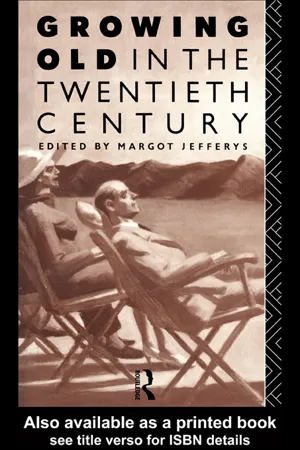
Growing Old in the Twentieth Century investigates many aspects of the current debates raging regarding care and provision for the elderly and the very elderly. It will be invaluable to gerontologists, social policy makers, official and unofficial carers, and anyone involved in health care.
- 272 pages
- English
- ePUB (mobile friendly)
- Available on iOS & Android
eBook - ePub
Growing Old in the Twentieth Century
About this book
Information
Part I
Retirement and Structured Dependency
Chapter One
The Politics of Retirement, 1908–1948
In the years immediately after the Second World War, the particular concerns of old age became a subject for serious social investigation for the first time. As Sara Harper and Pat Thane indicate in Chapter 2, much significant social and medical investigation was conducted between 1945 and 1965. The growth in academic social gerontology has, however, been a much more recent phenomenon and it is only with this development that several important historical issues relating to old age in the present century have established themselves on the agenda for research. Among these we may cite debates over population ageing, the funding of pensions and other social services, and differential experiences by cohort, class, and gender. Retirement has been central to all of these, although the complexity of its impact has yet to be fully explored. Its growth is considered here as a specific political issue which, for the purposes of both clarity and brevity, is distinguished apart from the broader social history of the period.
The first half of the twentieth century saw a considerable broadening in the provision of income-maintenance facilities for elderly people in Britain such that, dragged along behind the overall rise in living standards, their absolute material conditions improved greatly. Yet at the same time, social policy and public attitudes combined to define the elderly as an increasingly useless group in society. Age-related classifications became more common; older people were inexorably shaken out of the labour market and portrayed as an unproductive ‘burden’ on the rest of society; and most important of all, the concept of mandatory retirement was institutionalized in the 1946 National Insurance Act. Such marginalization of older people was accompanied by increasing material prosperity and political activism. This chapter sets out to explore some aspects of this paradox. It will show that, while older people organized themselves into pressure groups and old age itself became an increasingly attractive political issue, ultimately the organizations representing pensioners found themselves powerless to combat the notion that enforced retirement should become the normal experience for older people. Their powerlessness originated partly in ‘internal’ factors—inadequate organizational skills, fatal reliance on labour aristocrat values, failure to mobilize a broad base of political support—but chiefly in their inability to resolve several crucial externally imposed dilemmas associated with the idea of retirement.
Retirement and the Debate on Structured Dependence
Broadly speaking, the growth of retirement in the twentieth century has been viewed in two very different ways. Radical analysts of welfare development tend to see the imposition of mandatory retirement, encouraged or enforced by state pension schemes, as part of the process whereby, in late industrial societies with highly specialized divisions of labour, elderly people are marginalized into a condition of ‘structured dependence’. Peter Townsend argues that the dependence of the elderly is ‘structured’ in that it bears a structural relationship to social class inequalities, the division of labour, social security policies, social institutions, and so on. Furthermore, social class differences in the distribution of income and resources prior to retirement will dictate the quality of retirement as a personal experience.1 Some, such as Alan Walker, have gone so far as to argue that ‘retirement is largely a twentieth century phenomenon’, and that ‘the increasing dependency of elderly people in Britain has been socially engineered in order to facilitate the removal of older workers from the labour force’.2 Others, still disinclined to imply a ‘golden age of sensescence’ thesis, nonetheless view the particular relationship of retirement patterns to the production process in the twentieth century as novel. Chris Phillipson, for example, recognizing the precedents to be found in earlier centuries, and acknowledging the ‘historical consistency’ of attitudes to older people as a reserve army of labour, maintains, nevertheless, that’ what is peculiar to our period is the scale of marginalization and the increase in the number of people directly involved’.3
Proponents of this view contend that it is the intensity of social deprivation and its institutionalization in centralized state policies, production processes, and social attitudes that constitute a sufficiently novel form of structured dependence to render it qualitatively different from reliance by elderly people on Poor Law, charity, or family in the past. Structured dependence is associated with a particular stage in the capitalist mode of production, and imposed by a paternalistic state through universalist social security provision that both protects older people and keeps them in poverty. Thus, Walker points out that, in 1981, 66.8 per cent of all pensioners lived at or below the 140 per cent supplementary-benefit level, compared with one-fifth of the non-elderly; and the risk of experiencing poverty is three times greater for those over retirement age than it is for those below it.4
By contrast, Richard Smith and David Thomson have argued, on the basis of long-term demographic evidence, that forms of retirement have existed throughout history and (particularly if one excludes the high birthrate nineteenth century) that there have been many periods in which a simple dependency ratio of the elderly to the non-elderly population has been high. Smith denies that a significantly new ‘problem’ of poverty among the elderly emerged in the late nineteenth and early twentieth centuries. Instead, he argues, one must recognize ‘a long series of endeavours to resolve persistent questions concerning the duties of the individual, the family and the community in provision for the less fortunate’,5 of which the twentieth-century saga of state pensions is but one chapter. Indeed, Thomson suggests that, in relative terms, today’s pensions are lower in value than support for the elderly through the mid-nineteenth century Poor Law.6 In his view, the advocacy of family-oriented solutions in the treatment of old age was related to phases in which ‘the welfare claims on the communal funds were very pressing…during the periods of demographically induced difficulties’. By contrast, from 1908 to 1948 ‘there was a return of the collectivity to the major role in the support of the elderly…a swing back to a larger public than private responsibility’.7 In other words, if retirement, in either informal or structured versions, has existed throughout history, its recent growth may simply be a tribute to its attractiveness. Leslie Hannah has argued that proof of this can be found in the growth of private pension schemes which, even if frequently initiated by employers for ‘labour control’ reasons, demonstrate that we have invented retirement because we want it.8
A number of analytical problems are raised by the rather stark polarization between these opposing views. The term ‘dependence’ needs deconstructing. Notionally, at least, reliance on welfare may provide certain vulnerable groups (such as single mothers) with a degree of economic security and strengthened independence. The Smith-Thomson critique offers no causal explanation of precisely why shifts have occurred in the balance of community and state provision. Likewise, tables of the age distribution in certain selected parishes in early-modern England tell us nothing about how structured dependence has altered qualitatively over time. Indeed, the central problem raised by these two opposed models is whether the qualitative and experiential features of late-industrial structured dependence are exclusive to the last half century. Clearly, unless these features are defined with precision, there is a danger of ending up with a tautological explanation: what is recent must also be novel because it is recent. Smith does not deny ‘the crucial character of the transformed circumstances surrounding the elderly and their relationship with the community in the mid- or late-twentieth century’, but provides no further elaboration.9 Similarly, David Hackett Fischer maintains that growing old ‘is an experience profoundly different today from what it was two or three centuries ago’, although the only explanation he can offer is one grounded in modernization theory.10 Andrew Achenbaum lists four factors that have caused elderly people to emerge as a distinct social group this century—demographic trends, changing images of old age, group action by older people, and new directions in old age welfare policies.11 Still, none of these can claim a historical distinctiveness exclusive to the recent past.
Again, these two models suggest an over-simplistic distinction between ‘supply-side’ and ‘demand-led’ factors. The former suggests that retirement spread through unfettered consumer desire for more leisure, that industrialization progressively excluded older workers but also created the national wealth and political will (through the establishment of mass democracy) to support them on state pension schemes, and that increasing personal prosperity led to the individual’s growing ability to save through a private pension. The latter model depicts the imposition by an allpowerful, coercive capitalist state of enforced retirement on older workers who wish to continue in the labour market until, as in the nineteenth century, they are too infirm. In fact, neither of these two models is convincing on its own. Supply and demand are not easily separable; indeed, it is their very overlap that is interesting. As will be shown in this chapter, retirement was viewed ambiguously by working people who well realized that it distributes a variety of rewards and penalties, offering, for a minority, a period of welcome leisure in relative comfort, and, for the majority, a sharp drop in living standards with enforced idleness. While this chapter emphasizes the ‘political economy’ context in which the practice of retirement spread, it also stresses the point that its institutionalization did not go unnoticed by older people themselves. Their organizations had much to say, and the debate on pensions was affected by their marked ambivalence towards retirement as an imposed condition. Their relative ineffectiveness, however, was the product of an inability to resolve several cultural and economic dilemmas.
Politics and Pressure Groups
At a time when the problems of war and, later, unemployment were national priorities, it would be fallacious to talk of the existence of a ‘poverty lobby’, operating on a broad front and according equal status to all disadvantaged groups. Both before and during the inter-war depression, the claims of unemployed and poor families directly, if inadvertently, preempted the needs of older people. It would be just as mistaken to assume that pensions legislation was always indicative of concessionary responses to mounting pressure on behalf of the particular groups that eventually benefitted.12 If, for example, one aim of private insurance was to deflect the work-force away from militancy whilst investing in human capital, trades union support for higher state pensions at earlier ages reflected a desire to create jobs for younger men whilst minimizing their own potential benefit payments.13 Nevertheless, the study of pressure-group activity during our period shows that pensions policy was the outcome of a series of struggles which acted to curb, if not always significantly, the powers invested in successive governments.
Political theorists have drawn a distinction between ‘representative’ groups composed of interests and ‘promotional’ ones which speak for or on behalf of a particular client-body. Promotional groups will only be effective when they can deliver the full support of their clientele. On the other hand, groups purporting to be an authoritative mouthpiece may be disregarded because their membership covers only a fraction of, say, all old people. In recent years, for instance, Whitehall has refused to recognize both the National Federation of Old Age Pensions Associations and Age Concern as ‘truly negotiating bodies’.14 As consumers, but non-producers, retired people possess no strike sanction. Although alliances with producer groups such as the trades unions may be sought, the absence of independent industrial muscle renders them, in Bachrach and Baratz’s terms, ‘influential’ rather then ‘powerful’.15
Between 1908 and 1948 several groups negotiated the needs of older people, among them the National Conference on Old Age Pensions (NCOAP), the National Spinsters’ Pensions Association (which played an important role in the reduction of women’s pension age from 65 to 60), the National Federation of Old Age Pensions Associations (NFOAPA), and the National Old People’s Welfare Committee, established by voluntary groups during the Second World War. For the purposes of the present discussion, the NCOAP and NFOAPA provide suitably contrasting examples: to the former we might attach the tag ‘promotional’, to the latter a ‘representative’ label. The following discussion locates the campaigning activities of these two groups in the context of changes in official pensions policy, and focuses on the crucial role of the trade unions in the process of policy-making.
Pensions and Thrift, 1908–25
Following a thirty-year campaign, during which the issue of poverty in old age was thoroughly discussed, the 1908 Old Age Pension Act was the first, and definitive, legislative step on the road to the imposition of a retirement condition some forty years later. The Act itself carried no such condition. It offered, as Pat Thane put it, ‘a pension for the very old, the very poor and the very respectable’ with a qualifying age of 70, a sliding scale income limit of £21 to £31 10s. per annum, and clauses purporting to exclude recipients of poor relief, those convicted of various offences, and aliens.16 The immediate aim (in response to an increasingly vociferous political campaign) was to relieve poverty in old age, and, secondarily, to lower Poor Law expenditure on the elderly. The extent of the hidden need met by the Act was demonstated by the fact that 93.6 per cent of pensions granted in 1912–13 were for the full amount of 5s 0d.17 Following the 1908...
Table of contents
- Cover
- Half Title
- Title Page
- Copyright
- Contents
- Abbreviations
- List of Figures
- List of Tables
- The Contributors
- Preface
- Introduction: An Ageing Society and Ageing People
- Part I: Retirement and Structured Dependency
- Part II: Resources in Old Age: Mining National Statistical Sources
- Part III: Contemporary Studies of Old People and their Carers
- Name Index
- Subject Index
Trusted by 375,005 students
Access to over 1.5 million titles for a fair monthly price.
Study more efficiently using our study tools.
Frequently asked questions
Yes, you can cancel anytime from the Subscription tab in your account settings on the Perlego website. Your subscription will stay active until the end of your current billing period. Learn how to cancel your subscription
No, books cannot be downloaded as external files, such as PDFs, for use outside of Perlego. However, you can download books within the Perlego app for offline reading on mobile or tablet. Learn how to download books offline
Perlego offers two plans: Essential and Complete
- Essential is ideal for learners and professionals who enjoy exploring a wide range of subjects. Access the Essential Library with 800,000+ trusted titles and best-sellers across business, personal growth, and the humanities. Includes unlimited reading time and Standard Read Aloud voice.
- Complete: Perfect for advanced learners and researchers needing full, unrestricted access. Unlock 1.5M+ books across hundreds of subjects, including academic and specialized titles. The Complete Plan also includes advanced features like Premium Read Aloud and Research Assistant.
We are an online textbook subscription service, where you can get access to an entire online library for less than the price of a single book per month. With over 1.5 million books across 990+ topics, we’ve got you covered! Learn about our mission
Look out for the read-aloud symbol on your next book to see if you can listen to it. The read-aloud tool reads text aloud for you, highlighting the text as it is being read. You can pause it, speed it up and slow it down. Learn more about Read Aloud
Yes! You can use the Perlego app on both iOS and Android devices to read anytime, anywhere — even offline. Perfect for commutes or when you’re on the go.
Please note we cannot support devices running on iOS 13 and Android 7 or earlier. Learn more about using the app
Please note we cannot support devices running on iOS 13 and Android 7 or earlier. Learn more about using the app
Yes, you can access Growing Old in the Twentieth Century by Margot Jefferys in PDF and/or ePUB format, as well as other popular books in Social Sciences & Health Care Delivery. We have over 1.5 million books available in our catalogue for you to explore.