Want to get the best out of your digital camera? Not quite sure how to capture up-close shots? Want easy to follow, expert advice on the best ways to creatively capture macro shots you can be proud of?
This is your ticket to go beyond a snapshot to create a fine art print that you'll be so proud of. Macro and close-up photography involves a unique skill set in terms of exposure, lighting, and of course, composition in particular. You can take a quick photo of a sunflower in your back yard that will look mundane and typical OR you could learn how to take a picture of just a part of it-up close-and create a work of art. Let this book be your guide!
- 160 pages
- English
- ePUB (mobile friendly)
- Available on iOS & Android
eBook - ePub
About this book
Information
Chapter 1: What Is Macro Photography?
The Difference between Close-Up and Macro Photography
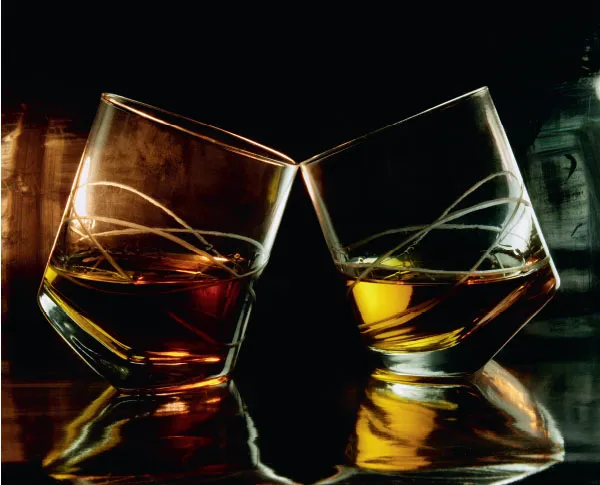
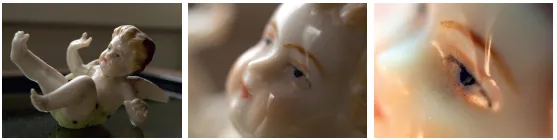
Although the technical name is micro photography (reduced to a very small size), the popular term is macro photography. What is the difference between close-up and macro photography? If you were to shoot a portrait, a close-up would be a shot of the person’s face in full frame. A macro shot would be the detailing of your subject’s eye or even the person’s iris, enabling you the opportunity to focus on minute specifics less apparent to the naked eye. Close- up and macro photography are actually worlds apart, yet both highlight an intimate view of the subject without the necessity of showing the whole ensemble.
Close-up photography can be described as “filling the frame,” whereas macro is the art of discovery; it’s a bit like comparing a magnifying glass to a microscope. Both macro or super macro enable you to shoot small subjects true to size, or a little bigger. This is called life size or 1:1 magnification. Anything farther away than this can be construed as close-up photography, not macro (even if you are using a macro lens). Macro does not involve zooming in; instead, you rely on the lens itself to magnify the image usually less than half-an-inch close. Close-up photography, however, can be achieved with any lens from zoom, telephoto, to fisheye or even wide angle. Macro is much more precise, and depending on your lens combination, you can get a ratio of 2:1 or greater, resulting in some amazing shots.
You may say, “What could I possibly use close-up or macro for?” Both styles can be used for four categories: fine art, editorial, advertising, and documentation (from showcasing, comparing, or examining objects to giving evidence, such as in forensics). Macro photography is particularly popular for capturing the miniscule details of insects and the intrinsically delicate beauty of flowers.
The Difficulty with Macro Photography
Macro photography is challenging because many of the rules that apply to other styles of photography simply don’t apply to extreme close-ups. Using a standard or telephoto lens is not the same as using a macro lens. A macro lens requires more lighting, and you need to acquaint yourself with focusing techniques. In fact, despite the appeal of extreme close-up photography, mastering it can be somewhat difficult. With high magnification you will encounter marginal depth-of-field by fractions of an inch, limited light, and, because you have to use manual techniques, focusing can become a frustrating ordeal of hit-or-miss attempts.
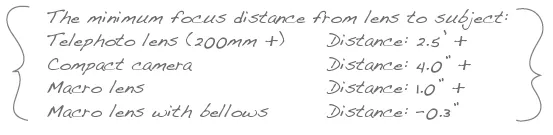
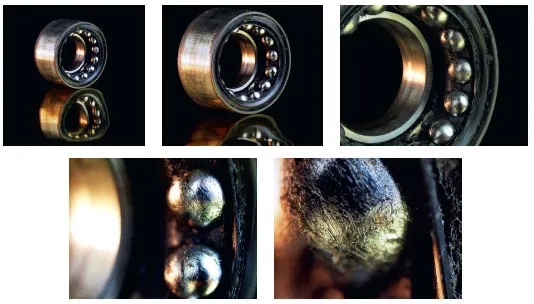
Here are a few important issues I learned when transferring from using a regular or telephoto lens to a macro lens. Because of the extreme proximity between the lens and the subject, accessibility to light will be poor, as much of the light you will need will be blocked out, so try the following tips:
1. Increase your light source. For outside shots, use a reflector or ring flash. For indoor shots, add incandescent lighting or strobe lights.
2. Slow your shutter speed, though this may cause further problems, if photographing outdoors in the wind. You may have to bracket your shots (see ‘Bracketing’ in Chapter 2 p. 54).
3. Open up your aperture a lot more or increase your EV by several stops.
4. Always use a tripod for steadiness; that will ensure focus and clarity.
Another concern is getting accustomed with Manual mode— for the settings and the focusing. Focusing is one of the biggest challenges you will encounter in macro photography. To get sharp photos, focusing must be precise.
This seems obvious, but the closer you are to your subject, the lower your depth of field. A low depth of field means a limited range as to what can be focused. The advantage of using manual focus is that it allows you total autonomy to a wider context of sharpness; however, it is more time-consuming because you have to adjust all your settings to complement distance, light, and focusing—a difficult process in terms of achieving complete sharpness, because you are relying on your own assumption as to what is sharp in comparison to having the camera automatically do it.
The alternative is to dial your camera to Aperture mode. The camera sets the exposure while you simply concentrate on focusing. This is easier, but it doesn’t allow you the flexibility to manipulate the exposure. And although autofocus provides the settings and focusing, it seems to become spasmodic when instructed to focus on specifics, either by being unable to differentiate between the front or back of the subject matter or obstinately focusing on the wrong detail or, worse, nothing at all. This is proof that cameras can’t discriminate. They focus only on what is being aimed at unless there is a lack of contrast between the foreground and background. The solution is either to find a more distinct area of contrast and switch on the focus lock or to focus manually and close down the aperture a stop to give more depth of field.
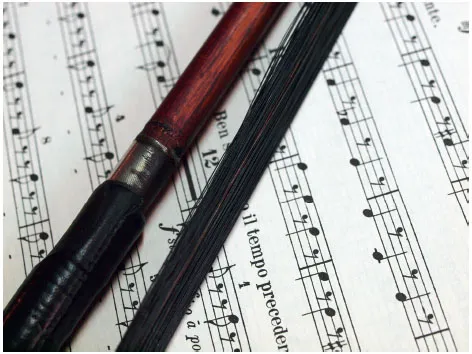
Autofocus may be ideal for creative photography, but not so much for documentation. Patience is a godsend. Despite the difficulties and special requirements of extreme close-up photography, those who dedicate themselves to it are rewarded with unparalleled images and boundless investigation into alien territories. Macro lenses can be very expensive, so let’s examine some affordable alternatives.
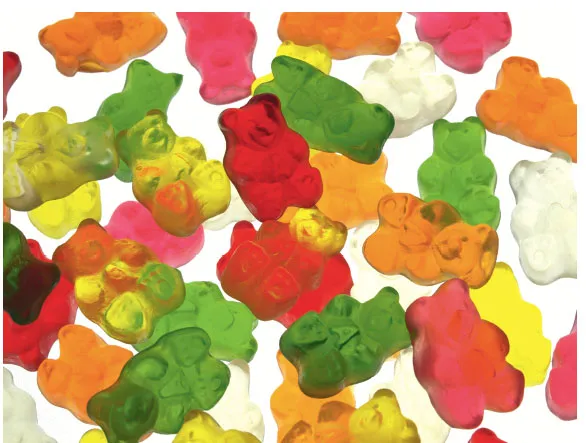
Extension Accessories for Close-Up Photography
If you can’t afford a macro fixed focus lens, there are several alternative means of getting a closer shot of your subject. Here are a couple of choices to consider.
Auxiliary Filters (Close-Up Lenses)
An auxiliary screw-on, close-up lens is placed in front of your camera lens and acts as a diopter (or added focus adjustment), resulting in a closer focusing distance. It is a bit like putting reading glasses over your lens. These come in ratios of +1, + 2, and so on. They can also be stacked so you get a +1 +2 = +3 magnification or higher. It sounds great and they are relatively inexpensive, plus they don’t require any exposure corrections, but the magnification is only marginal.
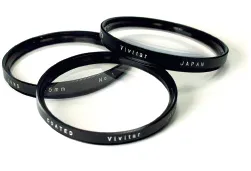
With most close-up lenses, the strength of the focus is in the center of the lens rather than around the perimeters. If you want com...
Table of contents
- Front Cover
- Half Title
- The Focus On Series
- Title Page
- Copyright
- Dedication
- Contents
- About the Author
- Acknowledgements
- Introduction
- Chapter 1: What Is Macro Photography?
- Chapter 2: Composition
- Chapter 3: Flower Photography
- Chapter 4: Lighting
- Chapter 5: Subjects to Photograph
- Chapter 6: What to Do with Your Images
- Index
Trusted by 375,005 students
Access to over 1.5 million titles for a fair monthly price.
Study more efficiently using our study tools.
Frequently asked questions
Yes, you can cancel anytime from the Subscription tab in your account settings on the Perlego website. Your subscription will stay active until the end of your current billing period. Learn how to cancel your subscription
No, books cannot be downloaded as external files, such as PDFs, for use outside of Perlego. However, you can download books within the Perlego app for offline reading on mobile or tablet. Learn how to download books offline
Perlego offers two plans: Essential and Complete
- Essential is ideal for learners and professionals who enjoy exploring a wide range of subjects. Access the Essential Library with 800,000+ trusted titles and best-sellers across business, personal growth, and the humanities. Includes unlimited reading time and Standard Read Aloud voice.
- Complete: Perfect for advanced learners and researchers needing full, unrestricted access. Unlock 1.5M+ books across hundreds of subjects, including academic and specialized titles. The Complete Plan also includes advanced features like Premium Read Aloud and Research Assistant.
We are an online textbook subscription service, where you can get access to an entire online library for less than the price of a single book per month. With over 1.5 million books across 990+ topics, we’ve got you covered! Learn about our mission
Look out for the read-aloud symbol on your next book to see if you can listen to it. The read-aloud tool reads text aloud for you, highlighting the text as it is being read. You can pause it, speed it up and slow it down. Learn more about Read Aloud
Yes! You can use the Perlego app on both iOS and Android devices to read anytime, anywhere — even offline. Perfect for commutes or when you’re on the go.
Please note we cannot support devices running on iOS 13 and Android 7 or earlier. Learn more about using the app
Please note we cannot support devices running on iOS 13 and Android 7 or earlier. Learn more about using the app
Yes, you can access Focus On Close-Up and Macro Photography by Clive Branson in PDF and/or ePUB format, as well as other popular books in Media & Performing Arts & Digital Media. We have over 1.5 million books available in our catalogue for you to explore.