Care, welfare and community are three key concepts in contemporary social policy. This reader covers a wide range of topics associated with them and relevant to the delivery of care and support to adults. It includes a wide-ranging collection of articles by leading writers and researchers, some previously published, some newly commissioned. It also has first-hand accounts by users and providers of care and welfare in the community. Groups covered include people with mental health problems, homeless people, older people, people with learning difficulties and people with impairments. The focus throughout is on how policies and practice can be developed appropriately and sensitively through an understanding of current issues.
The 40 chapters are grouped into four sections, each with an introduction. Five of the chapters are made up of extracts from a wide range of documents and testimonies.
* Power and inequality
* Difference and identity
* Rights and risk
*Territories and boundaries
Most of the material relates to a diverse turn-of-the-century Britain, but this is set in a wider context enabling the student to explore the alternative realities of other countries and other times.
Understanding Care, Welfare and Community provides an integrated, multidisciplinary overview of the many different aspects of community care. It is appropriate for students and professionals following a wide range of courses in social work, nursing, care, health, social policy, medicine, voluntary work and welfare services. It will also be a valuable resource for carers and practitioners, teachers and policy makers.
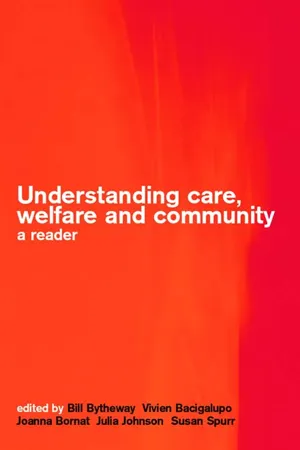
eBook - ePub
Understanding Care, Welfare and Community
A Reader
- 392 pages
- English
- ePUB (mobile friendly)
- Available on iOS & Android
eBook - ePub
Understanding Care, Welfare and Community
A Reader
About this book
Information
PART I
POWER AND INEQUALITY
INTRODUCTION
In this section, Power and Inequality, we draw attention to the dynamics of relationships: between people, between organisations and between social groups. Even the most intimate of support relationships may involve oppressive or alienating feelings of powerlessness. Many policies relating to care, welfare and community are intended to challenge or alleviate some of the negative consequences of inequalities; for example, by ending discrimination, by empowering users, or by ensuring that priority is given to those ‘most in need’.
In this first Part of the Reader, we begin with four personal accounts of ‘unsettled’ lives. These describe experiences of exile, mental illness, institutional life and physical disability. Although very different, they all reveal ways in which inequalities and power differentials in the care system affect interpersonal relations and life chances. In Chapter 2, a single autobiographical account describes how one couple, following family difficulties and migration, entered a state of abject poverty and fear. In Chapter 3, a Child Poverty Action Group team reports on a project that provided poor people with the opportunity to describe the effects of poverty in their own words and then, in Chapter 4, Mark Drakeford critically examines the post-Beveridge history of social security and social services. This reveals something of the power of central government, given its abiding concern with public expenditure, to limit the autonomy of local government and to determine the role of social workers.
Poverty and wealth have been the focus of much research and policy analysis throughout the twentieth century. There is a strong case for arguing that this particular dimension of social inequality is that most strongly associated with the need for care and welfare. So, in Chapter 5, we include a series of contrasting commentaries on the history of poverty and welfare. Some are based in the UK, some abroad. Issues of power and inequality and care and welfare in the community, underlie the observations of all these witnesses.
In Chapter 6, Jan Walmsley and Sheena Rolph report on their research into the history of a particular aspect of community care. They argue that the current idea that community care is new is mistaken and that there is much to be learned from studying how statutory agencies worked with – and against – families in the decades before the launching of the Welfare State. The inequality which disabled people continue to experience is detailed by Ayesha Vernon in Chapter 7. Here she articulates the anger that is widely felt by people with multiple oppressions.
Power and inequality are the driving force of political action. In Chapter 8, Dave Goodman describes his experience of campaigning and challenging current fiscal policies that directly affect the circumstances and welfare of older people. One important focus of political action is choice. In Chapter 9, we include extracts from a report on research into the moves that older people make, into and between care homes. Who has the power to determine who moves where and when? Chapter 10 is based on personal experience and provides some insight into this difficult process. Margaret Forster, the well-known novelist and biographer, vividly describes what was involved in negotiating the care of her father in the last years of his life.
CHAPTER 1
UNSETTLED LIVES
1.1 IN EXILE
Ait
Source: iNexile, Refugee Council, 8, January 2000, pp. 14–15.
I left my homeland Algeria in an attempt to flee persecution and horrendous acts of torture. In October of 1998 I arrived in the UK and was held in detention for the first four days after my arrival. On my release I was advised to contact the Refugee Council who would be able to advise me of my rights and provide me with accommodation.
I arrived in London on a Sunday with no money and nowhere to sleep and spent the night in Victoria station. I finally arrived at the Refugee Council on Monday morning and was sent to their One Stop Service. By this point I felt exhausted, distressed and disorientated, and after the experiences of the previous 24 hours I wished that I had remained in detention where I would at least have had a roof over my head and some form of security.
I was advised that there was no accommodation available in London and was made an offer of accommodation on a farm in Lincolnshire. I didn’t want to leave London but in my emotional state coupled with my limited knowledge of English geography I agreed, reluctantly.
When I arrived in Lincolnshire I realised just how secluded the accommodation was. The farm itself was far away from the town centre. The landlord spent long periods away from the property and even when he was there it was hard for me to communicate with him due to my limited English. I started to experience the familiar feelings of loneliness and isolation, which deteriorated quite rapidly into a severe depression. My doctor advised me to return to London and with his written recommendation I left Lincolnshire and revisited the Refugee Council’s One Stop Service.
By the time I arrived at the One Stop Service I was very distressed and crying. I was placed in a hotel for the first two days – then sent to a hostel for refugees where I spent the following two weeks. I was asked to leave the hostel due to the fact that I was taking medication and was advised that they do not have the facilities to cater for residents taking medication. I returned for a third time to the Refugee Council who placed me in church accommodation in North West London. All of the other residents in this accommodation were Kosovar refugees and I felt extremely isolated and uncomfortable as we could not communicate with each other. It became quite awkward for me to stay and I returned for the fourth time to the Refugee Council.
I was placed in my current accommodation, which is a room located in another church. Since my arrival I have found it very difficult to relax or rest here as there are church meetings throughout the week. This means that I cannot use my room because of the noise level and disruption caused by the music being played so loudly. This has forced me to stay out in the street during these times, which has often meant all day! I have been forced to stay in the cold without being able to use my room, which is in the middle of the main hall. Because of the noise, I have not been to sleep properly. The music keeps playing in my head, long after they have gone and I find my head spinning throughout the night. Sleeping pills have not helped me and my doctor said that he could not prescribe any stronger medicine. I cannot even rest during the day, especially when I have had such sleepless and stressful nights.
This noise level added to the fact that the room is unhygienic and has no adequate washing or bathing facilities exposes my life to unaccounted for risks. I have raised the problem with all those concerned, but I have not noticed an improvement or consideration for my health situation. My health is continuing to suffer due to having to take so much medicine without being able to recover at all. I am in a crisis situation. I do not think that it is right to leave me to undergo all this traumatising stress after all that I have suffered throughout all these many long years.
It has been nearly seven years since I departed from my homeland in Algeria and since that time I have not had anywhere that has felt like a base, a place where I have felt at ease and secure. I feel like a nomad and look forward to the time when I can once again have a space, which feels like a home, somewhere which is quiet and private. Somewhere which will contribute to my ability to recover from my traumatic experiences of the past and which will enable me to build upon for the future.
1.2 PLACES IN BETWEEN
Cas Alland
It is my view that periods of transition in our lives test to the utmost our own resourcefulness as well as that of the social networks in which we move. This is perhaps all the more so when, because of debility, we need to depend on agents outside our usual social spheres. My example is a personal one of my own transition from hospital to the community after a long illness. However I know, from the people who journeyed alongside me in similar states, that my experience is not unique. There are common themes and issues which, if left unresolved, make the problems of such transitions more traumatic.
I spent five and half months in a mental hospital. Being admitted to such a place is a shock, to me more so because I had spent ten years working in psychiatry. It is a humbling experience in which you appear to give up so much – not least the control to make decisions about your life. Your illness is the presenting picture and in the depths of despair the only hallmark that is seen by those helping you. They seldom have another reference point that indicates who you are separate from your illness. The roles you had are just labels that have their own stereotypes attached. There is little indication of your character strengths under such circumstances. If your illness is not incapacitating in itself then the sense that you are nothing more than your diagnosis can debilitate you further. The challenge is to retain a sense of who you are and convey it to others so that they have a key to give you the support that will most facilitate your recovery.
Over two months of my time in hospital was spent on a high observation unit whose objectives were to provide a high level of support and therapy whilst keeping me safe from my suicidal intentions. The unit was excellent. The boundaries were clear and the staff were confident about their role and worked well as a team. The help I received was unimaginable. I was lucky to find myself in such a place. It not only kept me safe but also allowed me to begin to deal with the issues which had brought me there. I was able to rediscover a commitment to life that I thought I had lost. It gave me the courage to face the depths of despair and challenged me to take back some control in my life. I was given permission to express myself and positively encouraged to make my own decisions and rediscover those lost reservoirs within. It is perhaps a paradox that a place that appeared to take away so much freedom helped me to be free.
A few weeks after I moved back onto the main ward I was asking to be discharged. With an impending date in sight the number of people involved in my situation increased and with it the confusion. Under the pressure to prove my need for help it was easy for me to lose touch with the progress I had made
During my period in hospital it became evident that my marriage had irretrievably broken down and for my health’s sake it was inappropriate to go back to the marital home. I had been working part-time and was fortunate enough to be still receiving pay although by the time I left hospital I was being paid a quarter of a full-time salary. I was wrongly told by a social worker that I didn’t qualify for any benefits because I had an income. I was informed that I was not entitled to housing because, as a single person with no dependants, I was low priority. From my own research my income was not enough to cover a private rent. After being advised to see a solicitor I discovered that I earned £10 too much to receive legal aid and could not afford the legal costs. The progress I had made was already being severely tested.
At my care programme discharge meeting there were three major areas of concern: the need to receive ongoing support and monitoring of my mental state following transition from the protected environment of hospital; the need for social support with the practical issues; and the need for long-term psychological therapy to continue working through the issues of my past. There were ten people at the meeting. If this wasn’t intimidating in itself then the lack of motivation, from the community agents, to become involved in my care was devastating.
The Community Mental Health Team (CMHT) said I didn’t fulfil their referral criteria and did not want to be involved. Although I work for a CMHT I don’t know to this day why this was the case. They gave no explanation. The social worker said that technically I had a home and, although my consultant was adamant that returning home was not an option, said there was nothing she could do. I was told there was a waiting list of a few months for psychology or psychotherapy but that a consultant psychiatrist would see me on a regular basis. The first appointment to see a psychiatrist, which I received a few days later, was for two months after my discharge. A keyworker was not identified. The psychology service had already assessed me. It was agreed that whoever saw me from there would fulfil that role, at some unknown future point. The only other option was to attend a day hospital. Two days later I went for an assessment and was again told that I did not come under their referral criteria but, because there were no other avenues to explore, they would give me a place two days a week for a month until psychological support was in place.
I am fortunate to have a sister who cares a great deal. She offered me her home as a place to convalesce immediately after hospital. Unfortunately she lives in Spain and although her support was invaluable I was not able to sort out practical issues from such a distance until I returned home three weeks later. Again I was fortunate to have good support from friends and went to stay with a couple on a temporary basis. The friends in question were also going through a period of extreme crisis. The husband had been made redundant and his wife was seeing her mother through the last stages of cancer. The arrangement was not ideal, but their generosity was moving.
After discharge I received a letter from the psychology service offering me yet another assessment. At the assessment I was told it would more likely be a year before I could be seen. I couldn’t help asking whether their waiting lists might be reduced had they not duplicated assessments. I was asked, hypothetically, what difference it would make if I were seen in the next month given that most of my concerns related to practical issues? It seemed impossible to convince them that to me it would make all the difference. I had been used to a high level of psychological help and was now receiving none. I had responded well to that approach. My ability to resolve my practical difficulties had been greatly facilitated by psychological intervention. Two weeks later they wrote explaining that they could not see me and had referred me to the CMHT – the same people who had already refused to be involved in my care. At the day hospital I was offered very low-level distraction groups that left me feeling paralysed. I felt unsafe about grappling the issues in my life without adequate and ongoing support. I was dependent on help being on offer. I did not want to turn anything down through fear of being labelled difficult and the help being cut off. However I was also aware that the support I was receiving was not matching my needs.
My mood deteriorated significantly. My recovery was in jeopardy. I was keen that everything possible should be done to prevent relapse. In desperation I saw my GP who was concerned enough to arrange an emergency appointment with a psychiatrist. Unfortunately I saw a locum who, very sympathetic to my situation, did what he could to pursue an urgent referral to the CMHT but was not around long enough to follow my progress. Two months on and I am still waiting for a response from them. Out of the blue I received an incapacity benefit form from my employer. Confused, following the advice that I was not entitled to any benefits, I made enquiries and was put in touch with the Welfare Rights Office. The help they provided was excellent and the guidance they gave invaluable. I realised that there were many sou...
Table of contents
- Front Cover
- Title Page
- Copyrights
- Contents
- Preface
- Acknowledgements
- PART I Power and Inequality
- PART II Difference and Identity
- PART III Rights and Risk
- PART IV Territories and Boundaries
- Index
Trusted by 375,005 students
Access to over 1.5 million titles for a fair monthly price.
Study more efficiently using our study tools.
Frequently asked questions
Yes, you can cancel anytime from the Subscription tab in your account settings on the Perlego website. Your subscription will stay active until the end of your current billing period. Learn how to cancel your subscription
No, books cannot be downloaded as external files, such as PDFs, for use outside of Perlego. However, you can download books within the Perlego app for offline reading on mobile or tablet. Learn how to download books offline
Perlego offers two plans: Essential and Complete
- Essential is ideal for learners and professionals who enjoy exploring a wide range of subjects. Access the Essential Library with 800,000+ trusted titles and best-sellers across business, personal growth, and the humanities. Includes unlimited reading time and Standard Read Aloud voice.
- Complete: Perfect for advanced learners and researchers needing full, unrestricted access. Unlock 1.5M+ books across hundreds of subjects, including academic and specialized titles. The Complete Plan also includes advanced features like Premium Read Aloud and Research Assistant.
We are an online textbook subscription service, where you can get access to an entire online library for less than the price of a single book per month. With over 1.5 million books across 990+ topics, we’ve got you covered! Learn about our mission
Look out for the read-aloud symbol on your next book to see if you can listen to it. The read-aloud tool reads text aloud for you, highlighting the text as it is being read. You can pause it, speed it up and slow it down. Learn more about Read Aloud
Yes! You can use the Perlego app on both iOS and Android devices to read anytime, anywhere — even offline. Perfect for commutes or when you’re on the go.
Please note we cannot support devices running on iOS 13 and Android 7 or earlier. Learn more about using the app
Please note we cannot support devices running on iOS 13 and Android 7 or earlier. Learn more about using the app
Yes, you can access Understanding Care, Welfare and Community by Vivien Bacigalupo, Joanna Bornat, Bill Bytheway, Julia Johnson, Susan Spurr, Vivien Bacigalupo,Joanna Bornat,Bill Bytheway,Julia Johnson,Susan Spurr in PDF and/or ePUB format, as well as other popular books in Social Sciences & Health Care Delivery. We have over 1.5 million books available in our catalogue for you to explore.