What do we mean by 'gender' and how does this relate to health?
How is 'biology' best understood?
What does a focus on the division of labour bring to our understanding of health work?
Is (gender) 'equity' in health possible?
How have developments such as the resurgence of emotions and the new genetics affected these and other social relations at the turn of the century?
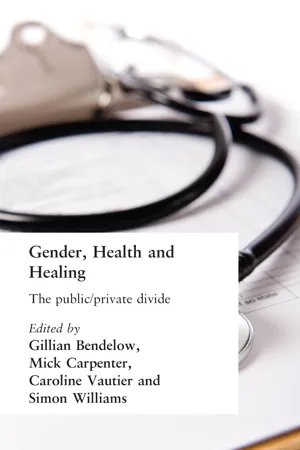
These are just some of the questions addressed in Gender, Health and Healing in which a whole range of issues are brought together and connected to emerging concerns in contemporary life such as the new genetics and transformations in biomedical knowledge and practices. It offers a challenging assessment of gender relations and embodied practices across the public/private divide, using health and healing as paradigmatic examples.
This thought-provoking volume lies at the intersection of gender studies, the sociology of health and healing, health policy, the critical analysis of scientific knowledge and the current debates around the body, health and emotions. Bringing together new and leading scholars in the field, it provides a unique critical overview of contemporary debates in health care for an interdisciplinary readership.
eBook - ePub
Gender, Health and Healing
The Public/Private Divide
- 304 pages
- English
- ePUB (mobile friendly)
- Available on iOS & Android
eBook - ePub
Gender, Health and Healing
The Public/Private Divide
About this book
Information
Part I
Biology ‘revisited’ and human reproduction
Old problems, new dilemmas?
1 Corporeal reflections on the biological
Reductionism, constructionism and beyond
Introduction
It is perhaps only the bold or foolhardy, in an era of floating signs and signifiers, who dares to resurrect the thorny question of biology. From Darwinian evolutionary theory, on the one hand, to the perils of eugenics and the pitfalls of socio-biology, on the other, the question of biology if not the spectre of biologism has been an implicit if not explicit theme: a foil, in effect, for the sociological imagination itself. The ‘repressed’ however, as Freudians are keen to remind us, has a habit of returning, for better or worse. Certainly it is possible to detect signs of this reappearance. New ways of understanding science and its relationship to culture, alternative ways of philosophically ordering scientific knowledge, together with newly influential movements – from ecology to animal rights – have combined in recent years, as Benton (1991) suggests, to compel or facilitate new ways of thinking about biology and the human sciences.1 To this we may add the recent upsurge of interest in the body and emotions, both inside and outside the academy. The body, it seems, is everywhere and nowhere today: a victim, like the sociology of emotions, of its own success perhaps (Wouters 1992: 248). Here, on this contested corporeal terrain, claims and counter-claims as to what precisely the body is (or is not) abound, the push for more integrated modes of theorising themselves at a relatively early stage of development.
In this chapter I take a closer look at these corporeal issues and the deeper ontological and epistemological questions they raise, taking feminist scholarship as a paradigmatic example. The aim in doing so is to provide a series of thoughts and reflections on the biological which avoid the pitfalls of (biological) reductionism and (social) constructionism alike. It is not, I shall argue, drawing on a variety of recent work in support of my claims, a question of choosing between either biology or society, but of re-envisioning this very relationship – and the former dichotomies it entails – in new (emergent, irreducible) ways which go beyond these existing terms of debate, without leaving out what is important to them in the process. In these and other respects, I hope, the chapter marks in spirit, if not content, Meg Stacey’s (1988) own non-determinist approach to the ‘biological base’. How then has the biological fared in these debates to date, and where do we go from here? It is to these and other related questions that I now turn.
* I would like to thank my colleagues on the editorial team who have read and commented on earlier drafts of this chapter. Thanks also to Lynda Birke for her perceptive comments and valuable insights into these biological matters, within and beyond this chapter.
The dilemma of biology: a ‘corporeal’ feminism?
Feminisms, in many ways, provide a paradigmatic expression of the tensions and dilemmas of recourse to the ‘biological’ body, both in theory and practice (Birke 1999): something, according to writers such as Spelman (1988), which has bordered on the ‘somatophobic’. All too often, it seems, the link made between women and their bodies has been used against them as a means of curtailing their own freedom like that of ‘others’ (that is, blacks, lesbians, children, the disabled) (Spelman 1988; Birke 1995). In challenging such ‘biological determinism’, Spelman argues, the body has remained under-theorised; feminists pointing instead towards broader social, cultural and political determinants of women’s oppression in Western patriarchal society. This charge, made well over a decade ago now, may seem somewhat dated, particularly in the light of recent feminist scholarship. It does none the less contain more than a germ of truth, particularly in relation to the biological. Theorising the body may now be a central feminist preoccupation – some would doubtless claim it has never been otherwise – yet the nature and status of biology, qualifications apart, remains somewhat ‘problematic’ in many of these discussions and debates to date.
One response to this corporeal dilemma, as Birke (1995, 1999) notes in relation to past feminist theories of biology and the body, has been to claim that women are ‘biologically disadvantaged’ relative to men. From this perspective, social reform can only achieve so much, leaving the rectification of remaining inequalities to increases in ‘control’ over nature (i.e. biology) itself. Firestone (1970), for example, in The Dialectic of Sex provides a clear expression of these concerns, including the ‘liberatory’ potential of science for women. The answer to women’s subordination, from this perspective, lay in future technological control over the ‘tyranny’ of their reproductive biology. The ‘specificity’ of the reproductive body, in other words, had to be ‘overcome’ if sexual equality was to be achieved (Birke 1995).
An alternative position has been to suggest that women should not aspire to be ‘like men’ at all. Rather, women should celebrate and affirm their bodies, including the capacity to recreate and nurture, care and love – a ‘biophilic’ position, that is to say – vis-à-vis the selfish, ‘necrophilic’ or ‘gynophobic’ nature or traits of men (Daly 1978). Essential sexual difference should, therefore, for theorists of this persuasion, be retained rather than overcome through scientific intervention (Birke 1995). Hovering somewhere in between these two strands of essentialism lies the work of feminist writers who, in their differing ways, highlight how women, as potential or actual reproducers, experience oppression (Birke 1995). O’Brien (1981, 1989), for example, sees women’s oppression as originating in the male discovery of their role in paternity. Physiology is ‘fate’ for men, she suggests, paternity itself an ‘alienated’ experience, based on abstract knowledge rather than the ‘unity of knowing and doing, of consciousness and creativity, of temporality and continuity’ which comes through the very process of giving birth (O’Brien 1989: 14). Whilst this statement implies a biological determinism of sorts, it is in fact, as Birke (1995) comments, deeply rooted in material and cultural processes of patriarchal oppression for writers such as O’Brien. Unity with ‘nature’ (itself a contested or problematic term) therefore becomes a desirable future state of affairs from this viewpoint (Birke 1995).
Rich (1976), in a similar (albeit more radical) vein, asks women to reconsider their so-called ‘problematic’ relationships to their bodies and to female biology (Birke 1995). Rather than simply perpetuate dominant (masculinist) views, women must instead, Rich argues, learn to ‘repossess’ their bodies:
In arguing that we have by no means yet explored or understood our biological grounding, the miracle and paradox of the female body and its spiritual and political meanings, I am really asking whether women cannot begin, at last, to think through the body, to connect what has been so cruelly disorganised – our great mental capacities, hardly used; our highly developed tactile sense; our genius for close observation; our complicated, pain-enduring, multi-pleasured physicality.
(Rich 1976: 284; emphasis added)
Whilst these responses to women’s corporeal specificity are often taken to exhaust the ‘sexual equality versus sexual difference debate’, they are, as Gatens (1992) notes, ultimately caught up in one and the same paradigm, which understands the body as a biologically ‘given’ entity and assumes rather than transcends a mind/body, nature/culture dualism. The sex/gender distinction in particular, a central issue within feminisms of the 1970s and early 1980s – see, for example, Oakley (1972) among others – failed to question how society constructs the ‘natural body’ itself.2
Recognition of this important fact has led recent feminist scholarship to an alternative view of the body and power; one which highlights the discursive construction of ‘sex’ itself, thereby challenging the dualistic manner in which sexual difference has been articulated to date. Instead of seeing ‘sex’ as a biological phenomenon and gender as a cultural category, these thinkers are concerned to undermine the dichotomy altogether. Within the corpus of Judith Butler’s (1993) work, for example, materiality itself becomes an ‘effect of power’, indeed as power’s most ‘productive effect’. Once ‘sex’ is understood in its ‘normativity’, she claims, the ‘materiality of the body will not be thinkable apart from the materialisation of that regulatory norm’ (ibid.: 2). Seen in these terms ‘sex’ is not simply what one has, or what one is, rather it is one of the regulatory and reiterative norms by which one becomes ‘viable’ at all. At stake in such a reformulation, for Butler, are five key propositions. First, a recasting, in Foucauldian terms, of body matters and the matter of bodies as a dynamic effect of power, and the regulatory norms that govern their materialisation and signification. Second, the understanding of ‘performativity’ as a reiterative power of discourse to (re-)produce the very phenomena that it regulates and constrains. Third, the construal of ‘sex’ as no longer a ‘bodily given’ upon which gender constructs are artificially imposed, but instead a ‘cultural norm’ which governs the materialisation of bodies. Fourth, a rethinking of the process by which a bodily norm is assumed, appropriated or adopted as one in which the very subject, the ‘speaking I’, is constituted by virtue of having gone through the process of assuming a ‘sex’. Finally, a linking of the assumption of ‘sex’ with the question of ‘identification’, and the discursive means by which the ‘heterosexual imperative’ enables certain ‘sexed’ identification whilst foreclosing and/or disavowing others (ibid.: 2–3).3
The (mythical) ‘pre-social’ body, from this viewpoint, is rejected in favour of a discursive body, a body which is bound up in the ‘order’ of desire, power and signification. Related to this, as alluded to above, is an acknowledgment (and/or celebration) of ‘difference’: one in which culture rather than biology ‘marks’ bodies and creates the specific conditions in which they live and recreate themselves (Grosz 1994). The emphasis here, broadly speaking, is ‘deconstructive’; a position which seeks to ‘destabilise’, ‘challenge’, ‘subvert’, ‘reverse’, ‘overturn’ ossified conceptual forms in favour of more plural, fluid or ‘leaky’ positions (see also Barrett and Phillips 1992; Shildrick 1997; Battersby 1998).
Problems remain none the less with both these positions (i.e. essentialism and constructionism). Biology, in the former case, whether celebrated or bemoaned, remains essentially fixed or determinative, save the ‘transformatory’ (qua liberatory) potential of technology itself. Constructionism, on the other hand, takes us in precisely the opposite direction through a problematic series of conflationary moves. To the extent that biology figures at all here, it becomes yet another form of discourse (i.e. ‘written in/out’ of the picture): a ‘reductionist’ one at that. The body that ‘performs’ moreover, as Grosz reminds us, must nevertheless ‘abide between performances, existing over and above the sum total of its performances’ (1995: 212, my emphasis). Sexuality, in this sense, is more than simply a position in social space (Turner 1995). There is little attempt here, by writers such as Butler, to understand the physicality of the body, or its material decline and decay across the lifecourse (Turner 1995, 1996). ‘Like many women’, as Birke (1995: 2) rightly comments, ‘I have trouble thinking about theories of social construction that ignore or play down my bodily pain and bleeding, or that ignore the way that desire (however constructed) finds expression through my material body.’ The upshot of these and related embodied matters, is that discursive (i.e. performative and citational) approaches to the body of this kind, at one and the same time, remain both promising and problematic.
What we have here, to put it in slightly different terms, is a conflation of the epistemological with the ontological – that is, the ‘epistemic’ fallacy’ (Bhaskar 1989) in which what we know and how we know it is confused with what there is to know. Like the biological itself, moreover, the social is reduced to language (i.e. the subtle play of signs and symbols): a form of ‘discourse determinism’ (Turner 1995) based on an inversion rather than overcoming of the problems of essentialism (Sayer 1997).4 This, in turn, suggests that the socially constructed and the socially constituted world cannot simply or unproblematically be equated: the former, qua discourse, merely one aspect of the latter (perhaps the most obvious one at that).5 Biology does not, it is clear, have to be ‘written out’ of existence in this way, or any other way for that matter; nor, however, does it have to be seen as ‘determinative’ (Birke 1995, 1999). In raising these issues and putting matters this way, I have perhaps set myself a somewhat easy or straw target: a caricature, in effect, of a far more complex, subtle and sophisticated series of arguments and debates. There is, I concede, some truth in this. A number of other more promising positions, both inside and outside feminist scholarship itself, are indeed now beginning to emerge with which to ‘rethink’ the biological in other non-reductionist or non-conflationary ways (Birke 1999; Rose and Rose 2000a; Rose 1997; Benton 1991). What then do these theories constitute, and where do we go from here? It is to these very questions, and the embodied agendas they call forth, that I now turn.
Where do we go from here? Five key issues
Duality and dualism, ontology and epistemology
The first issue to tackle here, head on, concerns the knotty problem of dualism itself. Do we, given their dubious Western history, need dichotomies? If so, how best might they be pressed into service? This is hotly contested terrain, upon which much debate, both past and present, has turned. It may, however, as a preliminary contribution to these debates, be useful to distinguish here between duality and dualism.6 As the process of Cartesian duality suggests, it is only through an act of conscious reflection (i.e. Cogito ergo sum) that the split between mind and body is effected. This duality, to be sure, represents a stage in the development of ‘human consciousness’, but is nevertheless, as we know only too well, founded upon a series of problematic assumptions about mind/body relations which have served neither women nor, ultimately, men (Seidler 1994), well. This stage of development (i.e. duality), in turn, leads to its own illusory appearance, namely the problem of dualism. As a doctrine, dualism turns duality into an ‘ism’: one in which the mind/body split appears somehow ‘natural’, rational and unconditioned. Moreover, it also spawns a number of other unfortunate, unhelpful dualisms such as nature/culture, reason/emotion, public/private, together with the associated ideological baggage and hierarchical orderings this involves. The critique of dualism, as a critique of the illusions of duality, and the critique of duality as ...
Table of contents
- Cover
- Half Title
- Title Page
- Copyright
- Contents
- List of contributors
- Acknowledgements
- Introduction: Overcoming divisions: reflections on tradition, change and critical continuity
- Part I: Biology ‘revisited’ and human reproduction: old problems, new dilemmas?
- Part II: Gender (in)equality and (emotional) division of labour: the ‘two Adams’ revisited?
- Part III: Health care in transition: ferment and change?
- Index
Trusted by 375,005 students
Access to over 1.5 million titles for a fair monthly price.
Study more efficiently using our study tools.
Frequently asked questions
Yes, you can cancel anytime from the Subscription tab in your account settings on the Perlego website. Your subscription will stay active until the end of your current billing period. Learn how to cancel your subscription
No, books cannot be downloaded as external files, such as PDFs, for use outside of Perlego. However, you can download books within the Perlego app for offline reading on mobile or tablet. Learn how to download books offline
Perlego offers two plans: Essential and Complete
- Essential is ideal for learners and professionals who enjoy exploring a wide range of subjects. Access the Essential Library with 800,000+ trusted titles and best-sellers across business, personal growth, and the humanities. Includes unlimited reading time and Standard Read Aloud voice.
- Complete: Perfect for advanced learners and researchers needing full, unrestricted access. Unlock 1.5M+ books across hundreds of subjects, including academic and specialized titles. The Complete Plan also includes advanced features like Premium Read Aloud and Research Assistant.
We are an online textbook subscription service, where you can get access to an entire online library for less than the price of a single book per month. With over 1.5 million books across 990+ topics, we’ve got you covered! Learn about our mission
Look out for the read-aloud symbol on your next book to see if you can listen to it. The read-aloud tool reads text aloud for you, highlighting the text as it is being read. You can pause it, speed it up and slow it down. Learn more about Read Aloud
Yes! You can use the Perlego app on both iOS and Android devices to read anytime, anywhere — even offline. Perfect for commutes or when you’re on the go.
Please note we cannot support devices running on iOS 13 and Android 7 or earlier. Learn more about using the app
Please note we cannot support devices running on iOS 13 and Android 7 or earlier. Learn more about using the app
Yes, you can access Gender, Health and Healing by Gill Bendelow,Mick Carpenter,Caroline Vautier,Simon Williams in PDF and/or ePUB format, as well as other popular books in Social Sciences & Health Care Delivery. We have over 1.5 million books available in our catalogue for you to explore.