A well designed, well written animated film has warmth, humor and charm. Since Steamboat Mickey, animators have been creating characters and films that are charming, warm and humorous, allowing people to connect with the animated medium. Animaton fans love the characters for a lifetime. This is the legacy of the countless animators and artists who created the classic characters and fun stories and the legacy of Disney Legend, Floyd Norman. Written with wit and verve, Animated Life is a guided tour through an entire lifetime of techniques, practical hands-on advice and insight into an entire industry. A vital tutorial in animation's past, present and future for students who are now poised to be part of another new generation in the art form. Apply artistic magic to your own projects and garner valuable insight and inspiration from a True Disney legend. With valuable advice, critical comment, and inspiration for every student of the arts, Animated Life is a classic in the making with completely relevant techniques and tools for the contemporary animation or fine arts professional.
eBook - ePub
Animated Life
A Lifetime of tips, tricks, techniques and stories from an animation Legend
- 278 pages
- English
- ePUB (mobile friendly)
- Available on iOS & Android
eBook - ePub
Animated Life
A Lifetime of tips, tricks, techniques and stories from an animation Legend
About this book
Information
PART 1
INSIDE THE MAGIC FACTORY
Wonderland | 1 |
The Walt Disney Studios
An animated wonderland in Southern California.
Inside the Real Magic Kingdom
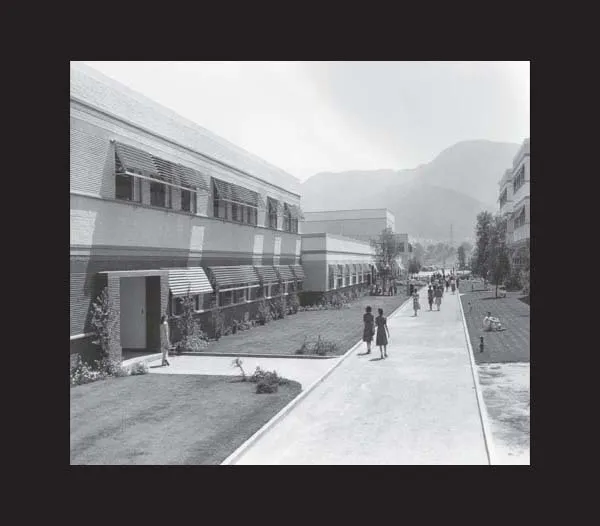
Let's take a trip back in time, to a time when traffic was light on the freeways, Hollywood was clean and tidy, and only the locals knew the location of film studios. Today, the Walt Disney Studios presides over Burbank like the Colossus of Rhodes, but back then the nondescript campus on Alameda Avenue gave not a hint of the activity inside.
In February 1956, nine starry-eyed youngsters reported for work at 500 South Buena Vista Avenue, eager to begin their careers in the cartoon business. Having a great job was only part of the deal, because an added bonus was finally getting inside Walt Disney's magic factory. Unlike today, there were few, if any, books on animation, and only an insider knew what a cartoon studio even looked like. Studio tours were practically nonexistent, and few people ever breached the studio gates. For us, all that had suddenly changed: like Alice, we had entered Wonderland.
STUDYING THE BACKGROUNDS
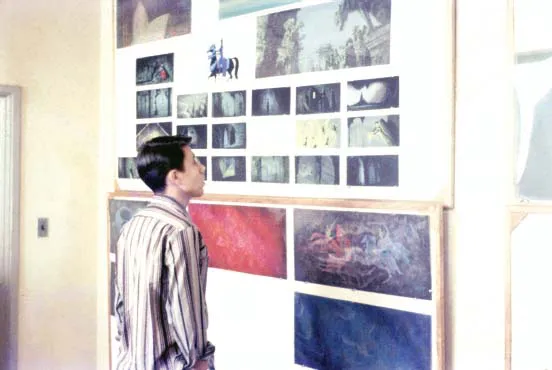
Rick Gonzales studies the backgrounds of color stylist Eyvind Earle while working on Sleeping Beauty.
Rick Gonzales studies the backgrounds of color stylist Eyvind Earle while working on Sleeping Beauty.
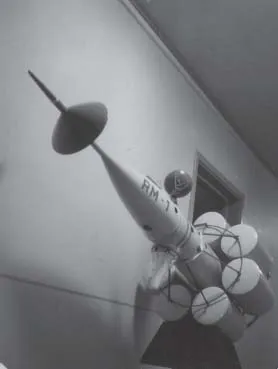
MOON ROCKET
One of the many scale models in Ward Kimball's unit.
One of the many scale models in Ward Kimball's unit.
Most people, if they thought at all about how Disney cartoons are made, assumed that Uncle Walt was drawing it all himself. An animated feature comprises hundreds of thousands of drawings and paintings completed over several years. Most people probably don't give it a second thought. It's all magic. But for an aspiring animation cartoonist, getting a job at Walt Disney was like hitting the major leagues—the Rolls Royce of animation.
Now here we were walking down Dopey Drive and making a right at Mickey Avenue. We were shown our office on the first floor of the animation building. It was a large room with several desks and a view of the studio theater and recording stage. The room number was 1B-1, and it was to be our home for a month as we worked to prove ourselves worthy of a position—even a lowly position—at the Walt Disney Studios. An animated film was the result of an assembly line of artists with very specific job responsibilities. When they start, one artist creates concept designs and another creates the storyboards, which are like the planning of the entire film—many times created without a script and written as they went along. Still another artist did “layout” drawing, the staging of the area the character would be standing in. Someone was recording the soundtrack and “breaking down” the actors’ words to single frames for the animator to draw to. Then came the animator, the clean-up crew, inbetweens and a quality control person called a checker. Then the drawings were Xeroxed, painted, and photographed on the painted background. Finally, an editor would take the film footage and cut it into the building work reel of the final movie. All these job classifications had levels of proficiency and years of experience. It was like joining a small army. Gee, I thought I left that stuff in Korea in 1958! Armed with pencil and paper, we sat about learning our animation craft, but break time meant a cup of coffee and a walk around the Walt Disney Studios campus.
Indeed, the Walt Disney Studios was more campus than movie lot. Unlike most tacky Hollywood studios, Disney had well-swept streets and trimmed hedges. Squirrels scampered about manicured lawns, park benches, and shady trees. It was a casual, relaxed atmosphere and one couldn't help but feel at home in this artist's paradise. But our first order of business was getting to know the Animation Building. This wonderful, three-story 1938 Art Deco facility was home to Walt's animation department. Having finally escaped the cramped quarters of the Hyperion bungalows in Silverlake, Disney's staff finally had a wonderful new workplace to call home. Ward Kimball called it “the first place I ever worked in where the furniture all matched!” Disney even secured the services of noted designer Kem Weber to custom-build chairs and furniture in the Arte Moderne style.
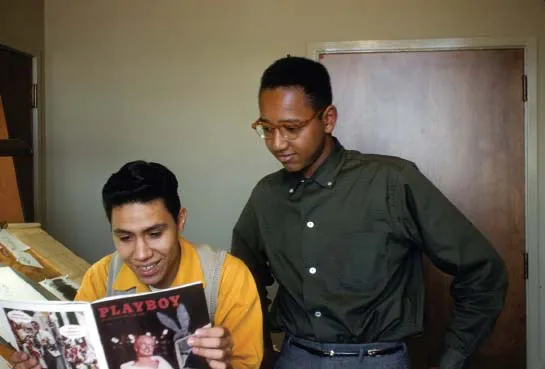
ANIMATION RESEARCH
Every good artist should be knowledgeable when it comes to anatomy. Rick and Floyd take their studies seriously.
Every good artist should be knowledgeable when it comes to anatomy. Rick and Floyd take their studies seriously.
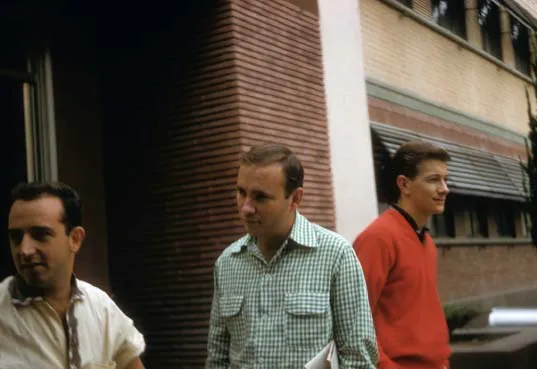
TAKING A BREAK
Gus Depace, Jim Fletcher, and Gordon Bellamy take a morning break outside the Animation Building.
Gus Depace, Jim Fletcher, and Gordon Bellamy take a morning break outside the Animation Building.
We began by touring the hallways of the first floor. Each studio wing had a small lobby with a directory and receptionist's desk. Once inside, we noticed that all but a few animation artists kept their office doors closed, so we felt comfortable entering and checking out the wonderful sketches on their drawing boards. We found the Effects department of C-Wing fascinating, as Disney's effects animators were busily creating wind, rain, and fire. Across the hall in D-Wing, we were advised to keep our voices down and make our visit short. We later learned that this wing was the domain of Disney's “Nine Old Men” and that visiting, though not discouraged, was not necessarily welcome.
As we moved down the hallway of the Animation Building, we noticed steps that led downstairs. Was there a basement floor, we wondered? So our little group decided to venture down into the catacombs of animation. What might be contained in this underground labyrinth? Was it the studio archives, Walt's bunker, or maybe an underground cartoonist or two?
Nope. This underground passageway provided a simple and practical way of moving the precious Disney art from animation to the Ink & Paint and Camera Buildings. Animation art could not be damaged by being exposed to the weather on a rainy California day. Later we would come to learn that these passageways provided another, less official function. Amorous young men and women would use these darkened hallways for many a midday rendezvous.
Emboldened by our tour of the Animation Building's first floor, we decided to explore the second floor of this creative complex. As you might expect, we were stunned by what we saw as we entered B-Wing right off the stairs. The hallway was filled with the beautiful background paintings of color stylist Eyvind Earle as he labored away on the new feature film Sleeping Beauty. It's difficult to explain how we felt that day as we stared slack-jawed at the most incredible artwork we had ever seen. One young artist in our group was so inspired that he made becoming a Disney background artist his lifetime goal—a goal, I'm happy to say, that he finally achieved.
Across the hallway in 2-A, the Ham Luske unit was hard at work developing new shows for the TV show Disneyland, and a short walk down the hallway took us to 2-D, the home of Ward Kimball's Space unit. Because of his fascination with space travel and extraterrestrial life, Walt Disney saw that Kimball was uniquely qualified to helm this unit, currently producing films that were more science fact than fiction. The hallway was filled with scale models of the moon rocket; futurist illustrator Chesley Bonstell– inspired space station, and the multistage rocket ship that would one day be realized as the Space Shuttle. Storyboards, graphs, and scientific schematics also filled the hallway. The unit had more of an appearance of a top government development facility than a cartoon studio, and even President Dwight Eisenhower requested a viewing of Kimball's films.
Venturing into the inner offices of Kimball's unit revealed animator and gagmen Charlie Downs and John Dunn working on a funny sequence in an upcoming film. In another room, master layout artists Ken O'Connor and Tom Yakutis sat at their desks working out a complex scene involving a spaceship orbiting the earth, while background artist Bill Layne painted the Martian landscape. Across the hall, strange Martian creatures were being created by development artist Con Pederson, who would one day work for Stanley Kubrick on 2001: A Space Odyssey. There was one large office we thought it best not to enter. The slide trombone sitting on the desk was a pretty good indication this was the office of the boss, Ward Kimball. The directing animator was well known for fronting his own Dixieland band, the Firehouse Five plus Two.
A walk down the second-floor hallway took us past 2-C and Jack Kinney's unit, where the Goofy shorts were still being produced. In 2-F, director Bill Justice was still doing Donald Duck cartoons, and directly across the hall, Supervising Director Gerry Geronimi was riding herd on Disney's upcoming animated feature, Sleeping Beauty. The last wing at the north end of the building was 2-G. This was the office of animator and director Les Clark, who was hard at work on a featurette on the life of Paul Bunyan. Clark shared the wing with C. August (Nick) Nichols, a former animator now directing the Mickey Mouse Club with Donald O'Connor's partner, Sidney Miller.
As we made our way down the hallway, we saw a rather odd-looking old gent sporting a vest and a pork-pie hat. He spoke to us and continued on his way. One guy in our group remarked that the man looked like a walking cartoon character. He wasn't far from the truth: the old gentleman was Cliff Edwards, the voice of Jiminy Cricket. A large room at the end of the hallway revealed a group of artists working on television commercials. This was the 1950s, and color television was still a dream of the future, so the commercials were being painted in black and white, or, more accurately, in shades of gray. Since 1954, Walt had insisted that his TV show Disneyland be filmed in full color, because he said someday they'll be watching it that way. But commercials were seen as ephemeral as today's newspaper, so black and white would suffice. A commercial director would occasionally hold up to his eye a little lens he wore on a string around his neck. This lens reduced color artwork to black and white values. He did so to check that the values wouldn't wash out when broadcast.
If working in colors, some hues like tan-ochre or fuchsia would just turn white on black and white film. Likewise, violet and ultramarine blue would just turn black.
It had been quite a tour, and our little group wondered whether we should press our luck and take a peek at the third floor of the Animation Building. The third floor was the domain of Disney's top story men, as well as the stomping grounds of Walt Disney himself. What would the Old Maestro think, should he catch us loitering in the hallway? Considering our lowly status as unproven apprentice inbetweeners, we agreed that discretion was the better part of valor and that this might be a tour reserved for a later day.
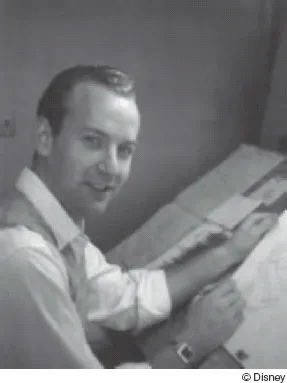
ARTIST AT WORK
“Reverend Jack” Foster was a member of the clergy before coming to Disney.
“Reverend Jack” Foster was a member of the clergy before coming to Disney.
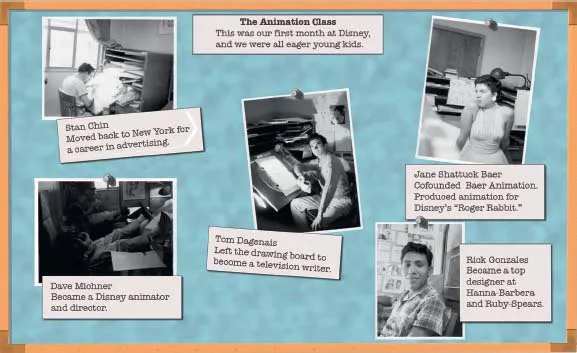
THE CLASS OF 1956
After a month of training, we were put to work on production, and most of us remained in the business for the rest of our careers.
After a month of training, we were put to work on production, and most of us remained in the business for the rest of our careers.
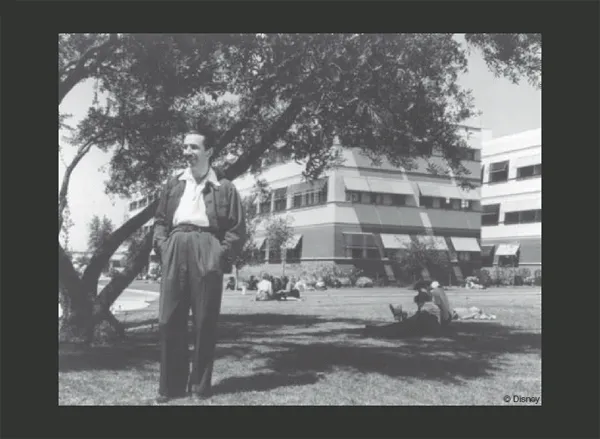
The Disney Bullpen | 2 |
The Walt Disney Studios
The animation students move into production.
Basic Training
If you were a young animation artist and had just scored your first ...
Table of contents
- Front Cover
- Title Page
- Copyright
- Acknowledgments
- Contents
- Intoduction
- PART 1 INSIDE THE MAGIC FACTORY
- PART 2 TIPS, TECHNIQUES, AND ANIMATED OBSERVATIONS
- WORKBOOK PAGES
- Index
Trusted by 375,005 students
Access to over 1.5 million titles for a fair monthly price.
Study more efficiently using our study tools.
Frequently asked questions
Yes, you can cancel anytime from the Subscription tab in your account settings on the Perlego website. Your subscription will stay active until the end of your current billing period. Learn how to cancel your subscription
No, books cannot be downloaded as external files, such as PDFs, for use outside of Perlego. However, you can download books within the Perlego app for offline reading on mobile or tablet. Learn how to download books offline
Perlego offers two plans: Essential and Complete
- Essential is ideal for learners and professionals who enjoy exploring a wide range of subjects. Access the Essential Library with 800,000+ trusted titles and best-sellers across business, personal growth, and the humanities. Includes unlimited reading time and Standard Read Aloud voice.
- Complete: Perfect for advanced learners and researchers needing full, unrestricted access. Unlock 1.5M+ books across hundreds of subjects, including academic and specialized titles. The Complete Plan also includes advanced features like Premium Read Aloud and Research Assistant.
We are an online textbook subscription service, where you can get access to an entire online library for less than the price of a single book per month. With over 1.5 million books across 990+ topics, we’ve got you covered! Learn about our mission
Look out for the read-aloud symbol on your next book to see if you can listen to it. The read-aloud tool reads text aloud for you, highlighting the text as it is being read. You can pause it, speed it up and slow it down. Learn more about Read Aloud
Yes! You can use the Perlego app on both iOS and Android devices to read anytime, anywhere — even offline. Perfect for commutes or when you’re on the go.
Please note we cannot support devices running on iOS 13 and Android 7 or earlier. Learn more about using the app
Please note we cannot support devices running on iOS 13 and Android 7 or earlier. Learn more about using the app
Yes, you can access Animated Life by Floyd Norman in PDF and/or ePUB format, as well as other popular books in Media & Performing Arts & Programming Games. We have over 1.5 million books available in our catalogue for you to explore.