This exciting collection opens up many new conversations on BodyPlace and introduces new theories of embodied places and the placing of bodies.
Extensive introductory and concluding sections guide students through the key debates and themes. Places Through the Body draws on a wide range of contemporary examples and creative ideas to address such topics as:
* How racist ideologies are embedded in modern architechtural discourse and practice
* How urban spaces make bodies disabled
* How the seemingly virtual worlds of knowledge and technology are embodied
* How gyms enable women body builders to make new kinds of bodies
* How male bodies are placed onto the silver screen
* New kinds of femininity
Here geographers, architects, anthropologists, artists, film theorists, theorists of cultural studies and psycho-analysis work alongside each other to make clear connections between bodies and places.
- 448 pages
- English
- ePUB (mobile friendly)
- Available on iOS & Android
eBook - ePub
Places Through the Body
About this book
1
INTRODUCTION
MakingPlacesBodies
Heidi J.Nast and Steve Pile
Very few things are universal. Bumper stickers across the United States of America proclaim only taxes and death. Of course, many escape taxes, but no-one sadly has eluded death (to our knowledge!). On the brighter side: death presumes life. And, since we are alive, we must have bodies. And, since we have bodies, we must be some place. Here we are then. Before this book has even started, it seems that it is over—we all have bodies and we are all some place. But let us not be so hasty, so quick to assume that this just about covers the story of bodies and places. We might also take a little time to wonder about the stories that we have failed to tell. Sure, we all have bodies, but the idea that we have bodies—that bodies are a possession that the individual has—is culturally, historically and geographically specific. Further, the impression that the individual is located in a body and that being in a body is also about being in a place warrants further scrutiny. It turns out that our universals—the body, the body in place, being in place—are actually unique, specific, singular. Paradoxically, then, at the same time that we all have bodies, none of us has the same body as anyone else; conversely, at the same time as we live in a particular place, no place is completely isolated from everywhere else (even Robinson Crusoe’s island was connected to other parts of the world— just not very often!).
Our bodies are unique, yet everyone else has a body too. If our bodies and places are unique, then this implies that only we can experience the world in the way we do—but, since other people have bodies and can live in the same places, our experiences cannot after all be unique. The argument is moving in circles. Both bodies and places need to be freed from the logic that says that they are either universal or unique. Instead, it would be better to think of the ways in which bodies and places are understood, how they are made and how they are interrelated, one to the other—because this is how we live our lives—through places, through the body.
There is an urgent need to look at the relationship between bodies and places, not because of an academic requirement to sort out paradoxes, but because the ways in which we live out body/place relationships are political. In her thought-provoking article, “Notes towards a Politics of Location” (1984), Adrienne Rich begins to doubt Virginia Woolf’s claim that women have no country and that women’s country is the whole world. Instead of “globalizing” the experience of “woman,” Rich argues that she does have a country and that, much as she might wish it otherwise, she cannot simply divest herself of her geographical location. If an appropriate feminist politics is to be devised, Rich says, “I need to understand how a place on the map is also a place in history within which as a woman, a Jew, a lesbian, a feminist I am created and trying to create” (1984:212).
She urges that an analysis of these intersections of gender, race, sexuality and politics in place begins with an analysis of “the geography closest in—the body. Here at least,” she continues, “I exist” (1984:212). Of course, there have been many studies of the body in a wide range of disciplines,1 and geographers themselves have sought to incorporate the body into their studies of lived place and spatial relationships.2 Nevertheless, cultural geographers have recently been intrigued by the idea of the geography closest in. For Rose, Rich’s arguments suggest that the female body is a site of struggle. Rich’s cartography of the female body maps out a particular political terrain:
The politics of pregnability and motherhood. The politics of orgasm. The politics of rape and incest, of abortion, birth control, forcible sterilization. Of prostitution and marital sex. Of what had been named sexual liberation. Of prescriptive heterosexuality. Of lesbian existence.
(Rich 1984:212–13; see also Rose 1993:29)
For Rose, the body is placed “geopolitically”: its location is marked by its position with specific historical and geographical circumstances. It matters, to Rich, that she is a citizen of the United States of America. At the time of writing, she was arguing that the Cold War was reaching new heights, as American foreign (and domestic) politics was dominated by the fear of a communist take-over, prompting insidious interventions in central America and beyond. Meanwhile, black politics at home made Rich acutely aware of her whiteness, while in Nazi Germany she would not have been white enough. For Rich, it is not enough to assert some kind of universal feminist struggle, but to recognize the specificities of women’s struggles in their situatedness, their location in history, on the map.
For Soja, Rich’s recognition of the “geopolitics of the body” suggests a spatial hierarchy of scales of oppression, from the body outwards, to the global (1996:36). However, Kirby has argued that Rich moves “fluidly through a number of spatial registers” (1996:19). For Kirby, Rich’s project is to identify the connecting points between the individual and place. These connecting points are variable, for the individual occupies, not one, but many positions.
“This body. White female; or female, white” (Rich 1984:215). The distinction may seem trivial, but Rich talks about the ways in which white and black babies were separated into separate wards in the hospital where she was born. In the first instance, she was marked by skin colour, by blood. She was white and female: children marked by race and sex.
To locate myself in my body means more than understanding what it has meant to me to have a vulva and clitoris and uterus and breasts. It mean recognizing this white skin, the places it has taken me, the places it has not let me go.
(Rich 1984:215–16)
The body is both mobile and channeled, both fluid and fixed, into places. It is not only the “geopolitics of the body” but also the politics of connection and disconnection, of rights over the body, of the body as a site of struggle. Rich maps out her connections to the world, maps out its territories, and shows where she is within these connections and territories. This cartography of places through her body reveals that ways in which she is positioned through her body, but also how her body becomes capable of imagining these connections and territories differently. Thus, Rich moves fluidly through spatial registers because her mappings of connections, of territories, subvert commonplace understandings of places as bounded, sealed areas. She shows that these spatial registers—these geopolitics of the body—are produced through unequal power relations, between men and women, between blacks and whites, between heterosexuals and homosexuals, between one nation and another. Beginning her analysis with the body allows her to map her place, to map out a history of spatial registers: points, connections, dislocations, boundaries, territories, countries, regions, power blocs. Her aim: to bring politics down to earth, to create a ground for struggle (1984: 218–19).
The meaty body is where Rich wishes to ground politics. However, it remains an uncomfortable place. Rich’s geography closest in is meant to stretch out to incorporate others in struggle and, because the geography of the body is closest in, it is also the ground on which to fight for women’s rights. In this, Rich herself marks the body through exactly the same power relations she is hoping to overthrow: she is “woman,” “Jew,” “lesbian”—there are not many other places to be. Rich’s use of fluid spatial registers suggest other ways of thinking places and bodies. The body is not simply the bearer of some pre-given cultural categories. For Grosz, “the body cannot be understood as a neutral screen, a biological tabula rasa onto which masculine and feminine could be indifferently projected” (1994:18).
Rich argues that her white skin has taken her places and stopped her going to other places, but Grosz would also insist that the privileging of skin or of whiteness or of white skin is a particular relationship, interlocked with other hierarchical forms of power, that make the body in other ways. For Grosz, the body also exists beyond social relations and the categories that social relations impose on the body. While medical science has been dominated, since the end of the eighteenth century, by the idea that the sexes are opposite (see Laqueur 1990), Grosz wishes to argue that bodies are unstable and indeterminate. Such medical knowledge might have permitted the better treatment of diseases specific to women, but it has also perpetuated a particular kind of understanding of the relationship between men and women: they are opposite, opposed. Yet men and women have more in common with each other than with any other “thing”. For Grosz, this suggests an alternative understanding of embodied difference: rather than being opposites, people might instead be “neighbors”. Not one sex, nor opposite sex, but neighborhood sex: a thousand sexes, a conurbation of sexes.
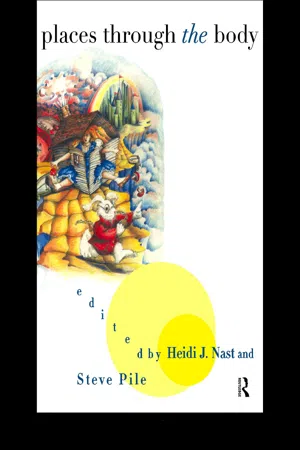
From this perspective, sex, gender, race, skin, blood are indeterminate and unstable signifiers of the differences and similarities between bodies. This understanding provokes questions, not about the real make-up of bodies, but about how bodies are really made-up. More and more, it seems as if the relationship between bodies and places is like not only Alice’s journey through Wonderland3 but also Dorothy’s trip down the yellow brick road to the Wizard of Oz (see also Cindy Davies’s discussion of the cover illustrations, pp. xvii–xviii of this volume). Alice’s body was never stable enough to qualify as being that of a little girl: she shrunk, grew, was in place and out of place. Alice, in Wonderland, never quite fitted in. Though she tried to understand, her bodies and their places never stabilized long enough to make any real sense, though sense there was of a kind. Dorothy was transported in a whirl-wind of dreams to a strange land where she never follows its strange logic, partly maybe because all the male characters appeared to be missing something vital. As she crossed from one place to another, Dorothy refigured and unmasked the charade of bodies. Eventually she gets to her goal, but even the Wizard turns out to be a sham; seemingly all powerful, but only while he was hidden. Alice and Dorothy, hand in hand, point to the fragile illusions through which the endurances and solidities of bodies and places are built.
Bit by bit, bodies become relational, territorialized in specific ways. Indeed, places themselves might be said to be exactly the same: they, too, are made-up out of relationships between, within and beyond them; territorialized through scales, borders, geography, geopolitics. Bodies and places, then, are made-up through the production of their spatial registers, through relations of power. Bodies and places are woven together through intricate webs of social and spatial relations that are made by, and make, embodied subjects. It is these intricate webs that this book is concerned to trace out.
While scholarly work frequently notes body-space associations, nowhere have these associations been systematically teased out or explicitly thought through across a number of social, spatial and cultural fields. Nor have the motivation and potentialities for thinking of bodily-spatial displacements been theorized or explored in any cross-disciplinary detail. What is being suggested here is that it is not enough simply to treat the body-place relationship as if it was either universal (non-specific) or unique (too specific). Instead, the particular ways in which spatial relationships come together to make bodies and places, through the body and through places, needs to be exemplified, demonstrated and clarified, in places, through the body. Thus, this collection privileges the embedded social practices that are constitutive of particular bodies and places; places-bodies as seemingly wide apart as those of capitalism, cities, museums, gymnasiums and harems. Body-place relationships are thus not only delivered from the fixed coordinates of social relationships and their constitutive spatial registers to places through the body (as they are produced, inspired, dreamed, born, borne); but they are also released from static, reified notions of bodies to bodies that make, and are made through, the practices and geography of places.
Though this collection privileges the relationship between bodies and places, this does not result in either becoming some arbitrary fixed point or point of departure for analysis. Instead, the contributors to the book come from a wide range of disciplinary backgrounds—revealing their particular takes on bodies and places. Accordingly, the collection speaks of “places through the body” in differently disciplined ways, allowing their styles and contents to be voiced one with another. These differences of style and content allow for a creative interplay across the book as a whole. However, it presents readers—and editors!—with some challenges: one of which is how to read the diverse contributions. To help “place” the chapters, we outline the thinking behind the “running order” of the book below. But we do this, not as a “final script” nor to prevent other readings, but just to situate our take on the chapters and on how we envisage the themes running through them.
In the end, we had to settle on a sequence of chapters in the book—but we hope this does not seem too final, too closed, for this would be to make-up the body, once again, into something too set, too fixed, too material. In this respect, we have tried to leave room for thoughts which might be a little surprising, ideas that are not immediately obvious, because we hope that one “message” of the book will be that bodies and places remain as indeterminate and unstable as they are distinct and enduring; open to analysis, but always beyond the limits of categories or orders to finally seal them up and close them down, like bodies in body bags, or places conquered by the Empire of Reason.

Part 1 deals with FilteringPlacesBodies. It shows how discursive practices, materiality (what is considered to be “material”) and spatiality (the spatial organization/relationality of the social world) collectively and mutually, figuratively and practically, filter through one another. Filtering, for us, evokes thoughts about keeping out, keeping back, defensiveness, interchanges, flows between, across, over, through places, through the body. However, the theme also inspires images of cleansing, contaminating, fertilizing, washing bodies and places. So, in this part of the book, chapters give clues as to how flows filter through places through bodies (and back again).
Drawing upon some of the metaphors of filtering and fluidity, then, Gibson-Graham (Chapter 2) reveal how the images and practices of heterosexuality filter through normative scriptings of capitalism. “Capital”, for example, is proto-typically cast as a perfect phallic hardness able to penetrate foreign and/or virgin markets at will. They go on to present an ...
Table of contents
- Cover Page
- Title Page
- Copyright Page
- Figures
- Contributors
- Acknowledgments
- The Cover Illustrations: A Word from the Artist
- 1. Introduction: Making Places Bodies
- 1. Filtering Places Bodies
- 2. Confining Places Bodies
- 3. Excessing Places Bodies
- 4. Projecting Places Bodies
- Conclusion
Trusted by 375,005 students
Access to over 1.5 million titles for a fair monthly price.
Study more efficiently using our study tools.
Frequently asked questions
Yes, you can cancel anytime from the Subscription tab in your account settings on the Perlego website. Your subscription will stay active until the end of your current billing period. Learn how to cancel your subscription
No, books cannot be downloaded as external files, such as PDFs, for use outside of Perlego. However, you can download books within the Perlego app for offline reading on mobile or tablet. Learn how to download books offline
Perlego offers two plans: Essential and Complete
- Essential is ideal for learners and professionals who enjoy exploring a wide range of subjects. Access the Essential Library with 800,000+ trusted titles and best-sellers across business, personal growth, and the humanities. Includes unlimited reading time and Standard Read Aloud voice.
- Complete: Perfect for advanced learners and researchers needing full, unrestricted access. Unlock 1.5M+ books across hundreds of subjects, including academic and specialized titles. The Complete Plan also includes advanced features like Premium Read Aloud and Research Assistant.
We are an online textbook subscription service, where you can get access to an entire online library for less than the price of a single book per month. With over 1.5 million books across 990+ topics, we’ve got you covered! Learn about our mission
Look out for the read-aloud symbol on your next book to see if you can listen to it. The read-aloud tool reads text aloud for you, highlighting the text as it is being read. You can pause it, speed it up and slow it down. Learn more about Read Aloud
Yes! You can use the Perlego app on both iOS and Android devices to read anytime, anywhere — even offline. Perfect for commutes or when you’re on the go.
Please note we cannot support devices running on iOS 13 and Android 7 or earlier. Learn more about using the app
Please note we cannot support devices running on iOS 13 and Android 7 or earlier. Learn more about using the app
Yes, you can access Places Through the Body by Heidi Nast,Steve Pile in PDF and/or ePUB format, as well as other popular books in Social Sciences & Geography. We have over 1.5 million books available in our catalogue for you to explore.