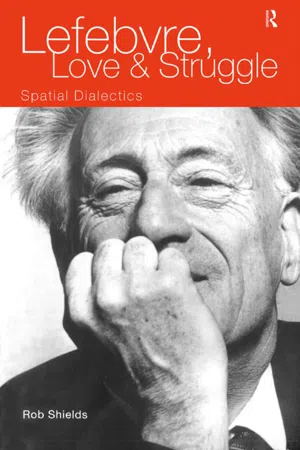
Lefebvre, Love and Struggle provides the only comprehensive guide to Lefebvre's work. It is an accessible introduction to one of the most significant European thinkers of the twentieth century.
Rob Shields draws on the full range of Lefebvres writings, including many previously untranslated and unpublished works and correspondence. Topics covered include Lefebvre's early relationship with Marxism, his critique of the rise of fascism, as well as his Critique of Everyday Life and the significant work on urban space for which he is best known today.
- 240 pages
- English
- ePUB (mobile friendly)
- Available on iOS & Android
eBook - ePub
About this book
Trusted by 375,005 students
Access to over 1.5 million titles for a fair monthly price.
Study more efficiently using our study tools.
Information
Topic
PhilosophySubtopic
Human Geography1
LEFEBVRE’S SIGNIFICANCE
I frankly confess, this communism so contrary to my interests and my inclinations, exercises a charm on my soul which I cannot resist….
After Heine’s Lutece
(1976:IX, 224 cited in Lefebvre 1995:34 [1962i:40])
This is a book about the ideas and intellectual practice of Henri Lefebvre. It is not a biography, but introducing both the man and the historical context of his life is important. Lefebvre would probably insist on the centrality of everyday life. His interest in the politics of the banal, and his opposition to the idea that politics should be an elitist activity, carried forward by a party vanguard, means that his own daily life, his politics, and his writing and teaching are all bound up with each other. Events, as Lefebvre once suggested, overturn theories and cause us to rethink our ideas.
Henri Lefebvre is significant as an involved participant at the centre of nearly a century of social, economic and intellectual change in Western Europe. The greatest problem in understanding his work is that his theories on particular subjects have often been studied without reference to his other works. Notably in English, there are many, many ‘Lefebvres’; each is a partial understanding. If he is a Marxist—and there is no doubt about that—he began as a Surrealist, even a Dadaist.1 His experience with artistic avant-gardes seeking a revolution through art, not politics, influenced him for the rest of his life. They gave his Marxism some unexpected twists, such as its intense focus on alienation and opposition to economism. He is never ‘just’ a Marxist or just an Existentialist or a Nietzschean. He is always more, and this surplus or excess has contributed to the difficulty of coming to terms with his work.
We can easily divide Lefebvre’s work into periods and map out zones in his wide-ranging intellectual geography. There is an abiding interest in emancipation and the condition of the human. If early on his interest is focused on the self-liberation of the individual, this later shifts to his commitment to Communism and socialist forms of autonomous management. He develops an interest first in his mother’s birthplace in the Pyrenees. From this ‘motherland’ he moves to a focus on the rural and peasant life, later to become best-known for his work on urban space. This led to him being cast as a geographer, but his fascination with linguistic systems and the ideological elements of cultural semiotics belies such a simple categorisation. Over a long life, he wrote prolifically on French figures, ranging from Descartes to the Romantics. And for a long time he occupied a position, stage centre, as ‘the Father of Dialectical Materialism’, his concise books on logic being translated into enough languages to make him the most translated French writer of his time.
These sprawling interests present an intellectual terrain in which different areas are actually interlinked, fed from the same springs of inspiration and tied together into life-projects that, once unearthed, are as indivisible watersheds. This geography also has its sweet plains and rough crags. In a long life, ’s interests and activities embraced the street marches of the late 1960s and the near revolution of May 1968 as well as the philosophical life of a scholar and the politics of French intellectuals. My intention is to take a holistic approach, surveying both the overall extent and the regional differences of this landscape, made up of Lefebvre’s sixty-plus books and more than three hundred articles.
What unites all of his work—from his first to most mature works—is his deeply humanistic interest in alienation. Humanism transcends even his commitment to a long-lost love: the Communist Party, from which he was expelled. This, he argues, is the key motivation for Marx and for social change anywhere. It is not technological progress, the absence of war, or ease of life, or even length of life, but the chance for a fully lived life that is the measure of a civilisation. The quality of any society lies in the opportunity for the unalienated and authentic life experience that it gives all its members. Grounded in anything else, democracy falls short of what it could be. In cultural terms, this quality supersedes historically imposed measures of beauty or elegance. In political and economic terms, it is an index of liberty.
A second unifying theme is his methodological understanding of the work of Marx and Engels. They applied dialectical materialism to economics, he argues, and would have gone on to other areas of life, as Engels did in his study of the family after Marx’s death. There are no ‘red lights’ in Marx that prevent us going on to apply dialectical materialism as a rigorous method for revealing the mechanisms of everyday life, our understanding of the environment, passions such as nationalism and even love. Marx’s work is merely exemplary. Lefebvre applied dialectical theory to Marxism, arguing that dialectical method is the standard of orthodoxy. It is because of dialectical materialism that ‘Marxism develops itself’ (1934b:29–30). If frozen into a dogma, however, Marxism quickly becomes an empty set of pieties.
This chapter asks ‘Why should we be interested in Lefebvre’s ideas?’ What is his place in the larger politico-intellectual landscape of the twentieth century? I refuse to place Lefebvre’s badly flawed character on a pedestal, but later we will outline his biography and sketch his involvement in some of the most important European avant-garde movements this century: Surrealism, Marxist theory, the Communist Party, Existentialism, the student revolts of the 1960s, and the development of research on the city, on social space and on globalisation, which laid the ground for postmodern theory. These passions will be examined in separate chapters.
Lefebvre’s status
The range of Lefebvre’s activities and contributions makes him a difficult figure to evaluate. He has been, and is, read in often contradictory ways. How then can we evaluate his intellectual contributions and his current status? His works are still often quoted. There is a curiosity about his complex position, and a thirst for both more clarity about what is known and about the vast bulk of Lefebvre’s work, which is largely unread, unremarked upon and untranslated. Many have discovered that his position on the edge of orthodox Marxism has both a coherence and an enduring message. Its unorthodoxy lies in the absence of economic reductionism and dogmatism. For Lefebvre, the work of Marx and other radical thinkers continued to open up possibilities and provoke. This is in sharp contrast to the tendency of these works to be taught and imposed as stultifying rule-books. If we find a lively and ongoing engagement with Marx, Hegel—and equally with German philosophers of the early and late nineteenth century such as Schelling and Nietzsche, respectively, as well as an international cast of twentieth-century cultural theorists, including Bakhtin and Lacan—this pleasant surprise is followed by the enduring coherence of his focus on the saddest aspects of modernity: its alienated, dehumanising traits, which are then translated, as the young Marx showed, into economic exploitation and oppression. After the dogma, the collapse of Party programmes into the infighting of Party nomenclatura, Lefebvre’s brand of Marxism continues to speak to and offer something for the dispossessed. In this sense, he has more in common with the Latin American Left than with Eurocommunists. In assessing Lefebvre’s current importance, it is therefore a set of contrasts with the established Party doctrines of the Left and his long-standing criticism of Structuralism and economism that distinguishes him. This will be the source of both his strengths and weaknesses vis-à-vis better known Marxisms and post- Structuralisms of the latter-day Left.
A second element of importance is the length of Lefebvre’s intellectual and activist career in and around Paris—stretching from the mid-1920s to the end of the 1980s. This spans a sequence of key artistic and philosophical currents centred in Paris, beginning with the artistic avant-garde of Surrealists and Dadaists to the philosophical interventions in everyday life made by Existentialists; it includes the politics of French Marxism, and the activism of the Situationists, the student movements of the 1960s and the independent Left such as Action Directe in the 1970s. Was he an inconsequential spectator or an important contributor? A ‘Zelig’ or a Leonardo?2 I will argue that Lefebvre was an important ‘conducting wire’ of motivating ideas and sentiments from group to group and generation to generation. His limits are revealed by the lack of a clear position on feminism and immigration into France. However, he is cited by feminists, ranging from Donna Haraway (1991) to bell hooks (1990), not to mention Latin American and African Marxists. Lefebvre is important as a common reference shared across Romantic movements for self-transcendence through art and poetry, armed struggles for liberation and new social movements for justice. No greater claim can be made for any progressive intellectual. From his central location in Paris, Lefebvre was in contact with three, even four, generations of European scholars and political activists. Even at the end of his life, despite a general crisis in Marxism,
At least one exception, of signal honour, stands out against the general shift of positions in these years. The oldest living survivor of the Western Marxist tradition…Henri Lefebvre, neither bent nor turned in his eighth decade, continuing to produce imperturbable and original work on subjects typically ignored by much of the Left.
(Anderson 1983:30)
More than an eye-witness of events, Lefebvre was involved at the grassroots level of political debate and social change. He was a key figure in the Communist Party’s intellectual circles. For a time a taxi driver, he was active in the Resistance. He is perhaps most notoriously associated with his students— including Daniel Cohn-Bendit, who led the ‘Festival’ of May 1968. Outside, and sometimes excluded from, a position in the more comfortable university faculties in Paris, Lefebvre was in direct contact with many regional social movements and various so-called extremists. He conducted years of research in industrial settings, on many factory floors, and in union halls and meeting rooms. He was a key adviser to East European leaders and even, some have claimed, a one-time tutor of Prince Charles. If he tried to explain the student protests of 1968 to the prince, Henri Lefebvre also inspired the 1980s politics of Class War punk activists in the UK, and the Green Party in Germany.
Not only was he long-lived, but he was broadly involved across several disciplines, and as mentioned above, not only in university life but also in activism, party politics and writing for the general public. In academic terms alone, he was closely involved in the development of dialectical logic and methods, in rural sociology, in the study of globalisation (le planétaire) and in the cultural sociology of everyday life, while dabbling in the sociology of literature and intellectual history. He was a key figure in the institutionalisation of urban studies and of applied sociology, directing the first Institute of Sociology, and the influential Institut de Sociologie Urbaine in Paris. He brought Marxism into the university curriculum, as the first to lecture on the topic at the Sorbonne and later as the first Professor of Sociology at the University of Nanterre, in the suburbs of Paris. Such ‘firsts’ and his institutional appointments suggest achievements.
The chapters that follow will examine these achievements for their contemporary importance, but we can briefly signal some elements immediately. In bringing French sociology into a closer relationship with ongoing struggles at the middle-range and micro-levels, Lefebvre helped to encourage not only an ‘applied’ sociology but also an engaged social science. Rather than simply passing comment, or serving as the national conscience, as French intellectuals do, Lefebvre took seriously the political nature of everyday life and developed social science contributions to the uncovering of inequalities, the monitoring of abuse and the resolution of conflicts—notably in cooperation with the union movement. He is, however, much better known for his theorisation of the importance of the spatial character of social life, setting his social concerns into the embodied, three-dimensional world rather than simply in words and pages of debate. Lefebvre’s study of The Production of Space (1991d) illustrates his ability to synthesise different disciplines and approaches. Drawing on his philosophical position, he applied dialectical materialism to the amorphous case of body space and geographic territoriality. But at the same time he took seriously his social and political commitments. Rather than simply discussing the philosophical status of space—‘how many dimensions exist’, or ‘is space a “thing” or “void between things”?’—Lefebvre investigates social attitudes towards space, all the while not neglecting to emphasise the integral importance of physical dimensions and spatial categories such as boundaries and regions in everyday life. The project took several tries—books on the city, on the relation between urban and rural areas and finally on ‘social space’ as a whole. The end result is a lengthy book that presents a history of different philosophical understandings of space and ties each one to a set of practices. Each philosophy is embodied and concretised in everyday routines and modifications to the built environment and landscape. More importantly, this socially constructed ‘second nature’ is chock full of morally coded sites and political regulations concretised in the environment. Philosophical understandings of space have political implications. These syntheses are totalising theories: even while the history of social productions of space rolls on, Lefebvre takes a stab at all aspects of the phenomenon in an attempt to explain all and to make his theory impregnable to criticism (see Chapter 8). Even artists, such as the Surrealists, who shock and surprise are shown to draw their power from upsetting everyday spatial codes and expectations.
The response by critics and disciples alike has been to try to cut Lefebvre down to size. By attempting to fit his work back into the narrower ontological terrains of their disciplines and the reigning epistemologies and methodologies of the day, Lefebvre has been drawn upon on a piecemeal basis. In English, this has been exacerbated by the unavailability of translations of Lefebvre’s most important theoretical works. In the chapters that follow, it will be shown that his applied work appears nonsensical if these theoretical works are not read. To continue the example of social space, while the concluding text The Production of Space was translated, and his small textbook on Dialectical Materialism is available in second-hand stores, few of his political economic works and none of his contributions to Nietzsche scholarship have been translated—including the first anti-Fascist appreciation of Nietzsche (1939a) and his synthesis, Hegel Marx Nietzsche ou le Royaume des Ombres (1975a). His very last book on space-time, Rythmanalyse (1992a; see also 1985a), is also unavailable (but see the translation of an anticipatory essay by Régulier and Lefebvre (1986a) in Kofman and Lebas’ edited collection of his Writings on Cities (Lefebvre et al. 1996). Englishlanguage translators and scholars make glaring errors in their reception of Lefebvre. Misunderstandings of Lefebvre are rife in Anglophone geography (for example, Curry 1996:179; see Chapter 8), while Lefebvre has been ignored in political economy (for example, Jessop 1991; Clement 1986) and features as only an intriguing source in cultural studies however brilliantly quoted (for example, Ross 1995; hooks 1990). By contrast, my approach will be to attempt to present the breadth of Lefebvre’s work across disciplines and approaches. Rather than emphasising this lack of fit, however, I wish to highlight the integral character of his approach. It is not an eclecticism.
Dialectical materialism is at the core of Lefebvre’s project. All of his writing since the late 1920s are dialectical and cannot be understood otherwise. Even his style is based on the Socratic question-and-answer method of dialectics. This also reflects the manner in which he produced his texts, which were mostly dictated. His writing practice is anchored in the duality of his voice and the activity of his typists. Dictating all of his most important books and articles ‘live’ while his female companions typed, a conversation is implicit in the rambling quality of his works. If they are hard to read or analyse, this is because they are cut up by rhetorical questions and because they consist of dictated material, and discussions that were the unacknowledged contributions of those typists, which filled in a lengthy outline of key points that Lefebvre wrote up ahead of time (sometimes this is evident, for example in explicitly numbered sections and paragraphs).
Lefebvre’s life history reveals him to be a hybrid, and ironically his focus on the dialectic was quite appropriate to the synthetic nature of his character. The following section outlines his life from post-First World War student through Surrealism to joining the Communist Party in 1928 and his battles against the party hierarchy to become the leading left-wing intellectual in France until he quitted the party in 1957 in disgust at its bureaucratic restrictions—a move that propelled him into the centre of the new 1960s student countercultures and allowed him to play a radical role in arguing for new understandings of the city, the state and globalisation in the 1970s and 1980s.
Following chapters examine in detail specific themes. Chapter 3 focuses on his early work and develops his pro to-Existentialist ideas. Chapter 4 outlines his interest in alienation, spontaneity and what he called unalienated ‘moments of presence’. Chapter 5 examines critically his idea of ‘everyday life’. Chapter 6 explores his importance as ‘father of the dialectic’ and his criticisms of Structuralism. Chapter 7 examines his links with Sartre and their joint development of key Existentialist concepts and methods. Chapter 8 explores his revolutionary theory of social space. In addition, his position on key debates and the judgements that other important writers have made about Lefebvre’s own arguments will be surveyed. In this manner, his more than sixty books and 300- plus articles will be drawn together. Great attention has been paid to crossreferencing and the reader is encouraged to examine the index and comprehensive bibliography of Lefebvre’s works and the translations of his writings. More important than the mass of detail, however, is that Lefebvre personifies the twentieth-century search for freedom, the demand for grassroots democracy, identity, self-fulfilment and happiness. His untraditional life reflects the disorder of the century, with its wars, decolonisation, rise of multinational capital, oil embargoes, the Cold War, and the rise of mass media. He is perhaps the only Communist—certainly the only political economist—to have dared assert that all he had ever written about was love (Hess 1988:26–30).
______________________
1 While a student, Lefebvre associated with members of both avant-garde movements, writing commentaries on their work and attempting to draw philosophica...
Table of contents
- Cover Page
- Title Page
- Copyright Page
- Preface and Acknowledgements
- 1: Lefebvre’s Significance
- 2: Adventure, Art and Wars 1905–45
- 3: Foundation Works: Philosophies, Hegel, Surrealism
- 4: False Authenticity: The Roots of Fascism
- 5: Moments of Presence
- 6: The Critique of Everyday Life: Marx and Nietzsche
- 7: Postwar Intellectual
- 8: Father of the Dialectic and Critic of Structuralism
- 9: Existential Marxism: Sartre
- 10: The Production of Space
- 11: Conclusion
- Bibliography of Henri Lefebvre’s Works
- Secondary Sources
Frequently asked questions
Yes, you can cancel anytime from the Subscription tab in your account settings on the Perlego website. Your subscription will stay active until the end of your current billing period. Learn how to cancel your subscription
No, books cannot be downloaded as external files, such as PDFs, for use outside of Perlego. However, you can download books within the Perlego app for offline reading on mobile or tablet. Learn how to download books offline
Perlego offers two plans: Essential and Complete
- Essential is ideal for learners and professionals who enjoy exploring a wide range of subjects. Access the Essential Library with 800,000+ trusted titles and best-sellers across business, personal growth, and the humanities. Includes unlimited reading time and Standard Read Aloud voice.
- Complete: Perfect for advanced learners and researchers needing full, unrestricted access. Unlock 1.5M+ books across hundreds of subjects, including academic and specialized titles. The Complete Plan also includes advanced features like Premium Read Aloud and Research Assistant.
We are an online textbook subscription service, where you can get access to an entire online library for less than the price of a single book per month. With over 1.5 million books across 990+ topics, we’ve got you covered! Learn about our mission
Look out for the read-aloud symbol on your next book to see if you can listen to it. The read-aloud tool reads text aloud for you, highlighting the text as it is being read. You can pause it, speed it up and slow it down. Learn more about Read Aloud
Yes! You can use the Perlego app on both iOS and Android devices to read anytime, anywhere — even offline. Perfect for commutes or when you’re on the go.
Please note we cannot support devices running on iOS 13 and Android 7 or earlier. Learn more about using the app
Please note we cannot support devices running on iOS 13 and Android 7 or earlier. Learn more about using the app
Yes, you can access Lefebvre, Love and Struggle by Rob Shields in PDF and/or ePUB format, as well as other popular books in Philosophy & Human Geography. We have over 1.5 million books available in our catalogue for you to explore.