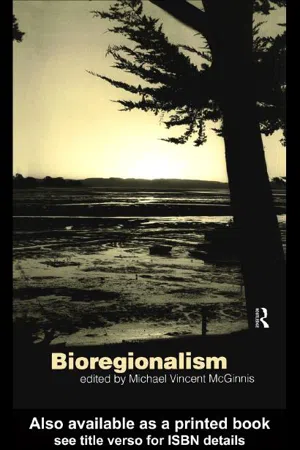
Bioregionalism is the first book to explain the theoretical and practical dimensions of bioregionalism from an interdisciplinary standpoint, focusing on the place of bioregional identity within global politics. Leading contributors from a broad range of disciplines introduce this exciting new concept as a framework for thinking about indigenous peoples, local knowledge, globalization, science, global environmental issues, modern society, conservation, history, education and restoration. Bioregionalism's emphasis on place and community radically changes the way we confront human and ecological issues.
- 256 pages
- English
- ePUB (mobile friendly)
- Available on iOS & Android
eBook - ePub
Bioregionalism
About this book
Information
1A rehearsal to bioregionalism
Michael Vincent McGinnis
Home is the region of nearness within which our relationship to nature is characterized by sparing and preserving…. Human homecoming is a matter oflearning to dwell intimately with that which resists our attempts to control,shape, manipulate and exploit.
(Grange 1977:136)
The sea anemone flows with the rhythm of the ocean’s currents; its colored and sensitive sepals feel the plentiful sea for food. Human beings are also connected to the ebb and flow of a living earth; the sensual fibers of an animate world tug and pull to connect culture with the land. When we listen to the landscape, we can fall back to our primitive roots—we can smell and taste the flesh of the land.
In my coastal bioregion, a wealth of images, sensations and feelings are produced by the intermingling of the sea, maritime community and landscape. A mosaic of habitats support a number of creatures that interact to form my community and place: bishop pine forest and tan bark oak forest; coast live oak and riparian woodlands; chaparral-coastal sage, purple sage and coastal dune scrub; coastal strand with freshwater or salt marsh; vernal pools and seasonal wetlands; and blowing grasslands on coastal bluffs with rocky headlands. Shells from nearby shores and roaming fog are part-time residents. These sights, sounds, feelings and tastes are part of my sensual memory of place.
A healthy relationship with place is reflected in the languages spoken, the dances and rituals of culture. Where I live, Chumash ceremonial dances such as the Swordfish Dance, the Fox Dance, the Barracuda Dance and the Seaweed Dance were propitiated by offerings of beads and other gifts. Each ceremonial dance was founded upon “direct observation” of the relationship and partnership that existed between culture and nature. Each dance represented a culture’s knowledge of place. The tastes of the tribal meal were believed to be born from the splendid place inhabited by the people. These tastes of place were celebrated in ritual and dance. The several languages spoken by the Chumash mirrored the ecologically and culturally diverse system. One language spoken, Limuw, means “in the sea is the meaning of the language spoken.” Tribal villages were named after special places, such as Mikiw or “the place of mussels.” The Chumash languages exemplified a healthy maritime partnership with the landscape.
An array of human partnerships with the landscape and place are described by Paul Shepard (1996), who spent a lifetime documenting the unfolding relationships that exist between a culture, particular places and animals. “Being human,” according to Shepard, “has always meant perceiving ourselves in a circle of animals” (Shepard 1996:13). Animals have shaped human language, folklore, fairy tales, games, poetry, art, ritual, literature, myth, dancing, singing, music and religious imagery. Animals play key roles, perhaps as a totem or emblem of a family or clan, in linking humanity to place. “Inside a circle” of animals and plants, human beings are joined by a multitude of fibers that connect them to a place. Human culture is a result of this system of primordial connections with others (both plants and animals, living and nonliving).
In global economy, the cultural significance of one’s place and earthly home are in jeopardy. Below the black-and-white graphic image of pangea (a period of earth’s history when the continents were closer together) the full-page advertisement in the New York Times read, “Can you see the trillion dollar market?” The ad represents an economically-oriented plan, which according to a short-sighted and inebriated political and economic elite, will support a global marketplace of ideas, goods and services. The ultimate consequence of globalization on distinct places and unique cultures remains clear—we are so dramatically affecting the health of the planet that some claim we are living on a dying planet. Have you noticed the emptiness of the sky or the absence of animals missing from your place? In industrialization and large-scale economic development, ecological diversity diminishes while a culture’s ability to adapt to the radical changes in ecological systems becomes increasingly doubtful. We find this same story repeated in diverse places and cultures everywhere. Planet “livability” declines for all earthly inhabitants.
This book’s focus is on the place of bioregional identity within global politics. A watershed, biotic province, biome, ecosystem—in short, representations of a bioregion—can be restored and sustained if a society fosters the institutional capacity of communities to participate and cooperate to preserve the commons. Bioregionalists believe that as members of distinct communities, human beings cannot avoid interacting with and being affected by their specific location, place and bioregion: despite modern technology, we are not insulated from nature. Off the trail, the well-equipped recreational vehicle may be subdued and immobilized by “bad” weather. When hiking in bear territory, there remains a wild uncertainty.
Bioregionalism is not a new idea but can be traced to the aboriginal, primal and native inhabitants of the landscape. Long before bioregionalism entered the mainstream lexicon, indigenous peoples practiced many of its tenets (Durning 1992). Increasingly, however, population growth and new technologies, arbitrary nations/state boundaries, global economic patterns, cultural dilution and declining resources are constraining the ability of indigenous (and nonindigenous) communities to maintain traditions consistent with their past.
During the nineteenth century, the gathering of food, raising a family and the development of a community rapidly became functions of industrialized nation-states. In Walden, Henry David Thoreau’s essay “Economy” was devoted to the importance of informal economies; those economies which support the household and community. With respect to the industrialization and formalization of economy, Thoreau writes: “Most men, even in this comparatively free country, through mere ignorance and mistake, are occupied with the factitious cares and superfluously coarse labors of life that its finer fruits cannot be plucked by them… he cannot afford to sustain the manliest of relations to men; his labor would be depreciated in the market. He has no time to be anything but a machine” (1995:4). Bioregionalists remain disheartened by the ceaseless mechanization of human labor, and the general transformation of community-based economies into large-scale, formal economies which support mass production and overconsumption.
Several decades after the publication of Walden, another critic of industrialized society was the regional planner and theorist Lewis Mumford. In a number of books, articles and essays Mumford questioned the imperialistic and dominating character of industrial society and called for a transformation of technology and science to fit regional culture and geography (Mumford 1925; Luccarelli 1995). Mumford was one of the first proponents of ecoregionalism in the US, and he criticized the bureaucratic state as incapable of resolving the cultural and ecological crisis (Mumford 1919). Mumford combined moral and cultural criticism to empower a new ecoregionalism, which was based on an alternative phenomenology of place and a regional geography that integrated culture with nature (Luccarelli 1995:23).
Thoreau’s emphasis on the importance of the informal aspects of economy and Mumford’s call for ecoregionalism are early representations of the values of contemporary bioregionalism. In a modern context based on the separation of society from the natural world, bioregionalists stress the importance of reinhabiting one’s place and earthly home. A bioregion represents the intersection of vernacular culture, place-based behavior, and community. Bioregionalists believe that we should return to the place “there is,” the landscape itself, the place we inhabit and the communal region we depend on.
This book came into being in response to the need for access to the theoretical and practical dimensions of contemporary bioregionalism—a bioregionalism that exists in a globalizing context. Societies are rapidly entering the global marketplace; individuals are participating in the telecommunicative world-wide web while the consumption and production of material goods is on the rise.
While no book can be all things to all readers, several criteria helped shape the choice of selections. Since bioregionalism is an intellectually rich and culturally diverse way of thinking and living, this compendium reflects different social and cultural aims, values (some essays are more critical of bioregionalism than others) and disciplines. Authors deal with the values of bioregionalism from a number of disciplines and epistemologies. The essays themselves manifest signs of fluctuating forces and represent diverse voices. The case studies rarely reach beyond the US. Note, however, the bioregional movement extends well beyond North America. Each author addresses a different area of bioregional thought (linking bioregionalism as a framework for thinking about indigenous peoples, local knowledge, global environmental politics, conservation, history, education and so on). Each essay was reviewed by activists and scholars, and bears the ideological burden of the theoretical aims of the writer. Each chapter is an ideological formation with political consequences.
The first part of the book is entitled Home place, and represents an introduction to bioregionalism. Bioregions encompass diverse cultural areas, homelands, biodiversity, spiritual and ideological canyons, reveal economic practices, territories of the mind, unique histories of place, and geographically discrete parts of the earth. To say that you are part of a bioregion means that you inhabit a living community and place.
Since the 1960s, various publications have addressed the importance of bioregional thinking and living. This vast literature is revealed by Doug Aberley in the next chapter. Aberley’s chapter is the first comprehensive history of the contemporary bioregional movement—a movement that is as deeply diverse as the landscape itself. The bioregional movement has spiritual, historical, cultural, artistic, literary and geographic identities that are very real. Bioregionalism is a grass-roots doctrine of social and community-based activism that has evolved wholly outside of mainstream government, industry and academic institutions. Bioregionalism is defined as a body of knowledge that has evolved to inform a process of transformative social change at two levels—as a conservation and sustainable strategy, and as a political movement which calls for devolution of power to ecologically and culturally defined bioregions. Aberley believes that “bioregionalism offers the best hope we have for creating an interdependent web of self-reliant, sustainable cultures.”
Each bioregional move entails its own history and cultural sensibility. An understanding of the diversity of the movement is key to recognizing the likely direction that the bioregional movement may take in the context of global economy. In Chapter 3, Dan Flores argues that bioregionalism offers a range of possibilities from which a culture can make economic and lifeway choices. Flores argues that globalism fails to accept the “particularism that is the historical reality of place. ” We are not mere products of our culture or society. We are also products of the various places and contexts that we depend on. Flores emphasizes the importance of understanding one’s bioregional history, which is based on a “deep time” (longue durée) awareness and realization of place. Flores writes: “[T]he continuing existence of [place] despite the homogenizing forces of the modern world ought to cause us to realize that one of the most insightful ways for us to think about the human past is in the form of what might be called bioregional histories. ” In Chapter 4, I describe the values that threaten place-based and bioregional behavior. As with all earthly inhabitants, human beings are “boundary creatures”; we construct boundaries that are real and imaginary, natural and mechanical. The hybridized world of global economy is based on the develop ment and homogenization of space (as opposed to place). The farther someone is removed from place (i.e. deplaced), the closer the bioregion resembles an environment, a natural resource, or a park. Bioregionalists believe that a viable culture must find its roots somewhere, in some place. I propose the ecological value of self-organization (or autopoiesis ) for bioregional living.
One of the most promising moves in the direction of bioregionalism is characterized by Christopher Klyza in Chapter 5. Klyza depicts the history of watershed-based organization in Vermont. Vermont’s cultures and ecosystems have survived a long period of industrialization and use. Vermont is the most rural state in the US; it has the second smallest population of any state; it has a tradition of vibrant local democracy, most apparent in town meetings; it has a strong independent streak; and its landscape is “re-wilding” and biologically recovering. Even though it is a relatively small state, it is part of three watersheds: St. Lawrence River, Connecticut River and Hudson River. Land in the state is predominantly in private ownership. Klyza describes what we can learn from the Vermont “experiments” in bioregionalism.
While Part I shows that bioregionalism originates in culture, is contingent on context and history, and on people’s connections to place and the natural world, Part II (entitled Place, region and globalism ) offers an alternative to place-based bioregional theory and practice. The authors in Part II focus on the politics of “regionalization,” which is produced by political and economic identification with places. The authors focus on social networks and pluralistic identities that are emerging in globalization. Ronnie Lipschutz, Mitchell Thomashow and David Feldman/Catherine Wilt emphasize the politics of place and the region. These essays represent alternative perspectives to place-based bioregionalism.
It is important to distinguish between regionalization and bioregionalism. Transnational issues over acid rain have fostered agreements between New York and the Canadian provinces of Quebec and Ontario. Because water pollution in the river Rhine transcends nation-state boundaries, a regional agreement between France, Germany and the other European Community border states has developed. These are examples of state-sponsored regionalization, but not bioregionalism. These forms of regionalization have “no particular commitment to topographic definitions of regions” or the particularities of place (FitzSimmons 1990; Press 1995).
The form of bioregionalism described in Part I is skeptical of these forms of state-sponsored programs and initiatives. Place-based bioregionalists stress the importance of bottom-up, grass-roots and organic activities. The authors in Part II break from this form of bioregional theory and practice.
In Chapter 6, Lipschutz is partial to a bioregional way of describing locality, and shows that there is a prospering interregional phenomenon based on the promise of the locale. Contrary to some expectations, economic globalization is not paralleled by the political integration that would appear an essential condition for centralized governance. Rather, Lipschutz shows that there is emerging a parallel transnational system of rules, principles, norms and practices oriented around a very large number of often dissimilar groups and organizations. The existence of larger connections such as those created by international trade alliances and telecommunications in no way preclude the development of a series of locally-oriented networks that cut across nation-states. Places and locales are defined by watersheds, regional economies of scale, and biological life. Each place is linked in a number of social and ecological networks that Lipschutz refers to as global civil society . Rediscovering the importance of a river system, for example, can spawn a social network of relationships between diverse political actors who wish to protect and restore an ecosystem. Lipschutz describes the significance of heteronomy in the politics of global civil society—a system in which political rules are dispersed among different types of functional jurisdictions operating at local levels. Global civil society is not based on a specific place or region, but entails networks of social organizations across the world that are linked to diverse places and people.
In Chapter 7, Thomashow also offers an alternative view of place-based bioregionalism. Thomashow’s argument for a “cosmopolitan” bioregionalism is consistent with Lipschutz’s description of global civil society. Thomashow contends that bioregionalism speaks to the “transient” as well as the rooted, that ecological identities are broad and vast, and not necessarily linked to any specific place. Cosmopolitan bioregionalism is based on the “spirit of transregional affiliation,” multiple contexts and personas, pluralistic identities, and ecological interdependencies that are found between places. ...
Table of contents
- Cover Page
- Title Page
- Copyright Page
- Dedication
- Illustrations
- Contributors
- Acknowledgments
- Foreword
- 1: A rehearsal to bioregionalism
- Part I: Home place
- Part II: Place, region and globalism
- Part III: Local knowledge and modern science
Trusted by 375,005 students
Access to over 1.5 million titles for a fair monthly price.
Study more efficiently using our study tools.
Frequently asked questions
Yes, you can cancel anytime from the Subscription tab in your account settings on the Perlego website. Your subscription will stay active until the end of your current billing period. Learn how to cancel your subscription
No, books cannot be downloaded as external files, such as PDFs, for use outside of Perlego. However, you can download books within the Perlego app for offline reading on mobile or tablet. Learn how to download books offline
We are an online textbook subscription service, where you can get access to an entire online library for less than the price of a single book per month. With over 1.5 million books across 990+ topics, we’ve got you covered! Learn about our mission
Look out for the read-aloud symbol on your next book to see if you can listen to it. The read-aloud tool reads text aloud for you, highlighting the text as it is being read. You can pause it, speed it up and slow it down. Learn more about Read Aloud
Yes! You can use the Perlego app on both iOS and Android devices to read anytime, anywhere — even offline. Perfect for commutes or when you’re on the go.
Please note we cannot support devices running on iOS 13 and Android 7 or earlier. Learn more about using the app
Please note we cannot support devices running on iOS 13 and Android 7 or earlier. Learn more about using the app
Yes, you can access Bioregionalism by Michael Vincent McGinnis in PDF and/or ePUB format, as well as other popular books in Biological Sciences & Environmental Science. We have over 1.5 million books available in our catalogue for you to explore.