eBook - ePub
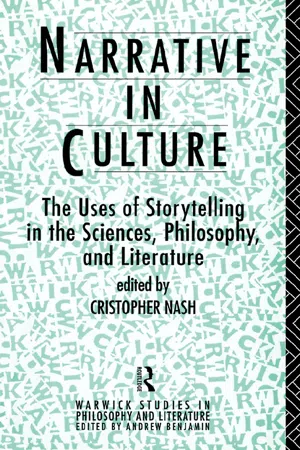
Narrative in Culture
The Uses of Storytelling in the Sciences, Philosophy and Literature
- 256 pages
- English
- ePUB (mobile friendly)
- Available on iOS & Android
eBook - ePub
Narrative in Culture
The Uses of Storytelling in the Sciences, Philosophy and Literature
About this book
Discourse can no longer be contained within the frameworks of literature and linguistics. It has broken through the barriers between subjects and dominates the way we relate to each other and to the world. Even where we least expect it, `storytelling' is going on, and the implications of this are vast. This is the view universally shared by the writers contributing to this book. Specialists in economics, law, the history and semiotics of science, psychology, politics, philosophy, and literary theory and criticism, they are a uniquely cross-disciplinary group.
Information
Subtopic
Philosophical HermeneuticsIndex
LiteratureNARRATIVE AND ‘FACT’
SOCIAL SCIENCE
1
Storytelling in Economics
DONALD N.McCLOSKEY
It is good to tell the story of science and art, economics and the nineteenth-century novel, the marginal productivity theory of distribution and the tradition of the Horatian ode as similarly as possible. I intend to do so. Economists are tellers of stories and makers of poems, and from recognizing this we can know better what economists do.
There seem to be two ways of understanding things; either by way of a metaphor or by way of a story, through something like a poem or through something like a novel. When a biologist is asked to explain why the moulting glands of a crab are located just as they are he has two possibilities. Either he can call on a model—a metaphor—of rationality inside the crab, explaining that locating them just there will maximize the efficiency of the glands in operation; or he can tell a story, of how crabs with badly located glands will fail to survive. If he is lucky with the modelling he will discover some soluble differential equations. If he is lucky with the storytelling he will discover a true history of some maladapted variety of crabs, showing it dying out. Metaphors and stories, models and histories, are the two ways of answering ‘why’.
It has probably been noticed before that the metaphorical and the narrative explanations answer to each other. Suppose the biologist happens first to offer his metaphor, his hypothetical individual crab moving bits of its body from here to there in search of the optimal location for moulting glands. The listener asks, ‘But why?’ The biologist will answer with a story: he says, ‘The reason why the glands must be located optimally is that if crabs did a poor job of locating their glands they would die off as time passed.’ A story answers a model.
But likewise a model answers a story. If the biologist gives the evolutionary story first, and the listener then asks, ‘But why?’, the biologist will answer with a metaphor: ‘The reason why the crabs will die off is that poorly located glands would serve poorly in the emergencies of crabby life.…’ The glands would not be located according to the metaphor of maximizing: that’s why.
Among what speakers of English call the sciences, metaphors dominate physics and stories dominate biology. Of course, the modes can mix. That we humans regard metaphors and stories as antiphonal guarantees they will. Mendel’s thinking about genetics is a rare case in biology of pure modelling, answered after a long while by the more usual storytelling. In 1902 W.S. Sutton observed homologous pairs of grasshopper chromosomes. He answered the question put to a metaphor—‘Why does the Mendelian model of genes work?’—with a story: ‘Because, to begin with, the genes are arranged along pairs of chromosomes, which I have seen, one half from each parent.’
The modes of explanation are more closely balanced in economics. An economist explains the success of cotton farming in the antebellum American South indifferently with static, modelling arguments (the South in 1860 had a comparative advantage in cotton) or with dynamic, storytelling arguments (the situation in 1860 was an evolution from earlier successes). The best economics, indeed, combines the two. Ludwig von Mises’ famous paper of 1920 on the impossibility of economic calculation under socialism was both a story of the failures of central planning during the recently concluded war and a model of why any replacement for the market would fail (Lavoie 1985:49).
The metaphors are best adapted to making predictions of tides in the sea or of shortages in markets, simulating out into a counterfactual world. (One could use here either an evolutionary story from the history of science or a maximizing model from the sociology or philosophy of science.) Seventeenth-century physics abandoned stories in favour of models, giving up the claim to tell in a narrative sense how gravity reached up and pulled things down; it just did, according to such-and-such an equation—let me show you the model. Similarly a price control on apartments will yield shortages; don’t ask how it will in sequence; it just will, according to such-and-such an equation—let me show you the model.
On the other hand the storytelling is best adapted to explaining something that has already happened, like the evolution of crabs or the development of the modern corporation. The Darwinian story was notably lacking in models, and in predictions. Mendel’s model, which offered to explain the descent of man by a metaphor rather than by a story, was neglected for thirty-four years, all the while that evolutionary stories were being told.
The contrast carries over to the failures of the two modes. When a metaphor is used too boldly in narrating a history it becomes ensnared in logical contradictions, such as those surrounding counterfactuals (McCloskey 1987). If a model of an economy is to be used to imagine what would have happened to Britain in the absence of the industrial revolution then the contradiction is that an economy of the British sort did in fact experience an industrial revolution. A world in which the Britain of 1780 did not yield up an industrial revolution would have been a very different one, before and after 1780. The model wants to eat the cake and have all the ingredients, too. It contradicts the story. Likewise, when a story attempts to predict something, by extrapolating the story into the future, it contradicts some persuasive model. The story of business cycles can organize the past, showing capitalist economies bobbing up and down. But it contradicts itself when it is offered as a prediction of the future. If the models of business cycles could predict the future there would be no surprises, and consequently no business cycles.
The point is that economists are like other human beings in that they both use metaphors and tell stories. They are concerned both to explain and to understand, erklären and verstehen. I am going to concentrate here on storytelling, having written elsewhere about the metaphorical side of the tale (McCloskey 1985). What might be called the poetics or stylistics of economics is worth talking about. But here the subject is the rhetoric of fiction in economics.
I propose to take seriously an assertion by Peter Brooks, in his Reading for the Plot: ‘Our lives are ceaselessly intertwined with narrative, with the stories that we tell, all of which are reworked in that story of our own lives that we narrate to ourselves.… We are immersed in narrative’ (Brooks 1985:3). As the historian J.H. Hexter put it, storytelling is ‘a sort of knowledge we cannot live without’ (Hexter 1986:8). Economists have not lived without it, not ever. It is no accident that the novel and economic science were born at the same time. We live in an age insatiate of plot.
Tell me a story, Dr Smith. Why, of course:
A pension scheme is proposed for the nation, in which ‘the employer will pay half. It will say in the law and on the worker’s salary cheque that the worker contributes 5% of his wages to the pension fund but that the employer contributes the other 5%. The example is a leading case in the old quarrel between lawyers and economists. A law is passed ‘designed’ (as they say) to have such-and-such an effect. The lawyerly mind goes this far, urging us therefore to limit the hours of women workers or to subsidize shipping. The women, he thinks, will be made better off; as will the ships. According to the lawyer, the workers under the pension scheme will be on balance 5% better off, getting half of their pension free from the employer.
An economist, however, will not want to leave the story of the pension plan in the first act, the lawyer’s and legislator’s act of laws ‘designed’ to split the costs. She will want to go further in the drama. She will say: ‘At the higher cost of labour the employers will hire fewer workers. In the second act the situation created by the law will begin to dissolve. At the old terms more workers will want to work than the employer wishes to hire. Jostling queues will form outside the factory gates. The competition of the workers will drive down wages. By the third and final act a part of the “employer’s” share—maybe even all of it—will sit on the workers themselves, in the form of lower wages. The intent of the law’, the economist concludes, ‘will have been frustrated.’
Thus in Chicago when a tax on employment was proposed the reporters asked who would pay the tax. Alderman Thomas Keane (who as it happens ended in jail, though not for misappropriation of economics) declared that the City had been careful to draft the law so that only the employers paid it. ‘The City of Chicago’, said Keane, ‘will never tax the working man.’
Thus in 1987, when Senator Kennedy proposed a plan for American workers and employers to share the cost of health insurance, newspapers reported Kennedy as estimating ‘the overall cost at $25 billion—$20 billion paid by employers and $5 billion by workers’. Senator Kennedy will never tax the working man. The manager of employee relations at the US Chamber of Commerce (who apparently agreed with Senator Kennedy’s economic analysis of where the tax would fall) said, ‘It is ridiculous to believe that every company…can afford to provide such a generous array of health care benefits.’ The US Chamber of Commerce will never tax the company.
The case illustrates a number of points about economic stories. It illustrates the delight that economists take in unforeseen consequences, a delight shared with other social scientists. It illustrates the selection of certain consequences for special attention: an accountant or political scientist would want to hear how the pension was funded, because it would affect business or politics in the future; economists usually set such consequences to the side. It illustrates also the way economists draw on typical scenes —the queues in front of the factory—and typical metaphors— workers as commodities to be bought and sold. Especially it illustrates the way stories support economic argument. Since Adam Smith and David Ricardo, economists have been addicted to little analytic stories, the Ricardian vice. The economist says, ‘Yes, I see how the story starts; but I see dramatic possibilities here; I see how events will develop from the situation given in the first act.’
It is not controversial that an economist is a storyteller when telling the story of the Federal Reserve Board or of the industrial revolution. Plainly and routinely, ninety per cent of what economists do is such storytelling. Yet even in the other ten per cent, in the part more obviously dominated by models and metaphors, the economist tells stories. The applied economist can be viewed as a realistic novelist or a realistic playwright, a Thomas Hardy or a George Bernard Shaw. The theorist, too, may be viewed as a teller of stories, though a non-realist, whose plots and characters have the same relation to truth as those in Gulliver’s Travels or A Midsummer Night’s Dream. Economics is saturated with narration.
The analogy on its face seems apt. Economics is a sort of social history. For all their brave talk about being the physicists of the social sciences, economists do their best work when looking backwards, the way a biologist or geologist or historian does. Journalists and politicians demand that economists prophesy, forecasting the social weather. Sometimes, unhappily, the economists will take money for trying. But it is not their chief skill, any more than earthquake forecasting is the chief skill of seismologists, or election forecasting the chief skill of political historians. Economists cannot predict much, and certainly cannot predict profitably. If they were so smart they would be rich (McCloskey 1988). Mainly economists are tellers of stories.
Well, so what? What is to be gained by thinking this way about economics? One answer can be given at once, and illustrates the uses of the literary analogy, namely: storytelling makes it clearer why economists disagree.
Disagreement among scientists is suggestive for the rhetoric of science in the same way that simultaneous discovery is suggestive for its sociology. The lay person does not appreciate how much economists agree, but he is not entirely wrong in thinking that they also disagree a lot. Economists have long-lasting and longdisagreeing schools, more typical of the humanities than of the sciences. Why then do they disagree?
When economists themselves try to answer they become sociological or philosophical, though in ways that a sociologist or philosopher would find uncongenial. When in a sociological mood they will smile knowingly and explain that what drives monetarists or Keynesians to ‘differentiate their product’, as they delight in putting it, is self-interest. Economists are nature’s Marxists, and enjoy uncovering and then sniggering at self-interest. When they are in a more elevated and philosophic mood they will speak sagely of ‘successive approximations’ or ‘treating a theory merely as if it were true’. Some have read a bit of Popper or Kuhn, and reckon they know a thing or two about the Methodology of Science. The stories that result from these ventures into ersatz sociology and sophomore philosophy are unconvincing. To tell the truth, the economists do not know why they disagree.
Storytelling offers a richer model of how economists talk and a more plausible story of their disagreements. The disagreement can be understood from a literary perspective in more helpful ways than saying that one economist has divergent material interest from another, or a different ‘crucial experiment’, or another ‘paradigm’.
It is first of all the theory of reading held by scientists that permits them to disagree, and with such ill temper. The oversimple theory of reading adopted officially by economists and other scientists is that scientific texts are transparent, a matter of ‘mere communication’, ‘just style’, simply ‘writing up’ the ‘theoretical results’ and ‘empirical findings’. If reading is so free from difficulties, then naturally the only way our readers can fail to agree with us is through their ill will or their dimness. (Leave aside the unlikely chance that it is we who are dim.) It’s right there in black and white. Don’t be a dunce.
A better theory of reading, one that admitted that scientific prose like literary prose is complicated and allusive, drawing on a richer rhetoric than mere demonstration, might soothe this ill temper. The better theory, after all, is the one a good teacher uses with students. She knows well enough that the text is not transparent to the students, and she does not get angry when they misunderstand. God likewise does not get angry when His students misunderstand His text. In fact, like scientists and scholars, God writes obscurely in order to snare us. As Gerald Bruns has noted, St Augustine viewed the obscurity of the Bible as having ‘a pragmatic function in the art of winning over an alienated and even contemptuous audience’ (Bruns 1984:157). He quotes a remark of Augustine about the difficulty of the Bible that might as well be about the latest proof in mathematical economics: ‘I do not doubt that this situation was provided by God to conquer pride by work and to combat disdain in our minds, by which those things which are easily discovered seem frequently to be worthless.’
One source of disagreement, then, is a naïve theory of reading, the theory that would ask naïvely for the ‘message’ in a poem, as though poems were riddles in rhyme. Another source of disagreement is likewise a source of disagreement about literature: compression, a lack of explicitness. Partly this is economic. Had she but world enough and time the writer could make everything explicit. In a world of scarcity, however, she cannot. Yet explicitness is no guarantee of agreement, because if the writer has all the time in the world the reader does not. I cannot listen long enough to understand some of my Marxist friends (though I ask them to keep trying). Similarly, the mathematician in economics has an expository style based on explicitness and a zero value of time. Everything will be clear, he promises earnestly, if the readers will but listen carefully to the axioms. The readers grow weary. They cannot remember all the axioms and anyway cannot see why one would wish to doubt them. They do not have the toleration for such speech that the mathematician has.
The point involves more than the economic scarcity of journal space and of the leisure time to read. It involves the anthropology of science, the customs of its inhabitants and their ability to read a language. A scientist convinced of what she writes will come from a certain background, supplied with a language. Unless her reader knows roughly the same language—that is, unless he has been raised in approximately the same conversation he will misunderstand and will be unpersuaded. This is an unforgivable failure only if it is an unforgivable failure to be, say, non-Javanese or non-French. The reader comes from another culture, with a different tongue. The training in reading English that a D.Phil. in English provides or the training in reading economics that a Ph.D. in economics provides are trainings in rapid reading, filling in the blanks.
A third and final source of disagreement in literature and in economics, beyond the naïve theory of reading and the limits on understanding foreign speech, is an inability of the reader to assume the point of view demanded by the author. A foolishly sentimental poem has the same irritating effect on a reader as does a foolishly libertarian piece of economics. The reader refuses to enter the author’s imaginative world, or is unable t...
Table of contents
- Cover Page
- Title Page
- Copyright Page
- List of Contributors
- Foreword
- Acknowledgements
- NARRATIVE AND ‘FACT’
- NARRATIVE AND ‘FICTION’
Trusted by 375,005 students
Access to over 1.5 million titles for a fair monthly price.
Study more efficiently using our study tools.
Frequently asked questions
Yes, you can cancel anytime from the Subscription tab in your account settings on the Perlego website. Your subscription will stay active until the end of your current billing period. Learn how to cancel your subscription
No, books cannot be downloaded as external files, such as PDFs, for use outside of Perlego. However, you can download books within the Perlego app for offline reading on mobile or tablet. Learn how to download books offline
Perlego offers two plans: Essential and Complete
- Essential is ideal for learners and professionals who enjoy exploring a wide range of subjects. Access the Essential Library with 800,000+ trusted titles and best-sellers across business, personal growth, and the humanities. Includes unlimited reading time and Standard Read Aloud voice.
- Complete: Perfect for advanced learners and researchers needing full, unrestricted access. Unlock 1.5M+ books across hundreds of subjects, including academic and specialized titles. The Complete Plan also includes advanced features like Premium Read Aloud and Research Assistant.
We are an online textbook subscription service, where you can get access to an entire online library for less than the price of a single book per month. With over 1.5 million books across 990+ topics, we’ve got you covered! Learn about our mission
Look out for the read-aloud symbol on your next book to see if you can listen to it. The read-aloud tool reads text aloud for you, highlighting the text as it is being read. You can pause it, speed it up and slow it down. Learn more about Read Aloud
Yes! You can use the Perlego app on both iOS and Android devices to read anytime, anywhere — even offline. Perfect for commutes or when you’re on the go.
Please note we cannot support devices running on iOS 13 and Android 7 or earlier. Learn more about using the app
Please note we cannot support devices running on iOS 13 and Android 7 or earlier. Learn more about using the app
Yes, you can access Narrative in Culture by Cristopher Nash in PDF and/or ePUB format, as well as other popular books in Literature & Philosophical Hermeneutics. We have over 1.5 million books available in our catalogue for you to explore.