- 352 pages
- English
- ePUB (mobile friendly)
- Available on iOS & Android
eBook - ePub
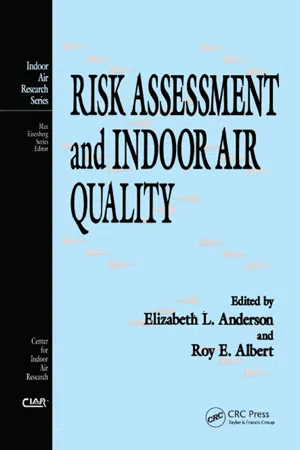
Risk Assessment and Indoor Air Quality
About this book
With the recent tightening of air quality standards as mandated by the U.S. EPA, has come great pressure on regulatory bodies at all levels of government, along with the industries and groups affected by these standards, to better assess the hazards and risks that result from air pollutants. Risk Assessment and Indoor Air Quality carefully ties tog
Information
CHAPTER 1
Introduction to Risk Assessment
CONTENTS
I. | Overview | ||
II. | What Is Risk Assessment? | ||
III. | Indoor Air Risk Assessments | ||
IV. | Important Indoor Air and Risk Assessment Definitions | ||
V. | The Origins of Environmental Risk Assessment | ||
A. | Environmental Risk Assessment Prior to 1970 | ||
B. | The Use of Risk Assessment in the U.S. for Regulating Air Pollutants | ||
1. | Early EPA Regulatory Efforts | ||
2. | The 1990 Clean Air Act Amendments | ||
3. | Current Activities | ||
C. | Risk Assessment in the European Community and the United Kingdom | ||
VI. | The Risk Assessment Process | ||
VII. | Current Indoor Air Risk Assessment Activities | ||
VIII. | Comparison of Indoor Air Risks and Other Environmental Risks | ||
IX. | Legislative and Regulatory Initiatives Addressing Indoor Air and Risk Assessment | ||
A. | U.S. Federal | ||
1. | National Environmental Policy Act (42 USC 4321) | ||
2. | U.S. Environmental Protection Agency | ||
3. | U.S. Occupational Safety and Health Administration | ||
4. | U.S. Department of Energy | ||
5. | U.S. Department of Health and Human Services | ||
6. | U.S. Consumer Product Safety Commission | ||
7. | U.S. Department of Housing and Urban Development | ||
B. | Others in the U.S. Involved in Indoor Air Quality | ||
1. | State and Local Regulatory Agencies | ||
2. | Private Organizations | ||
C. | International Organizations | ||
1. | Countries | ||
2. | World Health Organization | ||
Bibliography | |||
I. OVERVIEW
Environmental risks can result from contact with a toxic material or contaminant via the environment. A human health risk can be experienced by individuals or populations from contact with an environmental contaminant through inhalation, ingestion, or skin contact. Such risks can be acute (short-term) or chronic (long-term) in nature and can range from mildly irritating to life threatening. Environmental risks also include ecological risks, such as effects on plants, animals, and natural resources, resulting from the presence of undesirable materials in the environment. Welfare risks are a type of environmental risk generally associated with the quality of human life (e.g., visibility, soiling, and weathering). In the indoor environment, human health risks are the principal concern. As such, this book focuses on human health risks principally resulting from indoor air exposures.
This book was prepared to provide guidance for identification of human health risks associated with indoor air exposures, estimation of the possible extent and severity of these risks, and determination of the effects of mitigation on these risks. This book is intended as a desk reference to assist readers in making more informed decisions regarding the need and appropriate means for improving indoor air quality. Indoor air quality decisions that can benefit from the use of risk assessment include the following:
• setting priorities for study or mitigation of risks resulting from indoor air quality,
• determining proper avenues of evaluation or investigation of these risks,
• establishing criteria for the timing and degree of mitigation of these risks,
• identifying and selecting appropriate mitigation strategies,
• identifying appropriate research needs, and
• assisting in regulatory decision-making.
This chapter presents a brief history of the origin and development of risk assessment as well as an introduction to its application in indoor air quality studies. Chapter 2 defines the risk assessment process and describes its origins both scientifically and legislatively; Chapters 3, 6 provide detailed discussions of the four principal components of a risk assessment; Chapter 7 discusses the uncertainties associated with risk assessment; Chapter 8 describes basic methods for measuring indoor air contaminants; Chapter 9 presents a case study of the application of risk assessment to a typical indoor air problem; and Chapter 10 identifies future risk assessment directions and needs.
II. WHAT IS RISK ASSESSMENT?
Risk is generally defined as the potential for an unwanted negative consequence or event. As used in this book, risk is limited to unwanted adverse human health effects resulting from exposures in the indoor environment. Risk should be distinguished from hazard. A hazard is a possible source of danger; however, a risk is not present unless a human can come into contact with or be exposed to the hazard. A risk assessment in this context is the systematic evaluation of the factors that might result in an adverse human health effect resulting from a hazard, and often the attempted quantification of those factors and effects. As described by the National Research Council (NRC 1983), risks are assessed for a variety of reasons, one of the most important of which is regulatory decision-making. The results of the risk assessment are dealt with in a process usually called risk management. The distinctions between risk assessment and risk management are discussed more fully in later sections.
Ideally, risk assessment is based in science and risk management is the policy for use of that science. In reality, however, the distinctions are often not so clear. For example, policy choices are often required in the risk assessment and these can often significantly affect its outcome. In addition, the effects of exposure by animals and humans to toxic substances are not always well understood by scientists, often because the organisms and the interactions are so complex, or because the effects can vary within and across species. As such, assumptions must be made to allow scientists to extrapolate results across species and across ranges of exposure. Policy choices can influence the selection of these assumptions. A conservative (i.e., health protective) safety factor may be selected rather than a more moderate safety factor to minimize the unwanted consequences of error. What this means is that policy choices are intertwined with scientific determinations. Another difficulty in the risk management process is that regulatory decision-makers dislike uncertainty because it complicates the decision-making process, often forcing the use of conservative assumptions that may be economically undesirable. Early attempts at risk assessment and risk management aimed at providing specific health criteria, including workplace limits and national ambient air quality standards. Currently, attempts have been made to provide a broader risk assessment/risk management framework for decisionmaking that may include a variety of information such as exposure distributions, ranges of health effects, and even economic consequences of regulatory actions.
It is important that the reader recognize that risk assessment will rarely provide complete and unequivocal results for decision-making. The science of risk assessment is still in its relative infancy and it is complex. As such, risk assessment is, and will continue to be, associated with uncertainty. Typical areas of uncertainty with respect to air quality (indoor or outdoor) risk assessments include the following:
• large variations in measured data and in human responses to environmental exposures;
• limited understanding of the toxicology and exposure pathways for many contaminants;
• improperly designed or understood mathematical models;
• the unique nature of individual human exposures to the array of contaminants in his or her environment;
• imprecise knowledge of the contaminants to which humans are exposed; and
• the vast variety of possible exposures.
Still, enough is known in many instances today to allow risk assessment to be used as a tool with growing application and precision in decision-making. This book is intended to guide a reader with responsibilities or concerns about indoor air quality in identifying important air quality and health issues and in conducting analyses sufficient to facilitate responsible decision-making. It also is written for the reader who is technically experienced although not necessarily in the science of risk assessment.
III. INDOOR AIR RISK ASSESSMENTS
The term indoor environment, as used here, encompasses all enclosed spaces occupied by humans, including home, work, shopping, education, entertainment, and transportation. While humans can be exposed indoors to contaminants by inhalation, ingestion, and dermal contact, the inhalation pathway usually dominates indoor air quality investigations, and thus this book focuses on human health risks resulting from inhalation. However, risks from other pathways should be considered if there is information or strong evidence that another pathway can contribute significantly to a potential adverse human health effect. One example might be a biological contaminant that can be conveyed through inhalation and skin contact; another example is a contaminant found in the air of a household and, concurrently, in food eaten by members of the household.
Humans can be exposed to environmental risks outdoors or indoors. However, since we first began to control pollutants in the air that could adversely affect humans or the quality of life, most attention has focused on air pollutants in the outdoors and assumed outdoor exposures. Researchers now recognize, however, that most of the population spends the bulk of its time indoors and that indoor exposures are more important than, or at least as great a concern as, outdoor exposures. There are a number of reasons why the types and concentrations of indoor air pollutants are growing. For example, the energy crisis beginning in the early 1970s led architects, engineers, builders, building managers, and home owners to take steps to conserve energy, including reduction in the infiltration of outside air, recirculation of building air, and greater use of synthetic building and decorative materials. While these actions generally achieved their purpose of reducing energy costs, they often resulted in increasing indoor concentrations of chemical and biological substances arising from both indoor and outdoor sources. In addition, the synthetic materials and decorations increasingly being used in homes and buildings can release new chemicals into the indoor environment. Although debate continues concerning the causes, many scientists believe that these buildups in indoor air concentrations coincided with a growing increase in indoor air quality related illnesses of both specified and unspecified natures.
In its simplest form, an assessment of possible indoor air risks leads to the determination of an acceptable exposure limit for specific substances to which a human can be exposed. These exposure limits usually are derived by expert scientific judgment or through the application of accepted safety factors to animal test results. Acceptability is determined by comparing actual exposures with an accepted limit. If humans are exposed to concentrations less than the limit, then the exposure usually is judged acceptable; if the exposures are greater than the limit, then guidance usually specifies that the humans should be removed from the exposure or the exposures should be otherwise reduced. Acceptable workplace limits for air pollutants are published by numerous regulatory and quasi-regulatory bodies both in the U.S. and abroad. In the U.S., these include the Occupational Safety and Health Administration (OSHA), state and local agencies, and the American Conference ...
Table of contents
- Cover
- Title Page
- Copyright Page
- Table of Contents
- Series Preface
- Preface
- Chapter 1 Introduction to Risk Assessment
- Chapter 2 The Elements of Human Health Risk Assessment
- Chapter 3 Hazard Identification of Indoor Air Pollutants
- Chapter 4 Dose-Response Assessment — Quantitative Methods for the Investigation of Dose-Response Relationships
- Chapter 5 Exposure Characterization
- Chapter 6 Risk Characterization
- Chapter 7 Characterization of Uncertainty
- Chapter 8 Measurement of Indoor Air Contaminants
- Chapter 9 Application of Risk Assessment
- Chapter 10 Future Directions in Risk Assessment
- Index
Trusted by 375,005 students
Access to over 1.5 million titles for a fair monthly price.
Study more efficiently using our study tools.
Frequently asked questions
Yes, you can cancel anytime from the Subscription tab in your account settings on the Perlego website. Your subscription will stay active until the end of your current billing period. Learn how to cancel your subscription
No, books cannot be downloaded as external files, such as PDFs, for use outside of Perlego. However, you can download books within the Perlego app for offline reading on mobile or tablet. Learn how to download books offline
Perlego offers two plans: Essential and Complete
- Essential is ideal for learners and professionals who enjoy exploring a wide range of subjects. Access the Essential Library with 800,000+ trusted titles and best-sellers across business, personal growth, and the humanities. Includes unlimited reading time and Standard Read Aloud voice.
- Complete: Perfect for advanced learners and researchers needing full, unrestricted access. Unlock 1.5M+ books across hundreds of subjects, including academic and specialized titles. The Complete Plan also includes advanced features like Premium Read Aloud and Research Assistant.
We are an online textbook subscription service, where you can get access to an entire online library for less than the price of a single book per month. With over 1.5 million books across 990+ topics, we’ve got you covered! Learn about our mission
Look out for the read-aloud symbol on your next book to see if you can listen to it. The read-aloud tool reads text aloud for you, highlighting the text as it is being read. You can pause it, speed it up and slow it down. Learn more about Read Aloud
Yes! You can use the Perlego app on both iOS and Android devices to read anytime, anywhere — even offline. Perfect for commutes or when you’re on the go.
Please note we cannot support devices running on iOS 13 and Android 7 or earlier. Learn more about using the app
Please note we cannot support devices running on iOS 13 and Android 7 or earlier. Learn more about using the app
Yes, you can access Risk Assessment and Indoor Air Quality by Elizabeth L. Anderson,Roy E. Albert in PDF and/or ePUB format, as well as other popular books in Medicina & Teoria, pratica e riferimenti medici. We have over 1.5 million books available in our catalogue for you to explore.