- 384 pages
- English
- ePUB (mobile friendly)
- Available on iOS & Android
eBook - ePub
Caffeine
About this book
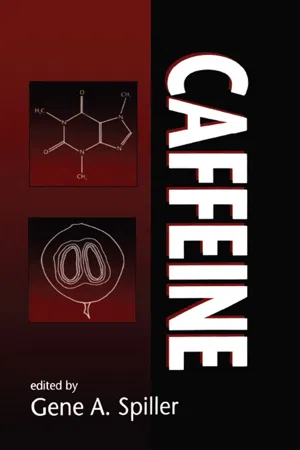
Caffeine-found in tea, coffee, mate, cola beverages, cocoa, and chocolate products-is an integral part of the diet of many people. Caffeine answers questions for a broad range of readers interested in the effects beverages and foods containing this dietary methylxanthine have on human health, nutrition, and physiological functioning. The composition, processing, consumption, health effects, and epidemiological correlations of caffeine are examined in detail. It is often said that too much caffeine is "bad for you." How much is too much? Get the facts on consumption of caffeine-containing products with this authoritative text. Chapters 1 and 2 offer an introductory, concise overview of the chemistry and analysis of methylxanthines. In Chapters 3 through 8, each natural product-tea, coffee, mate, and cocoa and chocolate products-is described in terms of botany, cultivation, processing, composition, and consumption patterns. Consumption of caffeine is also examined in detail in Chapter 9. Chapter 10 provides an easy-to-read overview of the basic physiology and biochemistry of caffeine. The ergogenic, cognitive, and emotional effects of caffeine are discussed in Chapters 11 and 12. Chapters 13 through 16 deal with specific health effects-serum cholesterol, cancer and fibrocystic breast disease, calcium and bone health, and human reproduction. For physicians, nutritionists, other health professionals, food scientists, and everyone interested in the effects of caffeine on the human body, Caffeine is a convenient, single-source reference.
Information
Topic
MedicineSubtopic
Nutrition, Dietics & BariatricsChapter 1
INTRODUCTION TO THE CHEMISTRY, ISOLATION, AND BIOSYNTHESIS OF METHYLXANTHINES
CONTENTS
I. | Introduction | |
II. | Physical and Chemical Properties of the Methylxanthines | |
A. Organoleptic Properties | ||
B. Melting and Sublimation Temperatures | ||
C. Solution Formation | ||
D. Ultraviolet and Infrared Absorption | ||
E. Complex Formation | ||
F. Acidic and Basic Equilibria | ||
III. | Isolation of the Methylxanthines | |
IV. | Biosynthesis of the Methylxanthines | |
A. In Coffee | ||
B. In Tea | ||
C. In Cacao | ||
References | ||
I. INTRODUCTION
The methylxanthines of interest are caffeine (1,3,7-trimethylxanthine), theophylline (1,3-dimethylxanthine), and theobromine (3,7-dimethylxanthine) and they occur in coffee, tea, maté, cocoa products, and cola beverages. This chapter is an introduction to their chemistry, isolation, and biosynthesis. While the class of methylxanthines is large and comprised of more members than these three, this chapter will essentially be limited to caffeine, theobromine, and theophylline.
Purine is the parent heterocyclic compound of the methylxanthines, which are often referred to as the purine alkaloids.1,2,3,4,5,6,7 Purine is also the parent compound of some of the base constituents of the nucleotides, which in turn are part of the nucleic acids RNA and DNA. Thus, it appears that the purine alkaloids have similar precursors to nucleic acids.
II. PHYSICAL AND CHEMICAL PROPERTIES OF THE METHYLXANTHINES
A. Organoleptic Properties
Caffeine, as an example methylxanthine, is a colorless powder at room temperature; it is odorless but does have a slightly bitter taste.8
B. Melting and Sublimation Temperatures
The trimethylated xanthine, caffeine, sublimes at 1800°C, which is a lower temperature of sublimation than theobromine.10 Temperatures of melting and sublimation are given in Table 1.
C. Solution Formation
Solubility values are distinctive for caffeine, theobromine, and theophylline (see Table 2). Caffeine dissolves well in boiling water, but at room temperature chloroform is one of the best solvents. Theobromine is generally much less soluble than caffeine but it will dissolve readily in aqueous acids and alkalis. Theophylline is intermediate between caffeine and theobromine in its ability to form solutions. A series of studies were conducted by Hockfield17 and Gilkey,18 who, after comparing the solubility rates of the xanthine alkaloids, determined that the methylxanthines in which both heterocyclic nitrogen atoms in the ring are methylated (caffeine and theophylline) display a much greater solubility in polar solvents than those with at least one unmethylated nitrogen atom (theobromine).
TABLE 1
Melting and Sublimation Temperatures for Methylxanthines
Melting and Sublimation Temperatures for Methylxanthines
Compound | Sublimation point (°C) | Melting point (°C) |
Caffeine | 1808 | 236.5 under pressure8 |
1789 | 2389 | |
1787 | 235 anhydrous7 | |
Theobromine | 290–2959 | 3579 |
2907 | 330 sealed tube7 | |
Theophylline | — | 270–2749 |
269–2727 |
TABLE 2
Solubility Values for Methylxanthines
Solubility Values for Methylxanthines
Solvent | Caffeine (%) | Theobromine (%) | Theophylline (%) |
Water, 150°C | 1.38 | ||
Water | 2.29 | 0.0059 | 0.839 |
Water, 400°C | 4.68 | ||
Water, hot | Soluble9 | ||
Water, 800°C | 18.29 | ||
Water, boiling | 66.79 | 0.679 | |
Ether | 0.38 | Almost insol.9 | Sparingly sol.9 |
0.29 | |||
Alcohol | 1.28 | 1.259 | |
1.59 | |||
Alcohol, 600°C | 4.59 | ||
95% Alcohol | 0.0459 | ||
Ethyl acetate | 2.58 | ||
Chloroform | 13.08 | Almost insol.9 | 0.919 |
18.29 | |||
Acetone | 2.09 | ||
Benzene | 1.09 | Almost insol.9 | |
Benzene, boiling | 4.59 | ||
Pyrrole | Freely sol.9 | ||
Tetrahydrofuran and 4% water | Freely sol.9 | ||
Petroleum ether | Sparingly sol.9 | ||
Carbon tetrachloride | Almost insol.9 |
These studies indicate that intermolecular hydrogen bonding between lactam systems in the nonmethylated alkaloids is responsible for these differences. The findings indicate a difference between the enthalpies of theobromine, which would be expected to form a dimer, and those of caffeine and theophylline, whose structures would preclude dimerization, is approximately that of one hydrogen bond per molecule.
D. Ultraviolet and Infrared Absorption
The methylxanthines show useful strong ultraviolet (UV) absorption between 250 and 280 nm.11 The spectra for the methylxanthines are very similar and only when one uses techniques such as derivative spectroscopy can substantial differences be seen. In addition to the UV absorption, the methylxanthines also exhibit strong infrared (IR) spectra which can provide critical information about these compounds.
E. Complex Formation
In aqueous solution, caffeine associates to form at least a dimer and probably a polymer;12 the molecules are arranged in a stack.13 Caffeine will also associate with purines and pyrimidines either as the free bases or as their nucleosides.13 Caffeine crystallizes from water as a monohydrate [9].
Chlorogenic acid forms a 1:1 complex with caffeine, which can be crystallized from aqueous alcohol and yields very little free caffeine on extraction with chloroform. Other compounds with which caffeine will complex in this way include isoeugenol, coumarin, indole-acetic acid, and anthocyanidin. The basis for this selection was the requirement for a substituted aromatic ring and a conjugated double bond in forming such a complex. This kind of complex does modify the physiological effects of caffeine.14 Complex formation will also increase the apparent aqueous solubility of caffeine in the presence of alkali benzoates, cinnamates, citrates, and sali...
Table of contents
- Cover
- Title Page
- Copyright Page
- Dedication
- Table of Contents
- Chapter 1 Introduction to the Chemistry, Isolation, and Biosynthesis of Methylxanthines
- Chapter 2 Analytical Methods for Quantitation of Methylxanthines
- Chapter 3 Tea: The Plant and Its Manufacture; Chemistry and Consumption of the Beverage
- Chapter 4 Tea in China
- Chapter 5 The Coffee Plant and Its Processing
- Chapter 6 The Chemical Components of Coffee
- Chapter 7 Methylxanthine Composition and Consumption Patterns of Cocoa and Chocolate Products
- Chapter 8 Maté
- Chapter 9 Caffeine Consumption
- Chapter 10 Basic Metabolism and Physiological Effects of the Methylxanthines
- Chapter 11 Caffeine as an Ergogenic Aid
- Chapter 12 Caffeine: Effects on Psychological Functioning and Performance
- Chapter 13 Coffee, Caffeine, and Serum Cholesterol
- Chapter 14 Coffee, Tea, Cancer and Fibrocystic Breast Disease
- Chapter 15 Caffeine, Calcium, and Bone Health
- Chapter 16 Caffeine and Reproduction
- Appendix I Caffeine Content of Some Cola Beverages
- Index
Trusted by 375,005 students
Access to over 1.5 million titles for a fair monthly price.
Study more efficiently using our study tools.
Frequently asked questions
Yes, you can cancel anytime from the Subscription tab in your account settings on the Perlego website. Your subscription will stay active until the end of your current billing period. Learn how to cancel your subscription
No, books cannot be downloaded as external files, such as PDFs, for use outside of Perlego. However, you can download books within the Perlego app for offline reading on mobile or tablet. Learn how to download books offline
Perlego offers two plans: Essential and Complete
- Essential is ideal for learners and professionals who enjoy exploring a wide range of subjects. Access the Essential Library with 800,000+ trusted titles and best-sellers across business, personal growth, and the humanities. Includes unlimited reading time and Standard Read Aloud voice.
- Complete: Perfect for advanced learners and researchers needing full, unrestricted access. Unlock 1.5M+ books across hundreds of subjects, including academic and specialized titles. The Complete Plan also includes advanced features like Premium Read Aloud and Research Assistant.
We are an online textbook subscription service, where you can get access to an entire online library for less than the price of a single book per month. With over 1.5 million books across 990+ topics, we’ve got you covered! Learn about our mission
Look out for the read-aloud symbol on your next book to see if you can listen to it. The read-aloud tool reads text aloud for you, highlighting the text as it is being read. You can pause it, speed it up and slow it down. Learn more about Read Aloud
Yes! You can use the Perlego app on both iOS and Android devices to read anytime, anywhere — even offline. Perfect for commutes or when you’re on the go.
Please note we cannot support devices running on iOS 13 and Android 7 or earlier. Learn more about using the app
Please note we cannot support devices running on iOS 13 and Android 7 or earlier. Learn more about using the app
Yes, you can access Caffeine by Gene A. Spiller in PDF and/or ePUB format, as well as other popular books in Medicine & Nutrition, Dietics & Bariatrics. We have over 1.5 million books available in our catalogue for you to explore.